




Park Kyong (1955‒) served as Co-Artistic Director of the Korean Pavilion at the 2023 Venice Biennale. It is less widely known that his career trajectory began more than forty years ago at StoreFront for Art and Architecture (hereinafter StoreFront).▼1 StoreFront, the alternative exhibition space in New York that Park, who trained in architecture, founded in his late twenties and led for sixteen years, was a dynamic laboratory for thinking about the city through architecture and raising social issues to the attention of public debate. The exhibitions and projects it presented through multilayered collaborations with architects, artists, and curators from around the world who were then beginning to gain recognition in the 1980s and 1990s came to be seen not as one-off events but as initiatives with wide social impact. In particular, the curatorial methodology Park developed at StoreFront carried into a series of international exhibitions and projects, offering an important way of understanding how architecture can intervene in urban realities and effect change through the medium of exhibitions. Having archived and studied this process, Eunjin Regina Shin (curator) and Yim Dongwoo (Professor, Hongik University) reconstruct the early history of Park and StoreFront in depth, examining the legacy this work has left to the field of architecture and the questions it continues to pose for us today.▼2 Editor
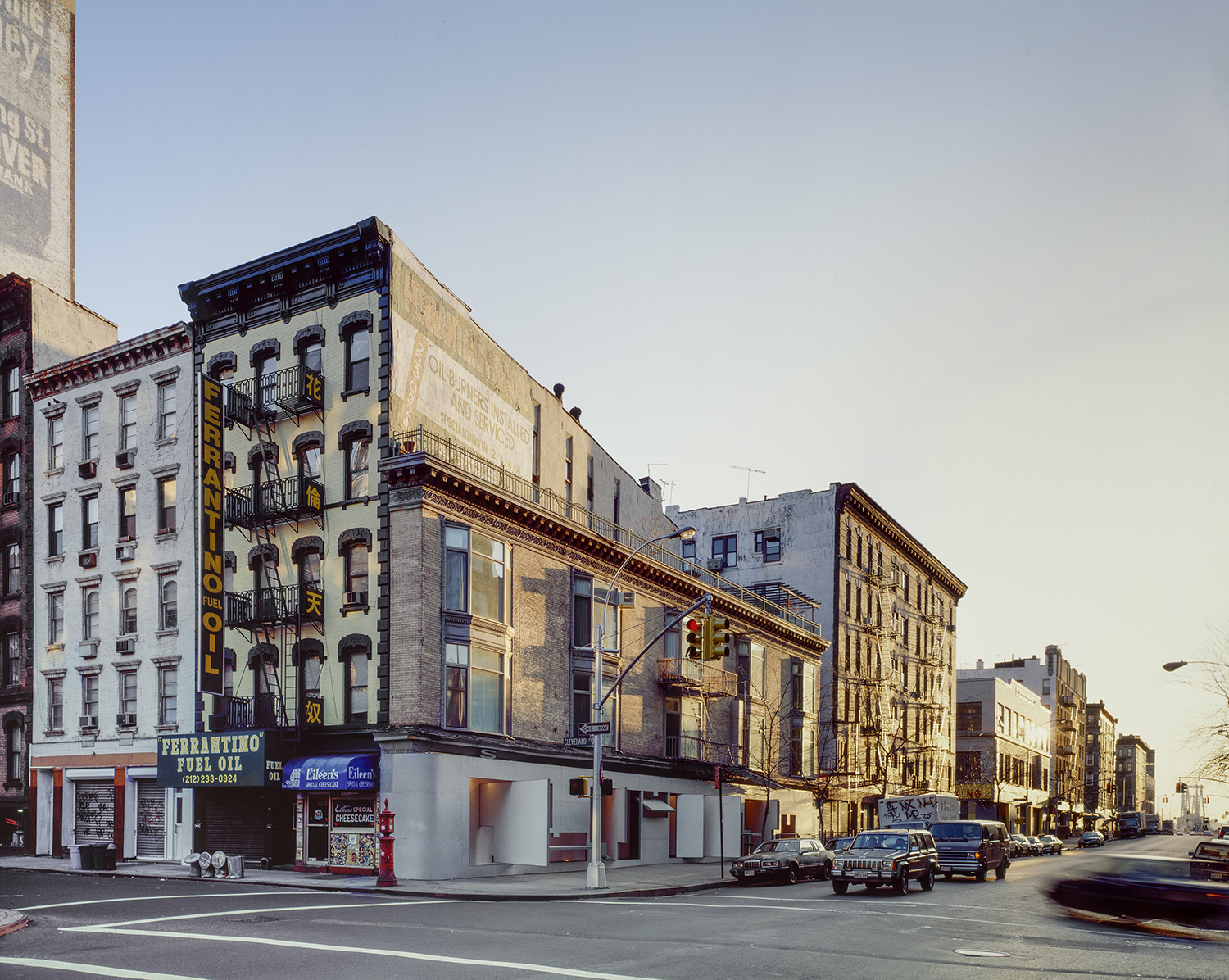
Exterior views of the StoreFront for Art and Architecture on Kenmare Street, New York, 1993. The striking façade was completed through a collaborative design by Steven Holl and Vito Acconci. Image courtesy of Paul Warchol
In 1988, two architecture exhibitions with distinctly different characters opened in succession in New York. ‘Deconstructivist Architecture’, which opened at the Museum of Modern Art (MoMA) in June, saw Philip Johnson, together with Mark Wigley, juxtapose the work of seven architects, including Frank Gehry, Zaha Hadid, and Rem Koolhaas, under the category of ‘Deconstructivist Architecture’, making visible a new formal sensibility that departed from harmony and unity.▼3 That November, StoreFront, a downtown exhibition space, opened ‘Project DMZ’, an exhibition addressing the Korean Demilitarized Zone (DMZ). While the MoMA exhibition brought together the formal experimentation of different architects under a single theme, StoreFront’s exhibition made military boundaries and the geopolitics of the Cold War the subjects of architectural imagination. In other words, while the museum presented architecture as a completed form, StoreFront treated architecture as a means of reading the realities of the city and society. This distinction provides a point of departure for understanding the practice of Park Kyong, who led StoreFront as its founding director until 1998.
Park Kyong was born in Korea in 1955, moved to the United States as a child, and studied architecture at the University of Michigan. In the late 1970s, he took part in a programme at New York’s Institute for Architecture and Urban Studies (IAUS).▼4 Not long afterwards, in 1982, he opened StoreFront in a small retail space on Prince Street in SoHo. Around this time, lofts and ageing buildings left behind by departing factories downtown were being converted into spaces for working, living, and exhibiting.
On the Lower East Side, a movement was also underway to squat in vacant buildings, repair them, and bring them back into use as shared spaces. Park recalled that he covered the monthly rent of USD 250 with the money he earned working at a small firm, while the artists and architects in his circle helped shape StoreFront’s early programmes.▼5 The inaugural programme, ‘Performance A‒Z’, which began in September 1982, actively engaged the physical conditions of the retail space. One performance took place each day for twenty-six days, and the display window facing the street became a stage connecting performers and audiences. This use of the boundary between the narrow interior and the sidewalk as an exhibition space was also embodied in the name StoreFront.▼6 Park later said that it was not he who had created StoreFront, but the city, community, and culture in that moment.▼7
<...
