




SPACE November 2026 (No. 708)
THEME 7. Human and Nonhuman
How Can We Create Systems Beyond the Human?
A world accelerating by the day. In the face of such change, architecture seems extraordinarily large and cumbersome. However, even in this slow-moving discipline, signs of change can be discerned. The rapid development of artificial intelligence, the climate crisis and resource depletion, and a growing reflection on anthropocentric thinking are blurring the boundaries between architecture’s beginning and end, the inside and outside of buildings, and between nature and technology. In doing so, they are unsettling the very premises on which architecture has long been founded.
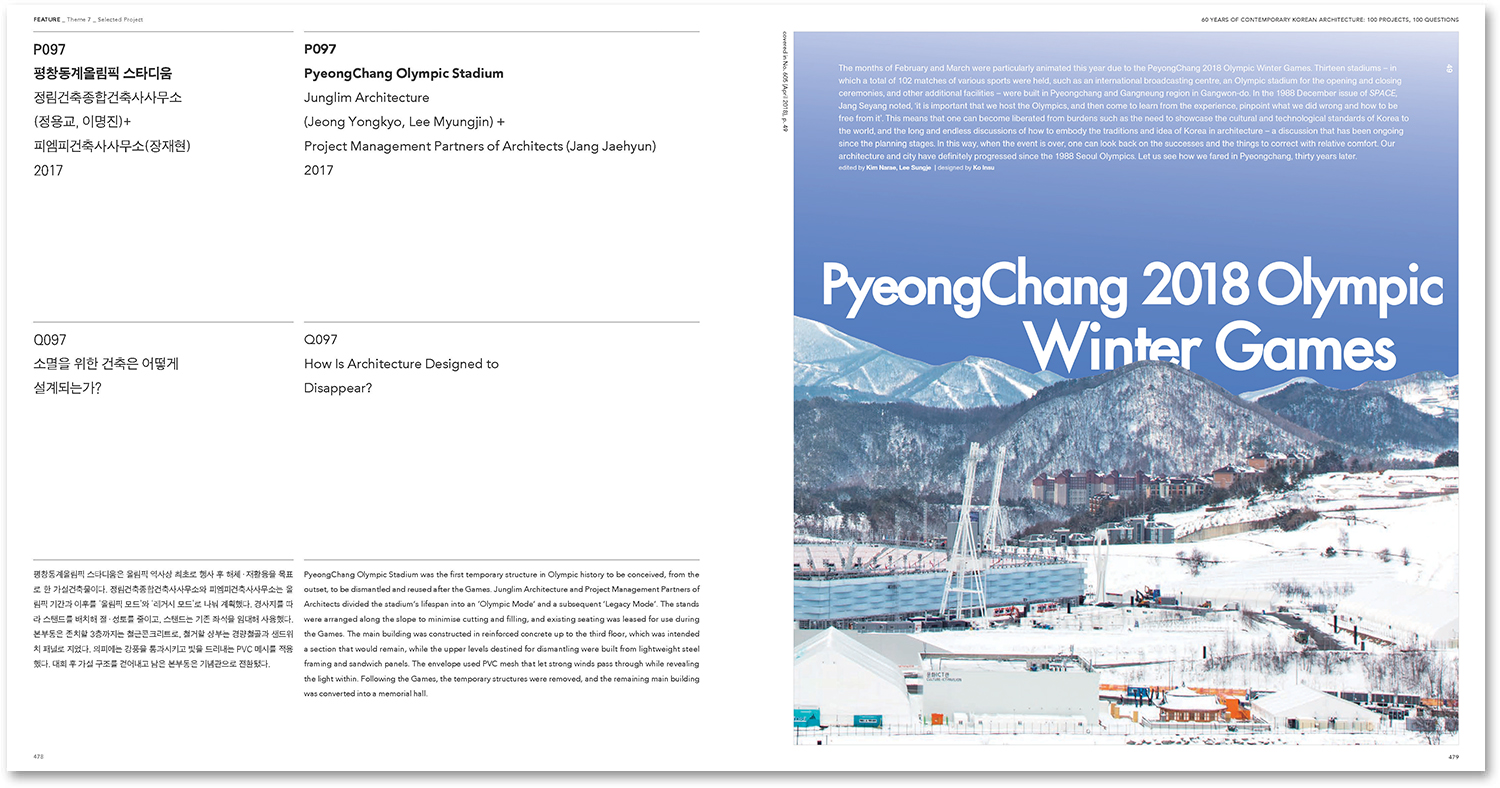
One such shift concerns how we understand architectural time and completeness. Buildings may be designed from the outset to be dismantled, or fragments of structures that have outlived their original purposes may be repurposed as both materials for new construction and objects of exhibition. Among the projects selected here, PyeongChang Olympic Stadium (2017) takes disappearance as its point of departure, while ‘A Recycling Assemblage’ (2020) begins with reuse. Both regard architecture not as an object completed upon construction, but as an ongoing process encompassing the production and use of materials, dismantlement, and reassembly. Meanwhile, new approaches are also emerging in the principles by which architecture operates. Breathing Folly (2023) takes air, heat, ground temperature and solar energy not as supplementary environmental technologies but as the very basis for organising space, overturning conventional distinctions between building and environment, and between structure and building services. At NAVER Data Center GAK Sejong (2023), space is determined not by the requirements of the human body but by the operational conditions of servers, cooling equipment and power networks. This vast facility, to which human access is restricted, reveals that the digital technologies we have regarded as belonging to an immaterial world in fact demand enormous quantities of materials, energy and equipment, finding concrete expression in architectural form and space.
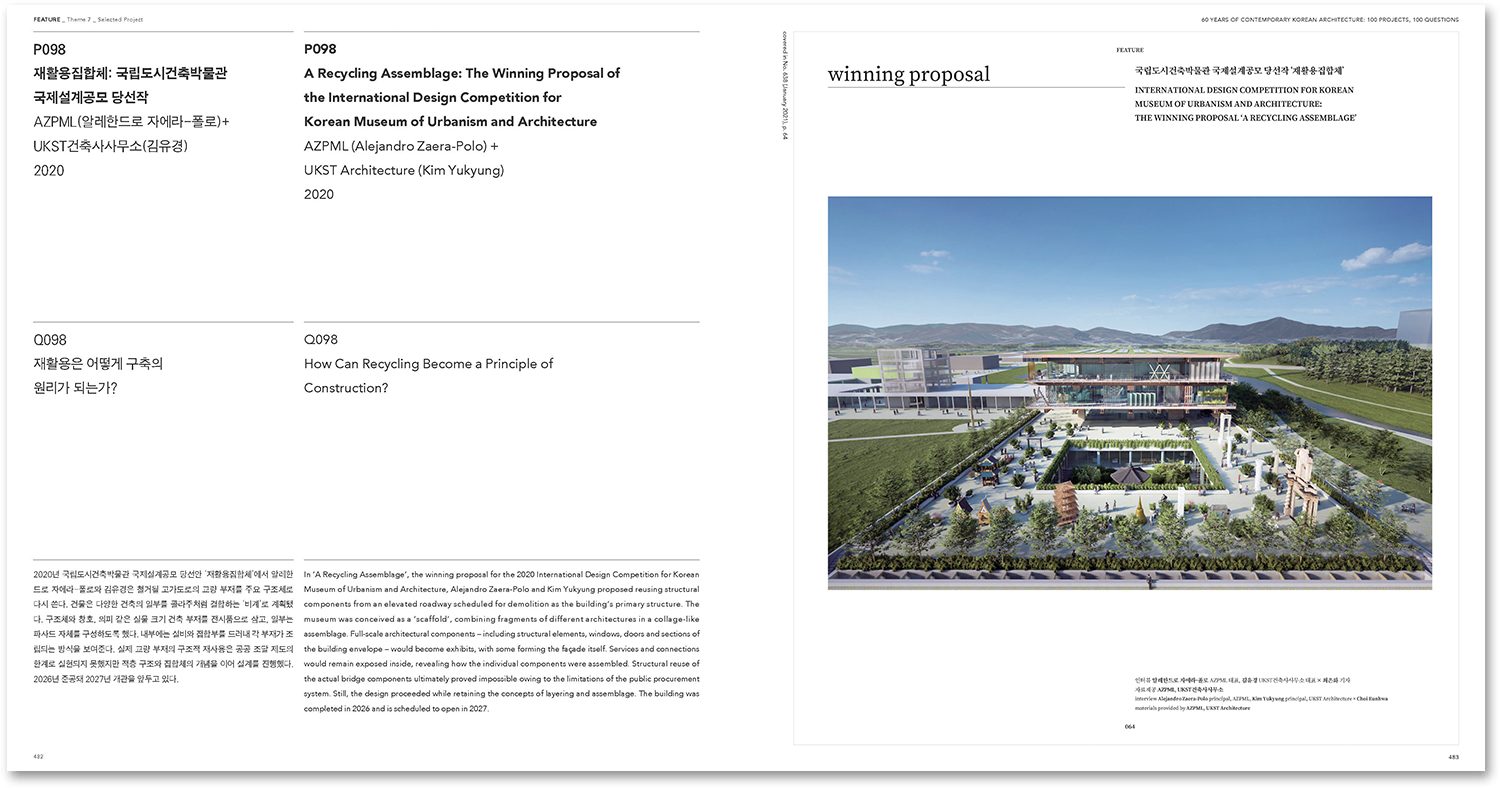
P097 PyeongChang Olympic Stadium | Q097 How Is Architecture Designed to Disappear? |
P098 A Recycling Assemblage: The Winning Proposal of the International Design Competition for Korean Museum of Urbanism and Architecture | Q098 How Can Recycling Become a Principle of Construction? |
P099 Breathing Folly | Q099 Can the Climate Crisis Become a Central Architectural Concern? |
P100 NAVER Data Center GAK Sejong Server Building & Operation Building | Q100 How Can Large-Scale Facilities for the Nonhuman Coexist with Nature? |
You can see more information on the SPACE No. November (2026).
0