




SPACE October 2026 (No. 707)
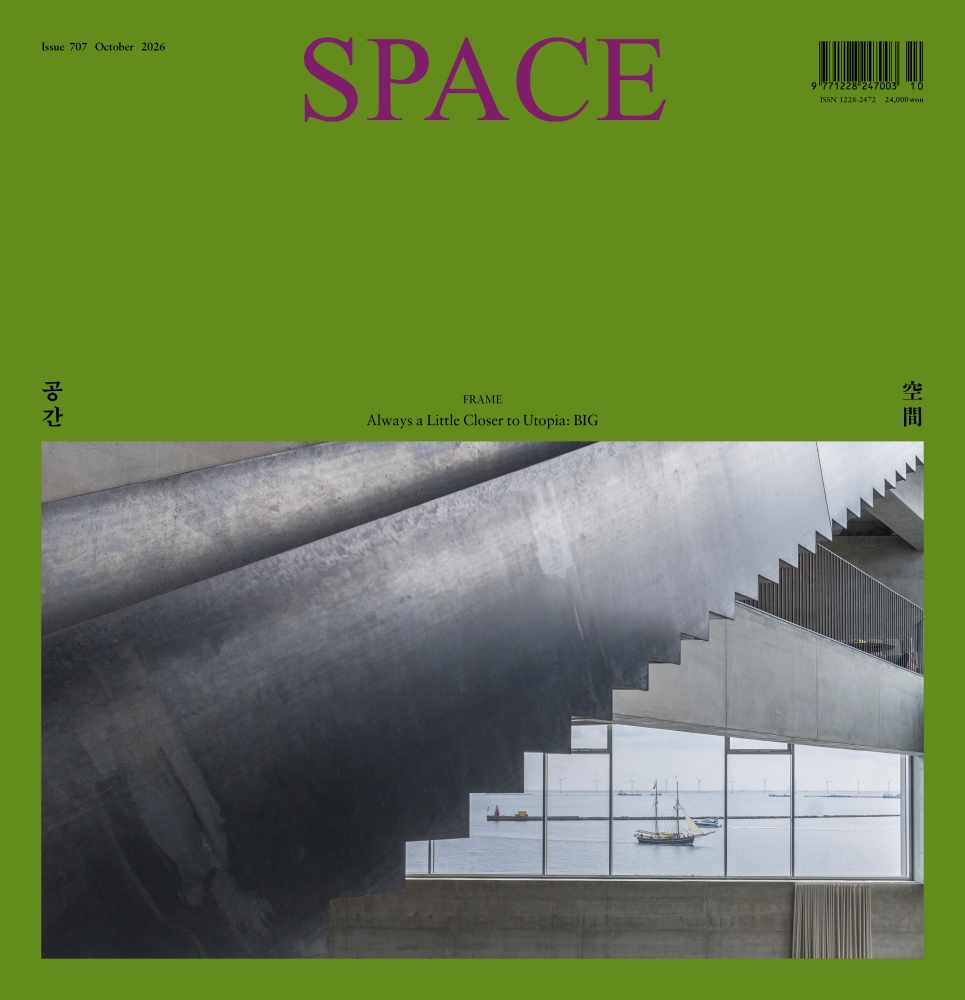
Architects of Optimism in an Age of Anxiety
At a time when both optimism and fear surrounding technology have become defining affects in public discourse, the October issue of SPACE presents BIG ‒ a practice that channels a tirelessly positive energy into its utopian visions ‒ in the FRAME section. Founded by Bjarke Ingels in 2006, BIG has grown over the past two decades into an international firm of more than 750 people. In an online interview conducted in late August, Ingels recalled that when the practice was still operating under the name PLOT (Bjarke Ingels Group + JDS Architects), SPACE was one of the first magazines to introduce their work to the world—a connection he recalls here with evident warmth (covered in SPACE No. 481).
At the time, SPACE shone a spotlight on the young Danish architects who were beginning to take their place on the world stage in a special feature entitled ‘Danish Edge’. BIG, Dorte Mandrup Arkitekter ApS, Lundgaard & Tranberg Architects, and aart a/s were among its central figures. In the feature, critic Merete Ahnfeldt-Mollerup traced the transformation of Copenhagen, which in a strange countermovement following the 9/11 attacks, had grown into a metropolis—a shift driven by the arrival of new clients and architects, both local and international, which began to send faultlines through the conservative Danish architectural establishment. Bjarke Ingels and Julien de Smet, having worked together at OMA in Rotterdam, brought Dutch architectural tendencies ‒ pragmatism, crude detailing, and bright colours ‒ back to Denmark, initially meeting resistance, but ultimately proving their worth by overturning preconceptions about residential developments through projects such as VM Houses.
Twenty years on, the spectrum of work produced by those once grouped together in a new wave of Danish architecture has grown broader and more defined. Where Dorte Mandrup Arkitekter and Lundgaard & Tranberg Architects have deepened their commitment to climate change, materiality, and the richness of detail, BIG’s architecture meets the public first and foremost through its visually arresting, monumental forms built with pixels, topology, and the repetition of pattern.
In this respect, it is particularly interesting that Bjarke took on the role of guest editor at Domus in 2025, producing ten issues under the theme of ‘materialism’. As if mindful of the long-standing criticism that BIG prioritises iconmaking above all else, he foregrounded a word that might easily be mistaken for ‘empty consumerism’, using it to explore the physical properties of materials themselves and the ways in which they can be put to practical use. The journey he proposed was ‘an odyssey through the material world, beginning with solid rock and ending with the flow of electrons’. But where is the Ithaca to which he ultimately seeks to return in this roving exploration? Bjarke reminds us of the self-evident truth that the world we inhabit is made, in the end, of available matter, and describes the journey as an attempt to put forward new architectural possibilities at ‘the frontier of material innovation and sustainability’. It is, in essence, a brand of relentless optimism—the conviction that architecture remains a valid answer to the questions of the age, even amid the anxiety of a climate crisis and an era of uncontrollably evolving AI.
This theme alone, of course, cannot fully account for the character of BIG’s current architecture. However, BIG HQ (2023), presented in this issue’s FRAME feature, is a project that keenly reflects BIG’s thinking on materials and architecture. Situated at the point where Copenhagen’s harbour meets the sea, the building is supported by a single monumental column composed of seven natural stones, ranging from granite to marble. A bold experiment in materiality made possible precisely because BIG was its own client, the column turns the entire building into a vast textbook through which the changing properties of materials can be studied over time. The chequerboard façade ‒ arrived at in the process of resolving the long span ‒ further demonstrates BIG’s characteristic ability to weave structure, architecture, and landscape into a seamless whole.
Alongside BIG HQ, this issue’s FRAME feature brings together a carefully curated selection of recently completed projects that each represent a distinct architectural typology: the Suzhou Museum of Contemporary Art (2025), Google Bay View (2022), Sluishuis Residences (2022), and Musée Atelier Audemars Piguet (2020). BIG’s work, delivered through a brand of public-friendly storytelling, is already widely known via the studio’s website and social media. It was precisely for this reason that this FRAME feature focuses on what lies beyond surface appearances—conducting in-depth interviews with Bjarke and the partners responsible for each project. Fortunately, the responses we received were specific, profound and illuminating. Through these candid interviews, readers will be able to experience the deep architectural thinking that powers BIG’s efforts in an age of anxiety: thinking that lies concealed beneath those endlessly fluid and optimistic diagrams.
Kim Jeoungeun Editor-in-Chief
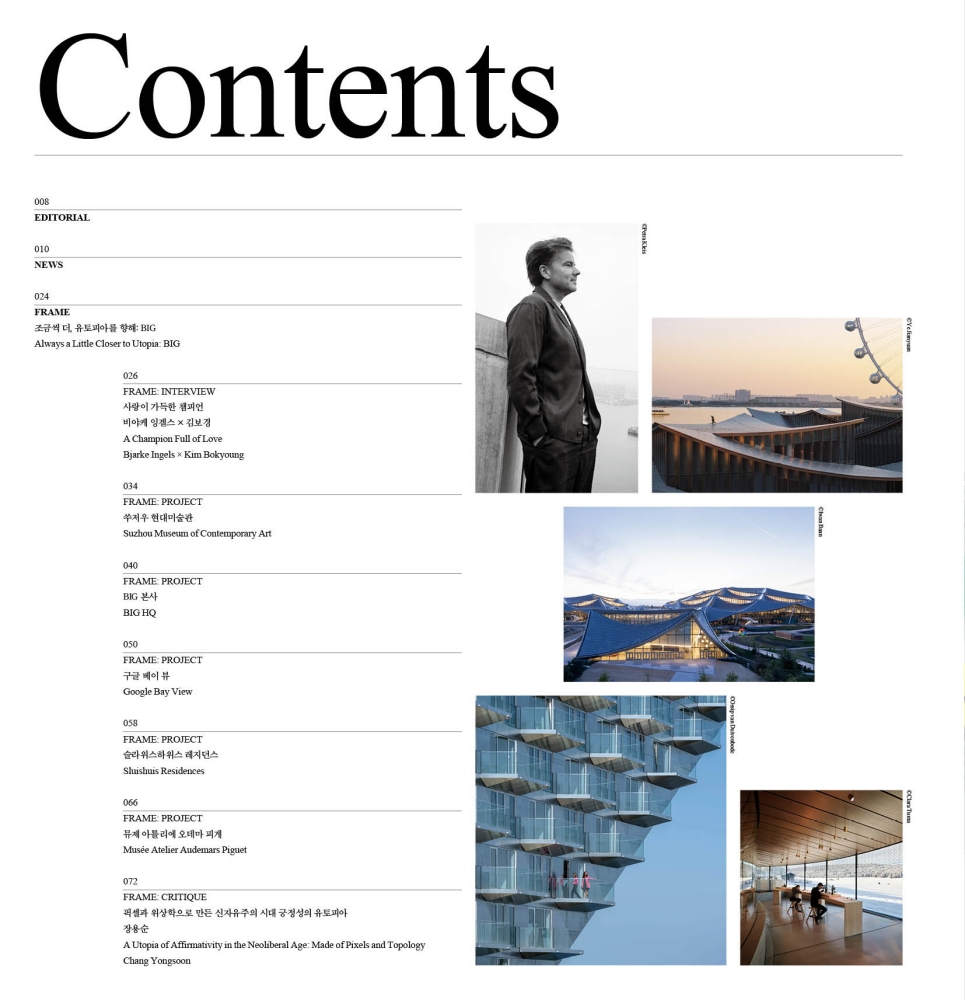
Contents | SPACE October 2026 (No. 707)
008 EDITORIAL
010 NEWS
024 FRAME
Always a Little Closer to Utopia: BIG
026 FRAME: INTERVIEW
A Champion Full of Love_ Bjarke Ingels × Kim Bokyoung
034 FRAME: PROJECT
Suzhou Museum of Contemporary Art
040 FRAME: PROJECT
BIG HQ
050 FRAME: PROJECT
Google Bay View
058 FRAME: PROJECT
Sluishuis Residences
066 FRAME: PROJECT
Musée Atelier Audemars Piguet
072 FRAME: CRITIQUE
A Utopia of Affirmativity in the Neoliberal Age: Made of Pixels and Topology_ Chang Yongsoon
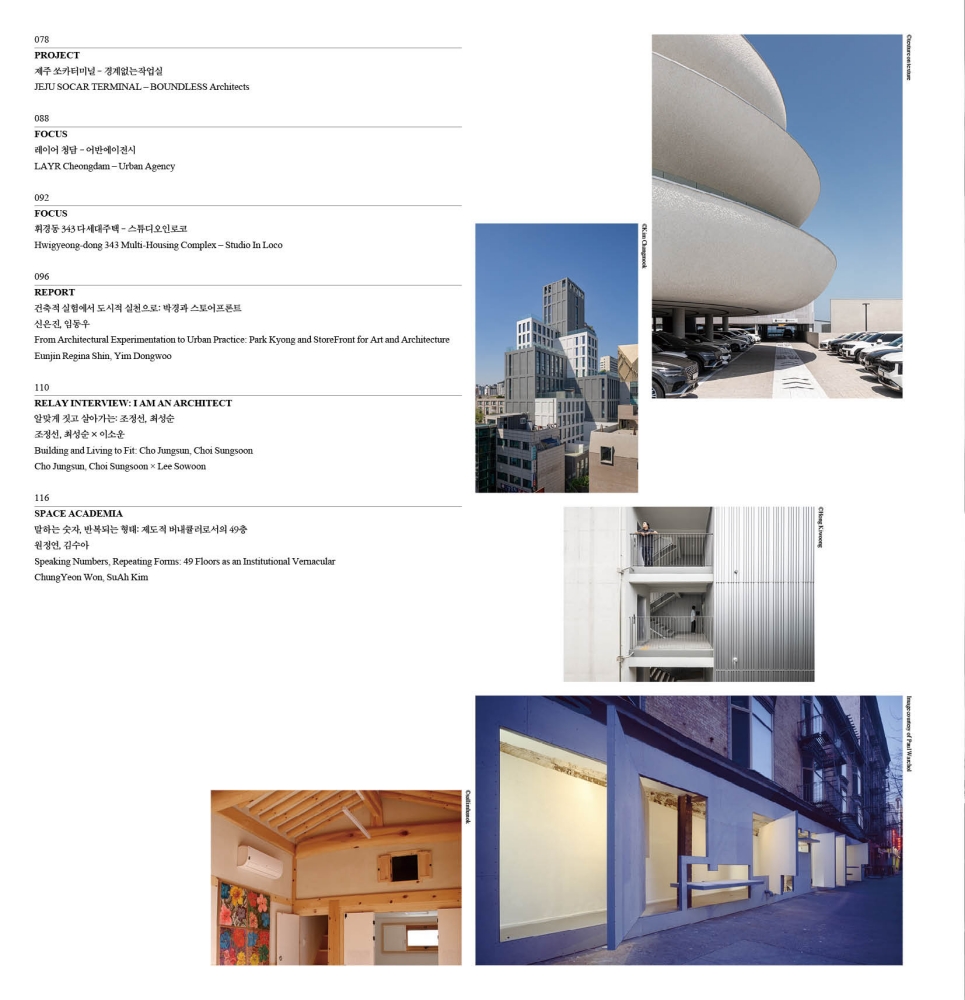
078 PROJECT
JEJU SOCAR TERMINAL ‒ BOUNDLESS Architects
088 FOCUS
LAYR Cheongdam ‒ Urban Agency
092 FOCUS
Hwigyeong-dong 343 Multi-Housing Complex ‒ Studio In Loco
096 REPORT
From Architectural Experimentation to Urban Practice: Park Kyong and StoreFront for Art and Architecture_ Eunjin Regina Shin, Yim Dongwoo
110 RELAY INTERVIEW: I AM AN ARCHITECT
Building and Living to Fit: Cho Jungsun, Choi Sungsoon_ Cho Jungsun, Choi Sungsoon × Lee Sowoon
116 SPACE ACADEMIA
Speaking Numbers, Repeating Forms: 49 Floors as an Institutional Vernacular_ ChungYeon Won, SuAh Kim
