
SPACE November 2026 (No. 708)
THEME 4.Collective Life
How Has Public Architecture Evolved from Places of Authority to Everyday Public Spaces?
For much of its history, public architecture in Korea was either conceived as monumental architecture expressing authority or as standardised commodity to be supplied quickly and uniformly. The dome of the National Assembly Building (1975), absent from the original design, was added after politicians complained that the building did not appear sufficiently authoritative. Classrooms organised along straight corridors, derived from standard plans dating to the Japanese colonial period, were repeated for more than half a century, while public libraries remained focused largely on the function of reading rooms until the early 1990s.Civil society was what first fractured this landscape. At Miral School (1997), a privately run Christian special-education school completed in 1997, every classroom was opened towards an atrium so that children with developmental disabilities could run and play freely even indoors. The following year, in Manseok-dong, Incheon, architect E Ilhoon joined volunteer teachers who had pooled small donations to create Study Room Next to the Railroad (1998) through practicing the philosophy of chaenanum, or dividing a house into separate volumes. If these projects remained isolated exceptions, the Miracle Library (2003–2004) – six children’s libraries beginning with Suncheon in 2003 and catalysed by the MBC entertainment programme Exclamation Mark – extended this trend into the public realm.
The enactment of the Framework Act on Architecture in 2007 and the Act on the Promotion of Building Service Industry in 2013 changed the very process by which public architecture was commissioned. Design competitions, once held mainly for monumental buildings, expanded to everyday facilities, giving emerging architects more opportunities to design small public projects. The Public Architect system introduced by the Yeongju City in 2009, the first of its kind in Korea, also created a structure through which previously disconnected public-architecture projects across the city could be considered together from the planning stage under a single master plan.
Experiments that began as exceptions outside the institutional framework now continue within the public sector. The lineage of special-education architecture opened by Miral School extends to the public Seoul Seojin School (2019), while the new image of the library established by the Miracle Library has been transformed once again at Gusan-dong Village Library (2015) into a library that preserves the memory of its neighbourhood.
P055 Miral School | Q055 How Can a Special-Education School Coexist with Its Local Community? |
P056 Study Room Next to the Railroad | Q056 How Does a Space of Care Face Its Neighbourhood? |
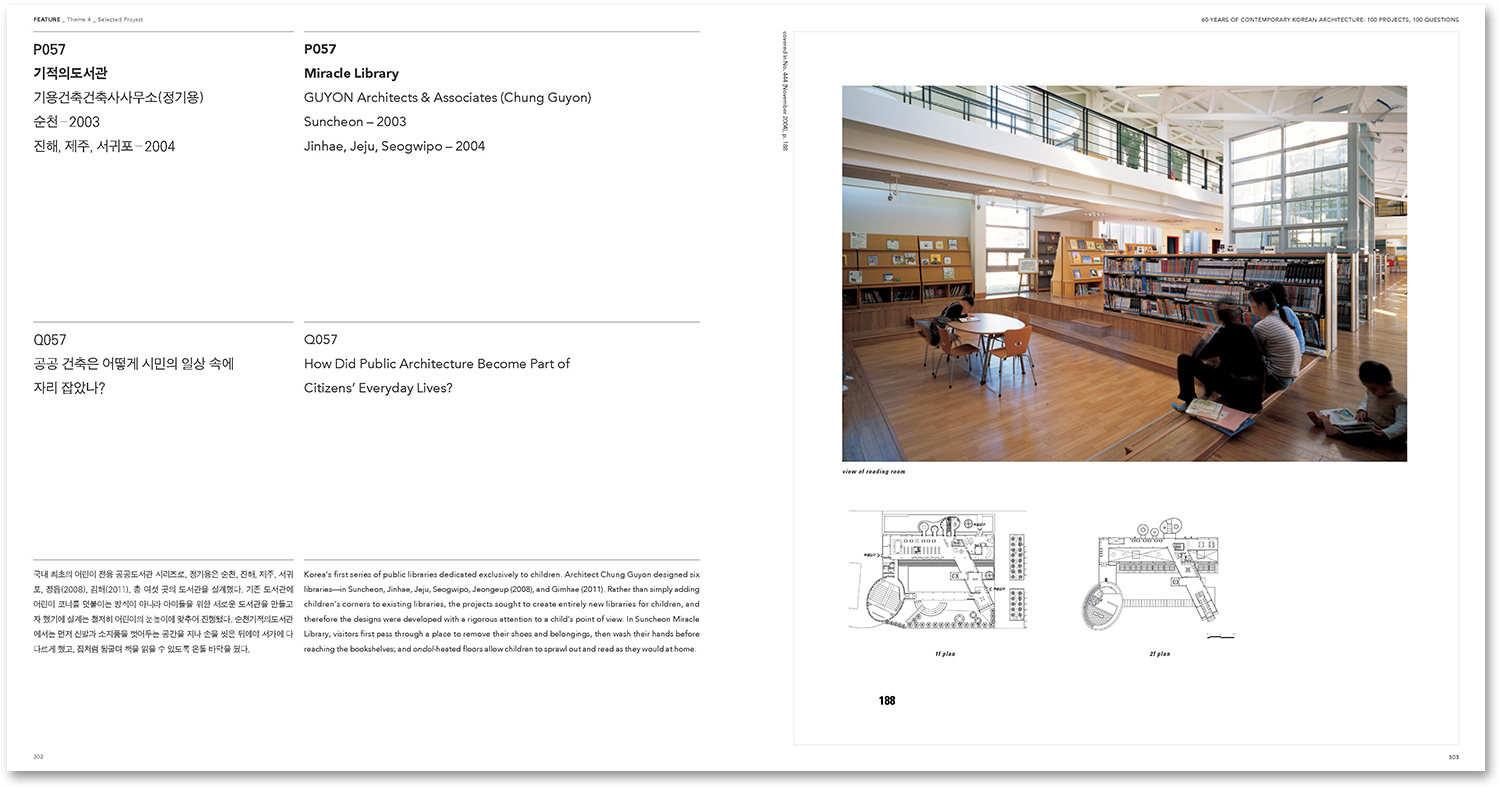
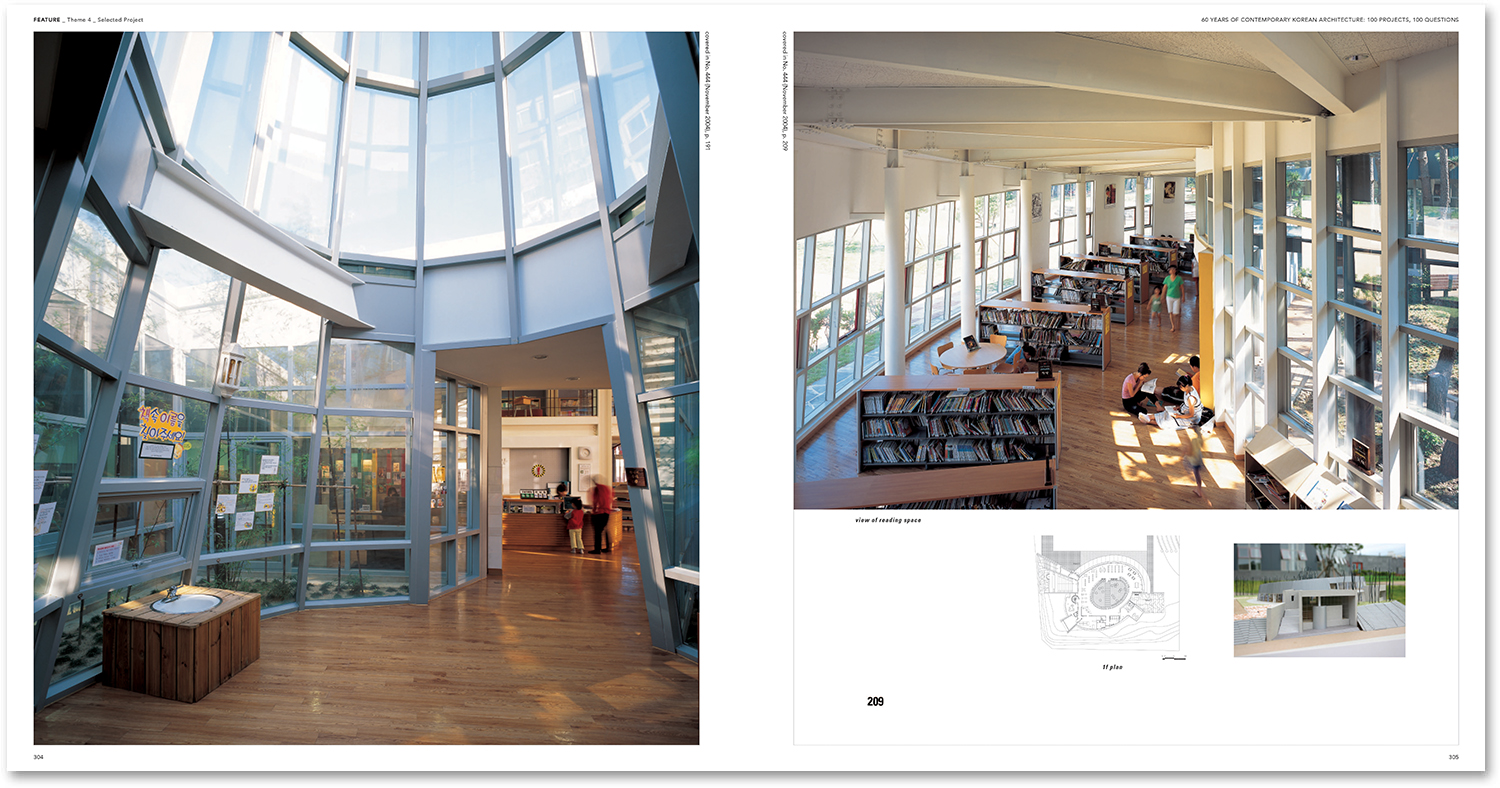
P057 Miracle Library | Q057 How Did Public Architecture Become Part of Citizens’ Everyday Lives? |
P058 Gusan-dong Village Library | Q058 How Can the Traces of Everyday Life Transform Public Architecture? |
P059 Yeongju Rehabilitation Center for the Disabled | Q059 How Far Can Public Architecture Advance Under the Direction of a Master Architect? |
P060 Seoul Seojin School | Q060 How Can a Special-Education School Become a Space for Everyone? |