
SPACE November 2026 (No. 708)
THEME 2. Materials and Materiality
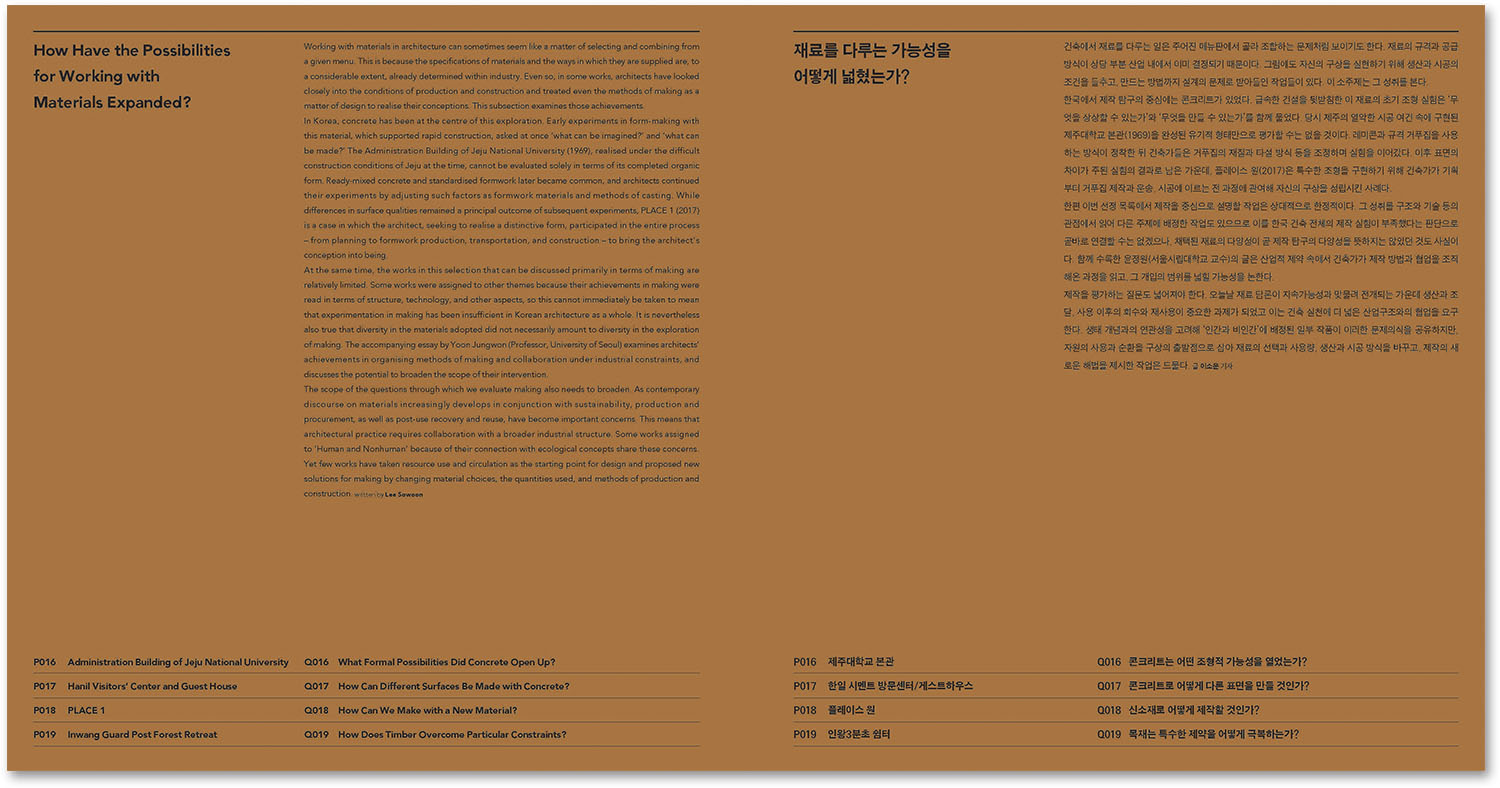
How Have the Possibilities for Working with Materials Expanded?
Working with materials in architecture can sometimes seem like a matter of selecting and combining from a given menu. This is because the specifications of materials and the ways in which they are supplied are, to a considerable extent, already determined within industry. Even so, in some works, architects have looked closely into the conditions of production and construction and treated even the methods of making as a matter of design to realise their conceptions. This subsection examines those achievements.
In Korea, concrete has been at the centre of this exploration. Early experiments in form-making with this material, which supported rapid construction, asked at once ‘what can be imagined?’ and ‘what can be made?’ The Administration Building of Jeju National University (1969), realised under the difficult construction conditions of Jeju at the time, cannot be evaluated solely in terms of its completed organic form. Ready-mixed concrete and standardised formwork later became common, and architects continued their experiments by adjusting such factors as formwork materials and methods of casting. While differences in surface qualities remained a principal outcome of subsequent experiments, PLACE 1 (2017) is a case in which the architect, seeking to realise a distinctive form, participated in the entire process – from planning to formwork production, transportation, and construction – to bring the architect’s conception into being.
At the same time, the works in this selection that can be discussed primarily in terms of making are relatively limited. Some works were assigned to other themes because their achievements in making were read in terms of structure, technology, and other aspects, so this cannot immediately be taken to mean that experimentation in making has been insufficient in Korean architecture as a whole. It is nevertheless also true that diversity in the materials adopted did not necessarily amount to diversity in the exploration of making. The accompanying essay by Yoon Jungwon (Professor, University of Seoul) examines architects’ achievements in organising methods of making and collaboration under industrial constraints, and discusses the potential to broaden the scope of their intervention.
The scope of the questions through which we evaluate making also needs to broaden. As contemporary discourse on materials increasingly develops in conjunction with sustainability, production and procurement, as well as post-use recovery and reuse, have become important concerns. This means that architectural practice requires collaboration with a broader industrial structure. Some works assigned to ‘Human and Nonhuman’ because of their connection with ecological concepts share these concerns. Yet few works have taken resource use and circulation as the starting point for design and proposed new solutions for making by changing material choices, the quantities used, and methods of production and construction.
P016 Administration Building of Jeju National University | Q016 What Formal Possibilities Did Concrete Open Up? |
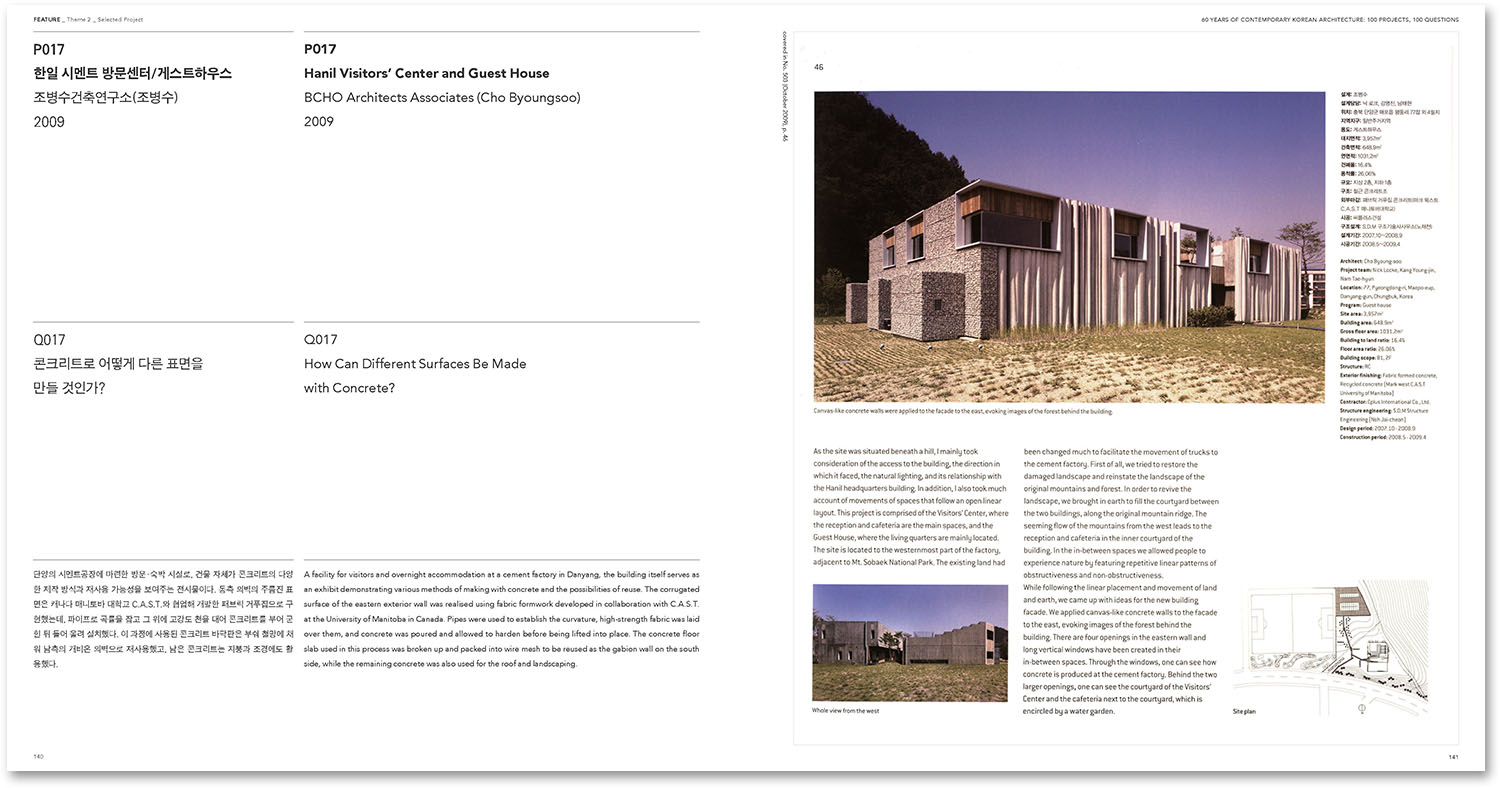
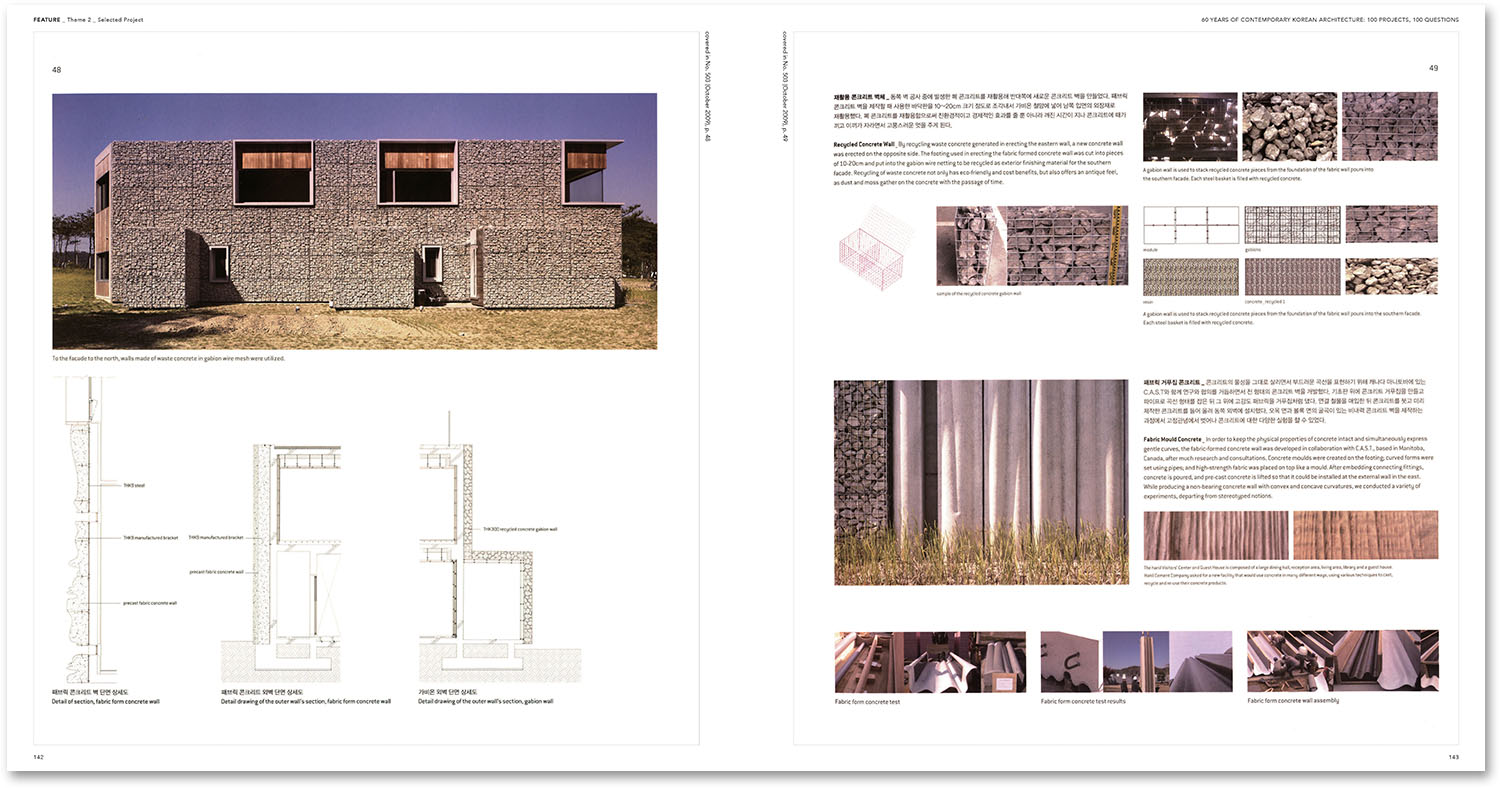
P017 Hanil Visitors’ Center and Guest House | Q017 How Can Different Surfaces Be Made with Concrete?
|
P018 PLACE 1 | Q018 How Can We Make with a New Material?
|
P019 Inwang Guard Post Forest Retreat
| Q019 How Does Timber Overcome Particular Constraints?
|