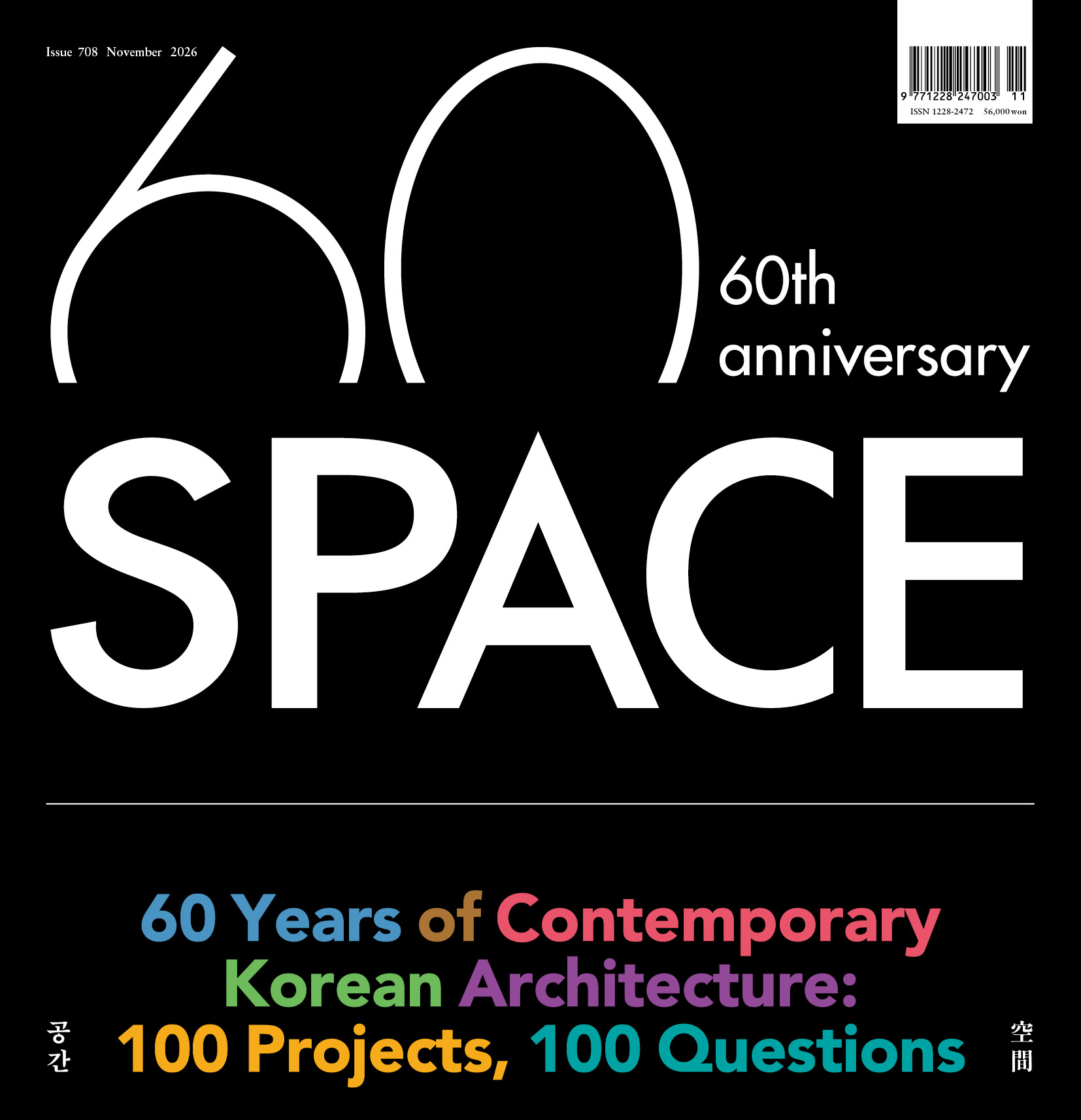

SPACE November 2026 (No. 708)
Reasoning Behind the 100 Projects of Contemporary Korean Architecture
Beginning: Ways to Celebrate
This special issue, celebrating the 60th anniversary of SPACE, has been curated to look back at contemporary Korean architecture through 100 projects and connected questions. The 1960s and 1970s are often regarded as the period in which Korea began to shape its own built environment. Therefore, revisiting SPACE, published in 1966, can be considered as an attempt to reread the history of contemporary Korean architecture. The weight of 60 years of history has been overwhelming. To be honest, it has been a tremendous responsibility to plan this issue, placing considerable pressure on the editorial team.
An earlier study acted as the first step. The trajectory of an architectural journal inevitably intersects with architectural history. The British magazine The Architectural Review, first published in 1896, marked its 120th anniversary with a special double issue combining the December 2016 and January 2017 issues. Previously, in 1996, the journal had celebrated its centenary with a comprehensive retrospective and a series of speculations about the future,▼1 at a time when the media landscape was rapidly changing in anticipation of the new millennium.▼2 By contrast, the 120th-anniversary issue revisited the magazine’s archives through key themes tracing the development of architecture as a discipline, in order to reflect on the role of architectural criticism.
Later that year, in September 2016, the American magazine Architectural Record, that began publication in 1891, presented a 125th-anniversary issue featuring ‘RECORD’s Top 125 Buildings’, a selection of greatest buildings completed since its inaugural year. At the same time, it recognised the possibility that the selection would change as the interpretation of architectural history changes.
Shinkenchiku, a Japanese architectural journal, celebrated its centenary in 2025 through the publication of a two-part series called ‘100 Years of Architecture’, across its August and September editions. The editors created a matrix with seven thematic axes arranged vertically; Methodological, Material, Time, Technological, Environmental, Urban, and Social, with a horizontal time axis divided into 10-year intervals. Kato Koichi, the architectural historian who served as the supervising editor of the special issue, stated that he wanted to redraw the history of contemporary architecture from a new perspective, free from chronological narratives and labels associated with architectural ‘-isms’ and styles. The project expanded the three conventional approaches to understanding architectural history; aesthetics, technology, and society, and employed a densely structured matrix of keywords and works to trace their interrelationships and the contexts surrounding them. This was an attempt to offer new ways of discovering and interpreting the history of contemporary architecture.
Domus of Italy adopted an entirely new approach. In 2018, to celebrate its 90th anniversary, the magazine launched a project called ‘Domus 10×10×10’, a 10-year long editorial project that will continue until 2028, marking the 100th anniversary. Each year, a different architect is appointed as a Guest Editor, who oversees the editorial content for the year. Beginning with Michele De Lucchi (2018), the baton was handed over to Winy Maas (2019), David Chipperfield (2020), Ando Tadao (2021), Jean Nouvel (2022), Steven Holl and Mori Toshiko (2023), Norman Foster (2024), Bjarke Ingels (2025), and Ma Yansong (2026). Each of these editors devised a manifesto based on his/her philosophy and developed year-long special issues according to their particular lens. Instead of compiling a history within a single volume, Domus has turned the coming decade itself into a form of
celebration.
Whether reconstructing the past or proposing visions of the future, special issues of a magazine, a medium that operates at a relatively slow pace, offer the opportunity to reflect on contemporary issues across a longer arc of time. In this respect, what kinds of special issues have been published by SPACE over the years? The first-anniversary issue (No. 13)▼3 reviewed two decades of architecture in Korea after liberation through articles such as ‘20 Years of Korean Modern Architecture: 1945.1966’. On the occasion of the 200th issue of the magazine (February 1984), the magazine held an architectural symposium under the theme, ‘What Does Modern Architecture Mean to Us?’ The symposium served as a forum for heated debate on the relationship between Korean architecture and modernism.
The 1980s were a period of dynamic change as Korean society began to engage more actively with the international community. This period coincided with the deaths of Kim Chung-up and Kim Swoo Geun, two leading figures in Korean architecture, and marked a generational shift in the architectural field. In 1986, the year the magazine celebrated its 20th anniversary, its founding publisher, Kim Swoo Geun, passed away. The combined September & October issue (No. 230) paid tribute to him. A decade later, in 1996, the magazine’s 30th-anniversary year, his successor as publisher, Chang Sea Young, died in September. The October issue (No. 348) was dedicated to his work and legacy. Ironically, during these anniversary years, SPACE lost two of its leading figures in succession.
As the decade of the 2000s passed, the record accumulated by SPACE grew ever more substantial, and the archive itself became an active subject of rediscovery. When publishing the 50th-anniversary issue in November 2016, the magazine revisited all 587 previous issues and selected key articles from each. More recently, to mark its 700th issue this March, Yim Dongwoo (Professor, Hongik University) classified project data published through 2024 by regions, methods of construction, programmes, and scale and noted a tendency for ‘smaller, more dispersed, and more diverse Korean architecture’. This research provided the basis for the current special issue of SPACE, which surveys six decades of contemporary Korean architecture through the projects featured in SPACE over the past 60 years.
7 Themes and a Shortlist of 380 Projects
Over the past 60 years, SPACE has featured more than 3,000 buildings under headings such as ‘Projects’ and ‘Recent Works’ sections, and has covered many more through a variety of formats. For this anniversary project, the editorial team appointed the 60 selectors to identify 100 works from this extensive archive. The selection process forces one to choose and eliminate continuously, while also questioning one’s judging criteria. Of course, there were some doubts, too. Would a list dominated by buildings with an established historical reputation really serve as a tool for revisiting the past?
Werner Heisenberg, the physicist who established the foundations of quantum mechanics, stated ‘What we observe is not nature itself, but nature exposed to our method of questioning.’▼4 In other words, a change in the questions we ask brings different aspects into view. The editors recognised both the weight carried by a list of ‘100 selections’ and its potential to generate sensationalist readings. Therefore, the decision was made to review the past 60 years in light of questions that still remain relevant today. The selection of 100 projects thus became a means of exploring and expanding the questions themselves.
The first task was to set out the themes through which to examine the projects: Space and Composition; Materials and Materiality; Structure and Technology; Collective Life; Urban and Region; History and Memory; and the Human and Nonhuman. The sequence begins with the internal disciplines of architecture, extends to the conditions surrounding it, and eventually ends up with more recent concerns. With the established themes, the shortlist was compiled. The editorial team reviewed projects published between the inaugural issue through the July 2026 issue, picking approximately 100 projects each for the relevant themes. In this process, artificial intelligence (AI) was used. The initial pool of around 300 projects grew to approximately 500 before being narrowed down to a final shortlist of 380. During the process, editors added projects that were widely recognised in their time, even if their prominence had since faded, and refined the list to get a balanced representation of architects and eras.
The balancing principles were as follows. It was difficult to place works by first-generation architects, whose reputations had already been well formed, at the same level as those of the younger architects who have not yet created their own architectural languages. Nevertheless, it seems important to maintain a balance that would allow us to trace how questions had been reinterpreted across generations. For architects with a prolonged and active career, awards were considered as one indicator of professional recognition, while giving priority to works that introduced new typologies that played a game changing role in architectural discourse. In principle, the selection was limited to works by Korean and foreign architects built in the territory of Korea. But exceptions were made for projects by Korean architects built abroad, such as exhibition pavilions for international expos. The editors also considered some works that had long been regarded as significant but received only brief mention in SPACE.
Others were included precisely because they had caused intense controversy in their day or now, such as the Buyeo Museum, Gwanghwamun Square and Sewoon Sangga. Although most of the selection consisted of completed buildings, a few unbuilt proposals were included where they clearly reflected the concerns and agendas of their time. At every stage, social evaluations and subjective judgements were inevitably intertwined.
7 Themes, 100 Projects, 100 Questions
The next step was to form a group of 60 selectors, including architectural historians, critics, architects, and other practitioners spanning several generations. Each member was required to nominate at least ten projects within each theme, with our selection criterion being outlined as follows ‘not 100 outstanding works but works that have addressed the issues and questions that matter today’. They were also asked to suggest important projects from the SPACE archive which were not in the editorial team’s shortlist of 380, with the hope of broadening the pool of candidates. Some of these projects were reconsidered and ultimately included in the final 100 selections, as they were recognised as part of the genealogy of a particular subsection.
The span of six decades, combined with our ambition to cover the major topics of architecture, made the seven themes exceptionally broad. Therefore, 60 selectors of different generations and interests, consequently adopted their own criteria for selection. Some even applied different criteria at a different period, and the number of nominees was quite variable. Rather than normalising the votes and putting them in a quantitative ranking, the editorial team used the results to consider how these projects could be grouped according to the subsections. From this process, the final list of 100 projects was composed. We then paired each project with a question arising from its subsection, producing a total of 100 questions. These might be questions posed in their own time or ones reconstructed from a contemporary perspective. Yet the criterion was always the same: is this question relevant today?
The first theme, ‘Space and Composition’, examines organising attitudes and methodologies of space. Theoretically, almost any project could be included under this theme. Over the years, we have encountered numerous movements and methodologies, from modernism and postmodernism to critical regionalism, deconstructivism, high-tech, fold, and Dutch Modern. The objective in this theme was to discover what projects have continued to retain their relevance even today, like some stones left behind by the receding waves on the shore, along with some milestones. In the process, we also explored the manner by which our own interpretation of Western architecture had developed and the interaction between foreign architects and the Korean context.
The decision to call the second theme ‘Materials and Materiality’, rather than simply Materials, reflects a tendency observed in recent Korean architecture: a growing interest in material expression and detail. Where does the current preoccupation with the materiality of architectural surfaces come from, and where is it going? This question also reflects our concern that there is a lack of projects that have explored the diverse possibilities of materials. Of course, there were buildings that employed brick, weathering steel, timber, and other materials. However, when six decades were condensed into 100 selections, the dominant use of concrete as both a finishing and a structural material was noticeable. The subsections in this section were organised around three keywords: making, perception, and representation.
Closely connected to materials, the third theme, ‘Structure and Technology’, focuses on projects that integrate structural logic and architectural form. This is another topic that begins with a concern for structural reasoning having been marginalised from contemporary design practices. It asks what alternatives might be found to reinforced concrete (RC), which has been accepted as the standard structural system in the Korean construction industry. To address this question, the genealogies of high-rise buildings and long span structures were traced, while mentioning the pioneering works that could be considered new experiments in structural design and fabrication.
The fourth theme, ‘Collective Life’, asks how we live together. It examines collective housing as an experiment in ways of living, along with shifts in the public space, highlighting architecture’s social realm. In developing the seven themes, numerous discussions were held about whether housing should have a dedicated section of its own. Ultimately, we decided against this, in keeping with our principle of organising the themes around questions rather than specific building programmes. Although both Sujoldang, The House of Three Trees and Painter N’s House are included on the list of final 100 selections under ‘Space and Composition’, ‘Structure and Technology’ and ‘History and Memory’, respectively, it is unfortunate that we could not devote a separate section ‘dwelling’, where a fundamental question could be addressed for architecture and architects.
Originally, when the shortlist was first distributed to the selectors, the subtitle for the fifth theme, ‘Urban and Region’, was: ‘From new town planning to urban shrinkage: what can architects do?’ As the final list indicates, this section considers projects that engage with the city at an urban scale, not individual structures. At the time of the foundation of SPACE, ‘urban’ was key theme, and emphasised projects that could be understood as forms of urban planning. Over the years, architects’ contributions to such projects have become increasingly anonymous except for notable projects such as Paju Book City and Sejong City. The following projects can be examined through the question of what role architects play in shaping the city.
The sixth theme, ‘History and Memory’, reflects the recent interest in preservation, restoration, regeneration, and adaptive reuse. It also is closely connected to the seventh theme, ‘Human and Nonhuman’.
‘Human and Nonhuman’ was the theme that selectors found most challenging. The discourse explored under this theme begins with a ‘classical’ question, how architecture should respond to its surrounding environment. From there, it extends to questions of sustainability in response to the global climate emergency and conception of method, material, and environmental conditions into a unified approach. It concludes with the question of how humans can coexist with other species on this planet. From the beginning of compiling the initial shortlist, it was clear perspectives on architecture and its relationship with the environment had dramatically shifted over the past 60 years. Given that this important theme had not been adequately addressed by SPACE or the Korean architectural community, the editorial team decided to try and find relevant works. Nevertheless, among the final 100 selections, this theme covers the fewest projects of all seven themes.
Structure of the Special Issue
The structure of this special issue will now be outlined. The seven themes that form its backbone are each divided into two or three subsections. Each subsection opens with a brief introduction by the editor responsible for that section. This is followed by a chronological listing of Selected Project ranging from as few as three or four to as many as twelve. Each project is accompanied by an excerpt from the original article as it appeared in SPACE. Following the project description, an additional Excerpted Article related to the subsection is included.
A Selector’s Note is then presented at the end of each set of selected projects and excerpted articles, in the form of the joint statements prepared by the 60 selectors. Lastly, a newly commissioned Essay is provided for each theme, offering an additional discussion or interpretation of the issues at hand. Excerpts from selectors’ note are distributed not only across the seven themes but also throughout the Prologue and the Opinion section of the Appendix. The Appendix includes profiles (Biography) of the 60 selectors. It also presents the top 20 projects (Original List) that received the most votes from the selectors through a ballot out of the 380 shortlisted projects. Read alongside the final 100 selections by the editorial team, this list offers a glimpse into the judgements of the selection process.
Closing
The projects featured in an architectural journal may reflect the perspectives and biases of its editors at the time of publication. Consequently, both the journal’s architectural tendencies and the scope of its coverage change over time. In some cases, the magazine may also have served as a platform for promoting particular architects. Moreover, the further we move away from the present, the more difficult it becomes to refer to a project’s original context. The shortlist of 380 and the selection of 100 projects were compiled based on this accumulated record and subjectively evaluated by the current editorial team. Therefore, any analysis of contemporary Korean architecture made as part of these lists should start with the recognition of their inherent biases. Hopefully this list will not be seen as a closed circuit, but rather as a starting point for subsequent questions and inquiries, precisely because they remain incomplete.
Kim Jeoungeun, Editor-in-Chief
----
1 May and November 1996 issues of The Architectural Review.
2 The website of The Architectural Review first appeared in 1997. For many years, it remained secondary to the print magazine, but by 2016, it had become an integral part of the publication’s content delivery. Meanwhile, VMSPACE, the website of SPACE, was first established in 2001, when the magazine published its 400th issue. In 2018, the website underwent a redesign and restructuring, accompanied by the development of a digital archive, and has continued to operate in its current form since then.
3 The following is an excerpt from the comprehensive evaluation submitted by selector member Cho Hyunjung, highlighting the first-anniversary issue of SPACE:‘When I was invited to participate in the ‘100 Projects of Contemporary Korean Architecture’ initiative marking the 60th anniversary of SPACE, I delved into the magazine’s archives. Following the habits of a historian, I searched for similar surveys that might have been conducted at regular intervals throughout its history. Contrary to my expectations, however, the only initiative resembling a selection of ‘the best in architecture’ was a survey titled ‘Survey: 11 Selections of Contemporary Korean Architecture’, published in Issue No. 13 (November 1967) to commemorate the magazine’s first anniversary. Eleven prominent figures in Korean architecture at the time, including Lee Cheon Seung, Kim Joungsu, Ahn Youngbae, and Won Chungsu, each nominated five projects that they believed could serve as ‘milestones for the future of Korean architecture’. The results yielded approximately twenty projects, including the French Embassy in Korea, the Freedom Center, St. Mary’s Hospital, Choheung Bank, and Jangchung Gymnasium. Interestingly, following the survey soliciting the opinions of eleven Korean architects, the first-anniversary issue also featured a survey of foreign architects. The magazine announced its launch to leading international figures such as Walter Gropius, Richard Neutra, and Yoshimura Junzo, inviting them to share their thoughts on the role of the architect, the meaning of tradition, and their visions for the city and the future of society. Meticulously organised through individual correspondence, this was an ambitious undertaking indeed. Although SPACE had been in publication for only one year, it had already assumed a significant responsibility: not only to introduce contemporary architectural developments to Korean readers, but also to communicate the presence and achievements of contemporary Korean architecture to the international architectural community. Looking back some 60 years later, the current 100 selected projects feature also serves as an opportunity to reflect on how those grand ambitions and visions have come to fruition.
4 Werner Heisenberg, Physics and Philosophy: The Revolution in Modern Science, New York: Harper & Brothers,1958.
Contents | SPACE November 2026 (No. 708)
008 FROM THE PUBLISHER
010 NEWS
038 FEATURE
60 Years of Contemporary Korean Architecture: 100 Projects, 100 Questions
042 PROLOGUE
046 Thematic Timeline
054 Essay Reasoning Behind the 100 Projects of Contemporary Korean Architecture_ Kim Jeoungeun
060 Essay The Flow of Contemporary Korean Architecture_ Chung Kwiweon, Nam Sangmoon, Kang Yerin
066 THEME 1
Space and Composition
068 How Have We Embraced and Expanded upon Western Architecture?
Selected Project P001‐P012
Excerpted Article
114 How Do Global Architectural Trends Inform the Korean Context?
Selected Project P013‐P015
Excerpted Article
128 Selector’s Note
130 Essay Formal Representation and Experiential Reflection: The Development of Contemporary Korean Monumentality_ Choi Wonjoon
066 THEME 2
Materials and Materiality
136 How Have the Possibilities for Working with Materials Expanded?
Selected Project P016‐P019
Excerpted Article
152 How Do Materials Shape Experience?
Selected Project P020‐P024
Excerpted Article
166 How Do Materials Reveal Meaning?
Selected Project P025‐P028
Excerpted Article
180 Selector’s Note
182 Essay Room for Intervention: How Far Can Architects Go in Making Materials?_ Yoon Jungwon
188 THEME 3
Structure and Technology
190 How Does Technology Transform the Vertical Urban Landscape?
Selected Project P029‐P034
Excerpted Article
210 How Are Large-Scale Spaces Created?
Selected Project P035‐P037
Excerpted Article
222 How Do New Structural and Fabrication Methods Transform Architectural Form and the Rules of Production?
Selected Project P038‐P044
Excerpted Article
248 Selector’s Note
250 Essay Experiments Under Given Conditions_ Hwang Kyungju
254 THEME 4
Collective Life
256 How Have Korean Apartments Evolved?
Selected Project P045‐P050
Excerpted Article
280 What Are the Alternatives to the Apartment?
Selected Project P051‐P054
Excerpted Article
296 How Has Public Architecture Evolved from Places of Authority to Everyday Public Spaces?
Selected Project P055‐P060
Excerpted Article
320 Selector’s Note
322 THEME 5
Urban and Region
324 What City Does an Architect Dream Of?
Selected Project P061‐P068
Excerpted Article
356 How Are Commercial Spaces Organised in a Capitalist Society?
Selected Project P069‐P073
Excerpted Article
370 What Is the Public Square in Korean Society?
Selected Project P074‐P076
Excerpted Article
382 Selector’s Note
384 Essay A Category Without a Name_ Lee Janghwan
388 Essay How Public Squares Are Built and Preserved_ Park Kyungsun
392 THEME 6
History and Memory
394 How Should We Interpret the Question of Tradition?
Selected Project P077‐P080
Excerpted Article
410 What Values Sustain a Building?
Selected Project P081‐P085
Excerpted Article
432 How Should We Inscribe New Memories on Old Buildings?
Selected Project P086‐P091
Excerpted Article
452 Selector’s Note
454 THEME 7
Human and Nonhuman
456 How Can We Coexist with Nature?
Selected Project P092‐P096
Excerpted Article
476 How Can We Create Systems Beyond the Human?
Selected Project P097‐P100
Excerpted Article
490 Selector’s Note
492 Essay Systems Beyond the Building, Architecture Beyond the Human_ Choon Choi
496 Essay An Invitation to Reread and Speak of Nonhuman-Architecture_ Lee Dammy
500 APPENDIX
502 Original List
506 Opinion
514 Biography
522 SPONSORSHIP