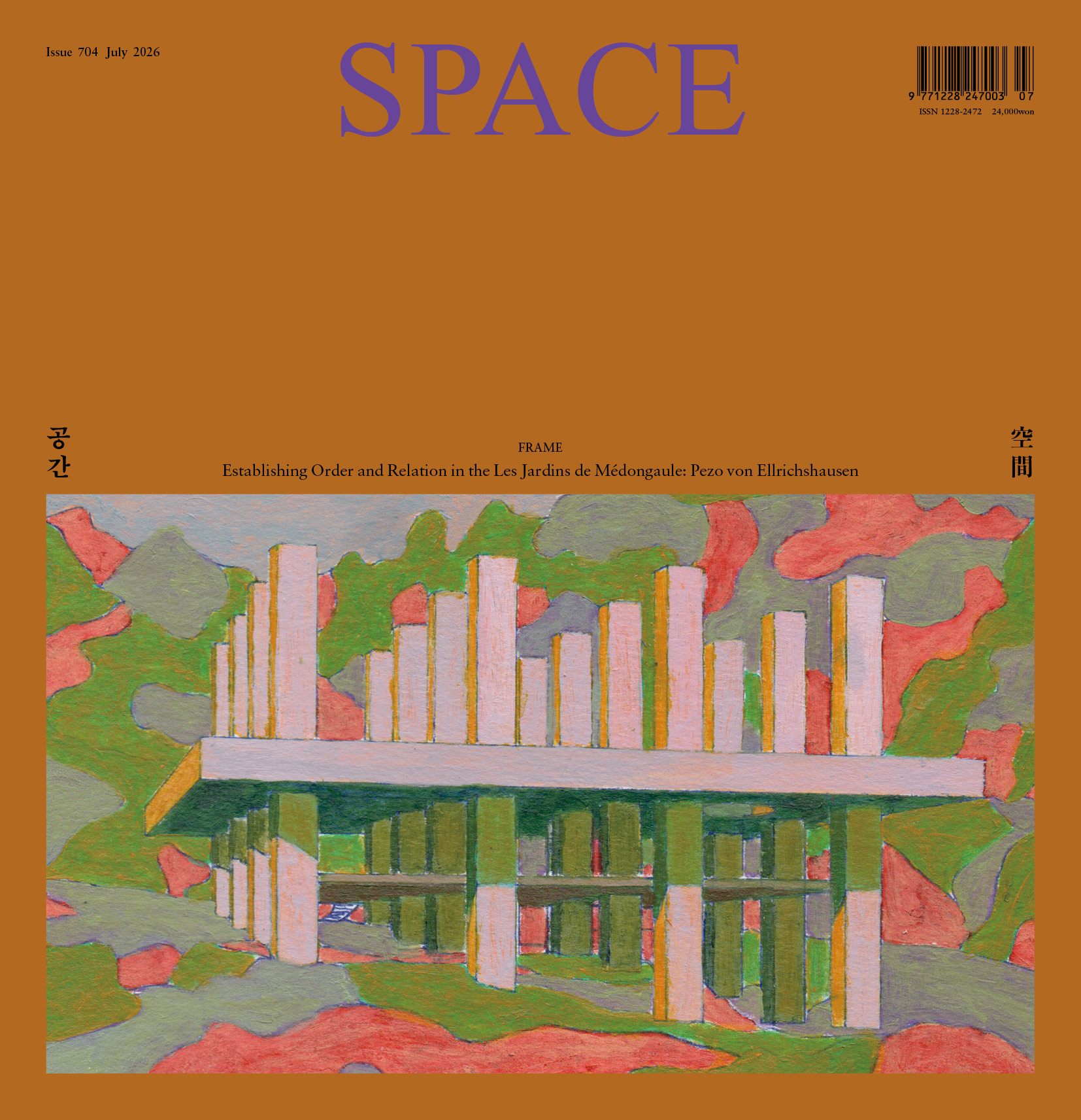

SPACE July 2026 (No. 704)
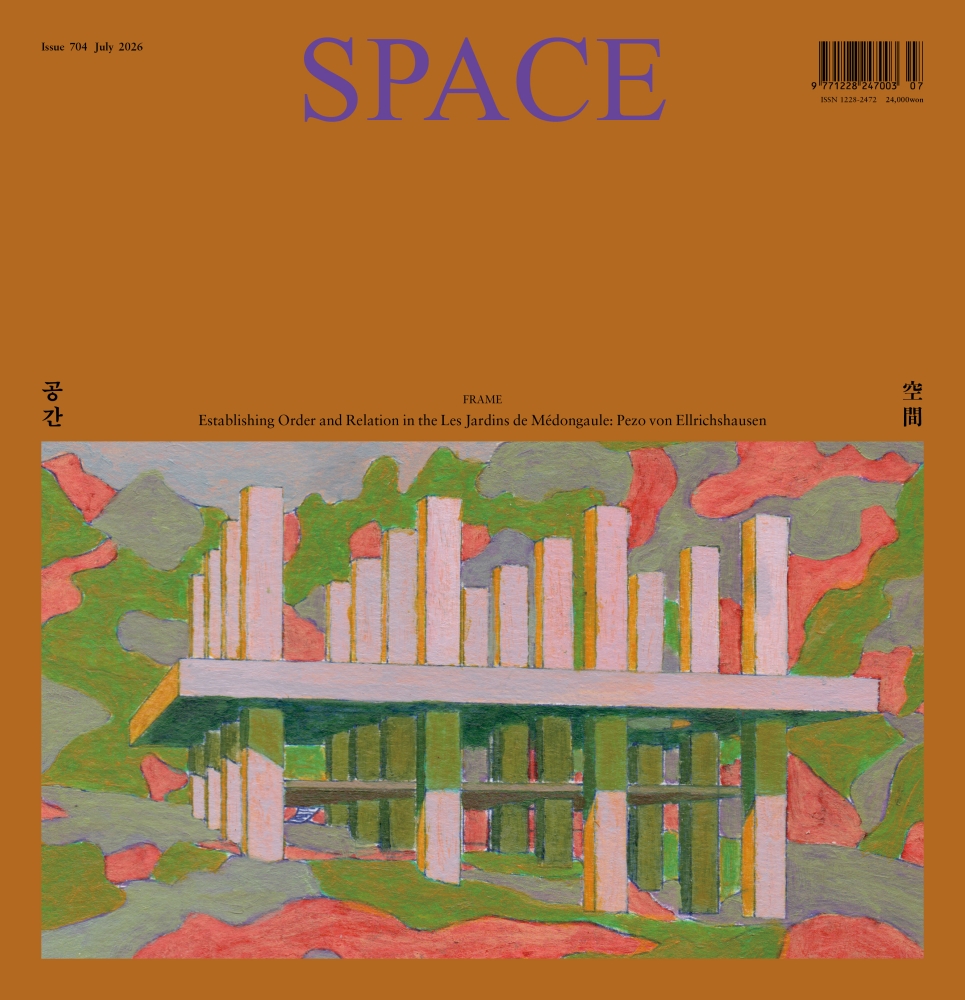
The Return of Meaning: Les Jardins de Médongaule and Pezo von Ellrichshausen
The Médongaule Contemporary Gardens, inspired by the philosophy of Nietzsche, have opened within Les Jardins de Médongaule in Yangpyeong. Envisioned as a humanities garden where architecture, art, and nature are united in harmony, Les Jardins de Médongaule continues to take shape through the contributions of architects and landscape architects. The Korean Gardens opened in September of last year, and the Médongaule Contemporary Gardens, which debuted this past June, are home to the REST (restaurant and outdoor theatre), several pavilions, PAIR(the residency building), BATH by Pezo von Ellrichshausen (Co-Principals, Mauricio Pezo, Sofia von Ellrichshausen). Dionysus (the visitor centre), designed by Ensamble Studio (Co-Principals, Antón García-Abril, Débora Mesa), is currently under construction.
The July issue of SPACE devote its FRAME section to the pavilions of Pezo von Ellrichshausen (hereinafter PvE) at Les Jardins de Médongaule. Recalling the archetypal idea of the garden as a threshold between culture and nature, the pavilion work of PvE ‒ a practice that has long explored architectural meaning through art ‒ commands particular attention. Given that efforts to infuse a place with an appreciation for the humanities have not always lived up to their promise, the work of PvE, widely regarded as an architect in philosophical dialogue with nature, reads as something singular.
The densely layered Médongaule Contemporary Gardens began with a master plan by landscape architect Guillaume Gosse de Gorre. PvE joined the project upon being commissioned to design the fountain POND at the garden’s entrance, and went on to conceive ‒ sequentially, and at times simultaneously ‒ the REST at the garden’s highest point and ten works. Each pavilion is linked by the PATH, yet the relationship between them remains loose, each absorbed in their own individual order. Among them is JARD, a work that exists only as a painting. This landscape painting is filled with some five thousand flowers native to the farm at the foot of the Andes in southern Chile, where the two architects live and work. Functioning as a kind of overture to the Médongaule Contemporary Gardens, the painting can be read as ‘an imaginary trip from America to Korea’. For PvE, drawing is a tool of thought no less significant than architecture with physical presence, and so painting and drawing have been due significance in this issue.
What immediately strikes the eye in their work is the clarity of geometric form: circles, squares, triangles. In conversation, PvE resisted the suggestion that their designs originate in geometry, yet their work consistently transforms the fundamental elements of architecture, columns, floors, walls, into pure geometric figures that yield a sense of the sublime. Consider JEUX, their interpretation of Saint-Exupery’s classic The Little Prince. Despite PvE’s claim that the work ‘avoids literal representation’, it is difficult not to read it: the concave form traces an invisible dotted line toward a perfect sphere, while the red marble conjures the desert. Phenomenological experience converges into metaphysical narrative. NIET, a labyrinth formed by six repeating circles, evokes ‘a continuous, organic, vital process without a single destination, without a single, definitive answer’—passing through Nietzsche’s language of amor fati.
Baek Jin (Professor, Seoul National University) writes that in an ‘age of production’ in which meaning has been steadily eroded, PvE’s work renews the question of geometry as architecture’s most elemental language—a cosmic proportion encoded in the human body: ‘Their geometry reawakens qualities that modern architecture has steadily sought to eliminate: the tension between building and ground, the damp and shaded realm beneath,
the sensation of gravity, and the buoyant feeling of ascending to the sky. They stand tall while accepting the ravages of climate and weathering. Rather than existing as autonomous objects detached from the world, they acquire meaning through an active dialogue with the earth.’ In this way, PvE’s ‘geometry imbued with meaning’ awakens our most primal senses, offering a rare occasion upon which to question human existence.
Kim Jeoungeun Editor-in-Chief
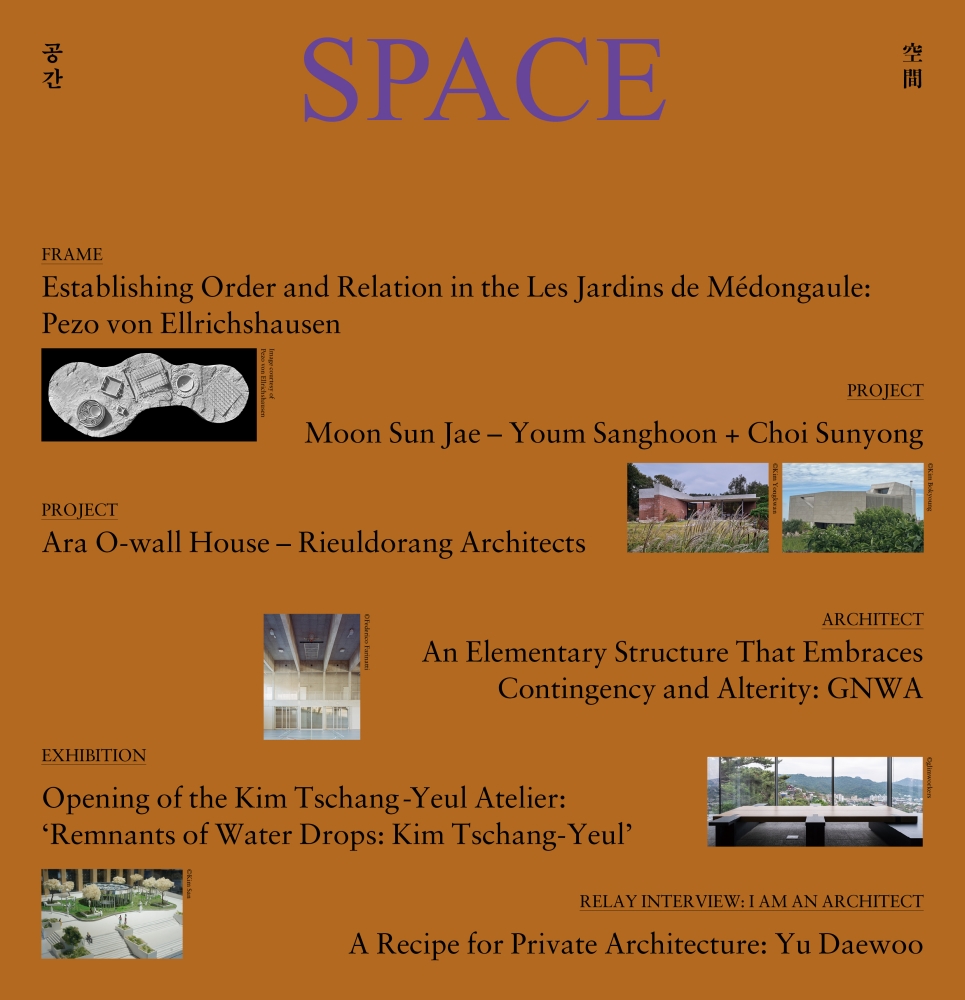
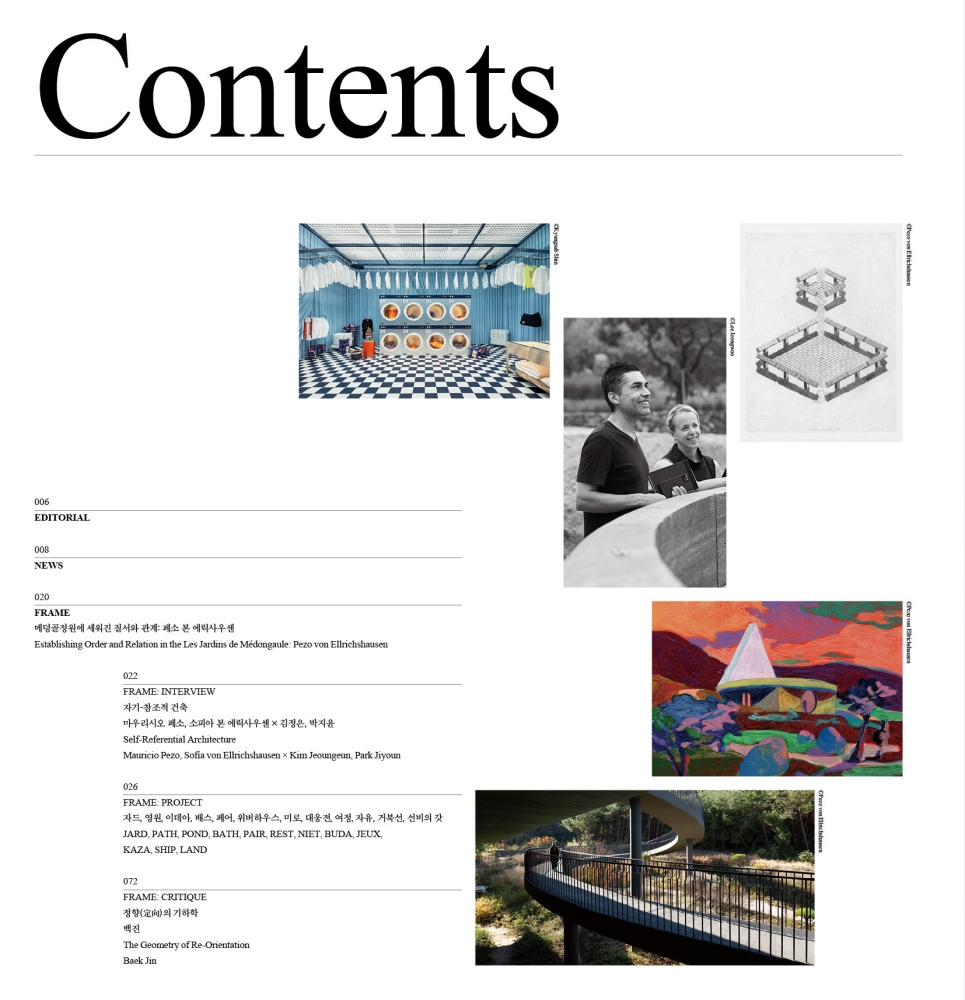
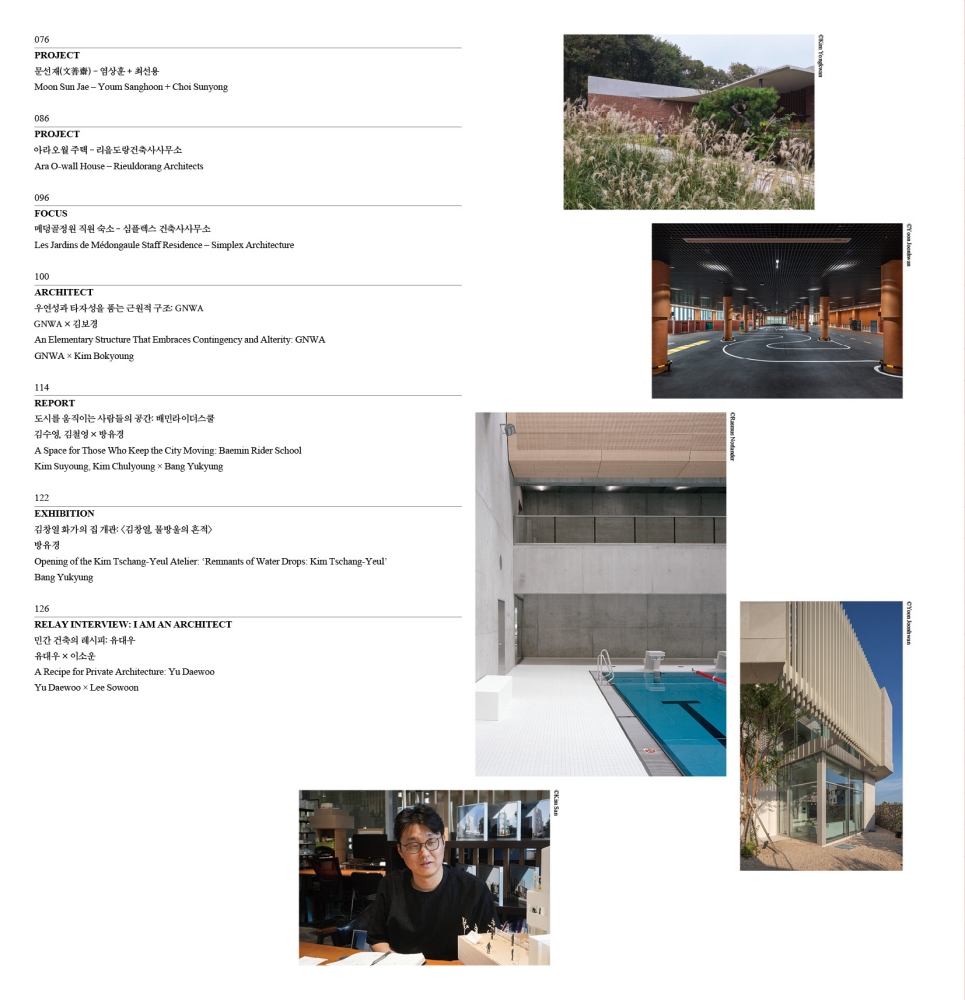
Contents | SPACE June 2026 (No. 703)
006 EDITORIAL
008 NEWS
020 FRAME
Establishing Order and Relation in the Les Jardins de Médongaule: Pezo von Ellrichshausen
022 FRAME: INTERVIEW
Self-Referential Architecture_ Mauricio Pezo, Sofía von Ellrichshausen × Kim Jeoungeun, Park Jiyoun
026 FRAME: PROJECT
JARD, PATH, POND, BATH, PAIR, REST, NIET, BUDA, JEUX, KAZA, SHIP, LAND
072 FRAME: CRITIQUE
The Geometry of Re-Orientation_ Baek Jin
076 PROJECT
Moon Sun Jae ‒ Youm Sanghoon + Choi Sunyong
086 PROJECT
Ara O-wall House ‒ Rieuldorang Architects
096 FOCUS
Les Jardins de Médongaule Staff Residence ‒ Simplex Architecture
100 ARCHITECT
An Elementary Structure That Embraces Contingency and Alterity: GNWA_ GNWA × Kim Bokyoung
114 REPORT
A Space for Those Who Keep the City Moving: Baemin Rider School_ Kim Suyoung, Kim Chulyoung × Bang Yukyung
122 EXHIBITION
Opening of the Kim Tschang-Yeul Atelier: ‘Remnants of Water Drops: Kim Tschang-Yeul’_ Bang Yukyung
126 RELAY INTERVIEW: I AM AN ARCHITECT
A Recipe for Private Architecture: Yu Daewoo_ Yu Daewoo × Lee Sowoon