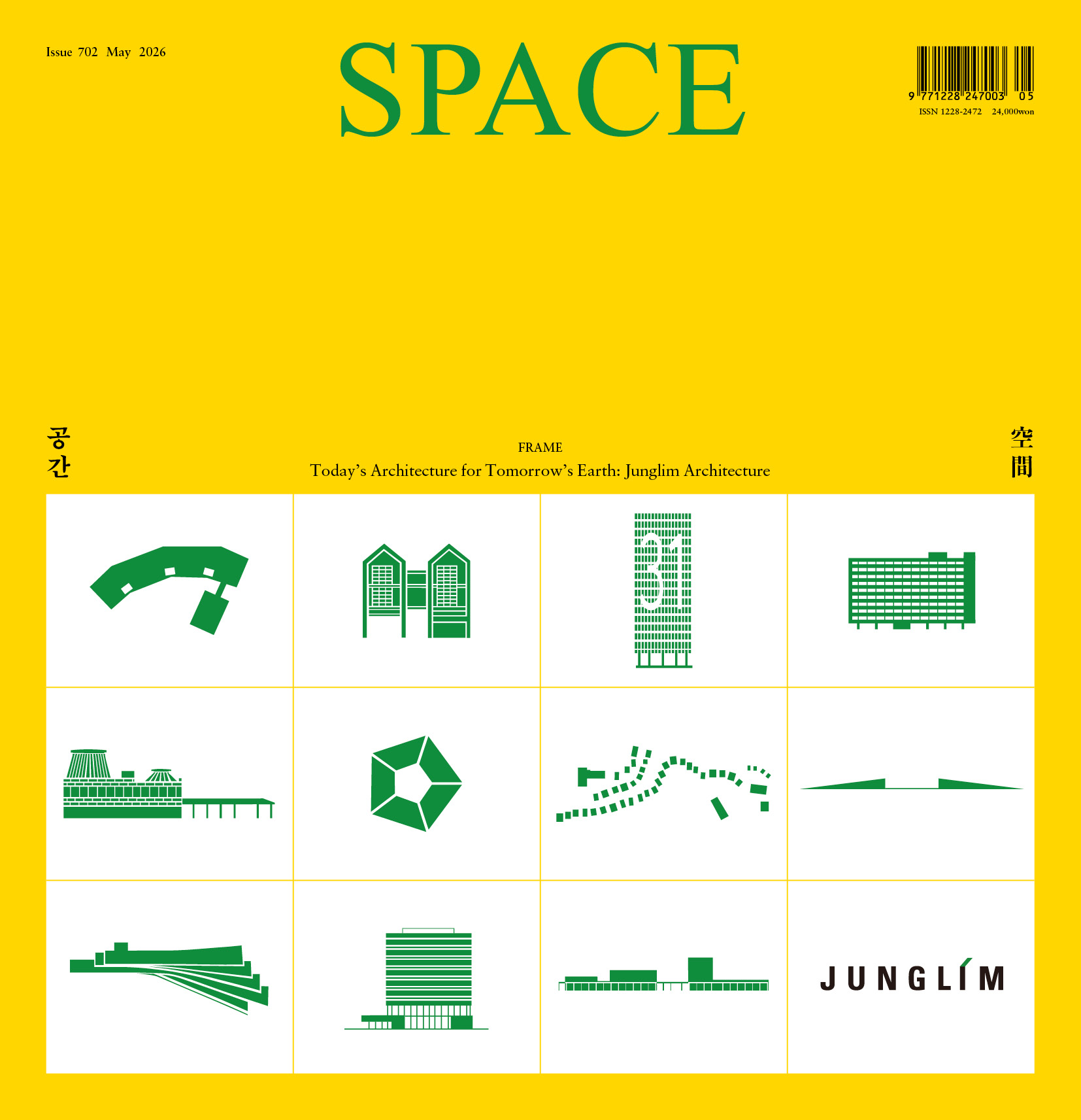

SPACE May 2026 (No. 702)
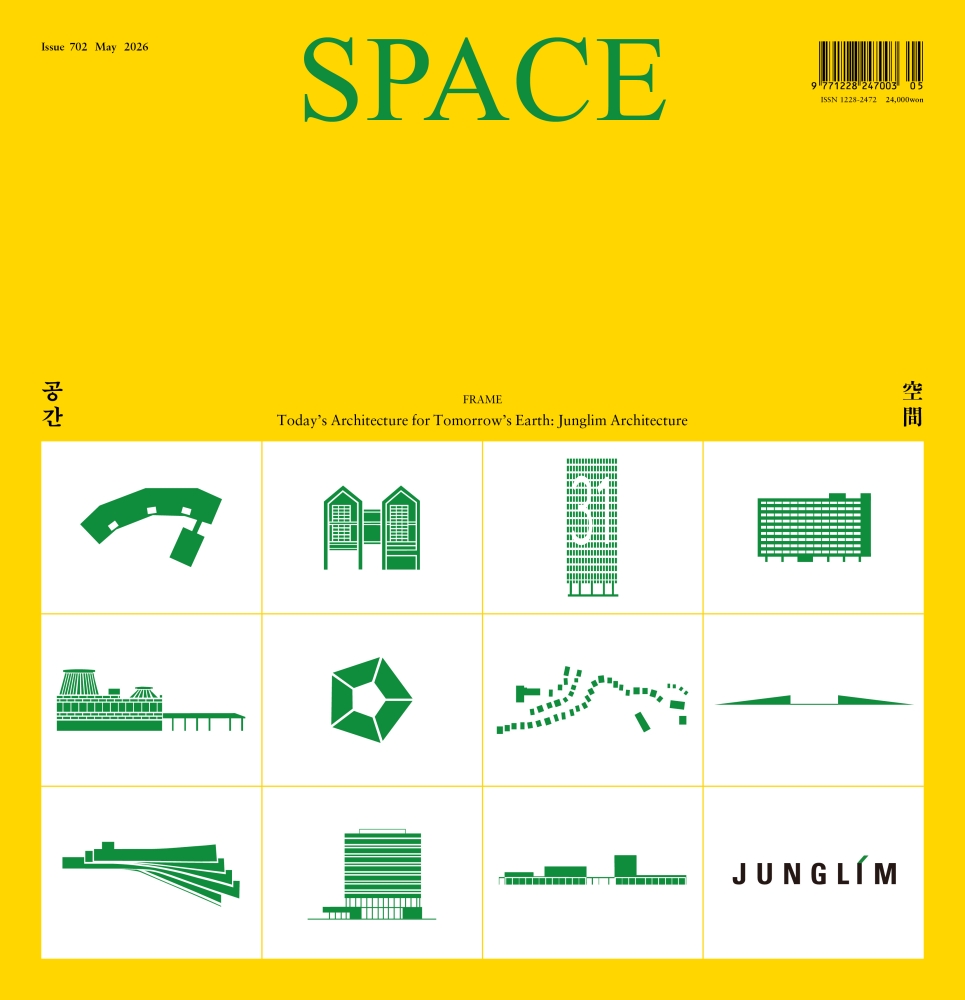
Junglim Architecture: At the Forefront of Change
In 2017, to mark the 50th anniversary of Junglim Architecture, SPACE published a special issue entitled ‘Ordinary Senses’. Focusing on the significance of the spaces created by Junglim Architecture that sit within the fabric of everyday life, the special issue traced the firm’s trajectory across four distinctive periods ‒ ‘Korean Modernism’ (1967 ‒ 1987), ‘The Age of Globalisation’ (1988 ‒ 1997), ‘The Senses of the City’ (1998 ‒ 2006), and ‘The 21st Century Public Space’ (2007 ‒ 2017) ‒ to chart its responsiveness to our shifting spatial environments. This issue’s FRAME feature, ‘Today’s Architecture for Tomorrow’s Earth’, extends that narrative by examining Junglim Architecture’s next chapter through the lens of ‘sustainability’. It also marks an occasion to affirm the place of sustainability at the centre of architectural practice today. Concepts that foreground environmental awareness ‒ sustainability, green design, ecological thinking, resilience ‒ already enjoy a broad global consensus, and architectural practice has responded in diverse ways. Championing these values is, in itself, nothing new. Whether they have translated into holistic, integrated application within Korea’s urban and architectural sphere, however, is a separate question. Since its founding in 1967, Junglim Architecture has helped drive state-led urban development and, riding the currents of globalisation, has taken leading roles across a wide spectrum—from public infrastructure and symbolic spaces to large-scale mixed-use developments and urban regeneration. This FRAME feature examines how the firm is making preparations and positioning itself in response to the societal imperative of the climate crisis, while also offering an opportunity to take stock of the realities and challenges faced by those on the front line of the architectural profession.
Junglim Architecture evaluates eleven projects through nine strategic lenses: Energy Performance, Low-Carbon Materials, Adaptive Reuse, Vernacular Design, Circular Design, Resilience, Underground Urbanism, Locality & Community, and Land & Ecology. In an accompanying roundtable, which brings together the architects behind each project, the discussion spans issues at every scale—from individual buildings through large-scale facilities to the urban dimension. Of these, the data centre projects stand out. This new building type born of the digital age is easily reduced to a matter of equipment and systems planning, yet advanced technologies such as artificial intelligence (AI) are already influencing the fields of architectural and urban planning. When the pace of technological change outstrips the speed of physical construction, what strategies can we adopt on the basis of ecological thinking? As large-scale buildings devoid of permanent human occupants increasingly claim space in the city, how should our human-scale conception of urbanism be reconfigured? Data centres are not the only provocation. Each of the nine solutions harbours fundamental questions of their own. When designing energy-minimising housing, what should the home of the future look like? Can eco-friendly materials coexist with aesthetic rigour? If we ask not only ‘how to build’ but also ‘how to disappear’, what are the values that architecture must hold on to? In sites of extreme land-use density, by what strategies can large-scale underground development unlock a city’s latent potential? And beyond a ‘sustainability’ premised on present environmental conditions, how do we give concrete form to resilience design that prepares for fifty or a hundred years hence—under the assumption that the planetary environment itself, through phenomena such as sea-level rise, may fundamentally change? The questions that Junglim Architecture’s collective intelligence lays open are, in themselves, the very process by which the architect’s role is being redefined—and a reminder that we already stand on the threshold of a new world.
Faced with these challenges, Nam Sangmoon (Principal, DAYPLACE) puts it this way: ‘Large design firms such as Junglim Architecture must diversify their portfolios ‒ which currently centre on new construction, such as urban mixed-use developments and new town developments ‒ to include urban regeneration, adaptive reuse, eco-friendly renovation and integrated environmental management services. The organisations themselves must also transform into project-based network structures commensurate with this shift, prioritising the improvement of their underlying structure over external growth.’ Within Junglim Architecture itself, this awareness has already reached the stage of implementation. According to Lee Myungjin (CEO, Advanced Design Division, Junglim Architecture), drawing on nearly twenty years of experience and data accumulated by the Green Tech (GT) team (established in 2009 as a eco-friendly team) the firm is, from this year onward, restructuring the processes of every major project through an environmental lens. Development of the corresponding manuals and research tools is proceeding in parallel. Structural change is not a declaration but a process. Junglim Architecture’s next one hundred years begin on that basis.
Kim Jeoungeun Editor-in-Chief
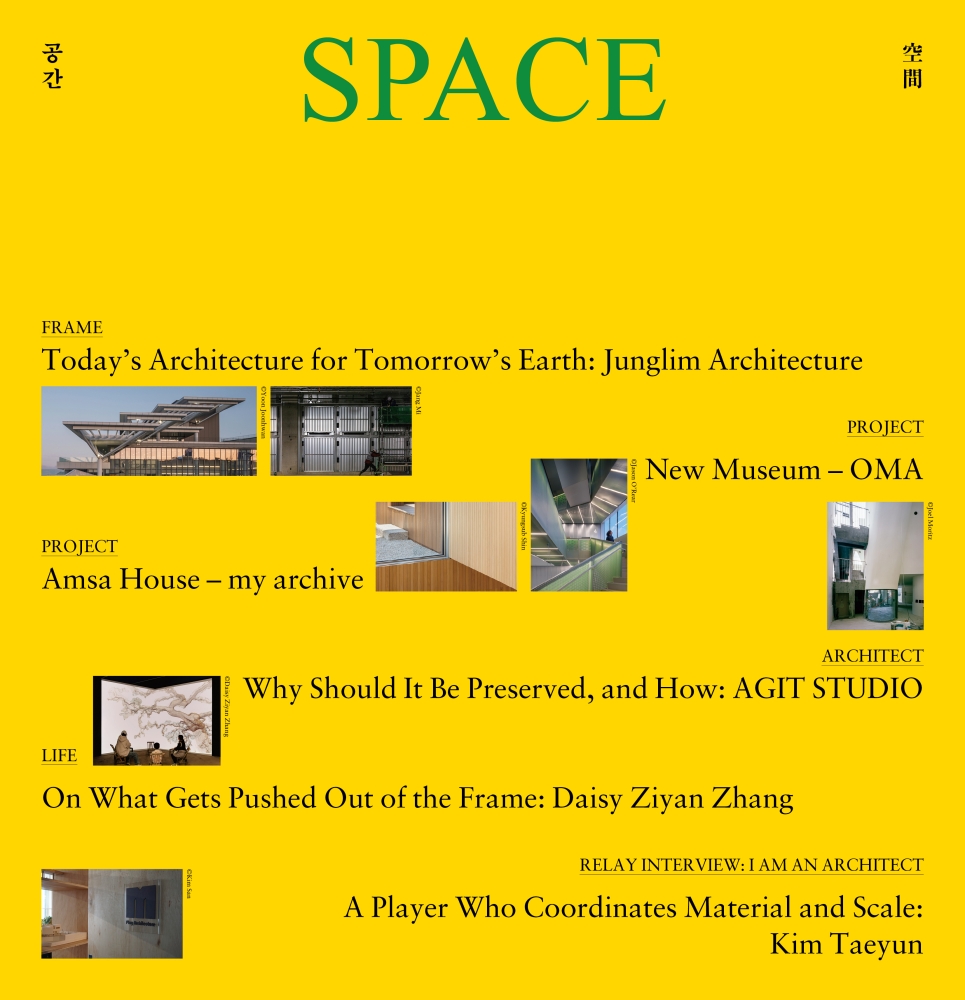
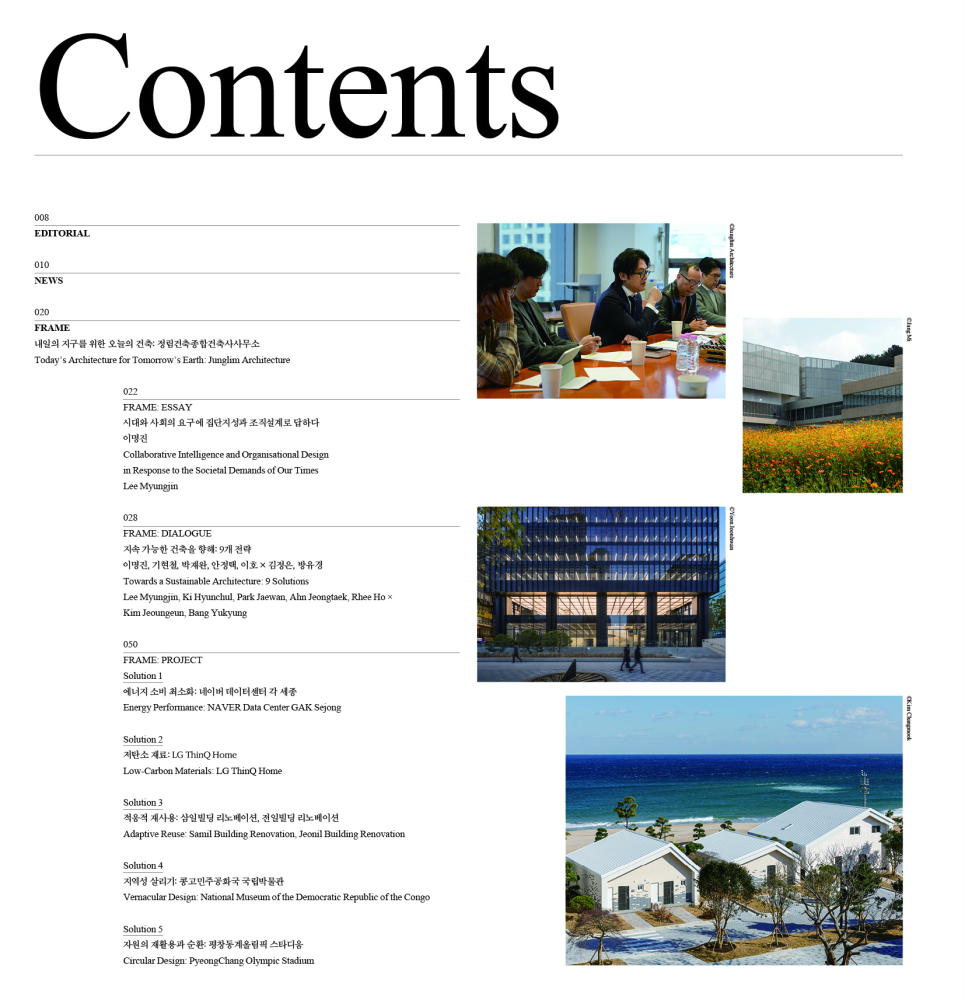
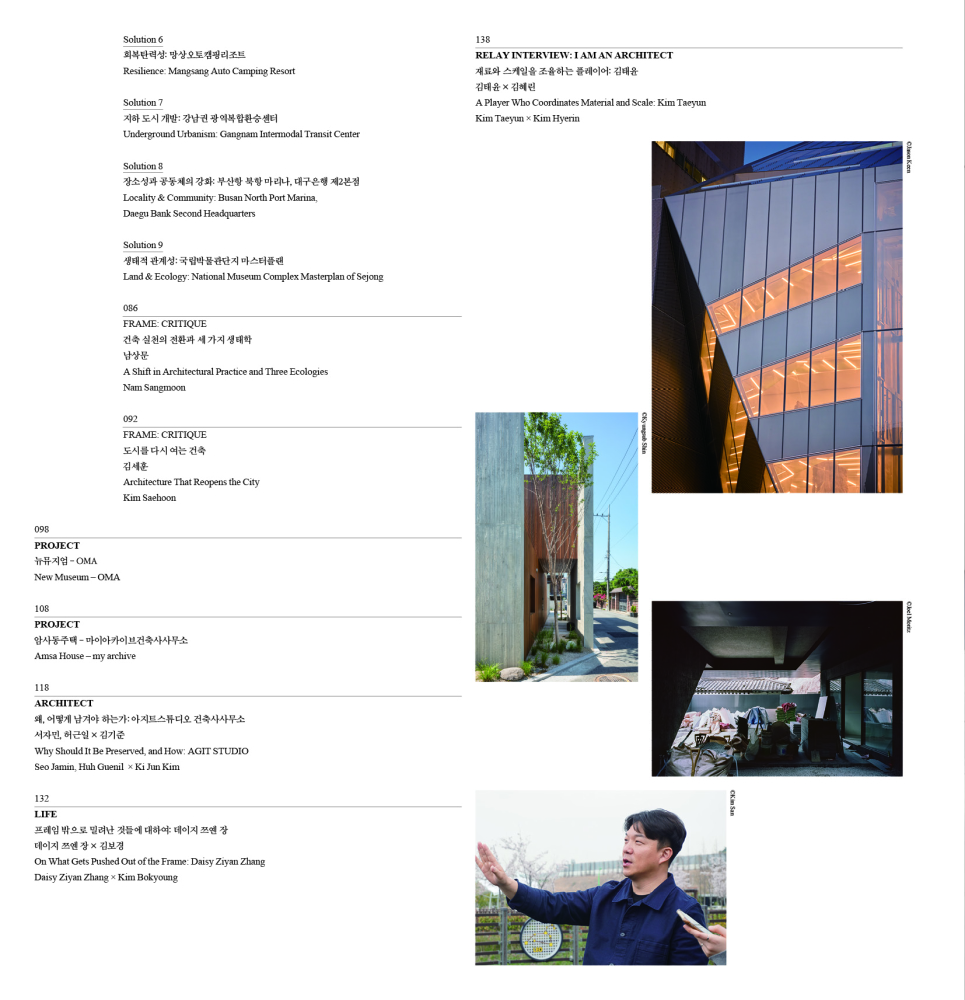
Contents | SPACE May 2026 (No. 702)
008 EDITORIAL
010 NEWS
020 FRAME
Today’s Architecture for Tomorrow’s Earth: Junglim Architecture
022 FRAME: ESSAY
Collaborative Intelligence and Organisational Design in Response to the Societal Demands of Our Times_ Lee Myungjin
028 FRAME: DIALOGUE
Towards a Sustainable Architecture: 9 Solutions_ Lee Myungjin, Ki Hyunchul, Park Jaewan, Ahn Jeongtaek, Rhee Ho × Kim Jeoungeun, Bang Yukyung
050 FRAME: PROJECT
Solution 1
Energy Performance: NAVER Data Center GAK Sejong
Solution 2
Low-Carbon Materials: LG ThinQ Home
Solution 3
Adaptive Reuse: Samil Building Renovation, Jeonil Building Renovation
Solution 4
Vernacular Design: National Museum of the Democratic Republic of the Congo
Solution 5
Circular Design: PyeongChang Olympic Stadium
Solution 6
Resilience: Mangsang Auto Camping Resort
Solution 7
Underground Urbanism: Gangnam Intermodal Transit Center
Solution 8
Locality & Community: Busan North Port Marina, Daegu Bank Second Headquarters
Solution 9
Land & Ecology: National Museum Complex Masterplan of Sejong
086 FRAME: CRITIQUE
A Shift in Architectural Practice and Three Ecologies_ Nam Sangmoon
092 FRAME: CRITIQUE
Architecture That Reopens the City_ Kim Saehoon
098 PROJECT
New Museum ‒ OMA
108 PROJECT
Amsa House ‒ my archive
118 ARCHITECT
Why Should It Be Preserved, and How: AGIT STUDIO_ Seo Jamin, Huh Guenil × Ki Jun Kim
132 LIFE
On What Gets Pushed Out of the Frame: Daisy Ziyan Zhang_ Daisy Ziyan Zhang × Kim Bokyoung
138 RELAY INTERVIEW: I AM AN ARCHITECT
A Player Who Coordinates Material and Scale: Kim Taeyun_ Kim Taeyun × Kim Hyerin