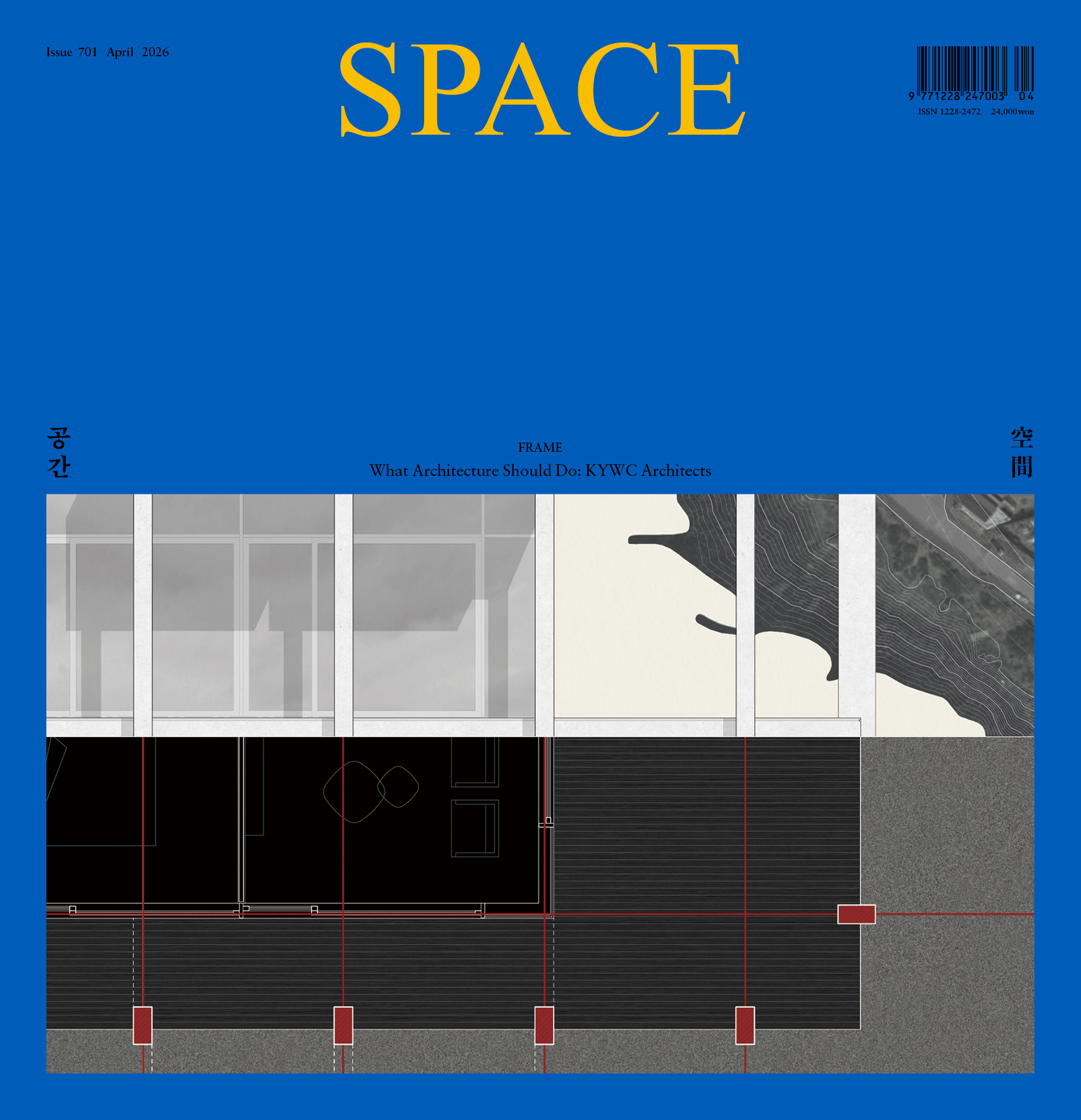

SPACE April 2026 (No. 701)
KYWC Trilogy
‘With this presentation, I feel I am finally saying everything I wanted to say to those I have mentored as architects.’ These are the words of Kim Seunghoy (Principal, KYWC Architects) at the outset of this FRAME feature. For Kim, who describes himself as not particularly sociable, publishing work in architectural journals is his way of engaging with society. ‘It is, in a sense, a trilogy.’; in 2020, he discussed the depth of the surface as a boundary that forms the relationship between interior and exterior in architecture (‘Depth of Surface, Potential of Space’, covered in SPACE No. 632). In 2022, he turned to ‘constructing’ ‒ that is, tectonics ‒ where structure and the finish become a unified environment responding to the city and the street (‘Construct ‘Constructing’’, covered in SPACE No. 658).
The April issue of SPACE focuses on four recent works by KYWC: ZYX Technology Office (2024), The Nature Holdings Office (2025), Seogwipo Samda Building (2024), and Sindori Workation Office (2024). What, then, does he seek to articulate in the final chapter of this trilogy? A small-scale office on a backstreet in Gangnam, Seoul; the headquarters of a global brand facing a major boulevard in Yongsan; a speculative office building fronting an urban plaza that could well accommodate a city hall; and a workation office set along a coastline frequented by dolphins. While differing in scale, site context, and user profile, these four projects all share a common programme: the office. Kim argues that the office ‒ an apparently neutral typology that ‘relatively, requires less direct intervention from the architect’ ‒ offers an apt condition for articulating an architecture that establishes order while generating difference. In this issue, under the theme ‘The Work of an Architect’, he reflects on the fundamental responsibilities that architects are summoned to uphold. This is concretised as the work of mediating between internal and external orders, distributing functions within space, and shaping the architectural pose through a responsive engagement with its surroundings. The themes Kim has developed through his so-called trilogy are most clearly revealed in his drawings. As he notes: ‘Taking this into consideration, the construction of a building takes shape on an architect’s desk. The construction was prepared in advance, devising a cross-sectional drawing of brick stacking, an elevation revealing the location of a form-tie, and a joint detail drawing explaining the assembly of steel frames […] It’s a kind of magic to reveal immaterial things such as land and programmes, laws and construction costs, and architects’ ideas as actual existences through bricks, concrete, and steel frames.’ (‘Construct ‘Constructing’’) As is well known, KYWC’s dense drawings are beautiful precisely because they render the architect’s thinking with such clarity. In particular, when one examines the section axonometric more closely, one can read the architect’s line of thought in a building—from the alignment between spatial organisation and structural system to the details inscribed into the architecture.
Founded in 1995, KYWC Architects has, over the past three decades, realised 150 completed projects, accumulating, in effect, 150 experiments. Although he continues to work with undiminished intensity, Kim has remarked that he approaches each publication with the urgency that ‘this may be the last,’ a sentiment that has deepened the editorial team’s sense of responsibility in bringing his reflections into print. To this end, we invited Choi Moongyu (Professor, Yonsei University), a long-time colleague and friend of Kim’s, who shares with him a similar trajectory across both education and practice, as well as an ongoing engagement with the role of the educator. The two travelled between Seoul and Jeju, engaging in extended conversations. Having followed Kim’s work closely since the early 2000s, Choi regards the defining qualities of his architecture very highly: the deft integration of diverse structural systems, the harmonious orchestration of materials, and a level of refinement achieved through meticulous detailing. At the same time, he focuses on the shifts evident in Kim’s recent work—the transition from a ‘visible tectonic’ to an ‘invisible tectonic’, and the increasingly legible references to classical architecture. Through this lens, Choi reads Kim’s trilogy as an instance of ‘late style’ ‒ one that resists the repetition of an established repertoire and instead seeks renewal ‒ ultimately guiding it toward an open-ended conclusion.
Kim Jeoungeun Editor-in-Chief
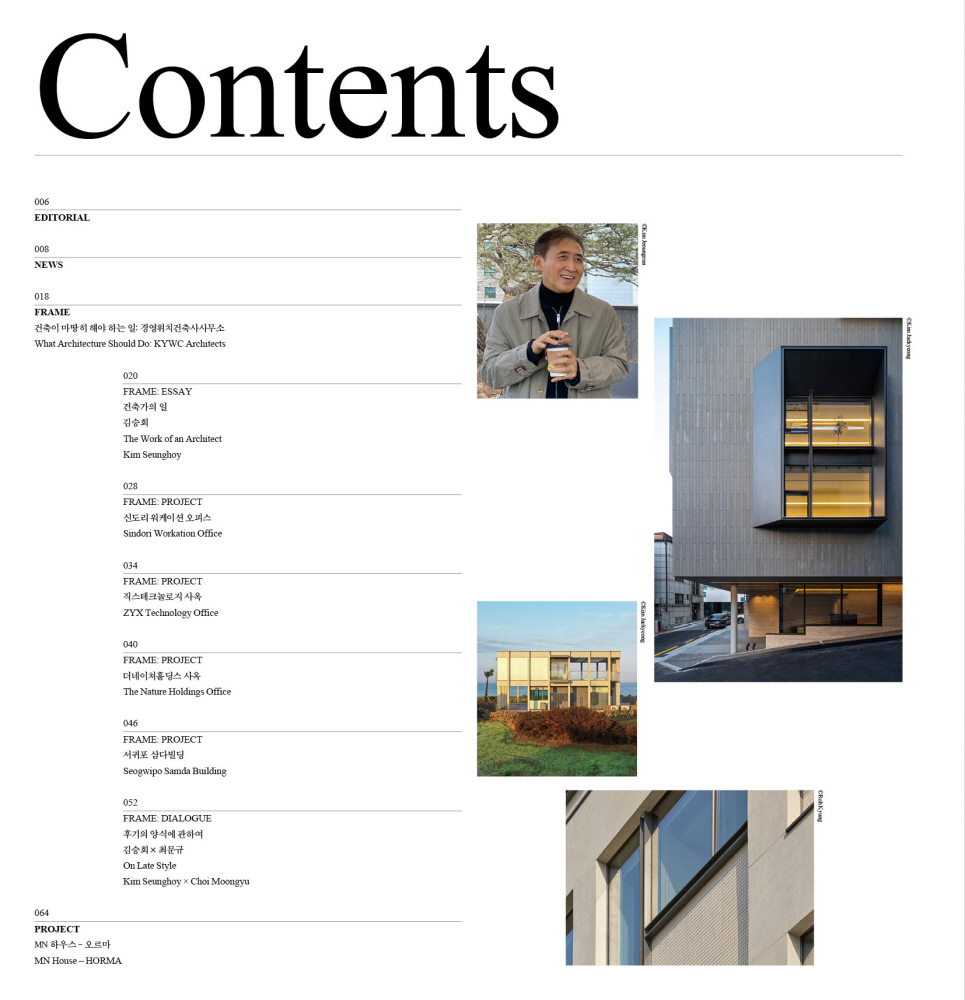
Contents | SPACE March 2026 (No. 700)
006 EDITORIAL
008 NEWS
018 FRAME
What Architecture Should Do: KYWC Architects
020 FRAME: ESSAY
The Work of an Architect_ Kim Seunghoy
028 FRAME: PROJECT
Sindori Workation Office
034 FRAME: PROJECT
ZYX Technology Office
040 FRAME: PROJECT
The Nature Holdings Office
046 FRAME: PROJECT
Seogwipo Samda Building
052 FRAME: DIALOGUE
On Late Style_ Kim Seunghoy × Choi Moongyu
064 PROJECT
MN House ‒ HORMA
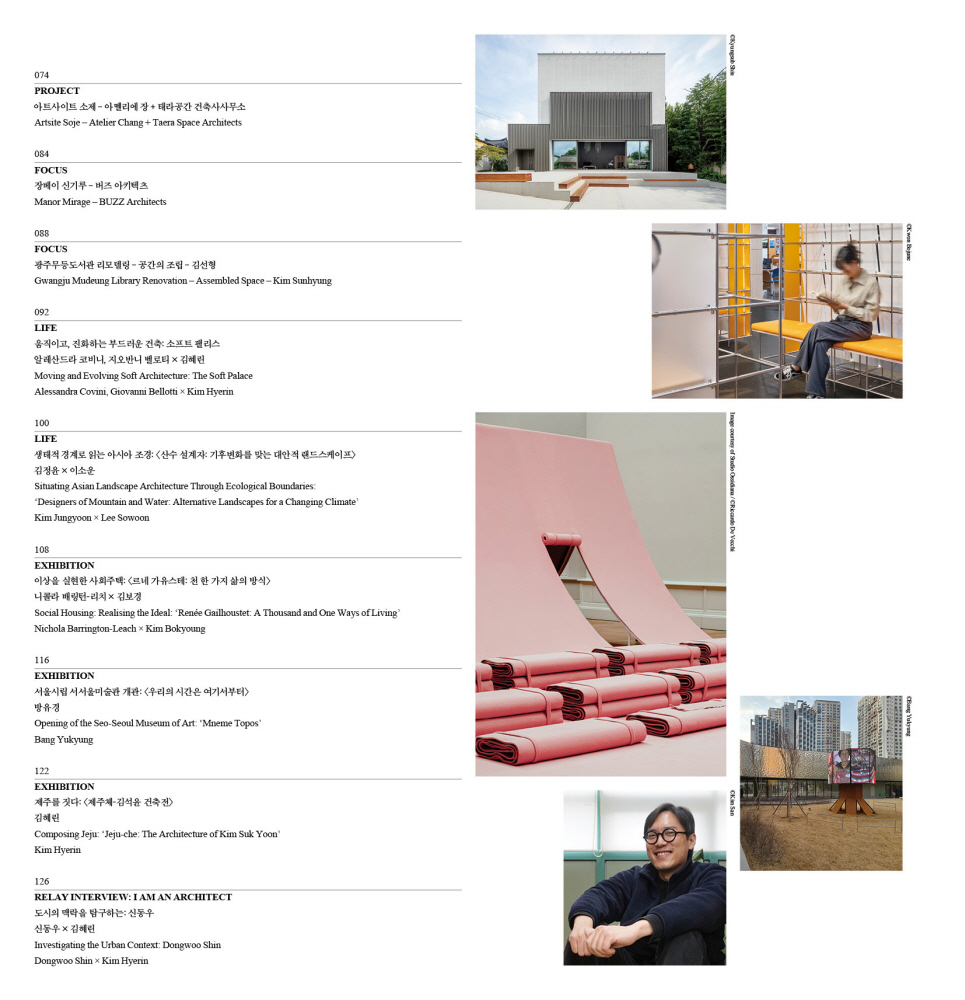
074 PROJECT
Artsite Soje ‒ Atelier Chang + Taera Space Architects
084 FOCUS
Manor Mirage ‒ BUZZ Architects
088 FOCUS
Gwangju Mudeung Library Renovation ‒ Assembled Space ‒ Kim Sunhyung
092 LIFE
Moving and Evolving Soft Architecture: The Soft Palace_ Alessandra Covini, Giovanni Bellotti × Kim Hyerin
100 LIFE
Situating Asian Landscape Architecture Through Ecological Boundaries: ‘Designers of Mountain and Water: Alternative Landscapes for a Changing Climate’_ Kim Jungyoon × Lee Sowoon
108 EXHIBITION
Social Housing: Realising the Ideal: ‘Renée Gailhoustet: A Thousand and One Ways of Living’_ Nichola Barrington-Leach × Kim Bokyoung
116 EXHIBITION
Opening of the Seo-Seoul Museum of Art: ‘Mneme Topos’_ Bang Yukyung
122 EXHIBITION
Composing Jeju: ‘Jeju-che: The Architecture of Kim Suk Yoon’_ Kim Hyerin
126 RELAY INTERVIEW: I AM AN ARCHITECT
Investigating the Urban Context: Dongwoo Shin_ Dongwoo Shin × Kim Hyerin