I was studying contemporary art when the retrospective exhibition of Gabriel Orozco, a Mexico-born artist, was held at the Museum of Modern Art in New York City. One afternoon, I rode the escalators to the top floor, the special exhibitions area. I was reading the exhibition description when I felt something at my feet. A crumbled shoe box. ‘Who would throw away a shoe box in an art museum?’ Confused, I walked into the exhibition hall where I found a caption: ‘Gabriel Orozco, Empty Shoe Box, 1993’. This roused new trains of thought as goosebumps appeared on my arms. The boundary lines concealed in the everyday have expanded. The line between artwork and waste has collapsed.
From a Space of Appreciation to a Garden of Engagement
At what point does our experience of an art museum begin? Once known as the treasuries or the burial tombs for collections, in the late twentieth century museums and art museums gained new identities
as spectacles and destinations in their own right through the incorporation of architecture and outdoor installations. Leeum Museum of Art features an architectural expo-like landscape created in 2004 by three wings, each designed by Mario Botta, Jean Nouvel and Rem Koolhaas. A monumental sculpture by a renowned artist, such as Alexander Calder, Louise Bourgeois, or Anish Kapoor, occupied the Outdoor Deck above the parking lot. These works functioned as landmarks that strengthened the monumental properties of the museum’s architecture and as thresholds to an uncommon (as opposed to everyday) experience of the art museum. Accordingly, the Outdoor Deck functioned as a platform or a pedestal for correspondence between the artwork and the surrounding environment. As a visitor would often require a certain distance from the work to properly appreciate its monumental verticality within the context of surrounding space, the Outdoor Deck was often considered a ‘background for art appreciation’.
A renovation of the Outdoor Deck, the ‘Gabriel Orozco Garden’, which opened this April, takes a step beyond the former functions of this outdoor exhibition space, emphasising the usability and publicness of the space. While this space retains its continuing role as ‘the first impression on an aesthetic journey’, the mode of experience is completely transformed. The garden moves away from the spatial narrative of monumental space and invites a change in perception through its unannounced horizontality that allows for the experience of the everyday. As the visitors actively intervene in the landscape and engage together in spatial revitalisation, the garden undergoes a spatial turn, becoming a space of transition, and acts as a new departure for an aesthetic engagement.
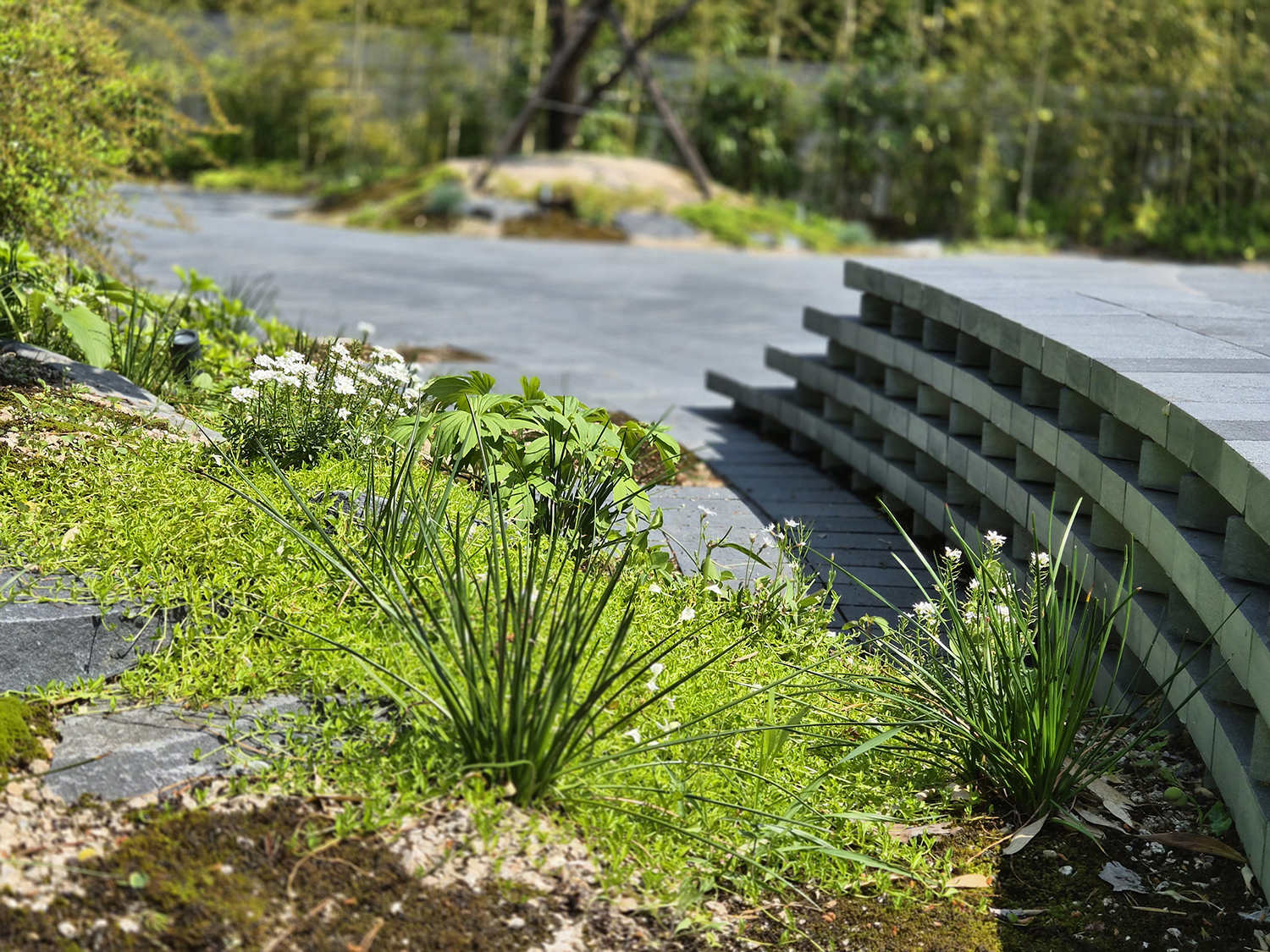
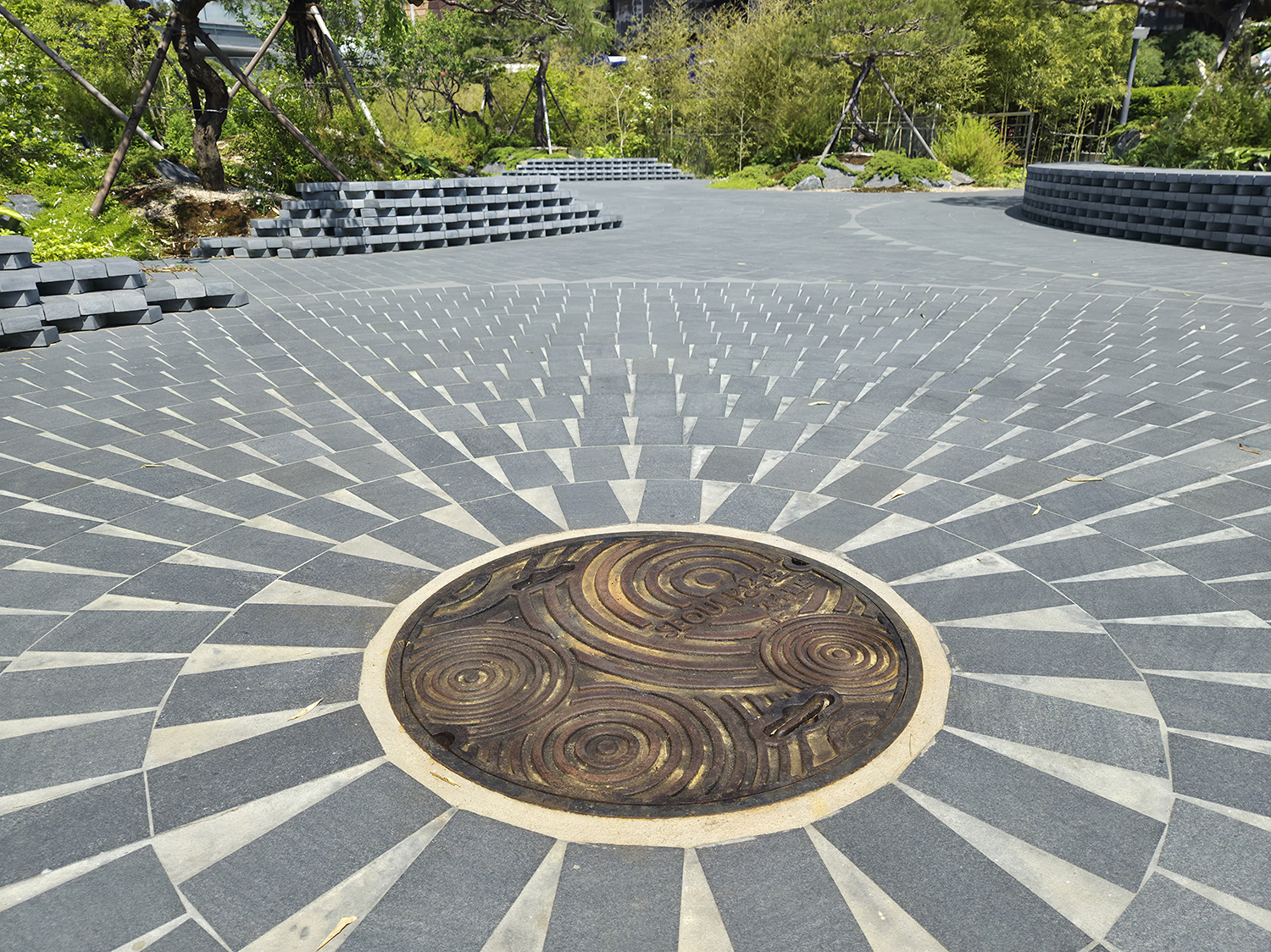
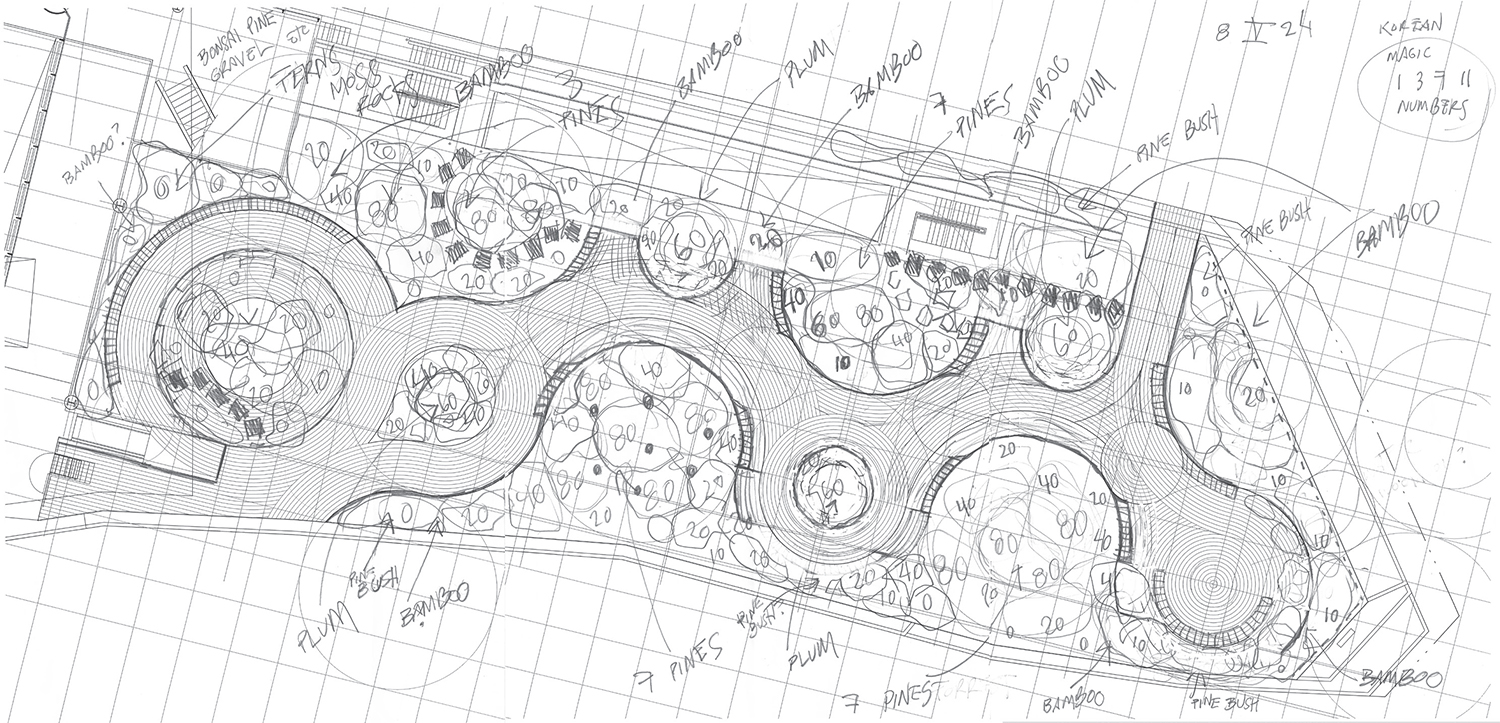
The Gabriel Orozco Garden is the first garden commission at Leeum Museum of Art, which is also a site-specific installation work and a horizontal sculpture. Within the catalogue of Orozco’s works, it is the third garden-sculpture project after the South London Gallery Garden (2016) and Chapultepec Park in Mexico City (2019 – 2025). The key element that shapes the forms and organises the spaces is the ‘circle’. In Orozco’s works, circles are adapted to offer a formal foundation that creates dynamism through serial composition, particularly in urban environments and everyday narratives. The circles are also dominant forms found in the garden at Leeum Museum of Art. Their vertical layering becomes a blueprint for ‘benches’ while their consecutive horizontal layout becomes the ‘pathway’. In addition, from the first circle (Plaza 1) to the last circle (Plaza 10), the planting scheme in the centre or at the periphery allows the visitors to view the garden from the comfort of eye level. While low hills in the planted areas are layered with trees, shrubs and ground covers that create an array of textures, the stone pavement emphasises the circular motion and connects the vegetal spaces seamlessly. Natural stones sourced from Boryeong, Chungcheongnam-do, have been cut to fit the curvilinear layout, placed carefully to form a circular pattern like ripples on the water’s surface. The low chroma of the pavement forms an image of a water stream flowing along a sylvan valley. This waterway metaphor reaches its apex with the manhole cover▼1 at the centre of Plaza 10. Replicating a Seoul Waterworks manhole, it is a mechanism that visualises the boundary between the everyday and the uncommon. A humorous, metaphoric insertion, this manhole cover is a found object that alludes to the artist’s early works, such as Yielding Stone (1992),▼2 which embodied the urban environment of the 1990s.
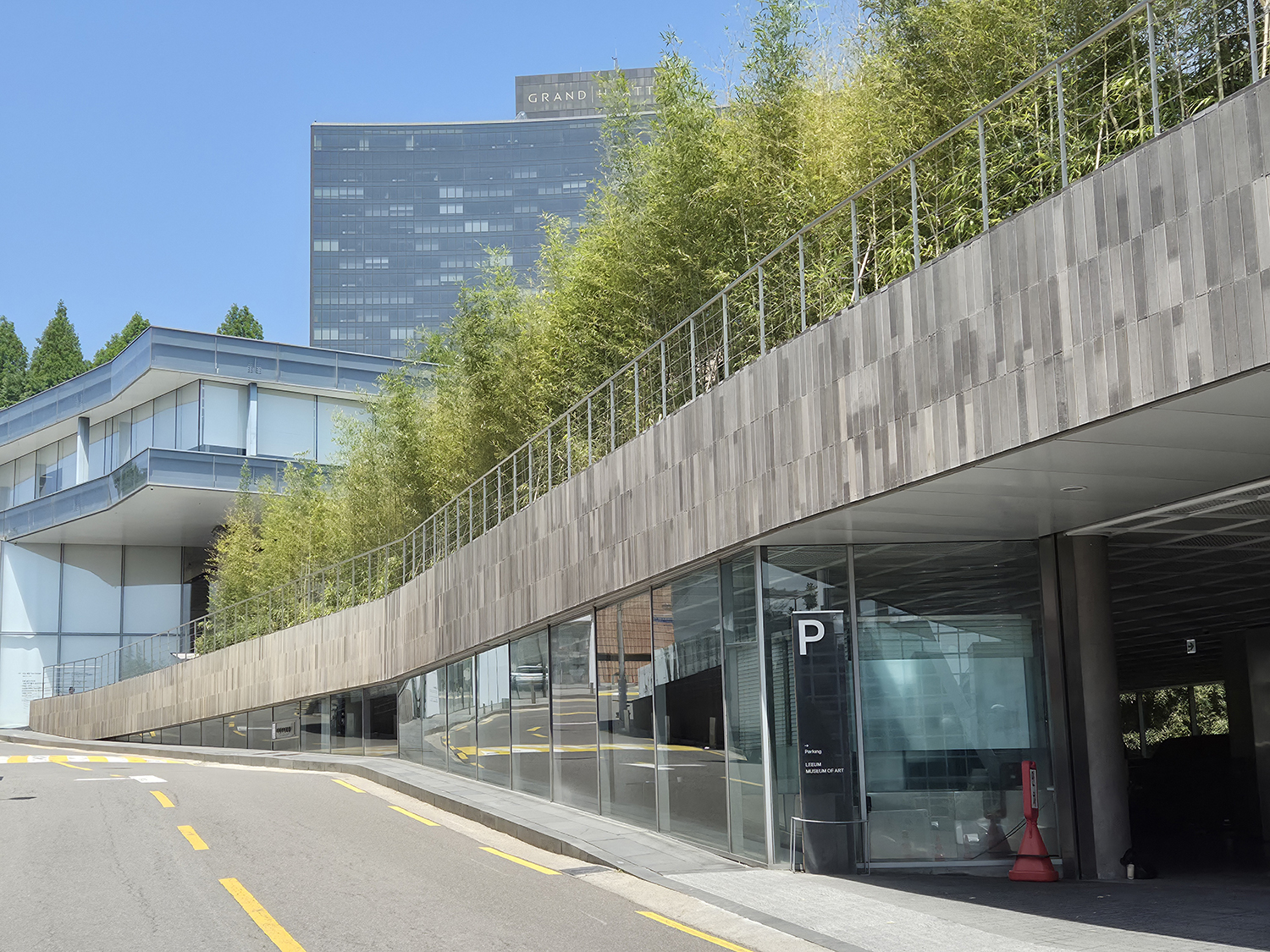
In the meantime, the previously installed jarrah decking boards on the Outdoor Deck have gained a new life. With their unique rippling textures, boards reused to fit the outer walls of the museum entrance way below the garden extend the comforting atmosphere of the garden to the pedestrian street. The attempt to conceive of a sense of ‘temporality’ through the reuse of architectural remnants, prompting memories of this site while presenting the boundary zone – the Gabriel Orozco Garden, the entrance deck and the pedestrian entrance way – as a new museum space. In addition, the provision of unoccupied space, a satiating void, in a high-density urban fabric, allows the museum to form a more public urban landscape. The affinity with the urban environment is a fundamental approach that relates to forms and meanings in Orozco’s works. For example, Home Run, an installation work from 1993, where buildings across the Museum of Modern Art were invited to leave oranges on their windowsill, demonstrated how the artist turns the threshold between the public and the private into an artistic narrative. The embodied boundaries are visualised, turning the everyday into an uncommon experience. As Orozco refrains from studio practice and ventures to the site-specific qualities of cities for inspiration, the artist’s artworks are realised through local collaborations. A well-known example is his collaboration with a local advertisement company to create the Light Sign series (1995) for The 1st Gwangju Biennale. In 2016, for the South London Gallery Garden, Orozco collaborated with 6a architects and gardeners from the Kew Gardens to create an English garden; similarly, for the Gabriel Orozco Garden at Leeum Museum of Art, the artist turned once again to collaborative synergy to capture a Korean atmosphere. The fact that the artist noted Heewon, a Korean garden by landscape architect Jung Youngsun, as the most memorable garden in Korea, is also noteworthy. The ambience of a Korean Garden is difficult to articulate into specific elements. Aesthetic qualities that balance nature with the artificial through vegetation, facilities, and environmental conditions influence the garden’s overall mood. Despite the geometric motif in the pavement and Jean Nouvel’s architectural façade in the background, this garden evokes an atmosphere that can be described as Korean; as the artist notes, this is made possible by the collaboration of architects and landscape architects in Korea▼3 who were responsible for the site’s construction. For example, the low hills in each plaza and the surrounding vegetation space supplement the soil depth for planting. The plazas that occupy the central area of the garden demonstrate simplicity; in contrast, the plaza near the garden edge features wild plants native to Korea, such as Thunberg’s Meadowsweet, which drape their branches over the grass and moss beneath. Enclosing the garden, the bamboo trees are planted in intervals that form a green screen without entirely obstructing the urban landscape behind the fence. This balanced planting technique forms sylvan layers and topographical flow that reconstructs the relationship between the vegetation and the facility, and the urban environment and the garden. This, in turn, forms a contextual connection with Korean gardens that emphasise the existing topography and natural conditions.
Gabriel Orozco’s plan sketch
The approach to the Leeum Museum of Art. Above the wall (plinth), finished using reclaimed timber from the existing Outdoor Deck lies the Gabriel Orozco Garden, whilst the parking lot is situated below. Photo by Bang Yukyung
Winter Landscape with the Three Friends of Winter
Structurally, the rooftop of a parking lot, the large void beneath the surface, is difficult to imagine once one steps into the Gabriel Orozco Garden. The series of bamboo along the garden’s edge, facing the road, creates an enclosure, while the pines and the plum blossoms soar from each Plaza, leading one to recognise the ground surface as ‘earth’. During the interview, Orozco noted that ‘we need to create earth’ in the city, further insisting that gardens should offer ‘intimacy with nature’. As a city is often composed of artificial environments, such intimacy depends on the sense of nature mediated through the materiality and the metaphor of the garden; the origin of such sense in this garden can be found in the planting concept, ‘Three Friends of Winter (Se-Han-Sam-Woo; 歲寒三友)’. Three Friends of Winter refers to three tree species: bamboos, pines, and plum blossoms. They have been adopted to symbolise fidelity and integrity in Confucian traditions, used as motifs in paintings and poetry for centuries. To draw attention to this imagery, the florals were selected according to a limited colour palette inspired by ‘winter’. Those that produce white flowers, such as Sargent Viburnum, Thunberg’s Meadowsweet, Wild Rose, Japanese Aster, and Grass of Parnassus, are planted on the Plaza hills to evoke a winter scenery (歲寒). The metaphor of trees growing amid the hills filled with white flowers entices the visitors to imagine a snowy valley even during the summer.
A Public Garden, A Museum Front Yard Considering that the modern and contemporary museums break down the barriers and expand the space through collaborations, the Gabriel Orozco Garden is part of the art museum’s attempt to introduce new forms of art to the public. The adaptation of a ‘public garden’ as a transitional space that can activate the boundary between the urban everyday and the uncommon experience of the museum is also noteworthy. For the visitors and the public alike, the transformation of the underused deck into a garden will feel as if the museum space has expanded. As it is located in front of the museum, the garden has the potential to stage new genre art such as performance and participatory art. Considering that a plethora of museums and art museums have developed their public quality using the façade plaza as the physical space, the Gabriel Orozco Garden makes one wonder about how its opening will encourage shifts in the museum’s relationship with the public, including between the visitors and the urban environment.
1 Gabriel Orozco notes that he found the waterworks manhole cover while walking around the city of Seoul in preparation for this garden project. He recognised the object as a symbol capable of portraying his metaphor concerning ‘water’ and ‘circles’ in the garden. As it was modeled to look exactly like an actual manhole cover and installed in Plaza 10, there were some visitors who, in fact, mistook it for a functional manhole cover. It can be described as ‘a found object’ that portrays the characteristic of the artist’s works that erode the boundary between the everyday and the uncommon.
2Yielding Stone is an early work by Gabriel Orozco that encapsulates his life and artistic practice. He created a plasticine ball of 62kg, the same as his weight, and rolled it around the streets of Manhattan. Afterwards, the distorted, grimy ball was photographed and exhibited. Born in Mexico, the artist moves from one city to another without a stable studio. Instead of moving the materials around, he works internationally, preferring to create with the found objects from each city. Yielding Stone demonstrates the connection between reality and movement through the metaphor of the body and sculpture while narrating the relationship between the world and the artist.
3 Landscape design and construction by Cho Hyeryeong, landscape architect, and Gram Design; architectural design and bench designs by Principal Kim Jakyung and Kang Seungyeon from Ondo Project Architects.
You can see more information on the SPACE No. June (2026).
Shin Myungjin
Shin Myungjin studied art history at New York University and landscape architecture at Seoul National University. She is currently working as a researcher at the Environmental Planning Institute, exploring the confluence of landscape architecture, art and city. She recently compiled and translated, Frederick Law Olmsted’s records, titled Birth of a Park, into Korean.




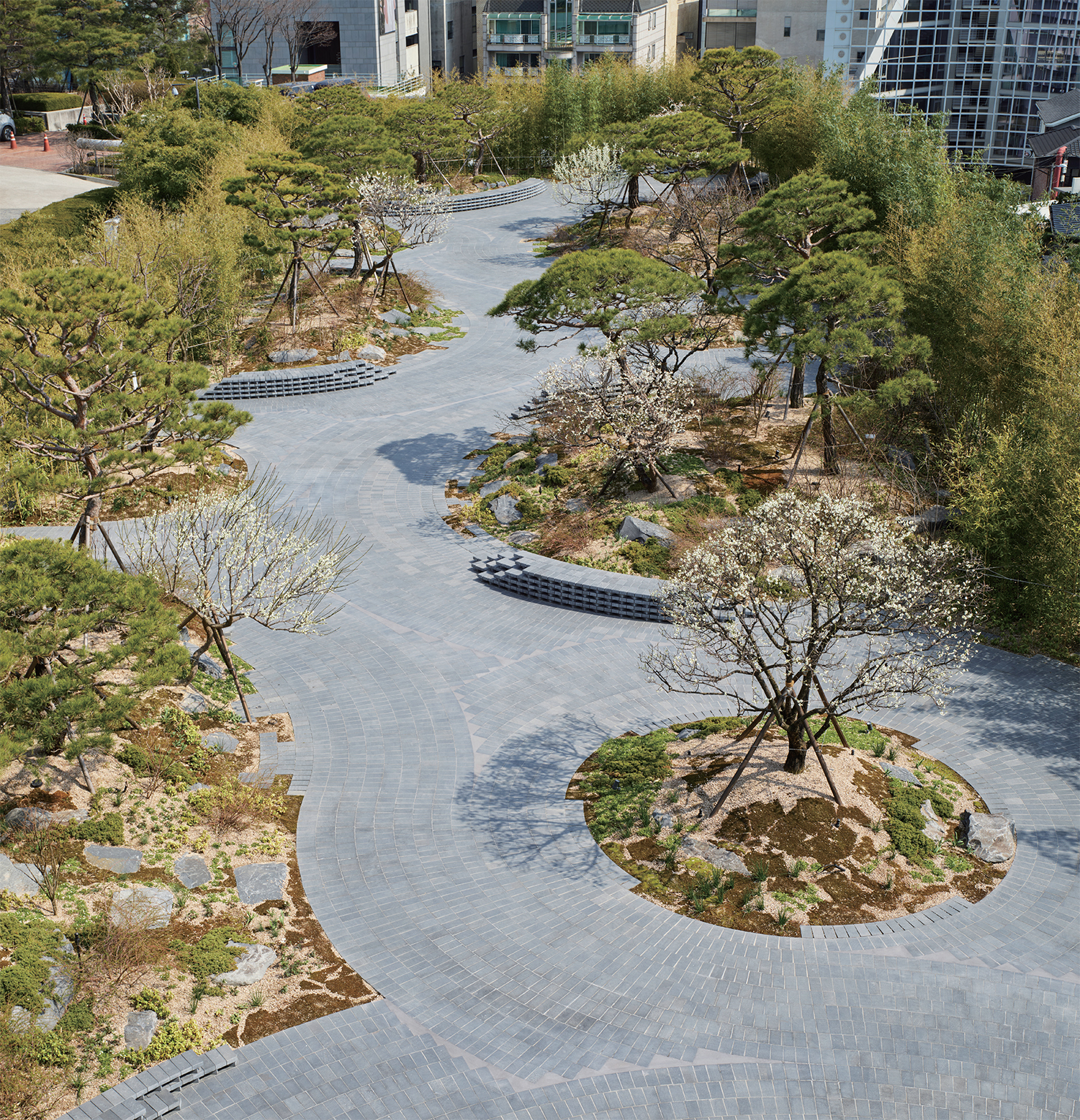
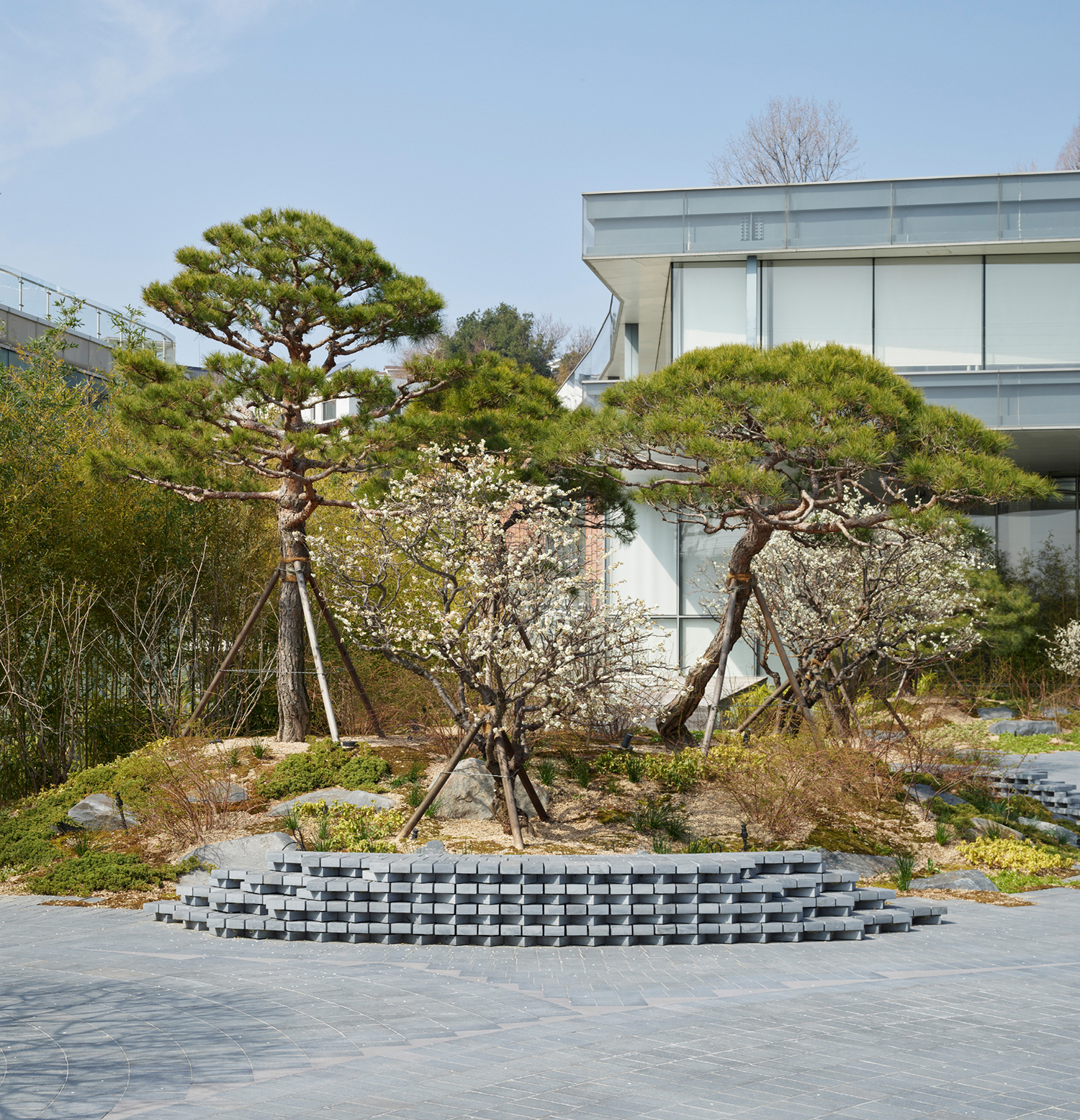
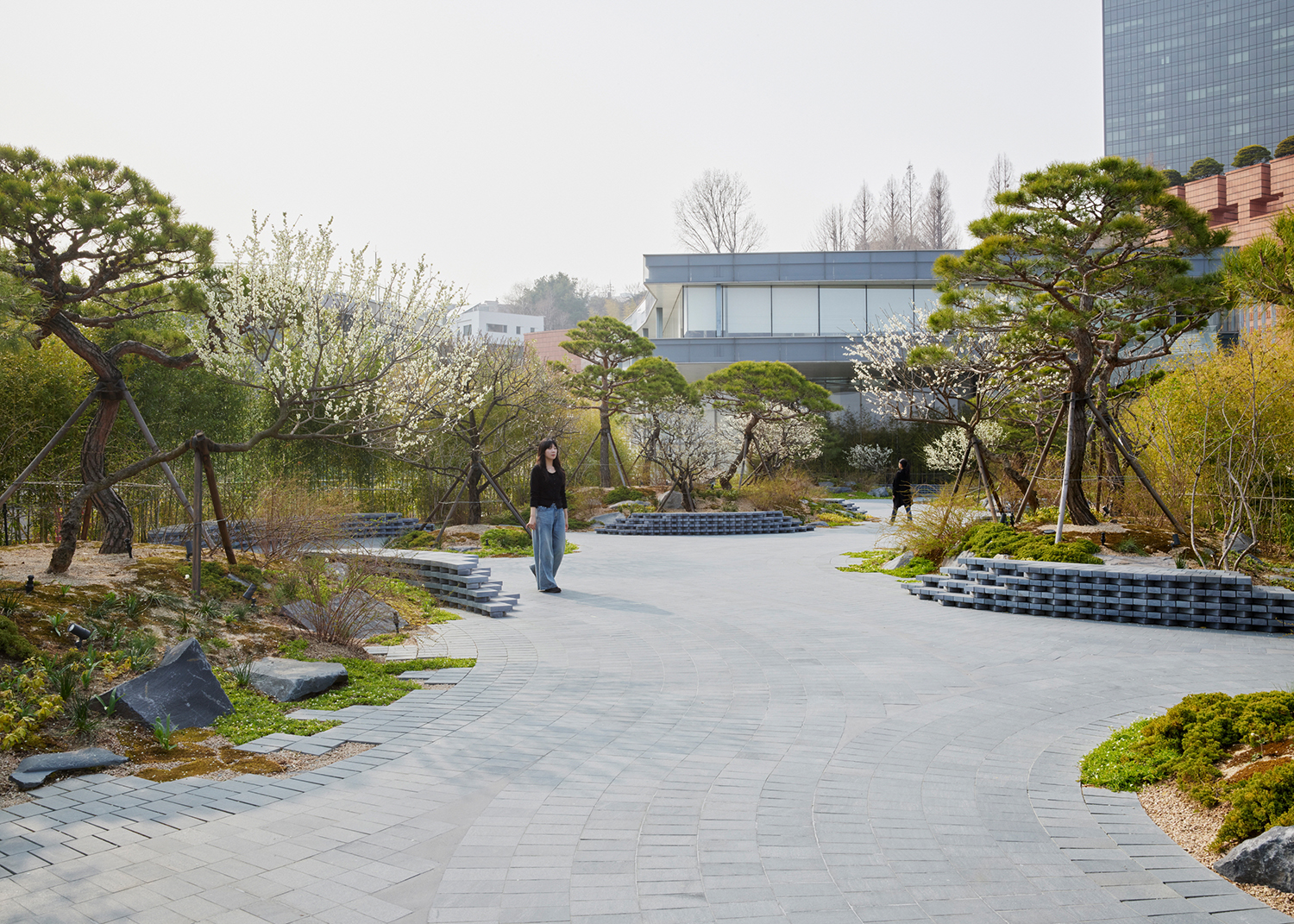 A view of the western side of the garden ©Gabriel Orozco / Photo by Chung Heeseung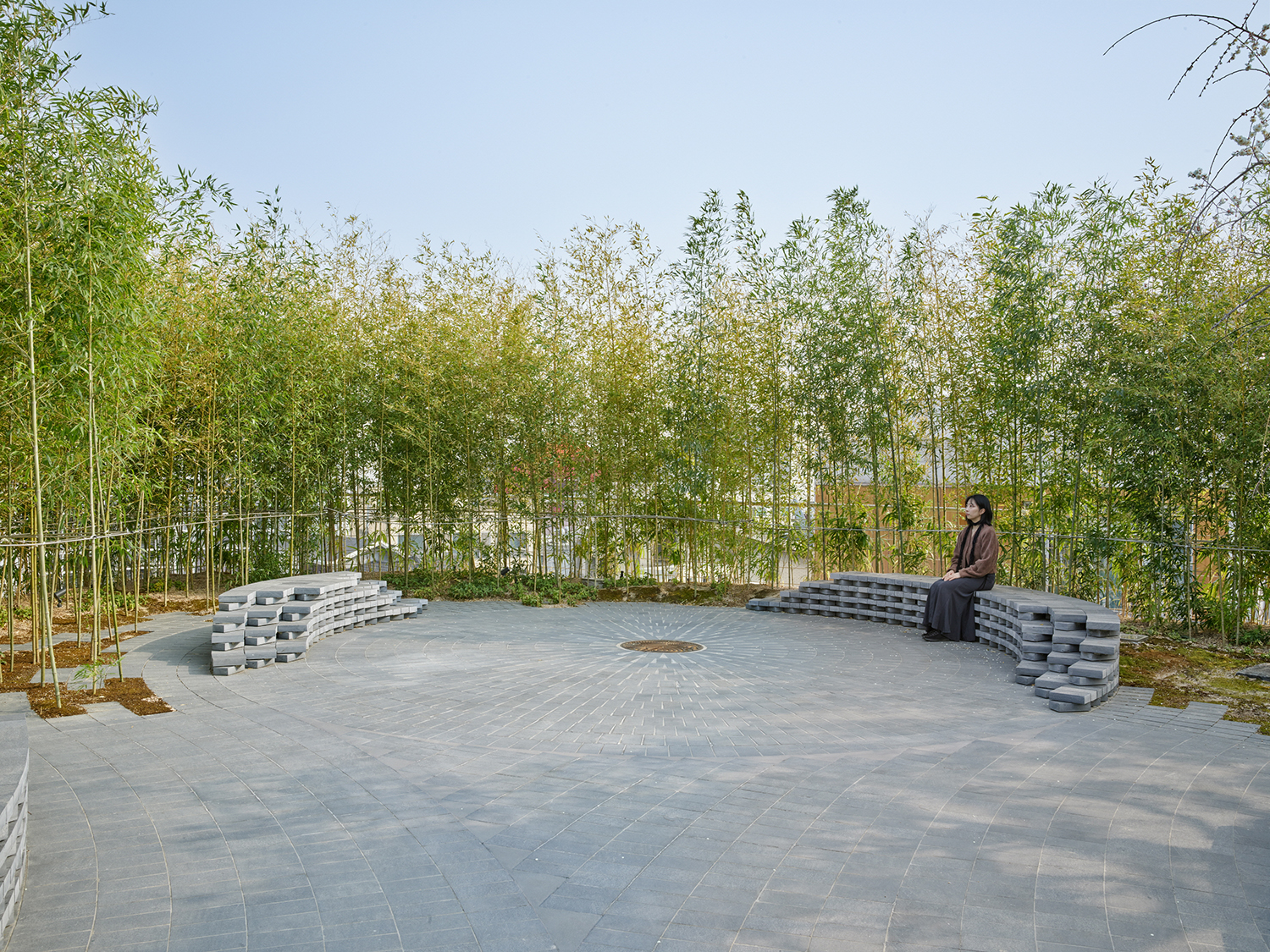
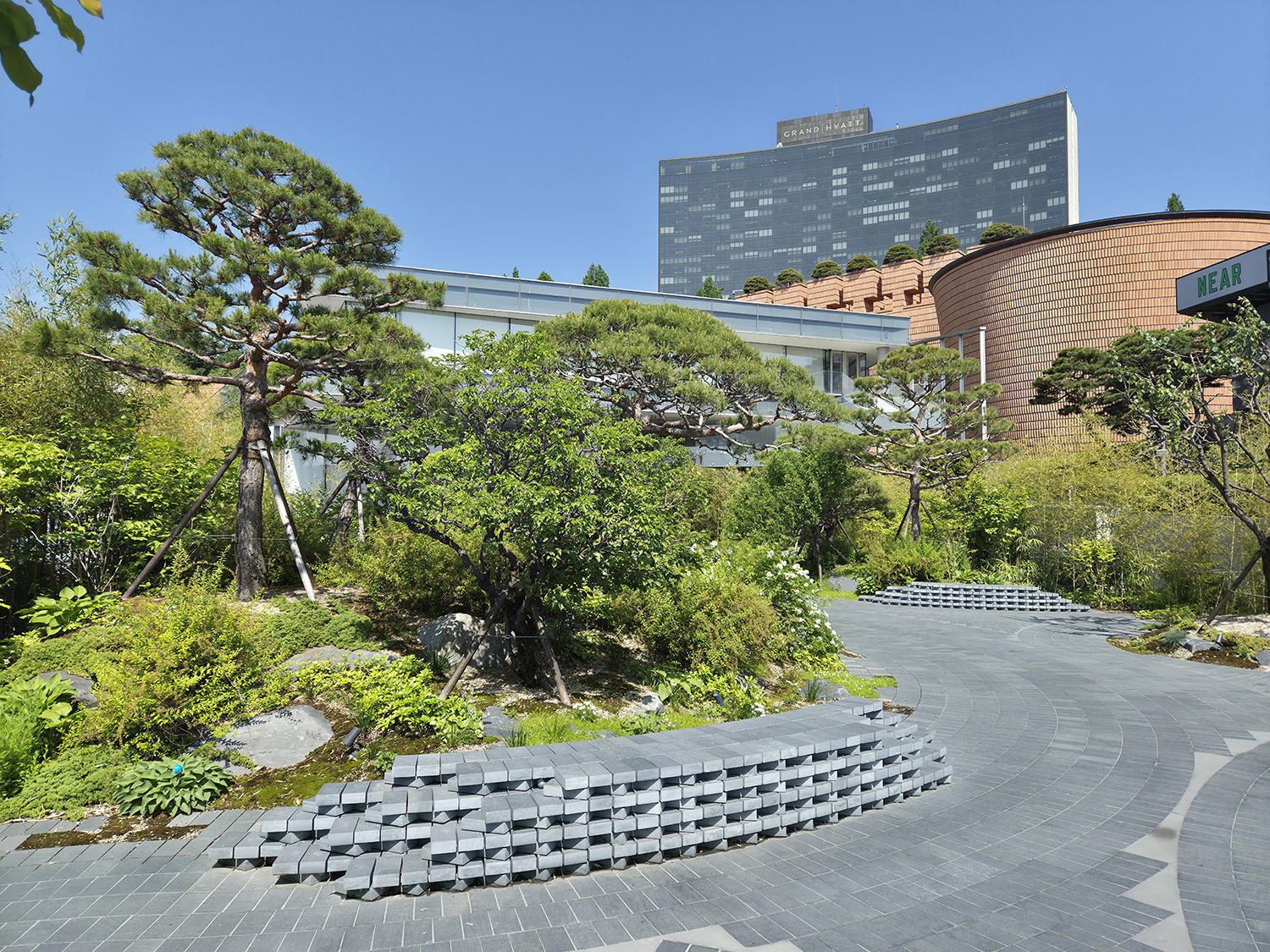 A view of the Leeum Museum of Art from the garden ©Gabriel Orozco / Photo by Bang Yukyung