
SPACE February 2026 (No. 699)
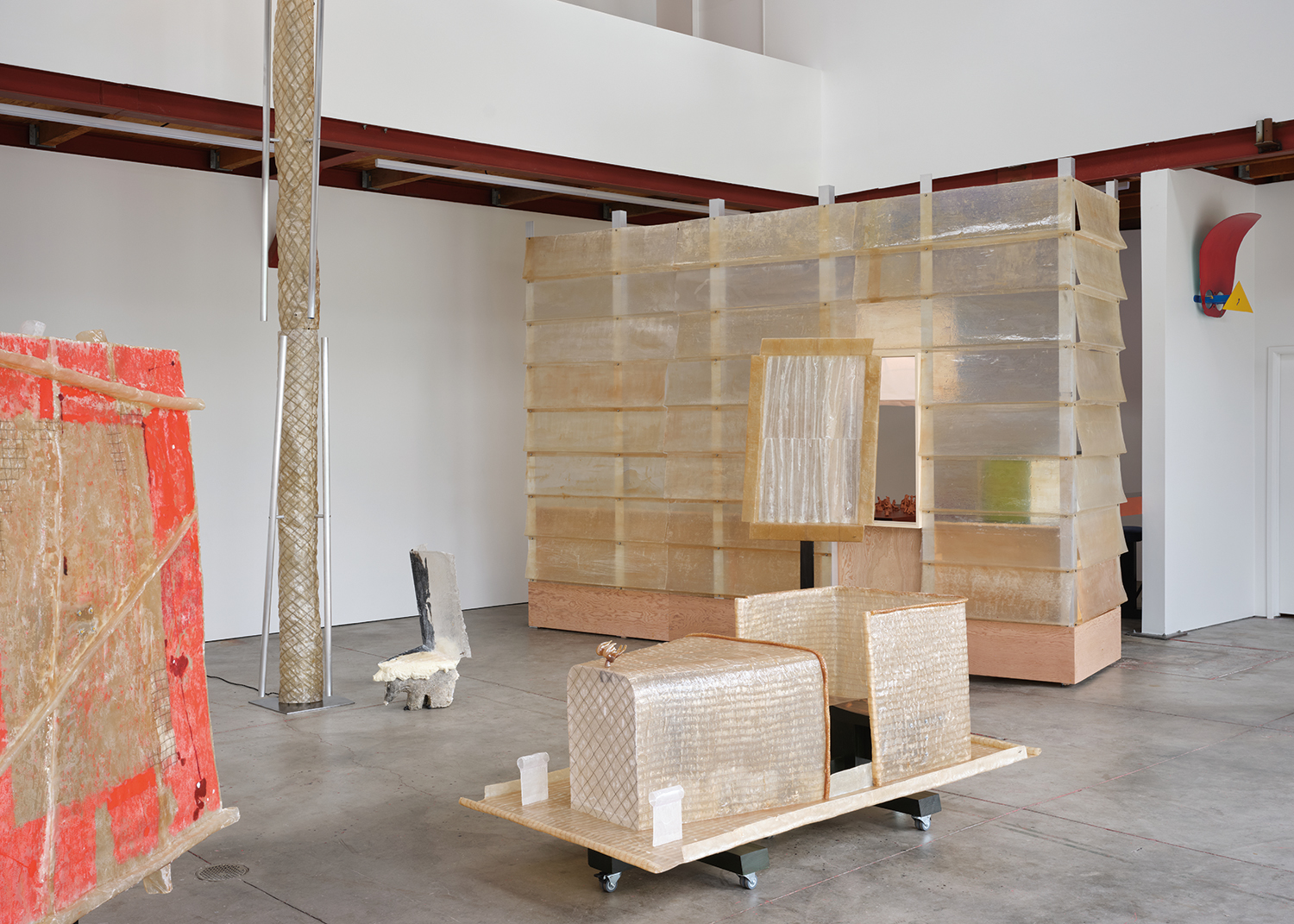
Exhibition view of ‘Phantom-22’ (2025), Marta Gallery in U.S. ©Erik Benjamins
Minjae Kim, who majored in architecture and painting, designs furniture with a formative footing in fine art and the structural thinking derived from architecture. Based in New York, he practises in Korea and the U.S., travelling back and forth, and creates personified furniture pieces or uses the human body, living organisms, and architectural forms as motifs, layering his interest in Korean sentiment and culture within his work. Such diverse contexts make it difficult to categorise his work under a single keyword or guiding concept, such as ‘Korean identity’ or ‘architectural furniture’. Orchestrated as reflections of subdivided, personal narratives that do not converge as a single theme, yet capturing contemporary sensibilities with a quick wit, his work seeks the potential for expansion beyond fixed categories. This is the story of Minjae Kim, whose practice initially began in architecture before expanding to encompass furniture, sculpture, and even architectural follies, as he continually explores a formative language that transcends function and usage.
Interview Minjae Kim artist × Kim Hyerin
Kim Hyerin: You majored in architecture and painting and worked as an architect at Studio Giancarlo Valle (now Studio Valle de Valle, hereinafter Giancarlo) for three years. Could you tell us about your transition in professional terms from an architect to artist-cum-furniture designer?
Minjae Kim: I started gaining practical experience at Giancarlo’s after graduating from graduate school. Even then, I used the backyard and basement of my place as a workroom, working on my own projects alongside my day job. Later, during the period of the Coronavirus Disease-19 pandemic, I had fewer working hours, which allowed me to devote more time to my own projects. This coincided with an increase in furniture consumption, alongside a boom in interior design, which naturally led me to shift the scope of my work.
Kim Hyerin: You primarily use fibreglass and wood as materials for your work. Is there a particular reason for choosing these materials?
Minjae Kim: I don’t have a preference for any particular materials. Fibreglass and wood are materials I encountered naturally while studying architecture. I had plenty of opportunities to work with wood at school. Fibreglass was also a material I was able to experiment with through various projects, and I found it highly accessible, as I could work with it at home or on the rooftop. Furthermore, fibreglass has a similar materiality to fabric, but once it undergoes a curing process with resin, it takes on a defined structure and form. While, in general, it is used by creating a mould and then layering multiple sheets of fibreglass and bonding with resin, I looked for ways to create the layers beforehand to simplify this process. When you quilt multiple sheets of fiberglass together with a sewing machine, you not only get to create the structure, but also create a visual effect. These quilted lines can also be used as design elements by varying the stitching, colour, and pattern. Furthermore, the resin I normally use contains paraffin, giving it a natural sheen as if it were waxed, and I was fond of this natural materiality.
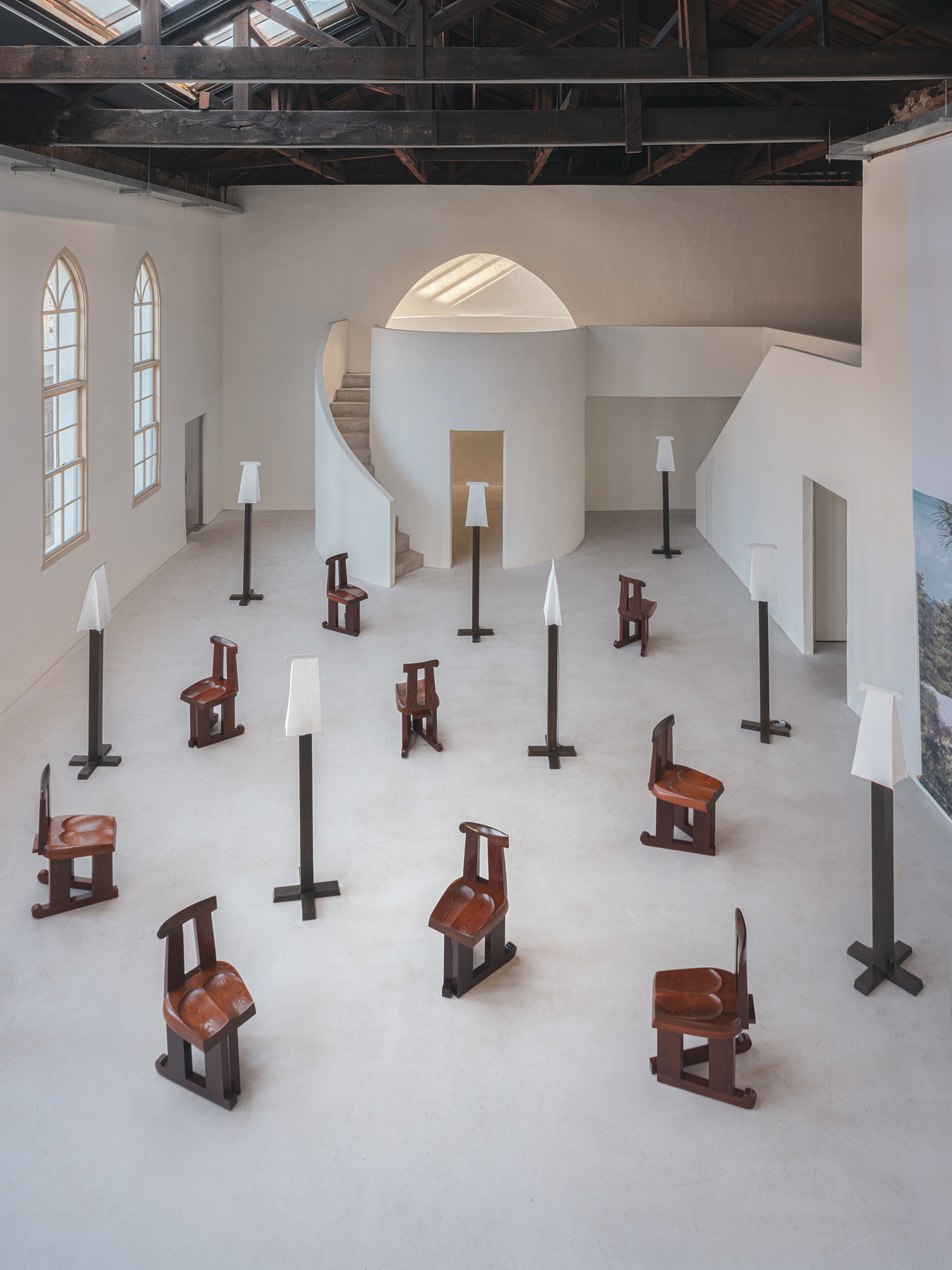
Exhibition view of ‘SEOUL’ (2025), Layer Studios in Seoul
Kim Hyerin: The way you work with fibreglass or the process you perform to carve your furniture pieces by hand is very much like a craft.
Minjae Kim: I majored in painting, and fundamentally I enjoy working with my hands. Even now, I prioritise hands-on production, but such an improvisational-approach-involved method of working can sometimes be difficult to incorporate into standard manufacturing or construction sites. For that reason, when commissioning work, I tend to entrust the initial assembly of the basic structure or framework to a carpenter, while I apply the finishing touches myself in the workroom.
Kim Hyerin: What process do you undergo from the conception of a design to its realisation?
Minjae Kim: When there’s a specific task to undertake, such as for a group exhibition or a client’s commission, I try to work in line with the given direction. I think this propensity probably stems from my time studying architecture as well as gaining practical experience in architecture and interior design. I believe in creating works that naturally blend into a given environment, rather than pieces that stand out within a space. In the design process, I start by establishing a basic framework based on specifications and proportions. Then, within that, I take the client’s requirements or any major points that intuitively resonate within the given composition and use those as my starting point. For solo exhibitions, I start by defining a framework based on stories I’ve wanted to tell or things I’m interested in, while, above all, carefully thinking about the impression I wish to leave on the audience. Then, I check the sizes, dimensions, and specifications using sketching and 3D modelling. And then, I adjust the design, thinking about how far the established form can be realised within the limits of the available materials and tools. Around 80% of the design is decided during this process, with the remaining 20% changing flexibly during the actual production. I tend to leave considerable room for adjustment throughout the working process. Unexpected situations arise all the time, and I try to respond to them flexibly.
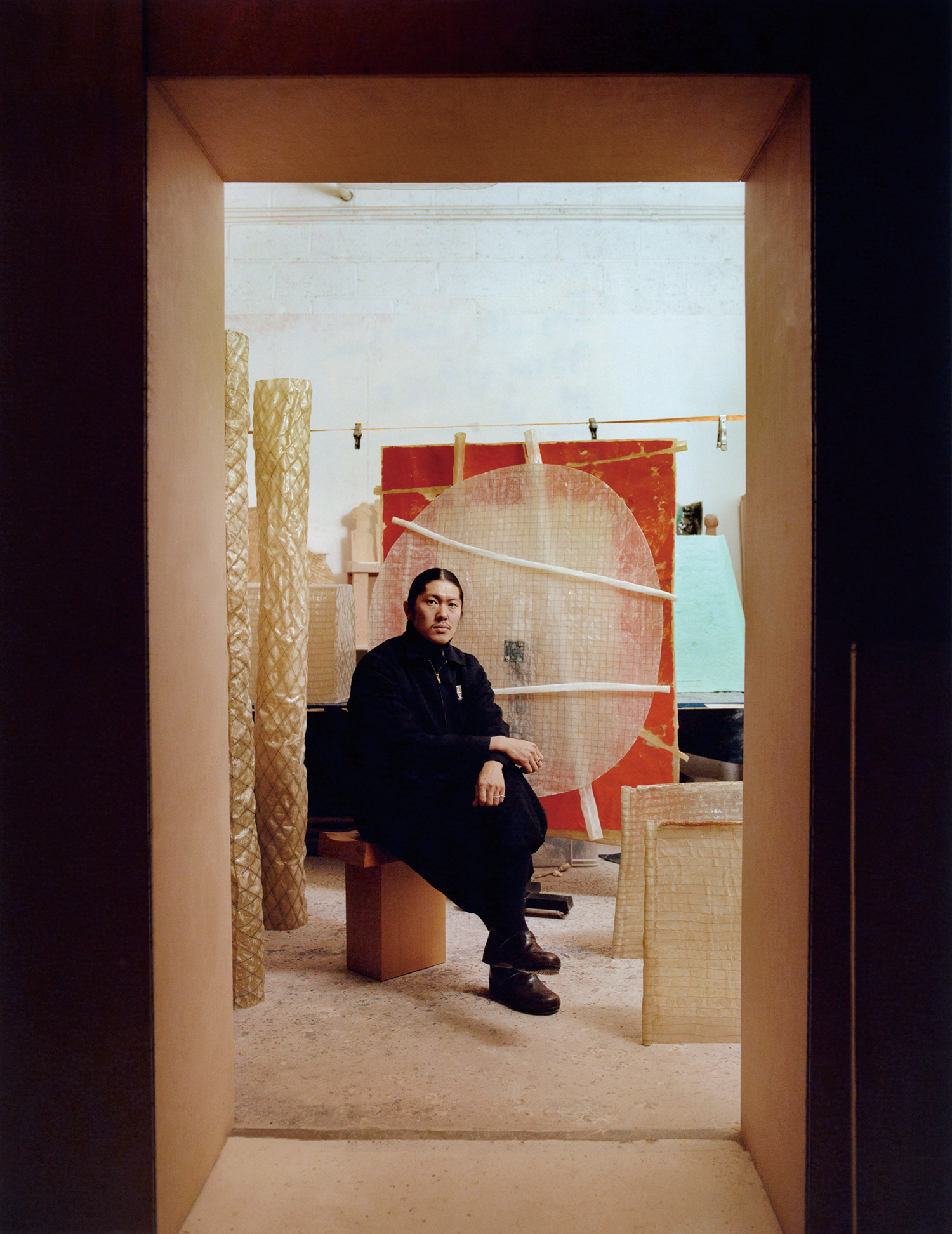
Minjae Kim in his studio ©Justin Kaneps
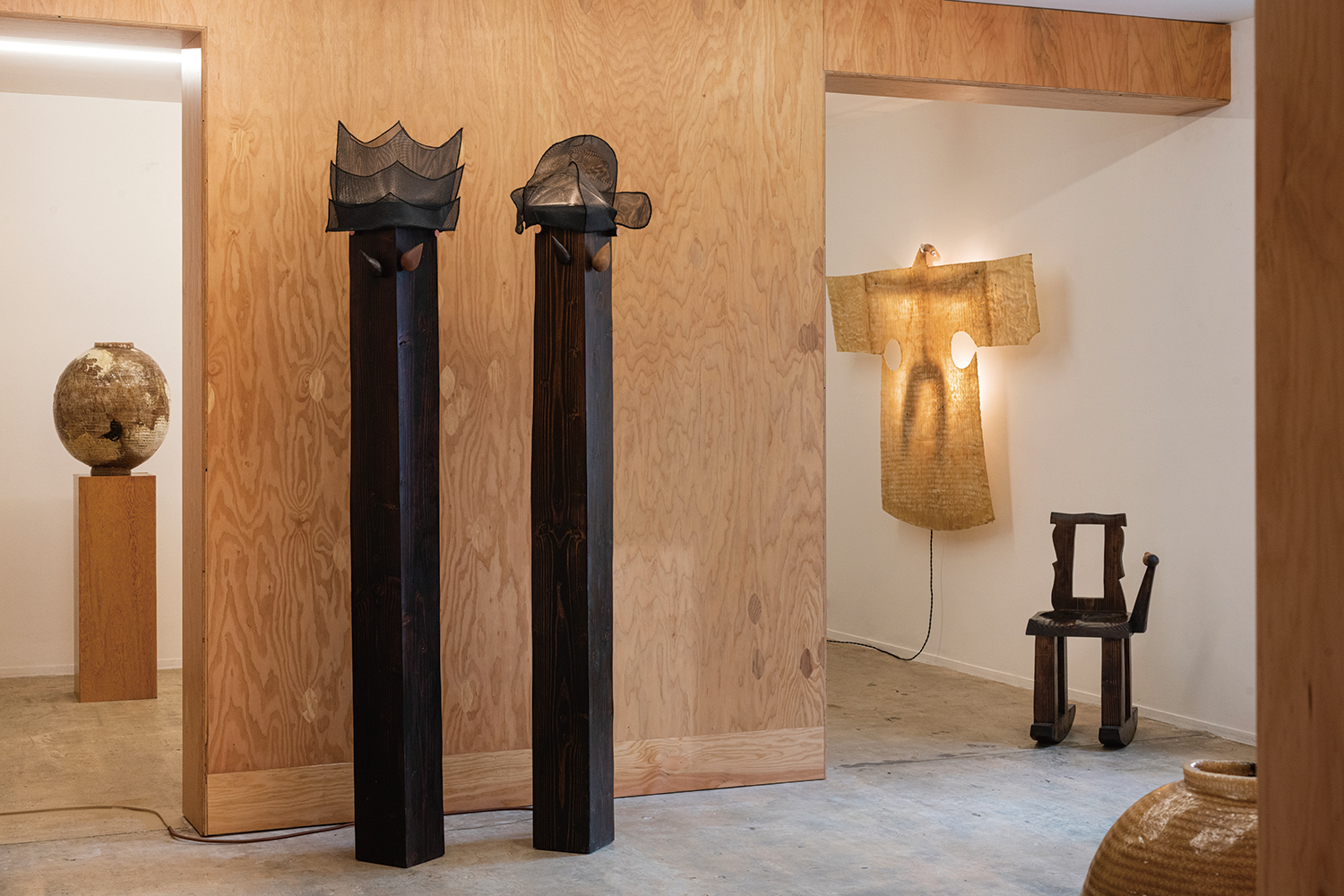
Exhibition view of ‘IYKYK’ (2022), Nina Johnson Gallery in U.S. ©Dominik Tarabanski
Kim Hyerin: In terms of your work, ‘each furniture piece’ has ‘a character of its own’.
Minjae Kim: The idea that ‘furniture has a character’ is something of a joke on my part. Although I sometimes borrow forms directly from living beings, such as people or animals, when I work on pieces, there are times when I approach the work by thinking of the furniture as being personified. When we meet someone, we quickly form an impression of them, and think that they must have a certain character—all based on first impressions. In a similar way, there comes a moment in the design process when I grasp the impression of a piece of furniture.
I wanted to share those moments with other people. Sometimes I exaggerate the form or give it a title to convey a feeling. Personification also makes it easier to communicate with people. I wish that they could transcend their status as mere objects and possess a presence and soul.
Kim Hyerin: Your work has received the following acclaim: ‘Mixed with authenticity and tradition, his works elicit a strong sense of nostalgia within the confines of contemporary expressionism and the avant-garde.’ (covered in SPACE No. 689) What is your personal view on this comment?
Minjae Kim: The theme of Korean identity in traditional or informal context has been something I have been contemplating since I was a student in architecture school. Since architecture and find art are both explored in predominantly in Western context, I believe many in the field of contemporary architecture and fine art would share a similar sense of frustration regarding this aspect. In my case, this feeling was somewhat amplified while living abroad. The catalyst for formally embarking on this type of work was also linked to the perception of Western audiences on my early pieces. Even when I worked without explicitly revealing Korean elements, the narrative often centred on my identity as a ‘Korean artist’ rather than the work itself. I particularly wanted to address the tendency in the West to over-interpret my work through the sole lens of my identity. This process led me to conclude that I should engage more deeply with Korean identity instead, and the exhibition ‘IYKYK’ (2022) is my response to this. IYKYK is a abbreviation for ‘If you know you know.’ I twisted it into ‘If you Korean you know.’ I decided to compose the exhibition using only elements that are universally recognisable to Koreans, such as a moon jar, gyoui, and jegi. In a way, it was the result of not just personal interest, but also necessity and external stimuli acting together.
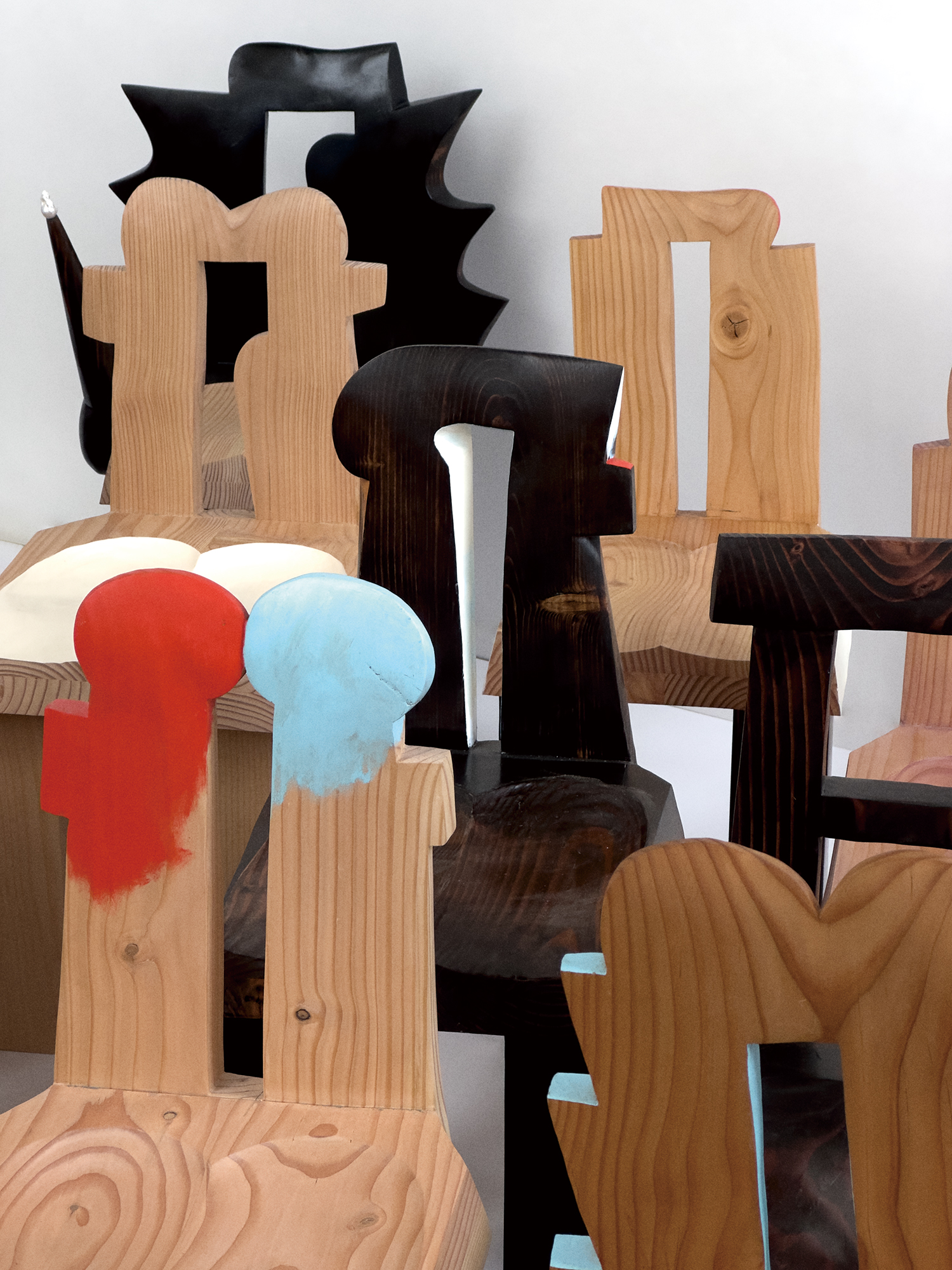
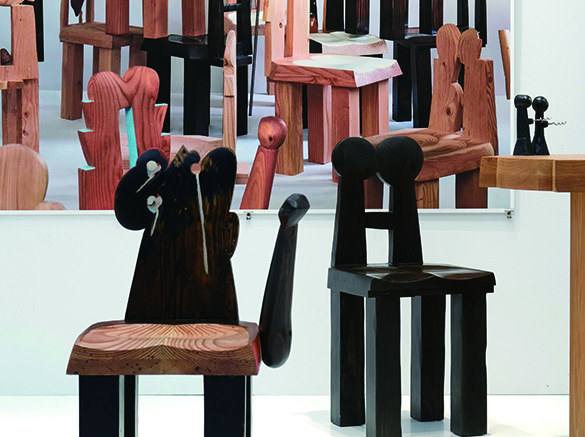
Carved Chair (2023) series (2023) ©Dominik Tarabanski
Kim Hyerin: You pay attention not only to traditional Korean elements, but also to everyday landscapes.
Minjae Kim: I try to focus not only on the traditions that we commonly perceive as high-end, but also on the cultures that are gradually disappearing, or that previous generations deliberately distanced themselves from. I am interested in the more indigenous, lived-in aspects of Korea’s past, such as the traditional lifestyles and customs that are shunned by our parents’ generation. I am constantly observing these things with a view to incorporating them into my work in the future. For example, traditional markets or Korean quayside landscapes have served as references. At my solo exhibition in Miami, entitled ‘Ba-Da’ (2024), I presented the installation piece Tong Tong Bae, comprising several small-scale furniture pieces arranged to resemble a ship. The lighting elements, resin textures, and paint colours used in the work were composed by referencing seaside landscapes seen on family trips. My father is from Busan, and whenever we went on family trips, we would always seek out the sea.
Kim Hyerin: You began your artistic career in New York in 2020, and recently you have continued to actively pursue your practice in Korea. What aspect of Seoul did you intend to uncover in your first solo exhibition in Korea, entitled ‘SEOUL’ (2025)?
Minjae Kim: It was an exhibition prepared using two elements, which are chairs and lamps. The lighting is an extension of my previous work, and uses the folding structure of the top part of a milk carton to create a form resembling a roof of a house. I imbued the lighting with the symbolism of a house, and given its function, I also considered the light entering it to be symbolic. With the SEOUL CHAIR, I wanted to create a form that Koreans would be fond of and relate to, borrowing the shape of the legs of a soban or the lines often seen in Korean architecture. Furthermore, as this was my first presentation as an artist in Korea, I chose ‘Seoul’ as the exhibition title to imply its meaning. Having worked in the U.S. since my twenties, many people are unaware that I am Korean, that I grew up in Seoul, and even more, many assume that I am Korean-American. I wanted to announce my roots more clearly while also conveying my aspirations for future work. Aside from the exhibition itself, I sought to firmly establish these assertions by capturing both the exhibits and the landscapes of Seoul. This was a project where the act of taking photographs held greater significance than the exhibition itself. After discussions with photographer Jang Mi, we selected Inwangsan Mountain as the location. To further exaggerate this act further, we staged it as a performative action, even involving carrying a chair on an A-frame carrier up Inwangsan Mountain and documenting it in photographs.
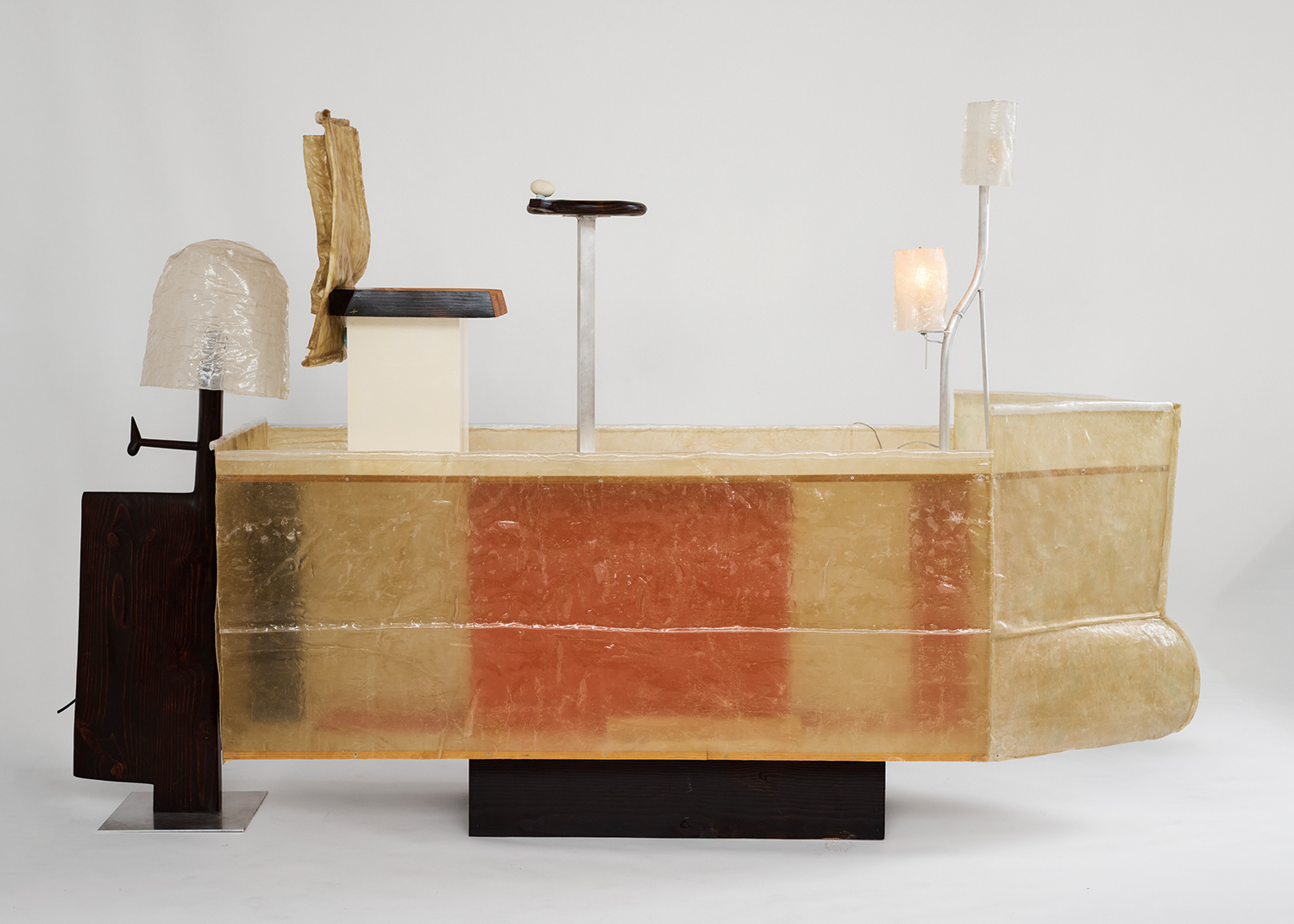
Tong Tong Bae assembly, ‘Ba-Da’ (2024), Nina Johnson Gallery in U.S. ©Jacob Holler
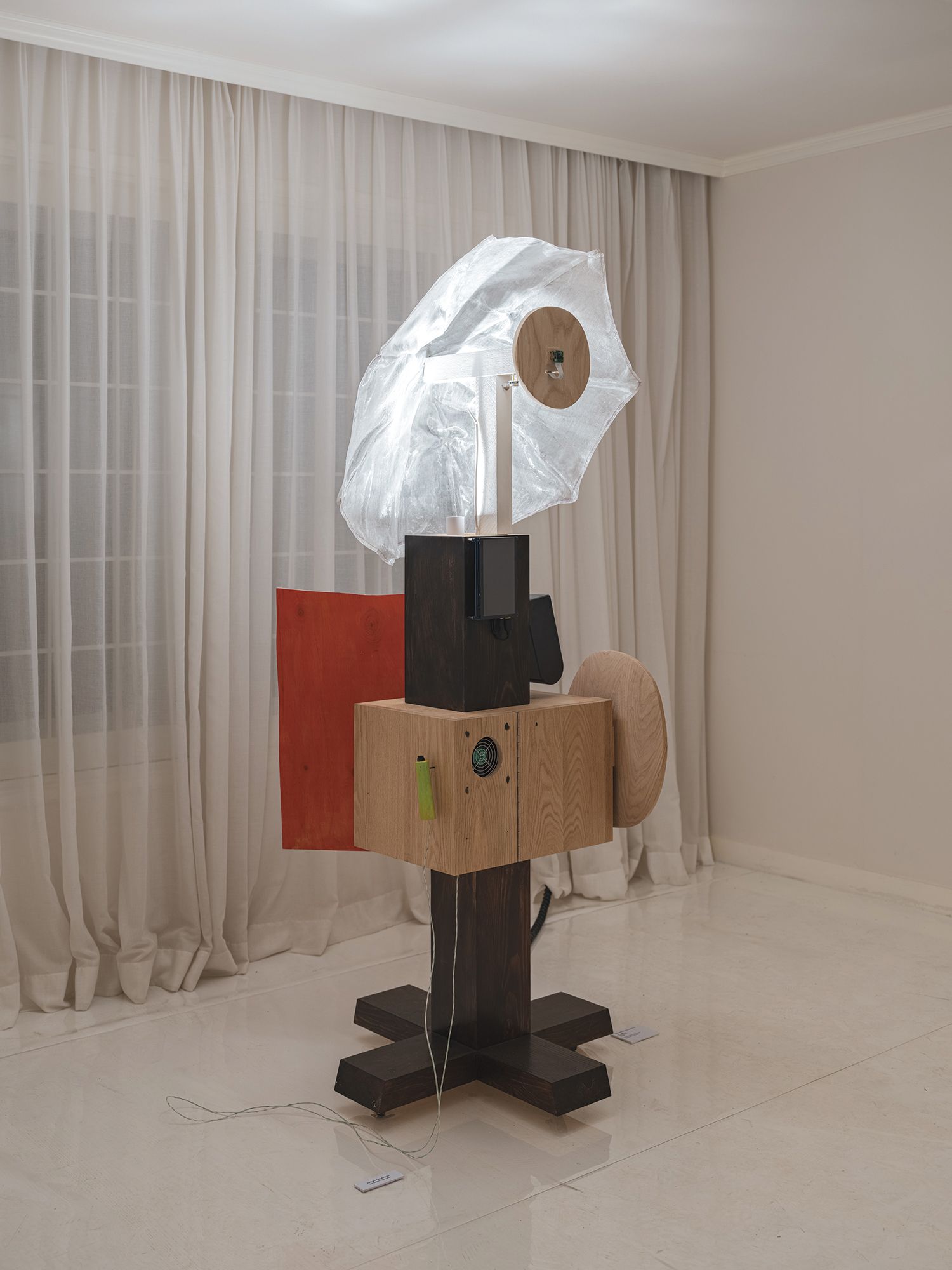
Minjae Kim & Choi Gunhyuk, Take-out Mirror, wood, resin, acryclics, lacquer, fiberglass, camera, monitor, Raspberry Pi, 66 × 70 × 180cm, 2025
Kim Hyerin: For a residency exhibition entitled: ‘Me, Meme: Anbin-nakdo (finding joy in modesty) at the End of the Century (fin de siècle)’ (2025), you lived and worked together with craft artist Lee Gyuhan and code artist Choi Gunhyuk at a residency for three months. Did you take on any new design challenges as part of this exhibition?
Minjae Kim: I usually like work that is interactive. Furniture, inherently provides a degree of interaction through its function and implied contact, but there is a limit to its engagement. Nevertheless, its very nature imposed limitations on expanding beyond a certain point. By collaborating with Choi Gunhyuk, who works primarily with digital media, I could create a more expansive interactive experience and develop numerous ideas into actual works. Together, we created pieces that extend beyond the simple interactions of using furniture, expanding into more different senses and realms. Examples include a mirror containing monitors, cameras, and computers within a wooden frame instead of glass, a clock with screens and computers installed in a cast aluminium case instead of hour and minute hands, and a Take-out Mirror that combines furniture with a photo booth to encourage audience participation.
Kim Hyerin: Whereas your earlier exhibitions primarily featured small-scale furniture pieces like lamps or chairs, in ‘Phantom-22’ (2025), you also employed architectural follies. Going forward, do you plan to expand your practice into more diverse fields?
Minjae Kim: For me, work is a means of fulfilling desires. In my first solo exhibition, ‘I Was Evening All Afternoon’ (2021), I parodied the conventional elements of Western design and lifestyle that I came across while studying and working abroad in my twenties. Through this, I expressed my curiosity and interest in these elements. I found certain types of furniture that I have never encountered in Korea, such as lounge chairs, daybeds, Catholic prayer stools, intriguing, and I felt a desire to own them or become part of them. Working and existing as an outsider seems to have channelled these possessive urges into my practice. And this approach seems to persist. I express through my work what I wish to do, define, or possess. ‘Phantom-22’ was also an exhibition imbued with such desires. While conveying my impressions of and criticism about L.A., I used architectural devices to divide the space into interior and exterior areas. The exterior space was filled with sculptures that I had created myself, and these pieces of sculpture do not premise on practicality or function. This was in alignment with the direction I want to push my career. Although working in furniture design allowed me to become an artist, I feel confined by the medium as well. I wish to break free from this framework. Furthermore, should the opportunity arise, I intend to explore ways to expand my scope back into architecture.
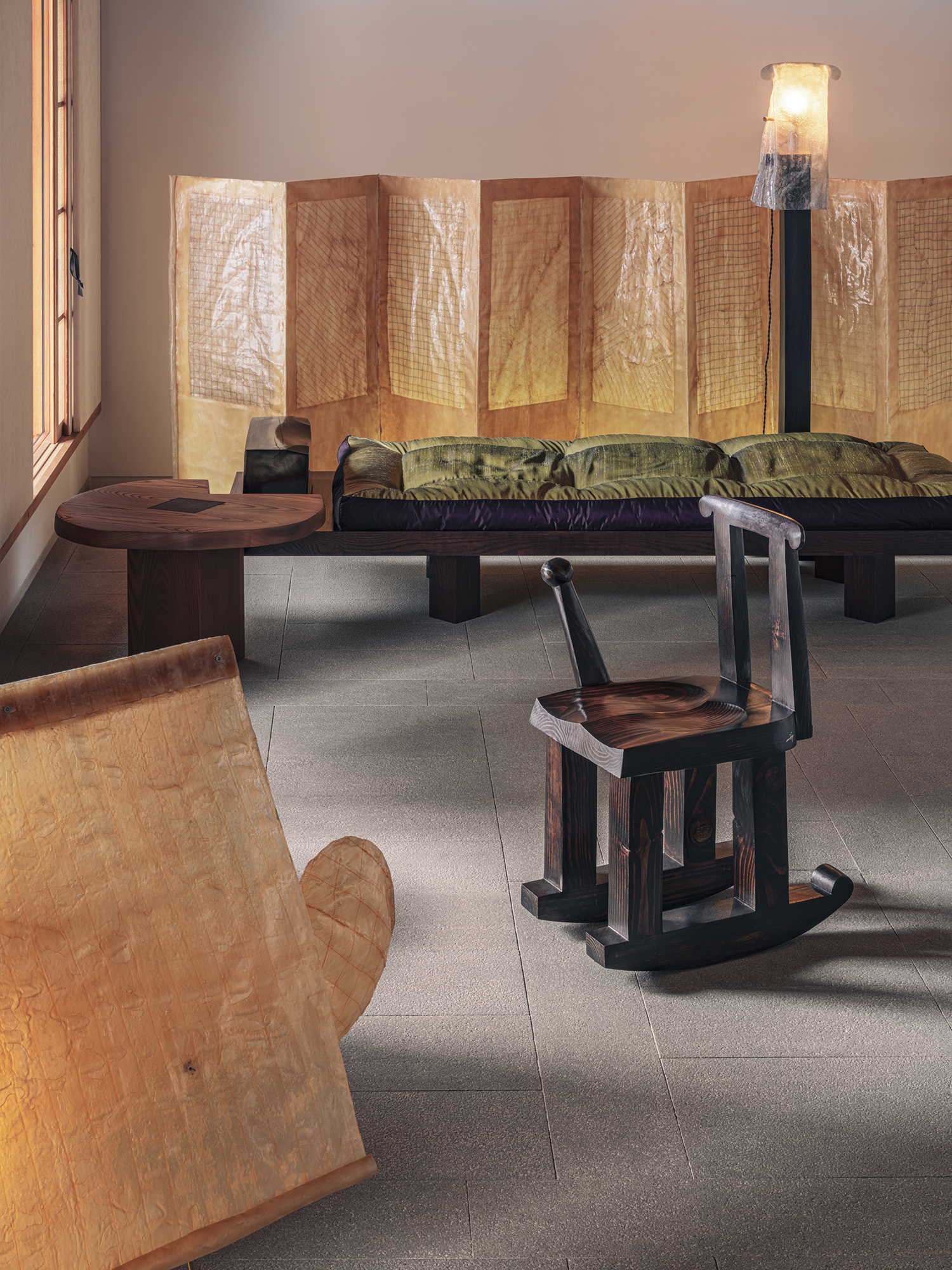
Exhibition view of ‘Room, As It Is’ (2024), Arumjigi in Seoul