
SPACE February 2026 (No. 699)
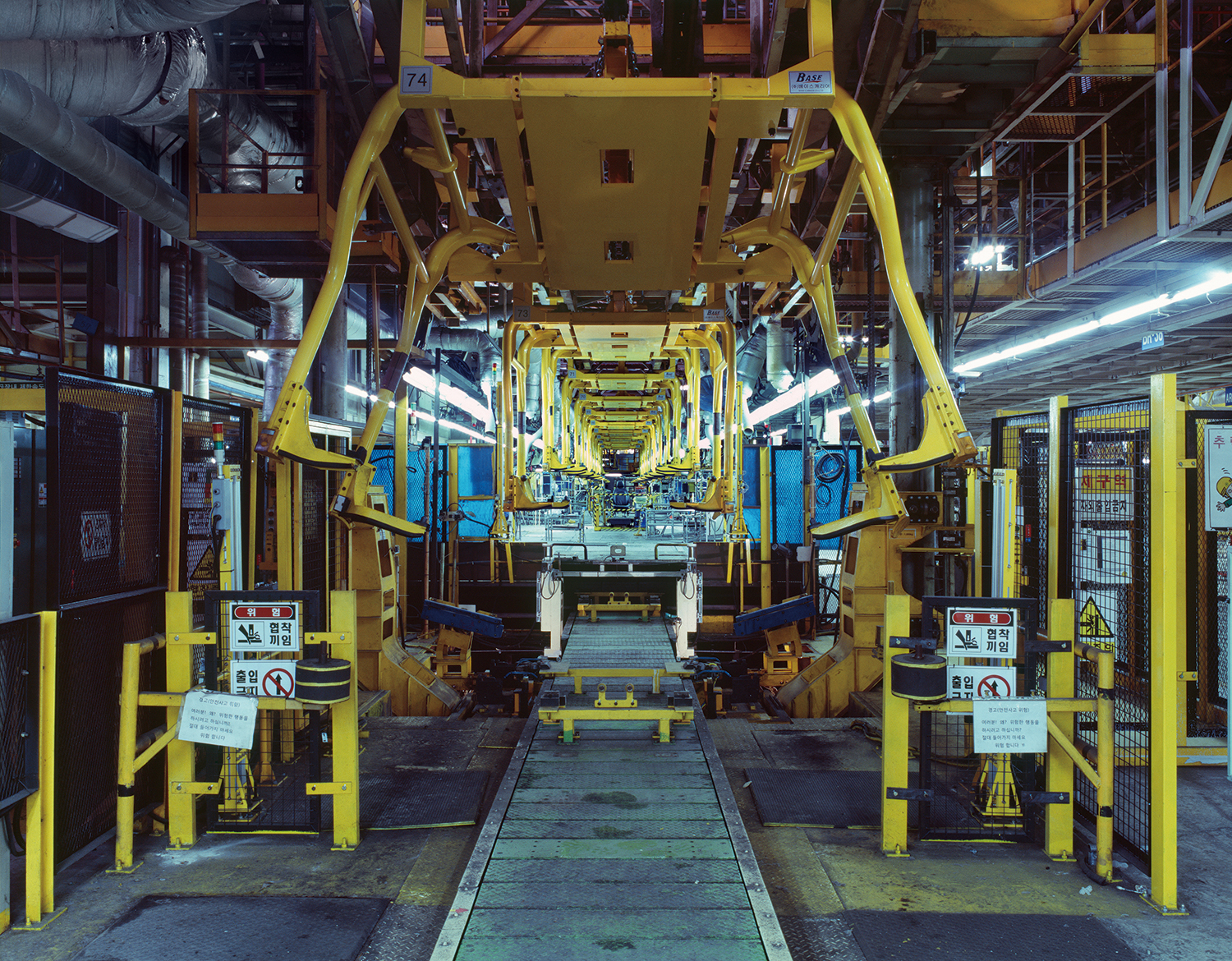
Oh Suk Keun’s Positioning and Repositioning 04 installed at the Assembly Shop 2
GM Korea’s Bupyeong Plant 2
Oct. 16 ‒ Nov. 30, 2025
interview Kim Eunhee Director, Gyeongin Collective × Bang Yukyung
GM Korea’s Bupyeong Plant 2 (hereinafter Bupyeong Plant 2) was shut down on the 26th of November, 2022, citing declining performance and worsening business viability. It was the first time in sixty years that the machines came had come to a halt. ‘MOTOR TIMES: Again, From Where It Stopped’▼1 takes this moment as its point of departure. The exhibition traces how the documentation of labour, which is measured and controlled down to the second, have been inscribed into this space and onto its machinery, as automobile parts were assembled on the conveyor belt and gradually took form. By making this intervention into the place of labour and opening a crack into industrial spectacle, the exhibition raises questions about what such an encounter can reveal. We spoke with curator Kim Eunhee (Director, Gyeongin Collective▼2) about the implications for and possibilities of this project.
Bang Yukyung (Bang): Following ‘Sosa Industrial Complex: The Factory That Builds Machines’ (hereinafter ‘Sosa Industrial Complex’), held at Bucheon Art Bunker B39 (hereinafter Art Bunker) in 2023, you curated ‘MOTOR TIMES: Again, From Where It Stopped’, a site-specific exhibition set within Bupyeong Plant 2, in 2025. As an artist, what first drew you to industrial facilities such as factories?
Kim Eunhee (Kim): I spent much of my life living in the Incheon and Bucheon area, so industrial complexes and factories were familiar landscapes to me. In manufacturing-based cities, factories function as sites of collective memory that connect the city to its people. When I began to think that the people I passed in these industrial zones could be my family members or neighbours, the factory started to look different. Since 2015, I had been working on a personal project documenting the metal workshops disappearing along the Gyeongin-ro as manufacturing declined, translating these sites into drawings. In 2020, I also participated in a village-mapping project organised by Bucheon City. At the time, my curiosity was drawn to Samyang Heavy Machinery in the Sosa Industrial Complex – the only site in the area that had not yet been redeveloped into apartments – and I visited it with the public official in charge of the project. Confronted with the history of the surrounding area, where foundries had been established since the Japanese colonial period, and with the spectacle of furnaces, large-scale moulds, and machine and civil-engineering equipment left behind like ruins, I suddenly felt that if I could understand this factory properly, I might be able to understand the identity of Bucheon as a city. After that, I secured a small space within the factory and began to document its disappearance, organising and collecting whatever I could—machines on site, traces of use, and mechanical and architectural drawings.
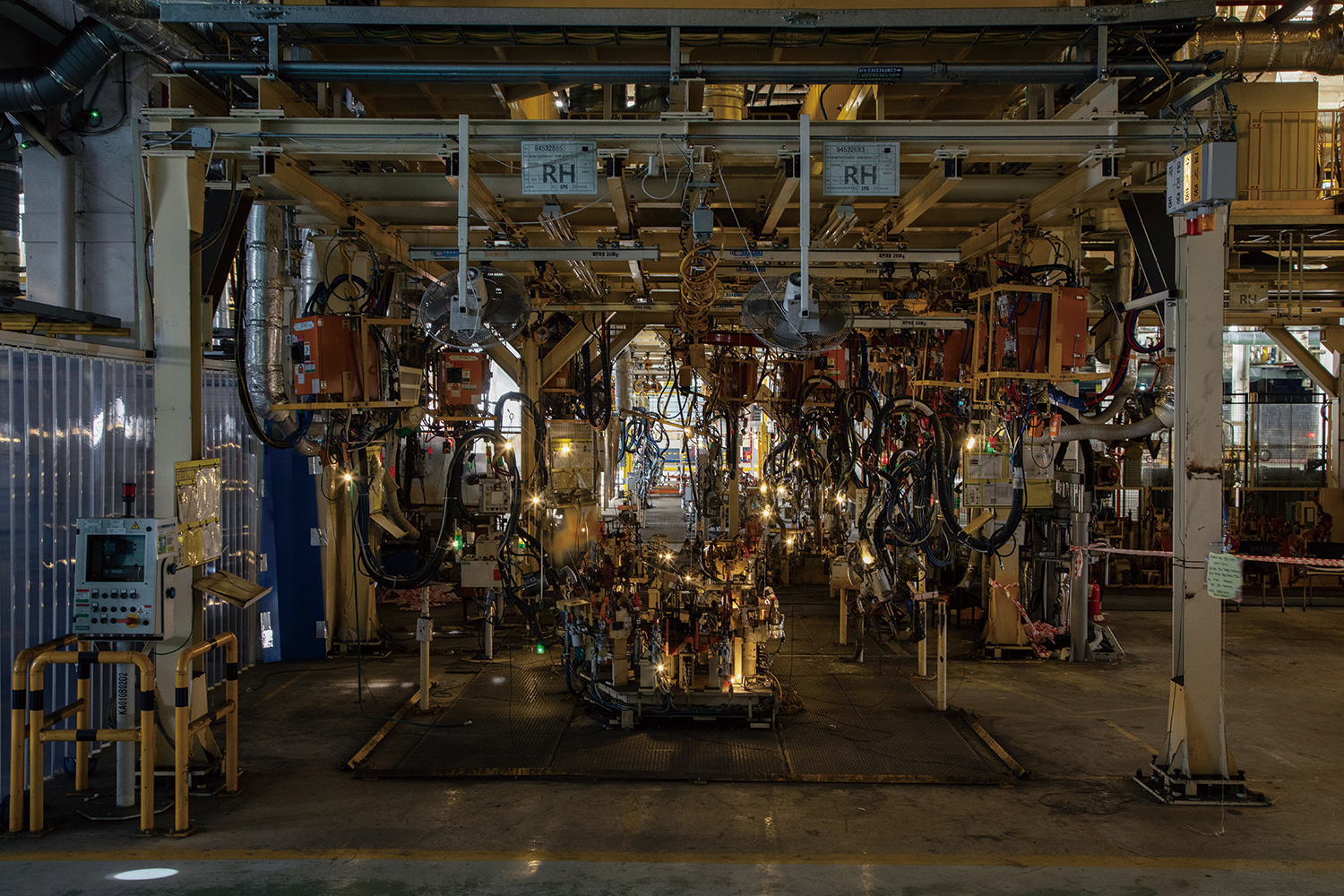
Yang Junguk’s The Shape That Makes Light installed at the Body Shop 2
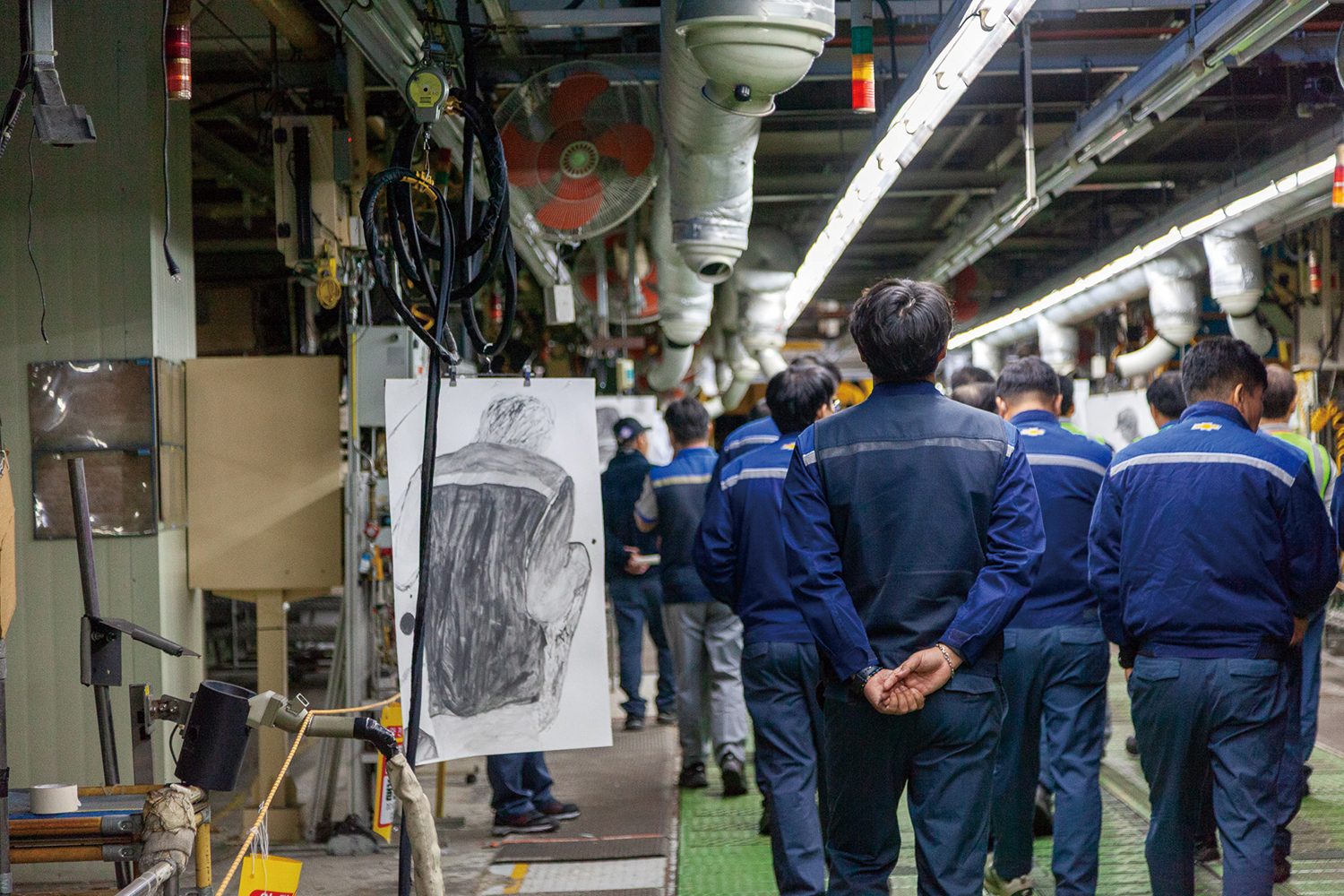
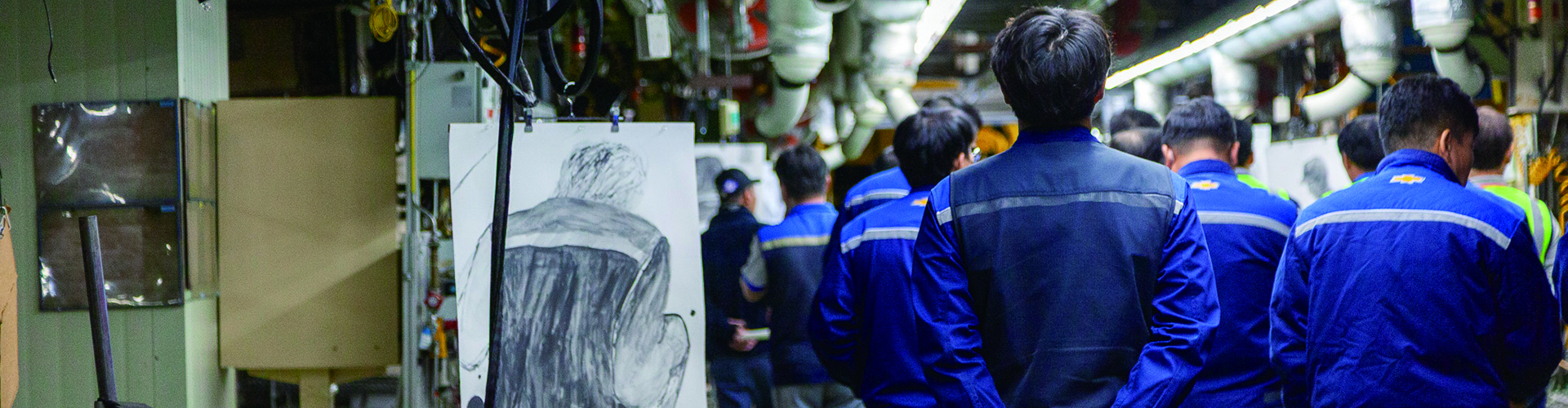
Kim Eunhee’s Plantography: Conveyor installed at the Assembly Shop 2 during the exhibition tour
Bang: I understand that members of the GM Korea Branch of the Korean Metal Workers’ Union, who had followed the process at ‘Sosa Industrial Complex’, later approached you to commission an archival project at Bupyeong Plant 2, which had been shut down. As both the curator and a participating artist, I am curious about the differences and commonalities between the two exhibitions.
Kim: ‘Sosa Industrial Complex’ was intended to reveal the process of making—to show how the world we live in has been constructed. This included not only the spatial reality of massive factory complexes that exceed the human scale, but also the stories of the workers who laboured within them. In Korea, the history of labour is typically recorded as a history of labour movements. What is often missing are accounts of how workers actually worked, learned, and grew. I wanted to uncover the specific details concealed within the generalised notion of ‘factory labour = 3D work’. Factories were places where young skilled workers, many of them in their late teens seeking income, developed into seasoned craftsmen. Their personal growth narratives are inseparable from the history of technological accumulation and industrial development. For this reason, one of the exhibition’s key points was to make materials collected on site – work logs, records, and artifacts – visibly accessible through display. By contrast, ‘MOTOR TIMES: Again, From Where It Stopped’ had a fundamentally different orientation, beginning with its title. Rather than focusing on the objects or artworks we had collected, we regarded the factory itself as the main protagonist. Entering a halted factory and experiencing and sensing a space now radically changed became the core focus of the exhibition.
Bang: The exhibition is divided between archival materials presented in the lobby of the factory’s PR hall and commissioned works installed in Assembly Shop 2 and Body Shop 2, both of which had ceased operation. It seems that the question of ‘what to archive, and how’ must have served as a key point of orientation.
Kim: Our main objective for archiving was to reveal the way the factory operates. We first internalised the structure of the massive factory and examined labour processes and activities within it. Tracing the production process – from engine to press, body, painting, assembly, and maintenance – we investigated machines, labour systems, and workflow through interviews and on-site research. In doing so, we encountered uncomfortable truths: the efficiency of the conveyor system imposed unreasonable labour, and the demands of the shop floor failed to reach those who held decision-making power. As labour narratives accumulated – such as the 20 seconds of tightly constrained rest within a repetitive 120-second cycle, or the story of how increased proficiency allowed eight workers to replace ten, resulting in the loss of two jobs – we came to feel that the exhibition needed to move beyond the industrial and mechanical aesthetics typically associated with large-scale facilities. During the archiving process, we therefore published a monthly bulletin featuring in-depth interviews with one worker from each production stage. As our understanding of Bupyeong Plant 2 deepened, the factory’s tightly organised spatial structure, aligned precisely with the production flow, began to register physically, almost as if it were constricting the body. This sensation directly shaped the exhibition’s spatial concept. While we documented the factory by organising zones around the conveyor belt and focusing on machinery and production facilities, we sought to embed within this framework the stories of mechanised human bodies, time, and labour.

Re: Assy (directors Kim Eunhee, Choi Hyukkyoo, video producer Yiyagi) installed at the Assembly Shop 2
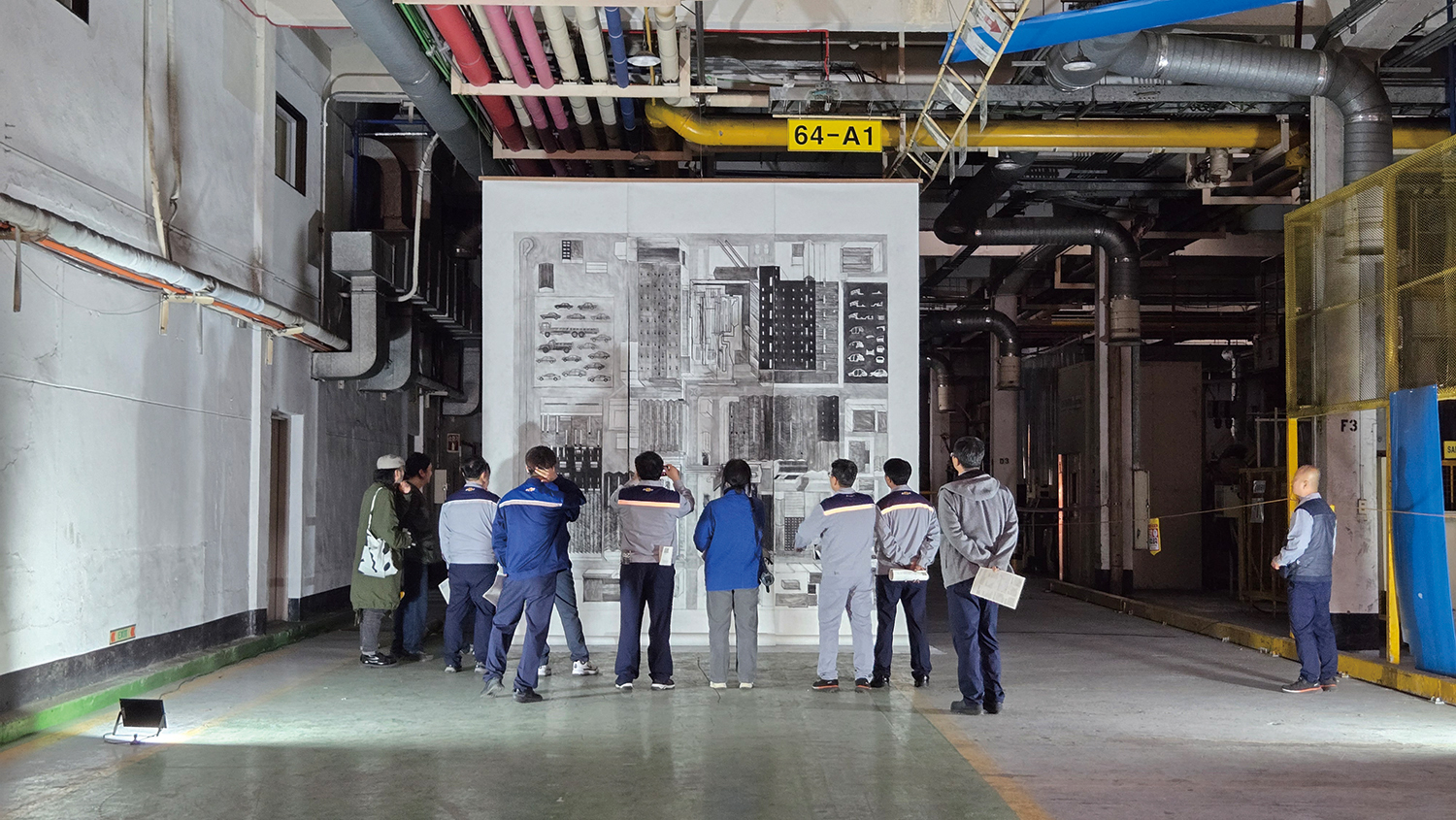
Kim Eunhee’s Plantography: Motorpia (assistant Jin Soojin) installed at the Body Shop 2 during the exhibition tour
Bang: The on-site exhibition proceeded in reverse order to the automobile production process, organised around the subthemes ‘Body of the Plant’, ‘Body of Car’, and ‘Body of Worker’. The exhibition was also experienced in the form of a 90-minute guided tour, led by the artists, in which visitors explored the automobile factory as if on an expedition. This approach felt new.
Kim: We came to recognise the importance of spatial experiences in exhibitions through ‘Sosa Industrial Complex’. At the time, the exhibition venue, Art Bunker, had formerly been a waste incineration plant, and the project began with the idea of laying out the useless waste materials we had collected. The materiality and flow of the exhibition were likewise organised to follow the process by which waste enters storage and is then incinerated. Through this, we learned that when exhibition content and exhibition spaces are sensorially connected, the content and message of the exhibition are conveyed more deeply. GM Korea’s Bupyeong Plant was different. Not only was its overall scale different, approximately 300,000 pyeong, but more importantly, it was not a discarded facility but a space that had stopped. For this reason, one of our key goals from the beginning was to open the closed factory gates and stage the exhibition inside. Perhaps because I studied architecture as an undergraduate, the process of partitioning exhibition space and planning circulation felt similar to architecture, in which spatial experience is designed through sequence. For some visitors, the exhibition may have felt closer to a site survey or a performance. We, the artists guiding the tour, took on roles similar to narrators or benshi. Even within the factory, lighting was turned on only in areas meant to be shown, like a stage, while overall illumination was lowered. Every environmental condition encountered along the route was a thoroughly planned device. The exhibited works (photographs of the empty factory, drawings capturing the backs of workers at the conveyor belt and etc.), rather than asserting themselves, call out and reactivate the names of those who have disappeared from the factory.
Bang: Although the exhibition has ended, the project itself is still ongoing. Could you tell me what plans you have in mind with Bupyeong Plant 2 as the site?
Kim: From the outset, we worked with the understanding that our first audience was not the general public but the thousands of factory workers. We also recognised the stage on which we were working as a ‘living factory’. The process of talking and leaving records with workers became a moment in which the workers confronted their past and newly acknowledged the roles they themselves had played in the history of labour and industrial development. Through this, we came to feel that our work constituted a form of practical and performative archiving that intervenes in reality. Going forward, I am envisioning the creation of stages or devices that allow workers to speak directly in ways different from before, and to record those moments.
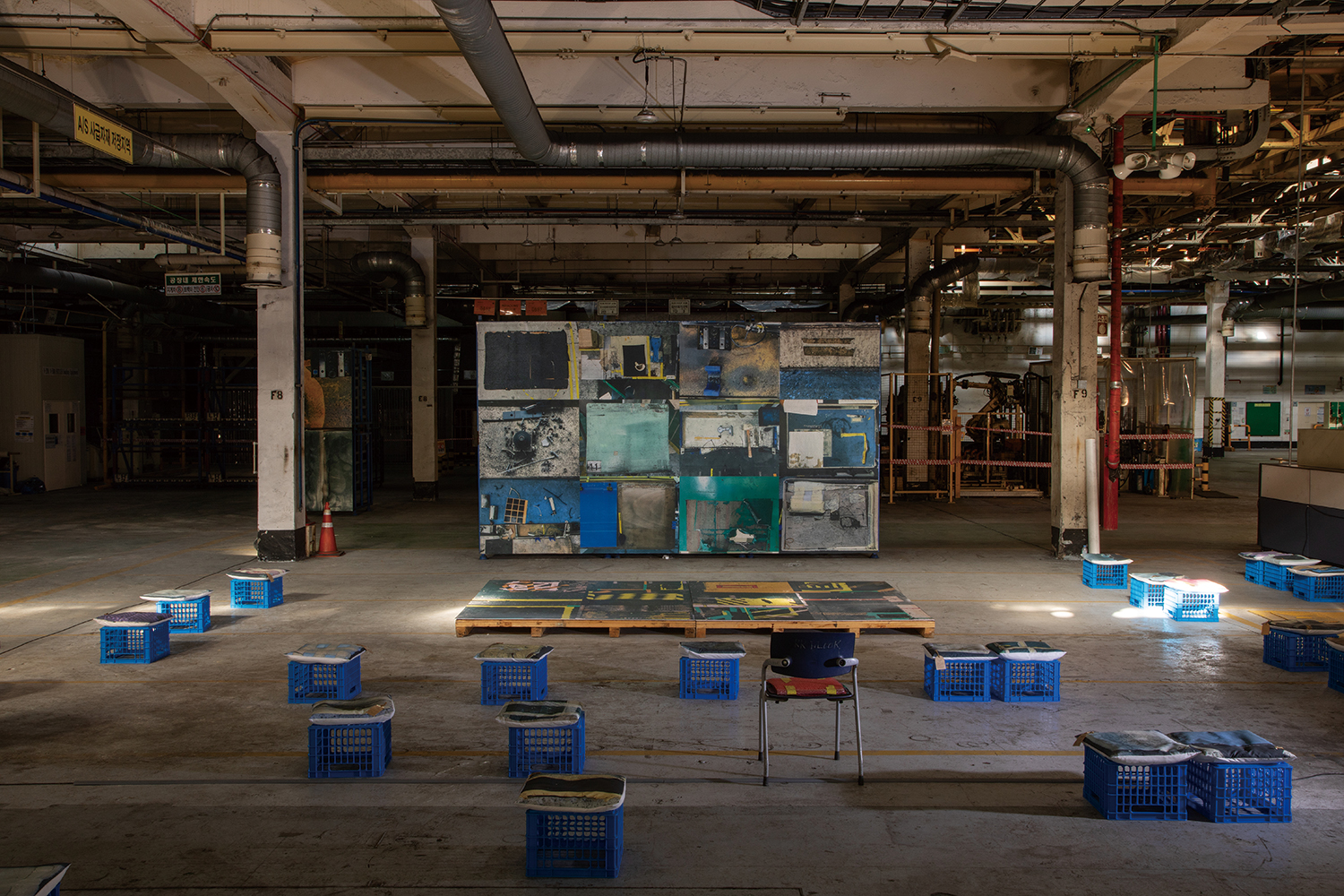
Min Woongi’s The Worker’s Place installed at the Body Shop 2
_
1 This exhibition was presented by the Bupyeong-gu Cultural Foundation and the GM Korea Branch of the Korean Metal Workers’ Union (KMWU), organised by Gyeongin Collective. Prior to the on-site exhibition at GM Korea’s Bupyeong Plant 2, an exhibition was held at Bupyeong Arts Center Gallery, from Sep. 26. to Nov. 2, 2025. It traced the history of Bupyeong’s evolution from a military-industrial town to a centre of automobile production, presenting an archival record of the intertwined transformation of industry and urban life.
2 Gyeongin Collective is a cultural and artistic group formed by curators, artists, and researchers. The group aims to archive and share the industrial histories and cultures of manufacturing-based cities in the Gyeongin region through creative and artistic engagement. This exhibition features visual artists Kim Eunhee, Min Woongi, photographer Oh Suk Keun, architect Lee Euijung, and cultural researcher Choi Hyukkyoo. Yoo Hwayeon and Jin Soojin, who engage in urban research and creative activities in Incheon, participated as guest members for the archiving exhibition. Son Minhwan,Yiyagi and TechCapsule participated as collaborating artists.