
SPACE February 2026 (No. 699)
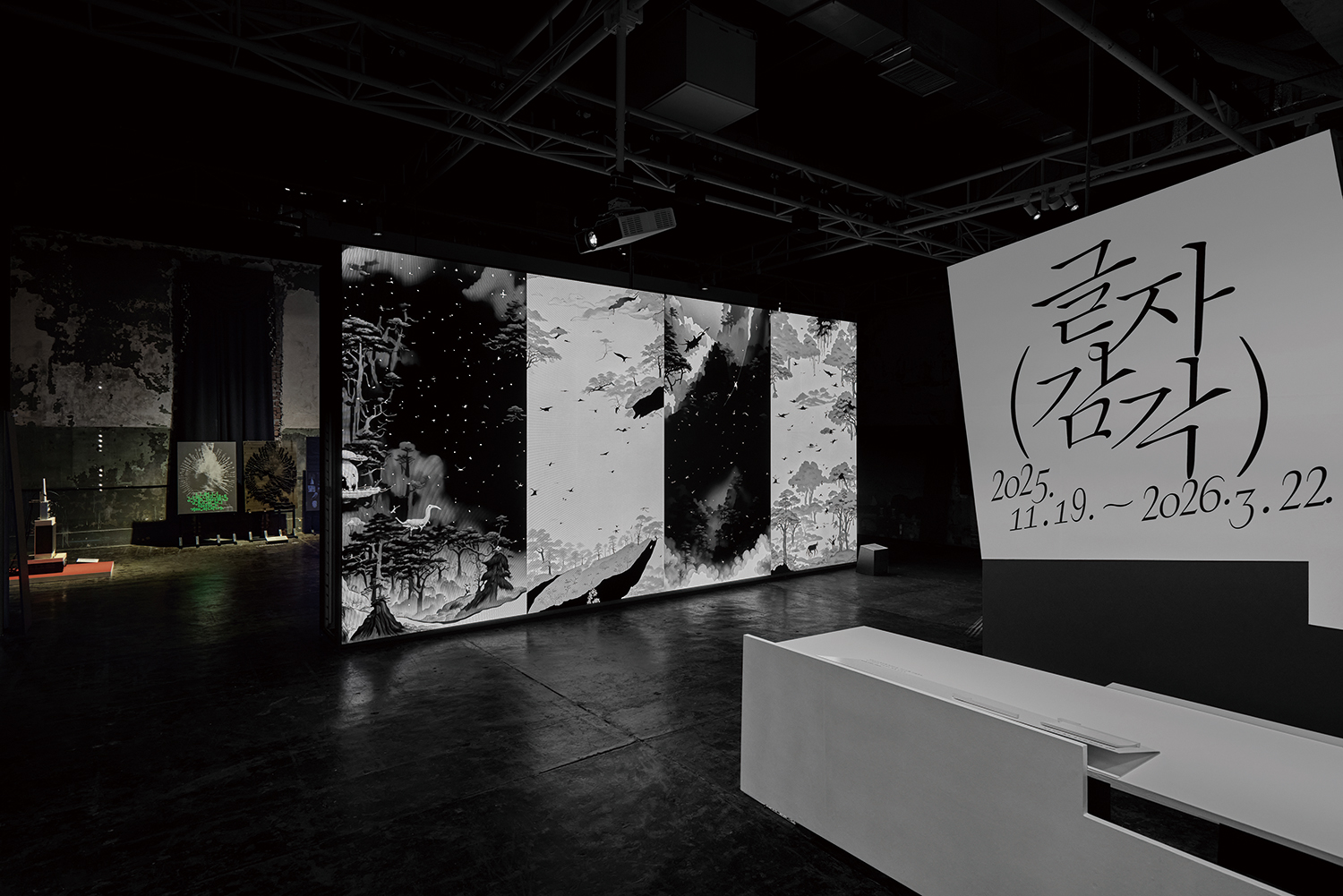
The work visible on the left is Je Baak’s The Spacing, which transmits video images generated by artificial intelligence combining emotional terms (Hanguel) listed by the artist.
‘Senses of Writing: Tools & Perception’
Culture Station Seoul 284 RTO
Nov. 19, 2025 – Mar. 22, 2026
How can we describe the texture of letters? What kinds of material properties do they possess, and how can they be sensed? The 5th Hangeul Design Project at the National Hangeul Museum, ‘Senses of Writing: Tools & Perception’, was conceived to reconsider the sensory transformations triggered by the act of writing through its interface with tools. Focusing on the relationship between writing and tools, the exhibition commissioned 23 teams of artists and designers to create works that expand the material properties and sensory dimensions of letters. As a result, the exhibition presents a wide range of materially grounded works: from writing tools translated into diverse materials such as paper, pigment, metal, wood, and leather; to furnitures and spatial structures designed to support the act of writing, including desks, chairs, and lamps; to objects that express the emotional and sensory shifts evoked by writing. In one corner of the exhibition, works that consciously respond to our rapidly changing technological environments capture visitors’ attention. A machine that converts the sensation of writing into sound; a device that analyses data such as pressure and speed applied at the moment of writing and outputs vector-based letterforms; a robot that draws digital letterforms; and AI-based media art that translates emotion-laden language proposed by artist into moving images: diverse practices that traverse genres are brought together in this single space.
Above all, the most conceptually decisive point of departure for the exhibition is in four literary works that probe the relationship between writing and tools. Keem Youngle, Kim Sungwoo, Jeon Byung Geun, and Kim Choyeop explore the meaning of writing and propose shifts and expansions in our thinking about writing tools through distinct literary forms and narrative modes, including a dictionary, an essay, and a work of science fiction. These four texts are each ‘installed’ using a containing tool, articulated as Leaning On, Held By, Hanging From, and Swayed By. Originally intended for book form, AABB – the studio commissioned for the book design – proposed an alternative interpretation. Explaining that ‘making a book that simply matches the manuscript felt like an obvious tautology,’ they instead focused on ‘the nature of the book as a tool that is acted upon—that is, as a storage medium’. AABB noted that while writing and letterform design are shaped by writing tools, in contemporary contexts, the influence of containing tools is no less significant. They point out that the development of screens has transformed the form of letters, and that since the invention of computers, letters have taken on the properties of code. The popularisation of social media and short-form content has also shortened texts and condensed expression, demonstrating that letters have been continuously reshaped not only by writing tools but also by containing tools.
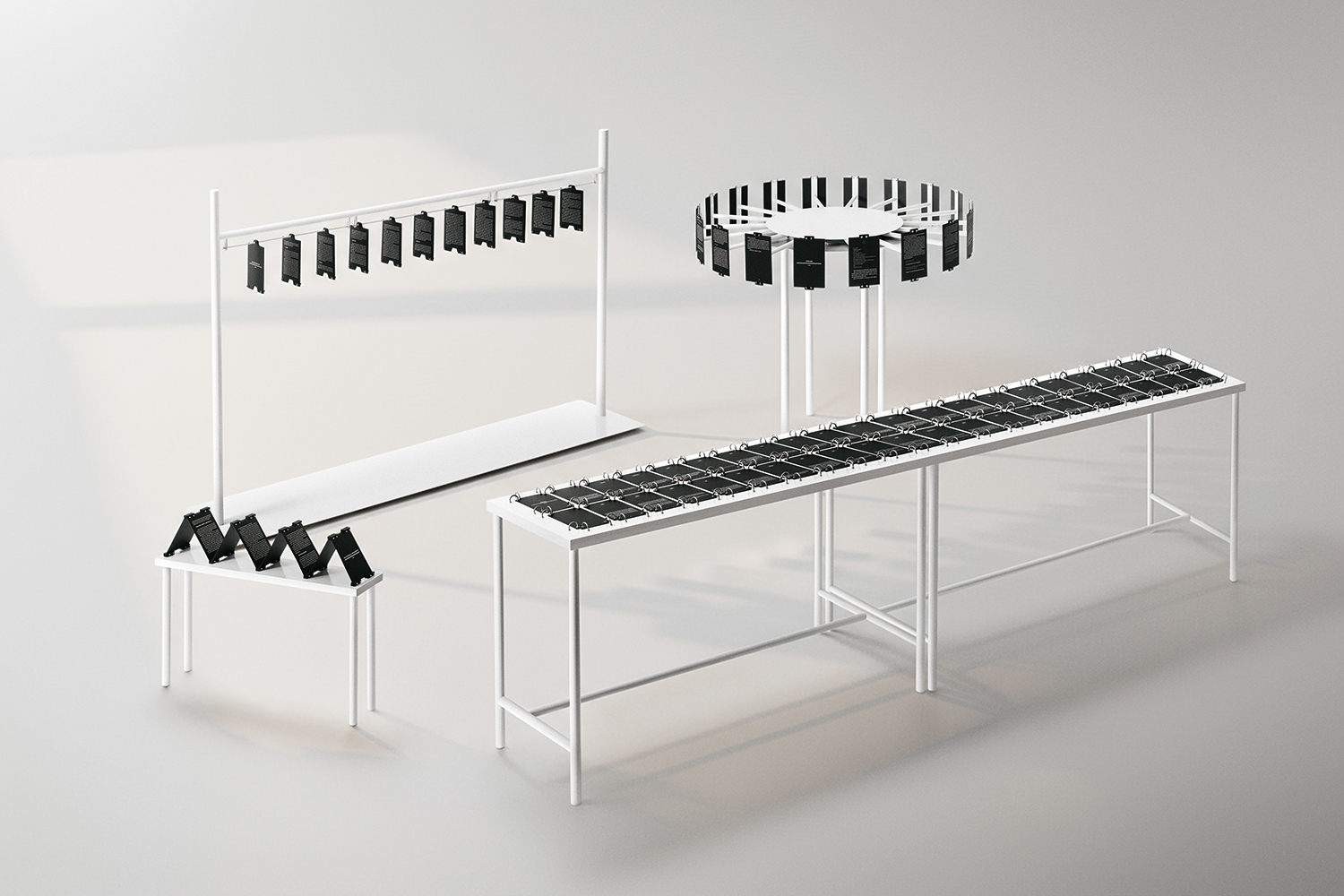
Kim Sungwoo, Keem Youngle, Jeon Byung Geun, Kim Choyeop: Four authors featured in AABB’s Leaning On, Held By, Hanging From, and Swayed By
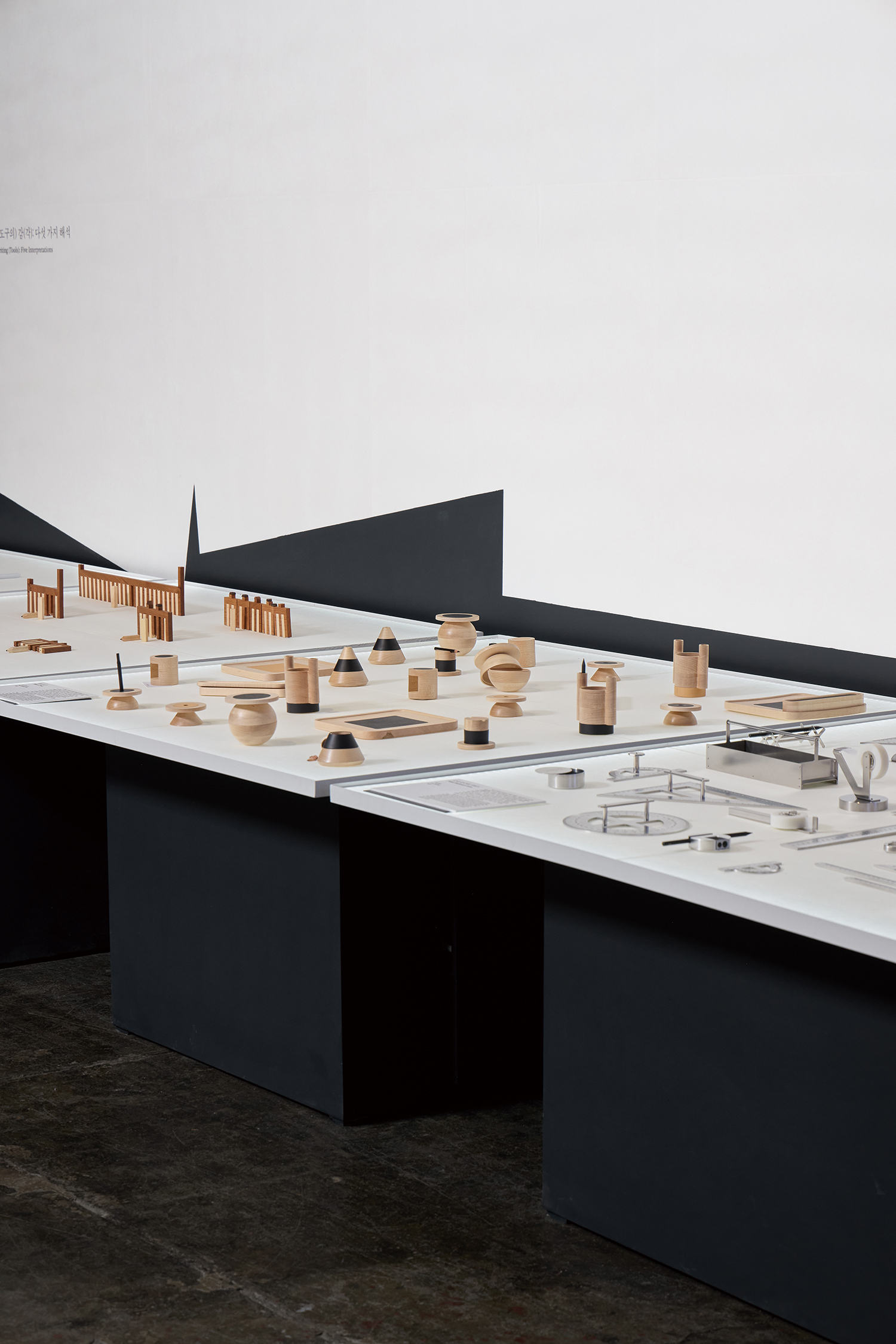
Commissioned works exploring writing tools: Mind Studio’s Joy of Writing Together (left), BE FORMATIVE’s Moeum Tools (middle), Lee Junhee’s Metal Stationery Series (right)
AABB’s work, focused on the form of the ‘tools for containing’, departs from conventional formats of ‘book’. Black panels, fabricated as individual units resembling book pages, serve as basic modules that are arranged, tilted, stacked on tables, or suspended, allowing for variable configurations. The relationship between writing, the tools of writing, and the tools for containment is articulated across four stages, ranging from the modest to the radical. Leaning On (Kim Sungwoo, Deeply Personal Reasons to Keep Writing in My Own Language) offers a mutually complementary reading of this relationship. By contrast, Held By (Keem Youngle, Dictionary of Traces) describes a condition in which the tool of containment begins to exert a degree of control; Hanging From (Jeon Byung Geun, The Sensibility of Writing and the Thinking Human) presents a relationship of subordination to the tool of containment; and Swayed By (Kim Choyeop, Sagak’s Escape) depicts a state that moves beyond subordination into one of complete control. As a result, viewers are no longer able to read comfortably by turning pages with their hands or following lines of text with their eyes; instead, they must physically adjust their bodies—moving, bending, and repositioning themselves according to the height and angle of each work. An early design premise – that graphics and sculpture are not fundamentally different – thus evolves into the concept of a ‘book read with the body’.
While most of the works in the exhibition position the subject of writing as the sender, AABB’s project subtly shifts the angle to foreground the receiver’s position, expanding the discussion to how text is read and sensorially experienced through mediation. Perhaps this work offers the most precise response to another narrative strand that the exhibition leaves implicit: the inevitable question of the sensory experience of reading that follows the sensory experience of writing. Visitors are encouraged to devote ample time to reading this work – composed of four texts and the tools that contain them – which offers both the first and last greeting at the entrance to the exhibition.

Seok Jaewon’s Hangul Grotesque (left) and Major Minority’s The Art of Writing: An Aaccidental History of Shorthand (right)
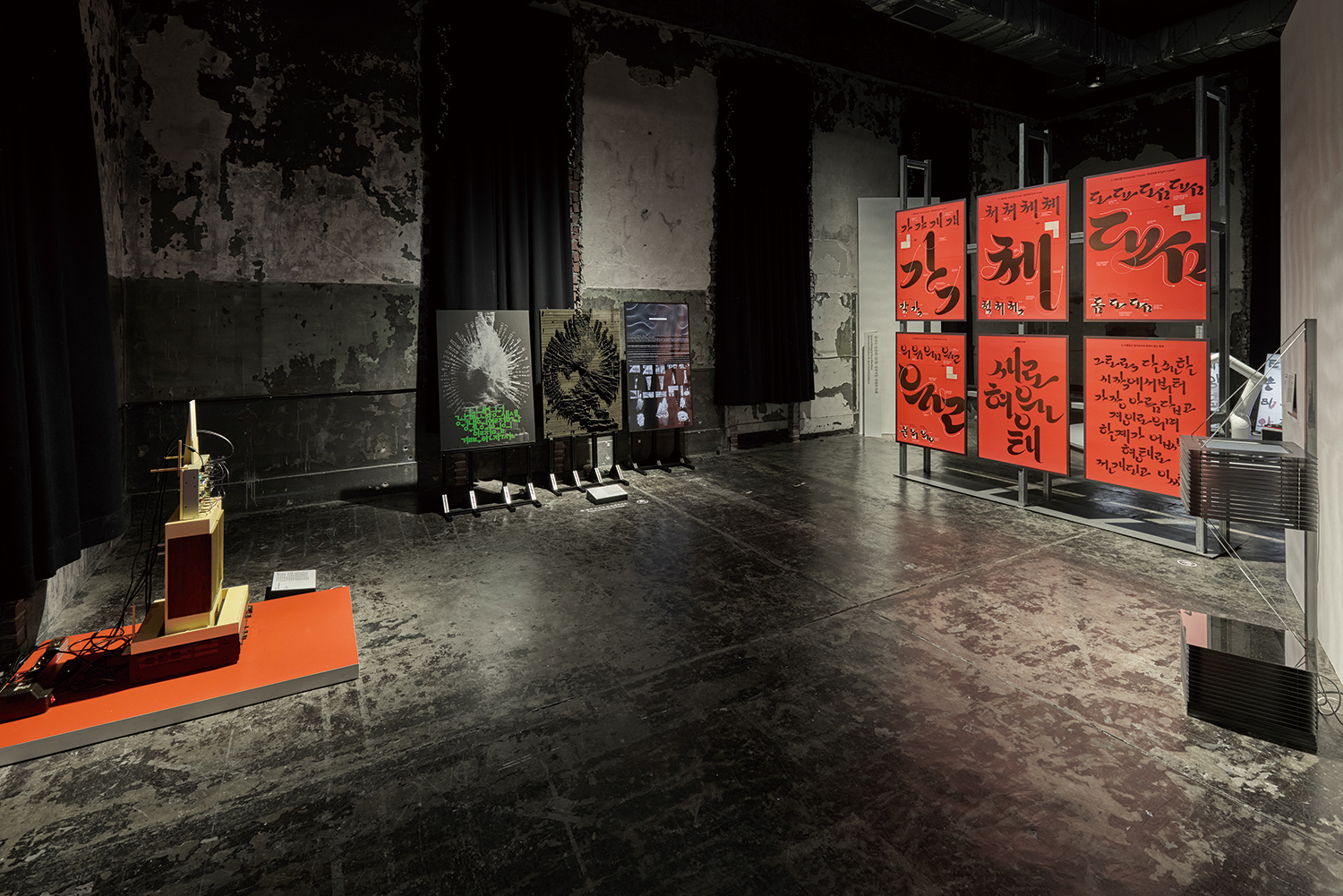
The work in the middle is Park Yun Hyeong’s Data Artifacts: Variable Radius Circle. It demonstrates the process of decomposing sentences by the writer Yi Sang (1910 – 1937) using artificial intelligence, converting them sequentially into text–image–3D object. The six orange panels installed on the right are LIFT-OFF’s Hangeul in Another Time. It reconfigures the form of Hangeul characters imagining ‘How Hangeul might have evolved if brushes had been used whilst writing horizontally?’