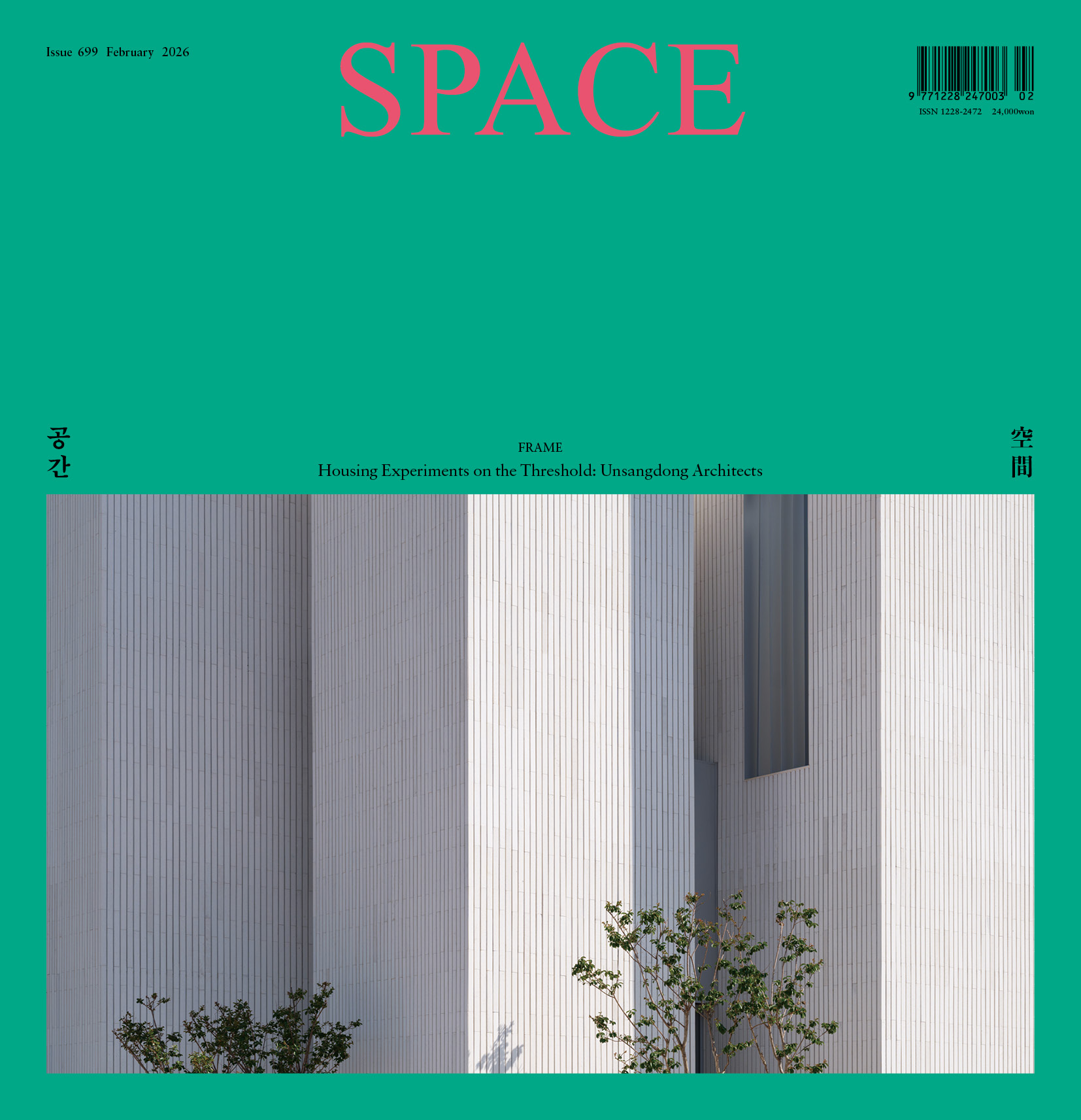

SPACE February 2026 (No. 699)
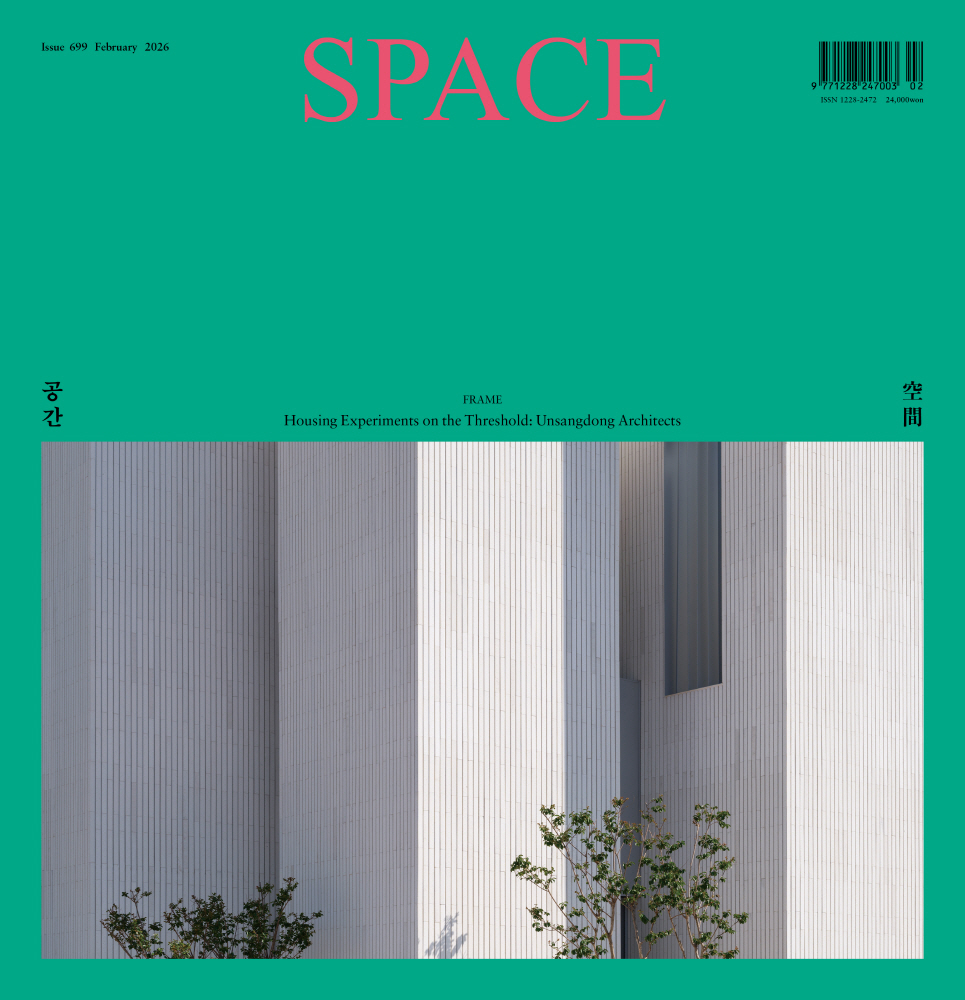
What Makes Unsangdong’s Housing Experiments Truly ‘Experimental’?
Housing has always been central to architectural thinking; the routes towards it, however, are multiple. In this issue’s FRAME section, we examine contemporary approaches to the dwelling through the housing projects of Unsangdong Architects (hereinafter Unsangdong). Put differently, this is an attempt to read Unsangdong’s architecture through housing of varied types and scales—such as single-family housing, rowhousing, and collective housing. One might question whether Unsangdong represents the forefront of housing design in Korea, or whether housing can be said to shape their practice as a whole. Given Unsangdong’s persistent use of the term ‘experiment’ to describe its work, these projects repay closer scrutiny. Having met at Artech architects & partners (Principal, Kim Kwanseok), Jang Yoongyoo and Shin Changhoon have jointly steered Unsangdong since 2000. Occupying a distinctive position between the atelier and the large-scale office, they have consistently treated a wide range of housing types as objects of experimentation. In the realm of housing, however, for an experiment to be viable requires both strategic acuity and decisive action—qualities that can penetrate the narrow gaps within a reality shaped by dense regulations, ingrained conventions, and layered social desires. Even when unrealised, bold initiatives at the conceptual level tend to carry a critical stance towards reality. Moreover, given that solutions capable of transcending market logics are rarely achievable, even in response to long-standing issues widely acknowledged within the architectural profession, attempts to rethink housing inevitably assume the character of an experiment.
Cube House (2023), a single house; Quarter House (2025), a row-housing project in which five families live both separately and together; Godeok Pungkyeongchae Urbanity (2024), a large apartment complex; and Busan EDC Smart Village (2021, hereinafter the Smart Village), a testbed for environmentally friendly and smart technologies: these four housing projects presented in this issue demonstrate a spectrum so broad that it is hard to believe that they can be attributed to a single practice. At the same time, certain recurring tendencies can be discerned across Unsangdong’s work. These include redefining typologies by retaining only their underlying concepts, focusing intently on a single architectural element such as a wall or a roof, decisively abandoning details that are difficult to realise at a high level of completion, and advancing the view that a more desirable city emerges through the aggregation of finely divided blocks. Taken together, these positions give rise to a distinctive formal language. Within the broader tendency in contemporary Korean architecture to pursue refinement through materiality and detail, this approach clearly constitutes a core focus in Unsangdong’s architecture.
In their approach to house-building, Jang Yoongyoo and Shin Changhoon continually rethink the essential qualities and character of dwelling, foregrounding a range of values related to the relationship between city and nature, as well as to notions of community. The question, however, lies in how such aspirations can be made operative in reality. To discuss the real-world challenges and architectural themes confronted by the four projects presented in this issue, Lee Eunkyung (Principal, EMA Architects & Associates) and Yi Jaeone (Principal, Urban Architecture Station Architects) were invited to join the two architects from Unsangdong. Much of their critical dialogue centres on the relationship between public and private space. Cube House is an exemplary case of a home shaped by the demand to protect privacy through a closed form, much like many single houses in new towns. Lee Eunkyung observes that, ‘Cube House maintains a closed form while preserving a connection to the exterior through a vertical incision, thereby demonstrating an attitude towards the public that differs from conventional insularity’. The mode of selective sharing discussed in Quarter House extends, in Godeok Pungkyeongchae Urbanity, into a typological enquiry that seeks to move beyond the gated community within the context of privately developed apartment housing. The Smart Village, meanwhile, is a passive housing complex that integrates a wide range of technologies across energy production and everyday life. As is often the case with privately developed apartment estates, housing complexes premised on passive design or smart technologies likewise offer limited scope for architectural intervention. Having long pursued research into houses that generate energy, Unsangdong aims to demonstrate that architectural engagement capable of enriching everyday life remains possible beyond the established conventions of the passive house. Nevertheless, the fact that the testbed ultimately adheres to an approach similar to that of conventional new-town development once again brings into focus the deep-seated inertia that continues to shape our society’s understanding of housing. Thus, Unsangdong’s experimentation ‒ articulated through the assertion that ‘establishing institutional mechanisms for architects to engage directly with cities remains a distant goal, I am instead trying to explore urban and social dimensions from a fundamentally architectural standpoint’ ‒ remains vital and urgent.
Kim Jeoungeun Editor-in-Chief
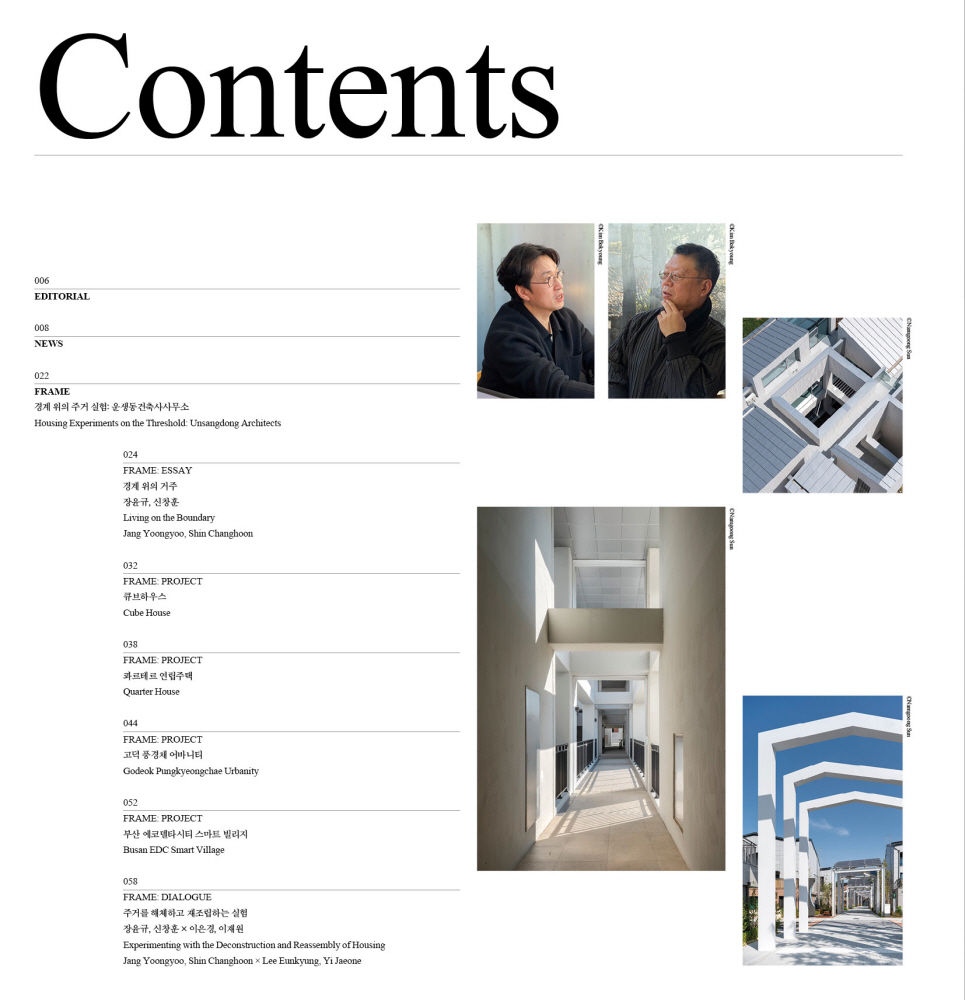
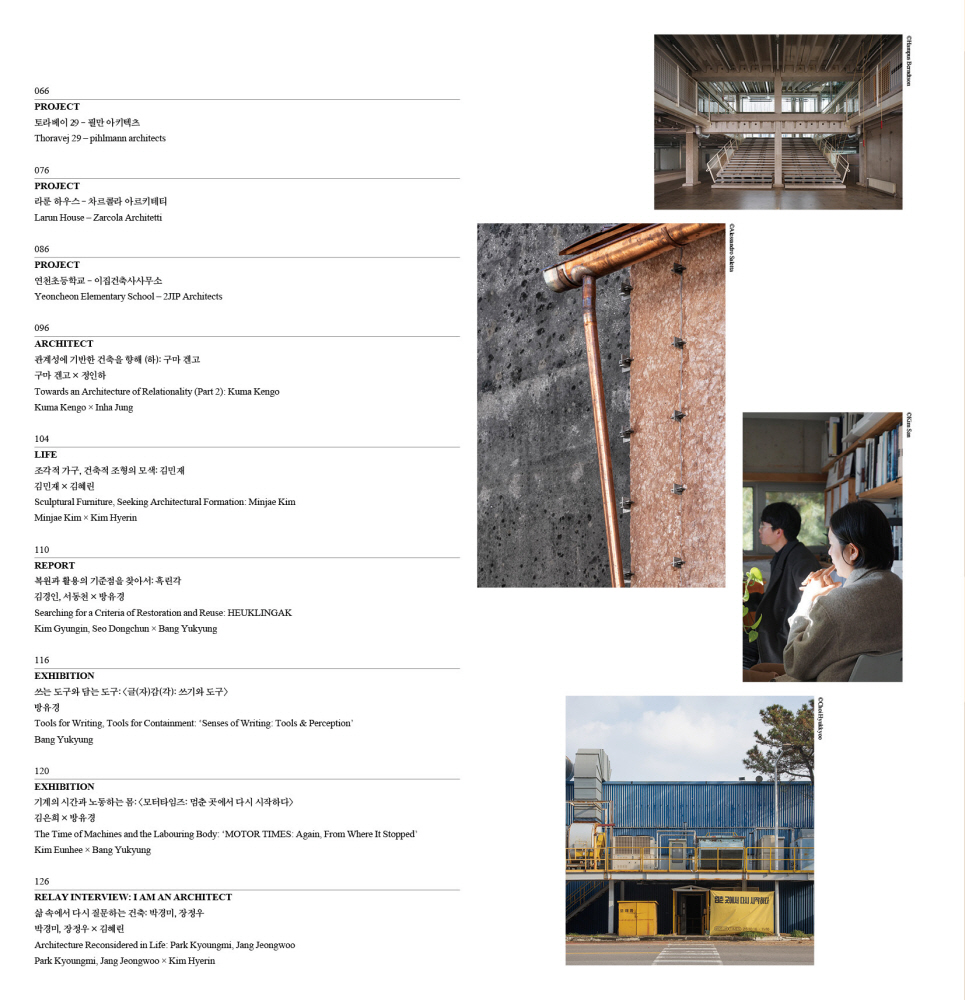
Contents | SPACE February 2026 (No. 699)
006 EDITORIAL
008 NEWS
022 FRAME
Housing Experiments on the Threshold: Unsangdong Architects
024 FRAME: ESSAY
Living on the Boundary_ Jang Yoongyoo, Shin Changhoon
032 FRAME: PROJECT
Cube House
038 FRAME: PROJECT
Quarter House
044 FRAME: PROJECT
Godeok Pungkyeongchae Urbanity
052 FRAME: PROJECT
Busan EDC Smart Village
058 FRAME: DIALOGUE
Experimenting with the Deconstruction and Reassembly of Housing_ Jang Yoongyoo, Shin Changhoon × Lee Eunkyung, Yi Jaeone
066 PROJECT
Thoravej 29 ‒ pihlmann architects
076 PROJECT
Larun House ‒ Zarcola Architetti
086 PROJECT
Yeoncheon Elementary School ‒ 2JIP Architects
096 ARCHITECT
Towards an Architecture of Relationality (Part 2): Kuma Kengo_ Kuma Kengo × Inha Jung
104 LIFE
Sculptural Furniture, Seeking Architectural Formation: Minjae Kim_ Minjae Kim × Kim Hyerin
110 REPORT
Searching for a Criteria of Restoration and Reuse: HEUKLINGAK_ Kim Gyungin, Seo Dongchun × Bang Yukyung
116 EXHIBITION
Tools for Writing, Tools for Containment: ‘Senses of Writing: Tools & Perception’_ Bang Yukyung
120 EXHIBITION
The Time of Machines and the Labouring Body: ‘MOTOR TIMES: Again, From Where It Stopped’_ Kim Eunhee × Bang Yukyung
126 RELAY INTERVIEW: I AM AN ARCHITECT
Architecture Reconsidered in Life: Park Kyoungmi, Jang Jeongwoo_ Park Kyoungmi, Jang Jeongwoo × Kim Hyerin