
SPACE April 2026 (No. 701)
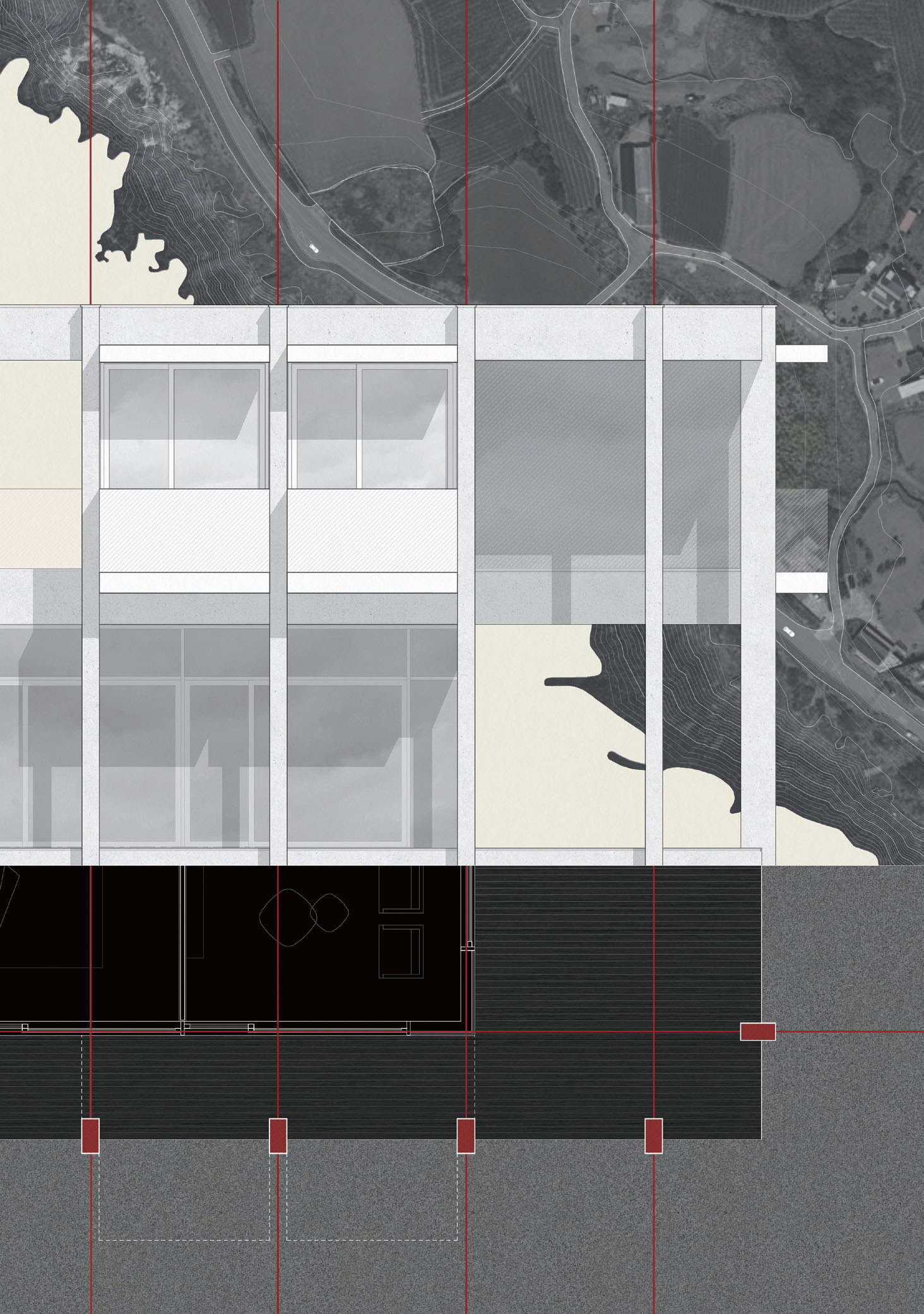
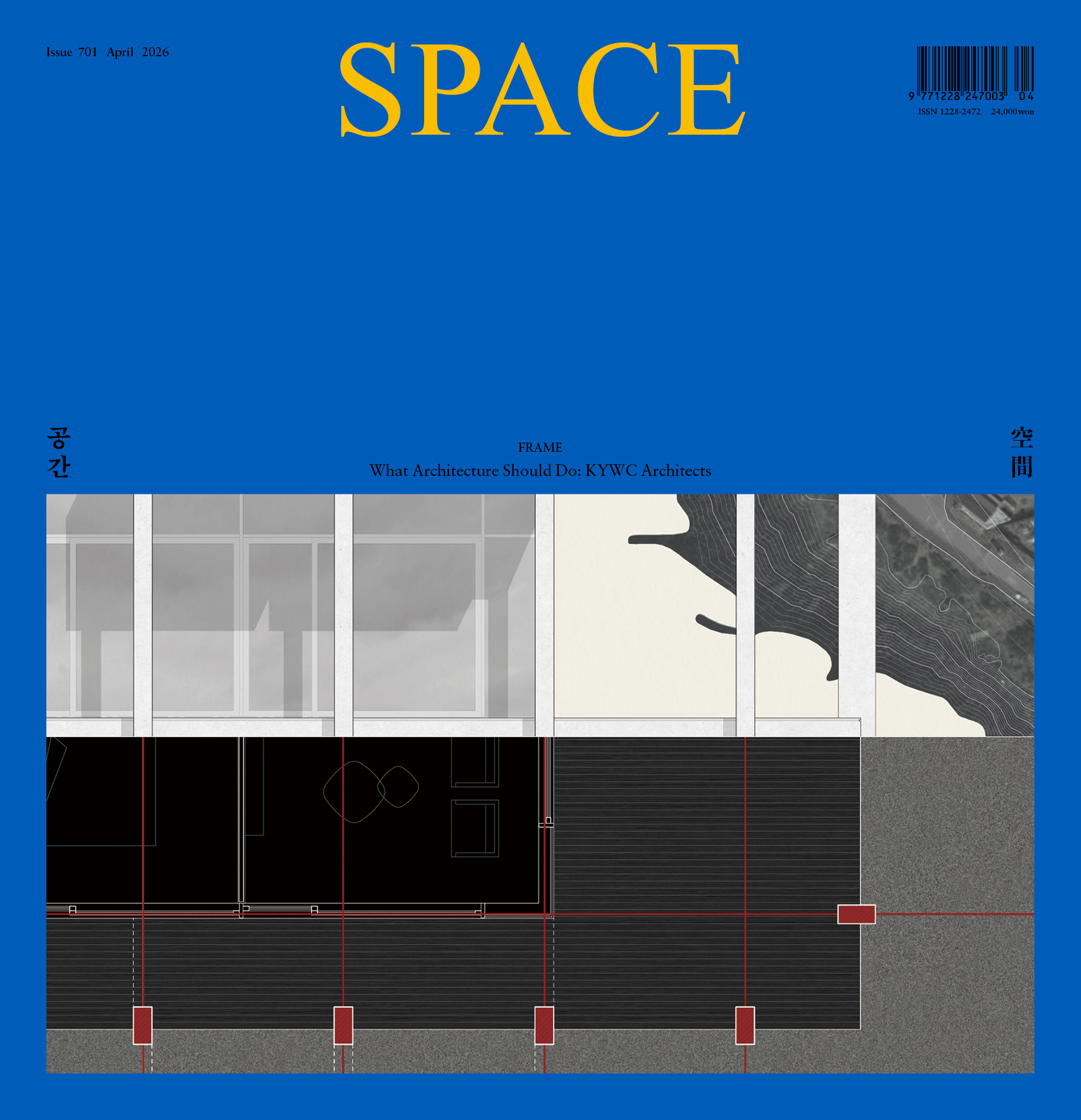
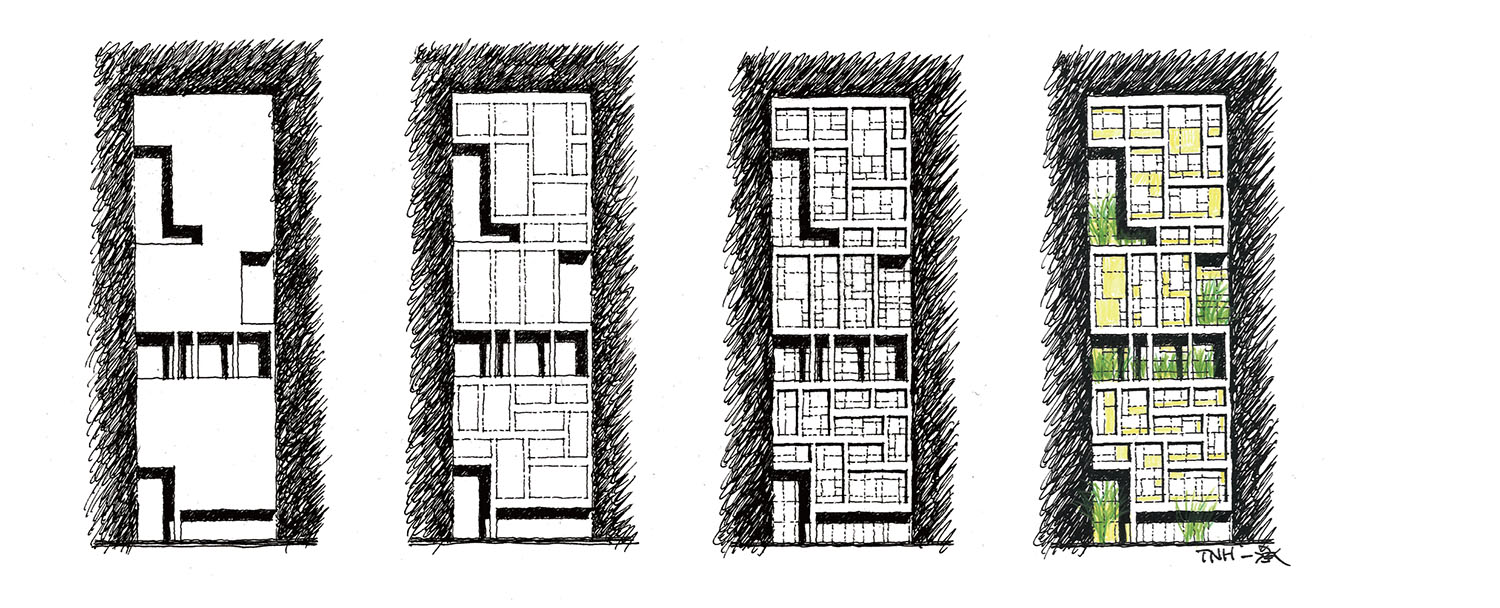
신도리 워케이션 오피스(2024) 콜라주
What Is Explored Through Architecture
When Minimal Design Is Required
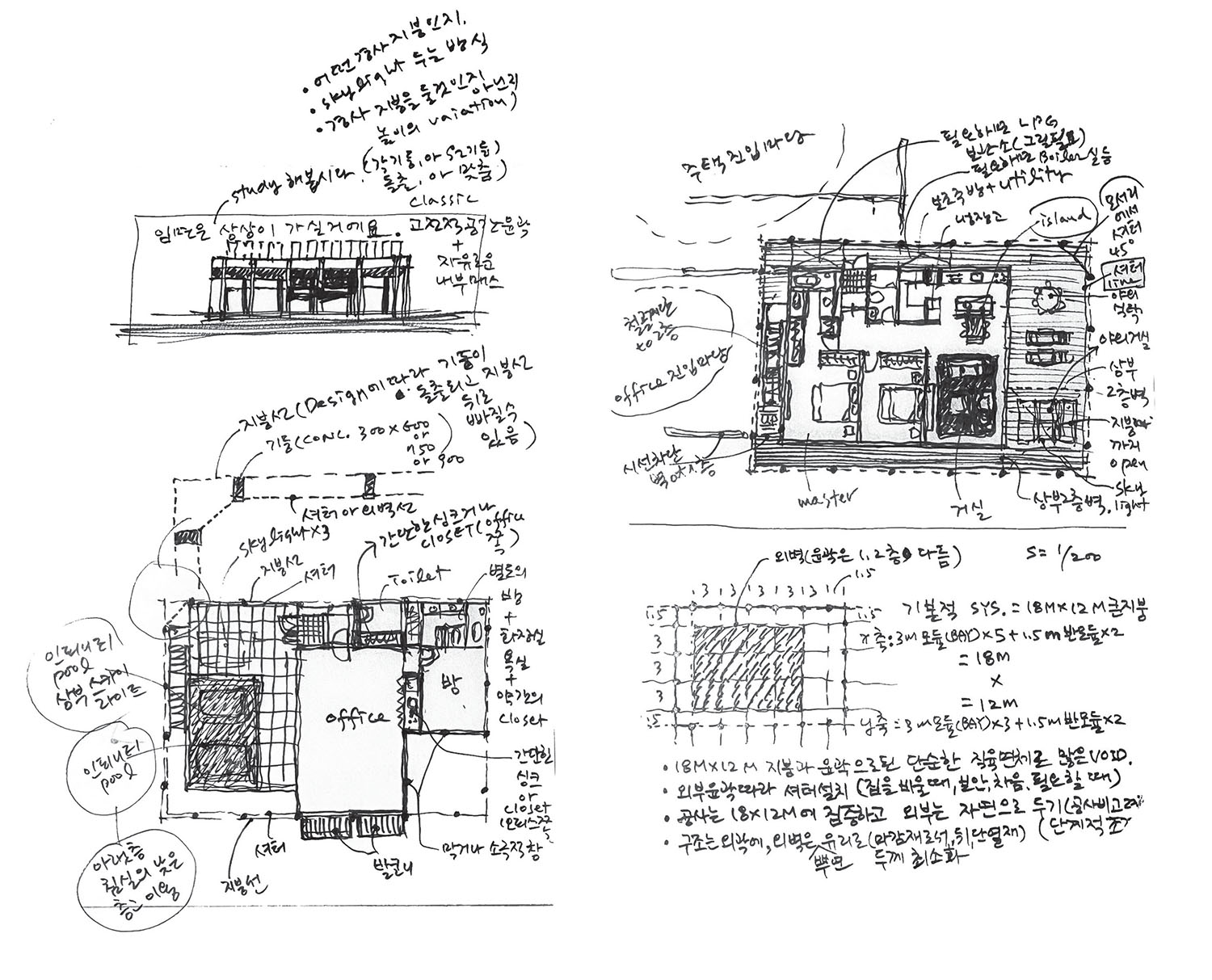
신도리 워케이션 오피스 스케치
Constructing Spatial Systems Through Structure and Revealing Them Through Form
The spatial layout of offices changes constantly. Today’s companies frequently reorganise their business divisions and internal structures. This is why many offices adopt large open floor plans. In designing offices, I do not stop at addressing the general requirements of efficient planning and flexible space. Instead, I explore ways of aligning the organisation of interior space with the structural system and to integrate that structural system with the external form. Through this process, the first stage of the task given to the architect can be completed.
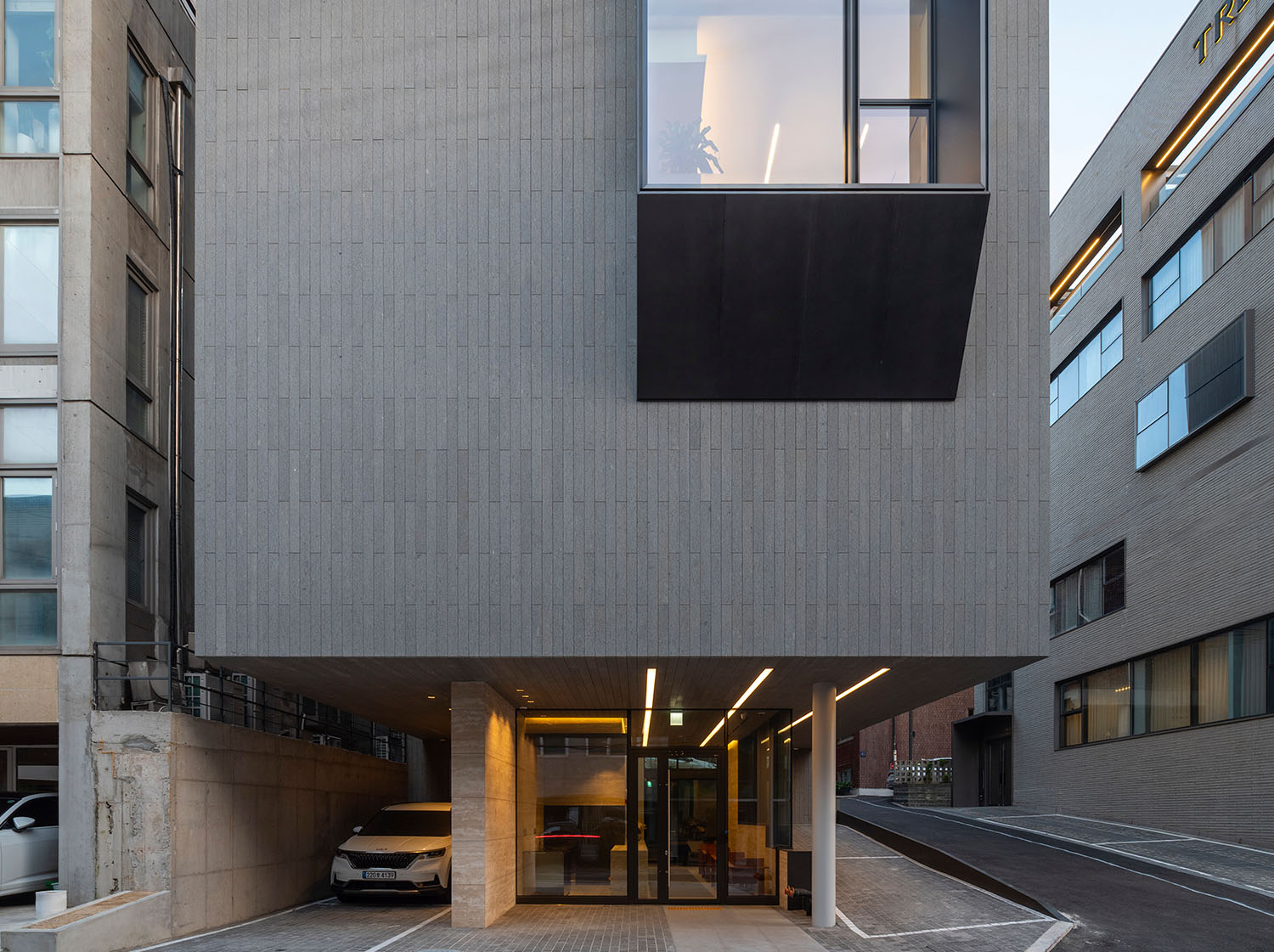
At the ZYX Technology Office (2024) and The Nature Holdings Office (2025), a flexible spatial layout was possible because there were no columns or walls within the office space. To create this column-free interior, all structural loads were resolved at the perimeter walls. At the ZYX Technology Office, a concrete box bears the structure while creating a clean interior space. The concrete box, lifted into the air, is supported by cylindrical columns and travertine walls at ground level, forming a piloti space.
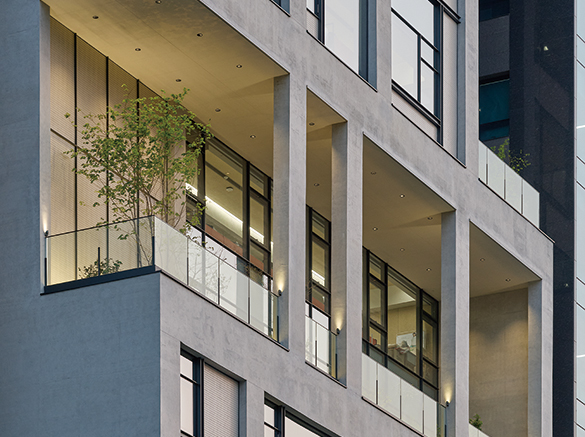
At The Nature Holdings Office, a large office space is created through an exposed concrete frame structure. The beam frame, organised only along the horizontal axis, gives direction to the interior space and forms a 3m-deep façade layer composed of a grid that resists lateral forces. This 3m-thick spatial layer is subdivided into multiple scales and forms complex relationships as it meets the interior spaces divided at consistent heights.
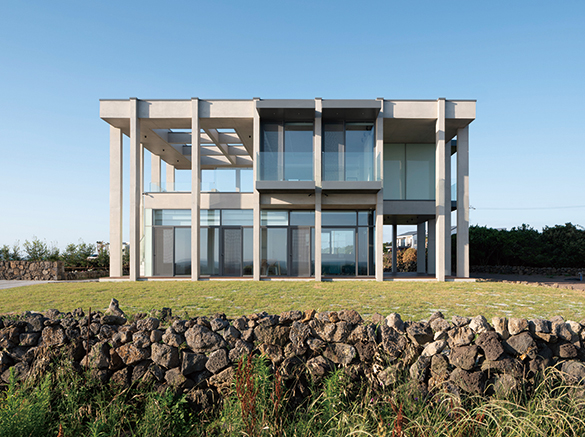
The Seogwipo Samda Building (2024) has a wide but irregular plan due to the shape of the site. To shape the irregular spatial outline, a combination of column-frame structure and structural walls was used. This hybrid structural system is expressed through the combination of an open curtain wall and enclosed thin tile walls.Sindori Workation Office (2024) – designed for a work and vacation programme – unfolds its interior and exterior spaces within a 3 × 5 modular concrete frame. It is a simple form in which the structural system and spatial system are integrated into one. Recalling the proportions and composition of classical architecture, a glass mass is combined with the concrete frame.
Creating an order for interior space through a concrete architectural language, integrating that order into a structural system, and ultimately revealing that order and system through form—this is the essential task unique to the architect. Of all the agents involved in the making of architecture, only the architect can accomplish this task. Through it, the narrative of architecture begins and the possibility of a guiding aesthetic emerges.
Based on the order of space and the logic of structure, the architect organises the spatial programme, responds to the environment and landscape, and develops its details. Only through this process does architecture finally reveal itself to the world.
 더네이쳐홀딩스 사옥(2025) 스케치
Organising Multi-Layered Spatial Programmes
When architects deal with spatial programmes, they take on the role of a coordinator. In exploring a programme, they come to understand the operational structure of an organisation and the ways of life of its members. Defining the size and function of spaces and determining their spatial layout means classifying and distributing the resource called ‘space’. Classification and distribution are, in essence, both professional tasks and political acts.
Even though the office building is an architectural typology that accommodates the single function of office work, users demand a variety of spatial conditions. Because different activities – work and rest, individual tasks and meetings – intersect, the office building unfolds as a multilayered programme as in many other buildings, and appears as a sectional composition of layered spaces.
The Nature Holdings Office contains a variety of spatial interfaces. The large open spaces on the first and second floors function as both a showcase and exhibition space for the fashion brand launched by the company. The third floor is a meeting space where clients and employees of partner companies are received, while the twelfth floor is an exhibition and assembly space that can host fashion shows or large gatherings. On the fourteenth floor, a dining hall and lounge for employees are provided.
The ZYX Technology Office constructs a spatial narrative of hospitality from the entrance to the office floors. A café that doubles as a lobby sits beneath the piloti, allowing employees to enjoy a cup of coffee on their way to work. The elevator hall opens into a refreshing double-height space, connected to a sunken garden and a small atrium. A basement level prepared for public education programmes functions as an interface between the company and society. The rooftop is designed as an outdoor garden composed of two levels. Although it is a relatively small office building, a variety of programmes unfold in a three-dimensional manner.
Seogwipo Samda Building consists largely of a leased office space and therefore accommodates indeterminate programmes. Nevertheless, the roles of the lower and upper zones are clearly distinguished. Up to the fourth floor, the lower portion opens into an atrium space. By drawing a pedestrian route linking the central plaza of Seogwipo and Seogwipo City Hall into the building and opening the central space vertically, a multilayered space is created.
The Sindori Workation Office, designed for a work and vacation programme, organises the first floor as a living space and the second floor as a working space. A wide and tall loggia is placed on the south side of the living room, and a small pool is located on the terrace connected to the office. In this way, the beautiful landscape of Jeju can be experienced in different ways.
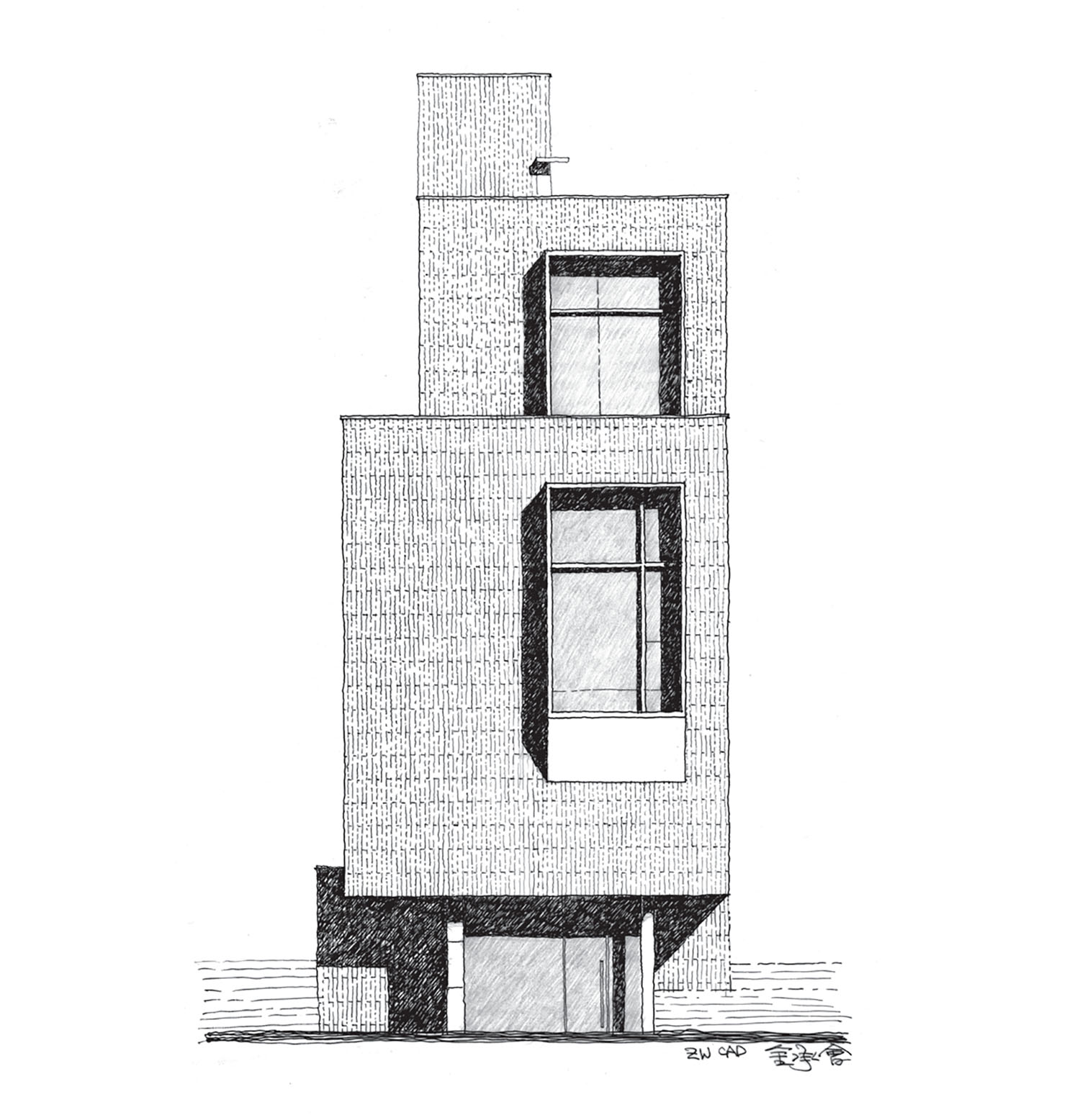
Sketch of ZYX Technology Office (2024)
Designing Architectural Devices That Respond to Environment and Landscape
The moment architecture settles on a particular site and is placed within the context that surrounds it, it becomes more than a place of dwelling; it becomes a device that responds to its environment and landscape. In regions with frequent rain and snow, sloped roofs appear, while in places with strong sunlight deep eaves are formed. Buildings located on a plaza stand on their sites differently from those situated in a cul-de-sac. One must decide what to open and where to close, and determine which materials should be used and at what scale they should be made to harmonise with their surroundings. As architecture responds to the surrounding environment and landscape, its pose – how it situates itself on the ground – emerges, and it acquires an particular expression.
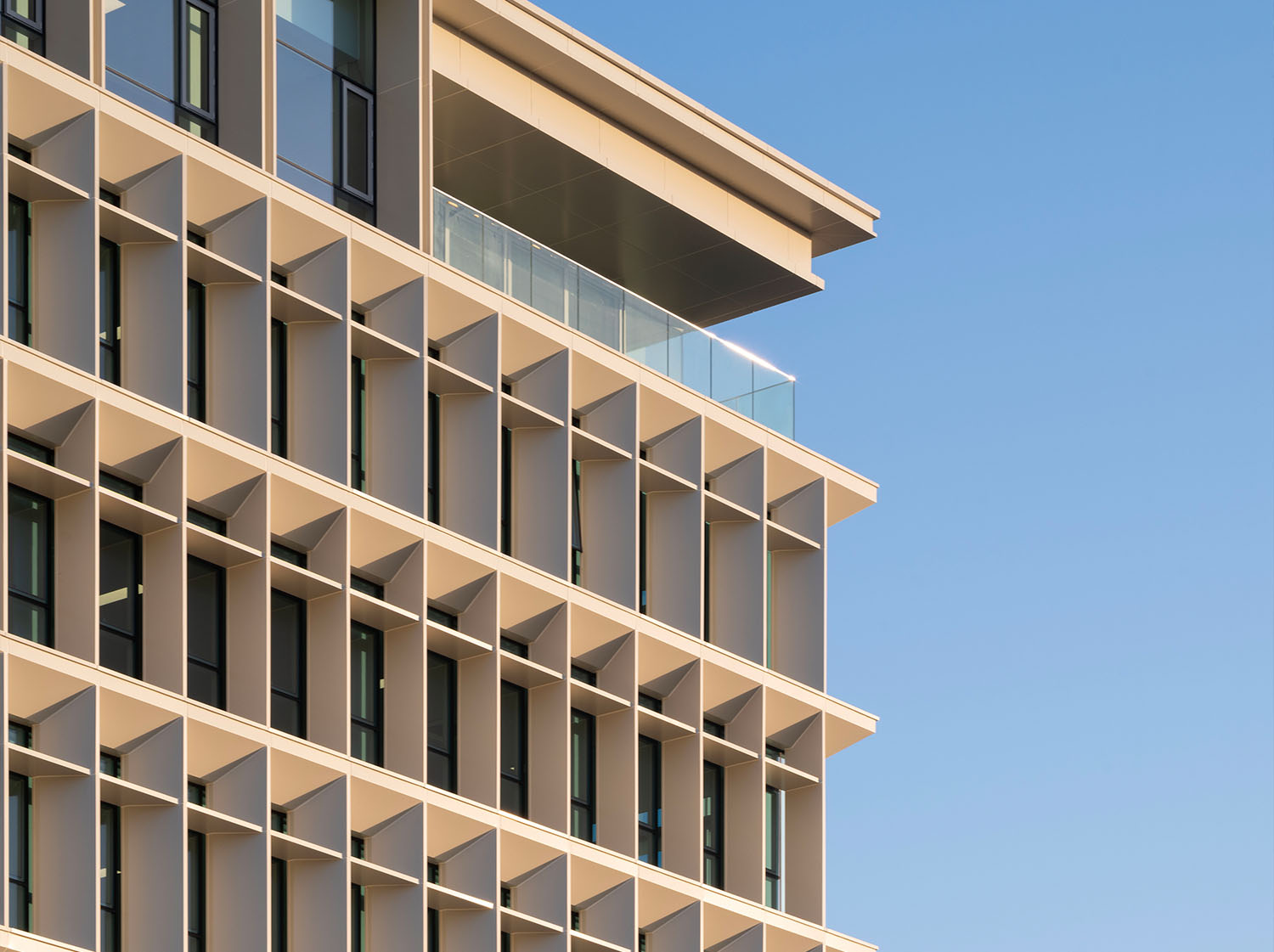
Seogwipo Samda Building faces the First Plaza of Seogwipo in Jeju. Because of the importance of this location, special efforts were devoted to refining the façade. Aluminum louvers that cast deep shadows were installed on the elevation facing the plaza. The repeated deep shadows give the plaza a three-dimensional expression. At the same time, a two-storey circular space responding to the corner was introduced so that the building could assume an appropriate posture for a corner site. The strong frontality of the Seogwipo Samda Building derives from the location of the First Plaza of Seogwipo, which rests against Hallasan Mountain and looks out toward the Pacific Ocean.
The ZYX Technology Office stands at the corner of a back street and responds to the atmosphere of the alley. To achieve this, the mass was articulated so that the building would appear modest when viewed from the street. The box was lifted from the ground on a piloti, and the large opening created beneath the raised mass was offered to the street, forming a loggia that engages in dialogue with the urban scene. Recalling Benjamin’s remark that ‘the god of the city dwells in the loggia,’ I wanted to create an open void within the city.The Sindori Coast in Jeju, where dolphins occasionally appear, is always beautiful. The shoreline is appealing, but the distant peaks of the oreum (volcanic cone) are equally striking. At the Sindori Workation Office, I sought to bring this beautiful landscape into the building. As the area frequently suffers from typhoons, an appropriate distance was required between the building and the harsher elements of the natural environment. I explored an architectural form capable of accommodating this contradictory demand—to invite the landscape in while at the same time maintaining a distance from it. A clear and composed outline was set upon the site, contrasting with the rugged coastline and the soft barley fields. A two-storey concrete colonnade surrounds the building, creating a cloister that mediates between interior and exterior. Basalt walls form an ordered courtyard that contrasts with the wild nature beyond. Between the columns of the colonnade, Hallasan Mountain, the oreum, and the blue sea unfold like a six-panel folding screen. Through the process of responding to environment and landscape, the order of space and structure is reconfigured to form the building’s pose, and with the addition of refined details, architecture finally takes shape with its own expression.
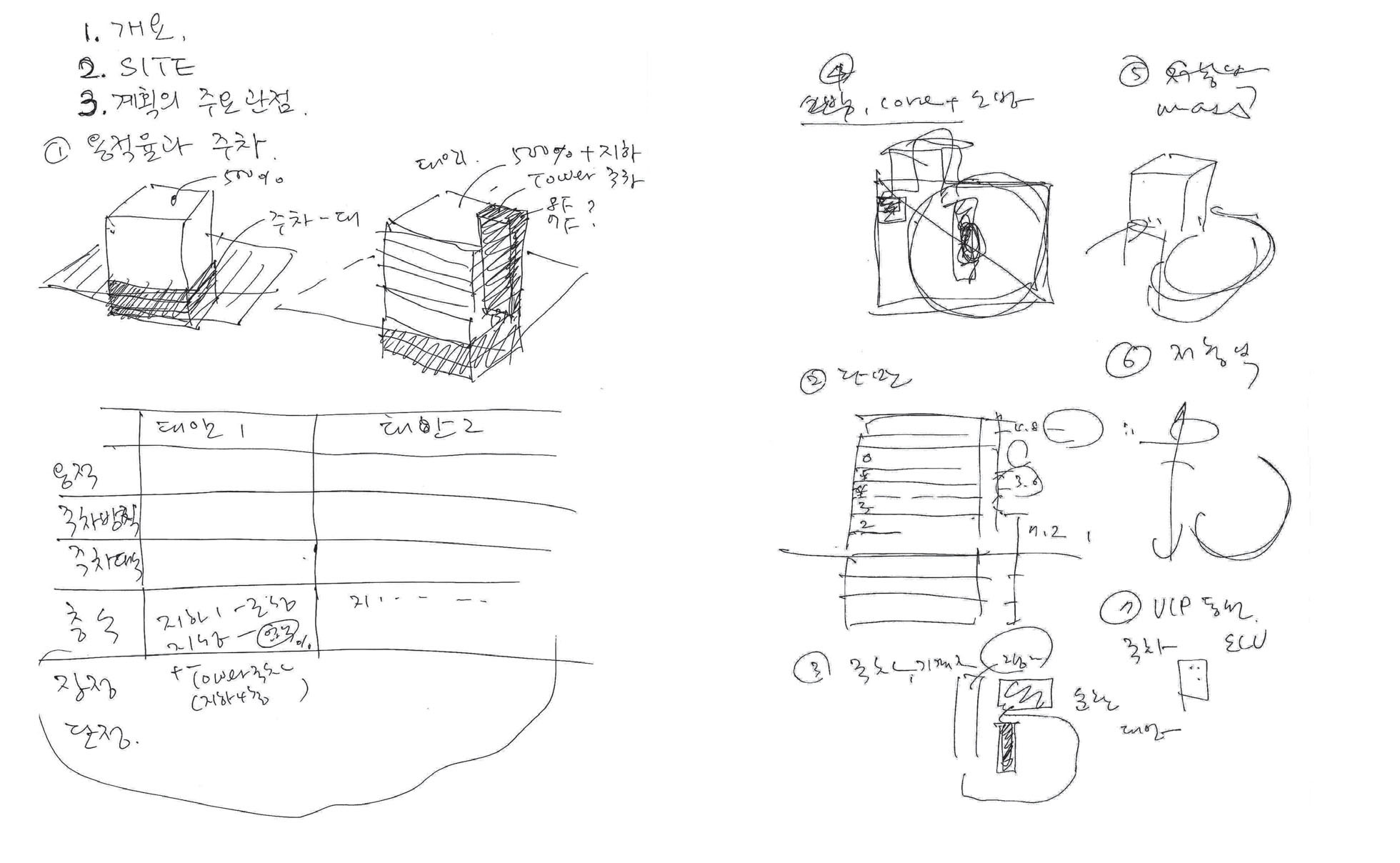
Sketches of Seogwipo Samda Building (2024)
Inscribing Detail into Architecture
Like writing a letter by hand, architects inscribe careful details into their buildings. Time is always limited and budgets are fixed, making it difficult to realise as many details as one might wish. Yet remembering that detail determines the level of architecture, I tried to devise and implement at least one more meaningful detail wherever possible.
When designing the Seogwipo Samda Building, I focused on the details of the façade facing the plaza. I wanted to reveal the bright light of Seogwipo three-dimensionally through shadow. The façade was formed with a grid of louvers. The inclination of the louvers changes on alternating floors, responding to the views approaching from both sides of the plaza. On the corner’s circular mass, a moiré pattern was created using a double layer of mesh. Through the façade defined by light and shadow and the corner mass with its moiré pattern, the First Plaza of Seogwipo acquires a face and an expression.
The Nature Holdings Office is also a building in which the façade plays an important role. Because the building sits between adjacent parcels, it is perceived from the street primarily through its façade. I developed details that create openings of various sizes within a concrete frame. The aluminum subframes inserted within the concrete grid introduce a finer scale. Within these subframes, the surfaces are further divided into windows and tiled wall panels, creating a gradual hierarchy of structure and materials – concrete frame, aluminum frame, window, tiled wall, and tile module – across the façade. Details responding to multiple scales give the simple form of the building a rich texture and a musical rhythm. At the ZYX Technology Office, dark gray basalt was used as the primary material for the exterior walls. The stone was cut into pieces 12cm wide and 1.2m long, creating a texture and scale reminiscent of wooden siding. The projecting colour-finished stainless steel details attached to the basalt mass were shaped with the finest possible profile and contour that metal could achieve. These refined details in stone and metal clearly demonstrate the level of completion of the building.
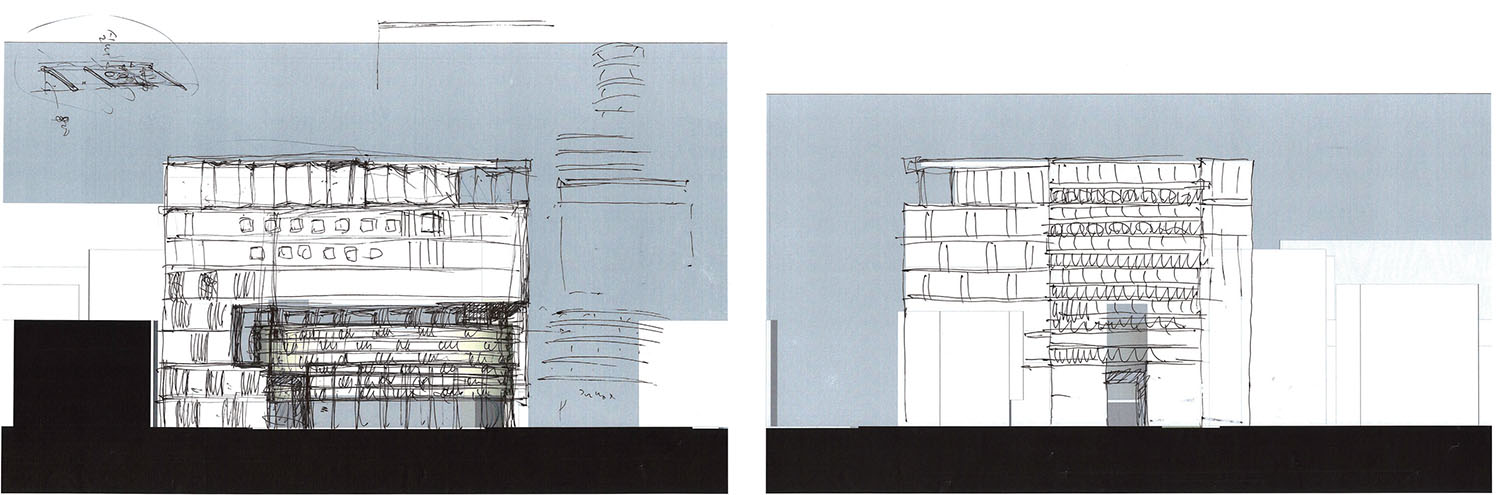
Sketches of Seogwipo Samda Building (2024)
The Work an Architect Ought to Do
Through the FRAME features, I have presented several themes that continue to interest me. In ‘Depth of Surface, Potential of Space’ (covered in SPACE No. 632) and ‘Constructing ‘Construction’’ (covered in SPACE No. 658), I discussed ideas about what might be called the flesh and bones of architecture. In this issue, I have attempted to reflect on the work of the architect.
When I write down what I believe to be the work of the architect, they turn out to be things that are quite ordinary and self-evident. They are tasks that only architects can do, and tasks that they ought to do. To construct space and establish structure, and to reveal them as a formal order; to organise diverse programs and place them within space; to devise architectural devices that respond to environment and landscape; and to resolve them through detailed articulation. All of these are pursuits that architects have followed for a long time. Through their work, architects give form to their beliefs and values. In relation to the many issues our time faces – environment and labour, publicness and hospitality, the distribution of social assets, privacy and community – architects can pursue the values of themselves and of the society to which they belong through the language of architecture.
I have written about the work of the architect partly because I wished to revisit the state of mind I had when I first began architecture. At the same time, I wanted to say, ‘No, that is not the case,’ in response to the tendency for architecture to be rapidly consumed and discarded as visual images, and to the futile practice of reducing architecture to a few photographs. The work of the architect is far greater, broader, and deeper than what appears in photographs.