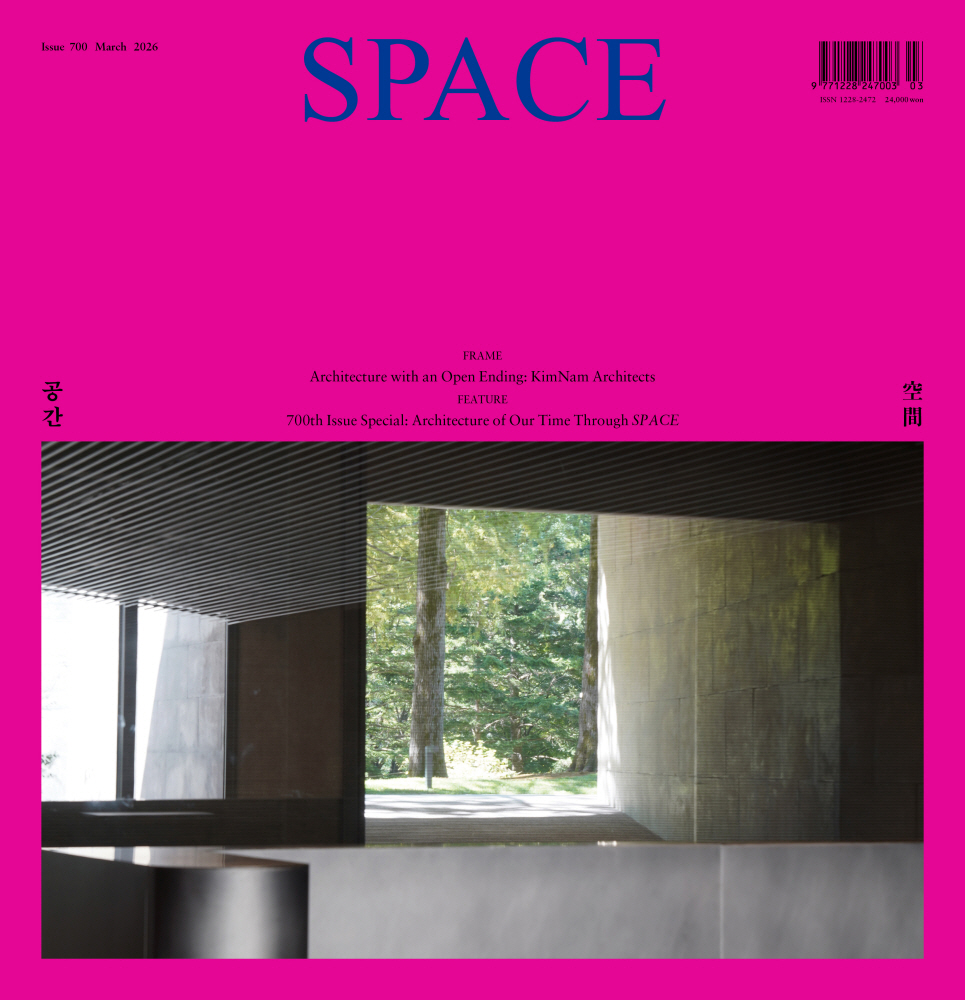

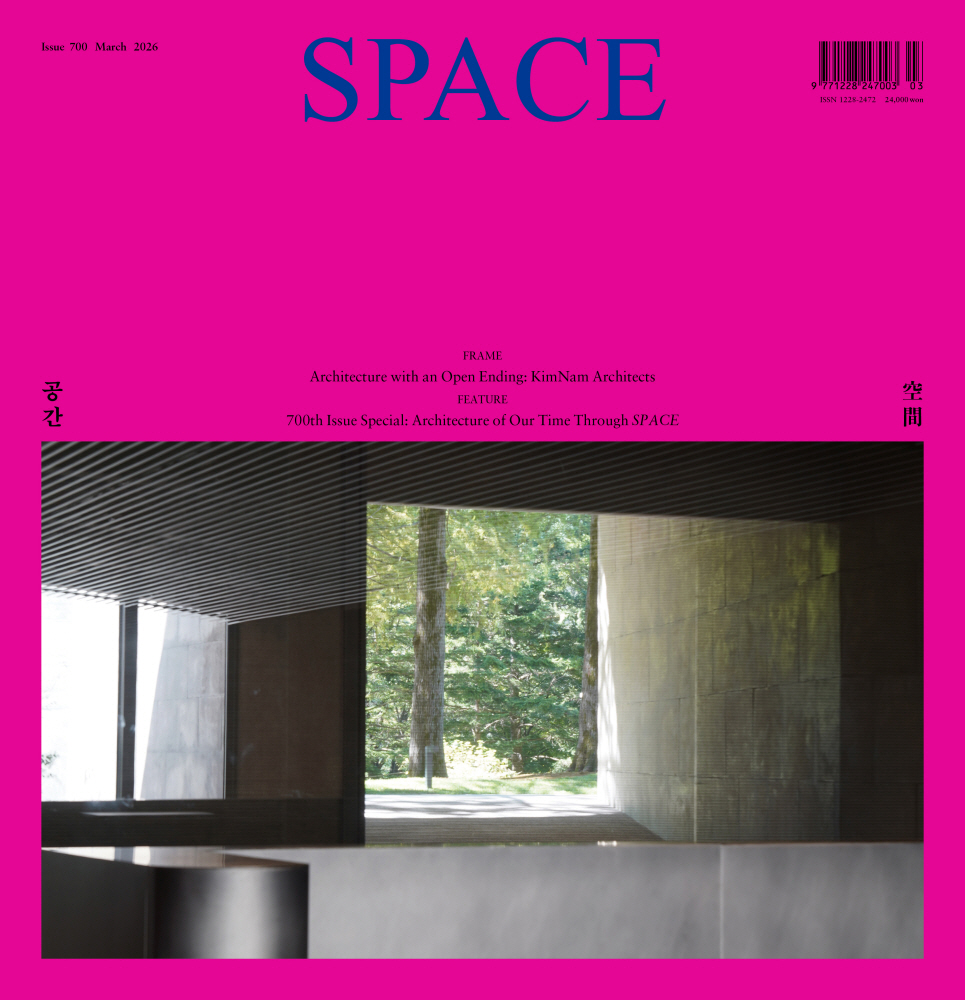
SPACE March 2026 (No. 700)
Questioning Architecture of Our Time
Although generational theory was a dubious tool, [...] Gwak came to accept that, if anyone could claim ownership of the word ‘contemporary’, teenagers had a greater share in it than he did.
_ Kim Kitae, ‘Universal Liberal Arts’, Two People’s International (Munhakdongne, 2024).
Youth does not always signify the new, nor does novelty automatically amount to progress. Even so, the line quoted from the short story above invites a nod of agreement. Few would dispute the notion that to understand Korean architecture of our time we must also look at the world as younger architects see it. This March issue marks the 700th issue of SPACE, which celebrates its 60th anniversary this year. Across these 700 issues lie clues to understanding the contemporary—scattered like beads yet to be strung together. From these countless fragments, which should we select to assemble a representative collage of the contemporary? The 700th issue special feature, ‘Architecture of Our Time Through SPACE’ (though not conceived with this intention in mind at the article’s conception) ultimately grants a substantial share of its space to younger architects.
Yim Dongwoo (Professor, Hongik University), together with his graduate students, has translated thousands of projects published in SPACE as raw data, categorising them using variables such as programme, scale, location, and construction methods. Interpreting the indicators that emerge across the different periods, he traces the broad trajectories of contemporary Korean architecture. At the same time, as a member of the generation currently active and in practice, Yim may also, implicitly, be reading these indicators through the sensibilities of a contemporary participant. He pays close attention to shifts in architectural education and institutional frameworks, and traces correlations between changes in demographic structure, as well as considering how SPACE ‒ long regarded as a platform for so-called authorial architecture ‒ has related and framed its selection of projects. Projects published in SPACE have, over the past six decades, both detailed the history of territorial development in Korea and reflected the dominant preoccupations in the architectural field. At times, however, they have also drawn different contours shaped by the values of the editorial team of the period. The data can be read in two ways: on the one hand suggesting that, since the 2000s, Korean architecture has become ‘smaller, more dispersed, and more diversified’, or indicating that SPACE has increasingly turned its attention to these architectural modes and forms. Yim leaves this set of indicators open to future reinterpretation, proposing an open-ended conclusion. The Korean architectural scene today has entered an unprecedented phase in which three to four generations are active simultaneously. It is therefore difficult to confine Yim’s observations to younger architects. Even so, the course and pace of change appears to be more closely aligned with the emergent trajectories of younger practitioners.
If Yim approaches contemporaneity through a diachronic analysis, Kim Jeoungeun attempts it through a transversal mode of reading. In her essay, ‘What Kind of Projects Are Published in SPACE?’, she revisits a number of works encountered over the past seven to eight years—works met within a temporal horizon still legible as the ‘present’. Through keywords such as agency in architecture, structure, materials and materiality, memory, and collectivity, she reads the contours of recent architecture. To read the contemporary is, ultimately, to prepare questions oriented toward the future. For instance, the significance of examining how currents in contemporary Korean architecture intersect with ‒ and diverge from ‒ global tendencies may lie less in measuring how closely we align ourselves with those currents than in discerning where the gaps emerge and what they might signify. It may also take the form of asking whether our meagre material conditions and social perceptions constitute limitations to be overcome or provide the ground upon which to establish a distinctive character. Throughout the coming year, SPACE will pursue such questions, and this journey will culminate with the November issue marking our 60th anniversary.
At the same time, we will not neglect our responsibility to seek out architecture that shatters the horizon of the contemporary by delineating its own piercing, distinctive paths. In this spirit, the FRAME section of this issue presents three projects by KimNam Architects (Co-Principals, Kim Jinhyu, Nam Hojin)—Hoam Cafe, Incheon International Airport Cargo Lounge, and Hyundai Department Store Valet Lounge. As Mihn Hyunjun (Professor, Hongik University) puts it, these works may at first glance appear trivial or minor, yet they propose a methodology that has the potential to be expanded to larger-scale architectural thinking.
Editor-in-Chief Kim Jeoungeun
Contents | SPACE March 2026 (No. 700)
006 FROM THE PUBLISHER
008 EDITORIAL
010 NEWS
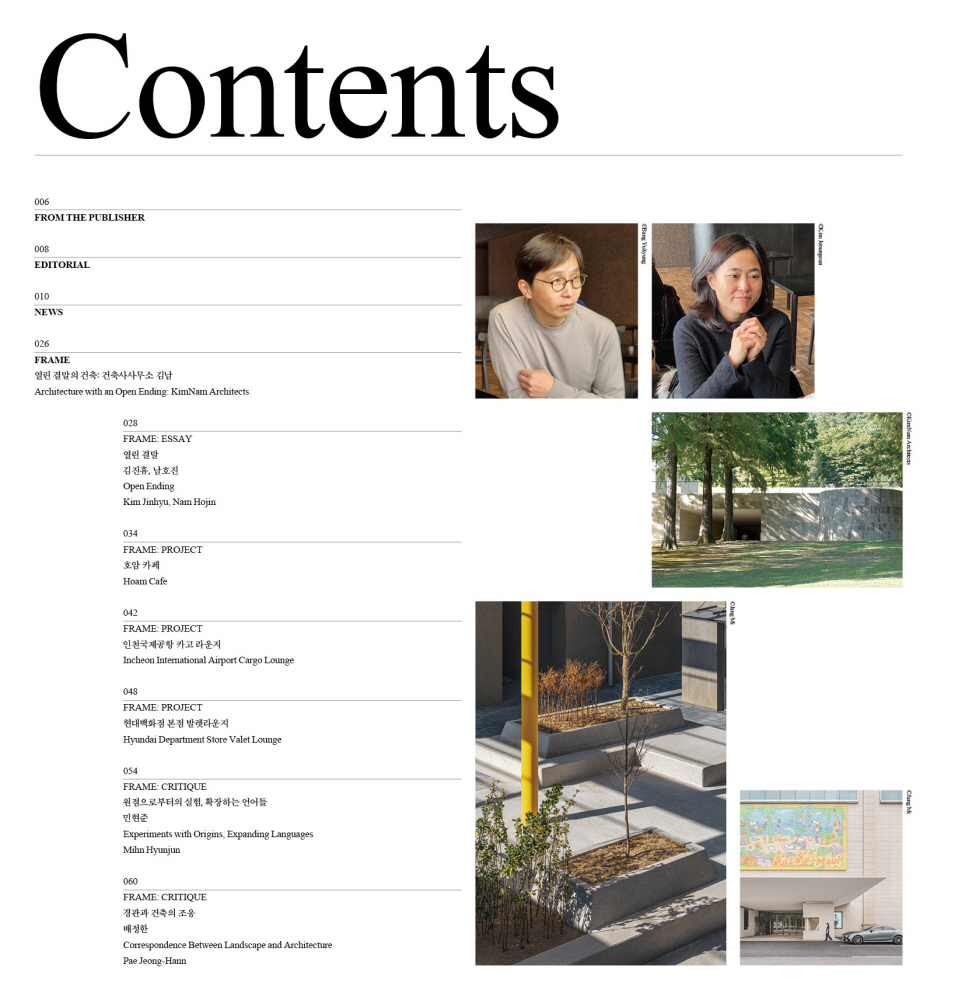
026 FRAME
Architecture with an Open Ending: KimNam Architects
028 FRAME: ESSAY
Open Ending_ Kim Jinhyu, Nam Hojin
034 FRAME: PROJECT
Hoam Cafe
042 FRAME: PROJECT
Incheon International Airport Cargo Lounge
048 FRAME: PROJECT
Hyundai Department Store Valet Lounge
054 FRAME: CRITIQUE
Experiments with Origins, Expanding Languages_ Mihn Hyunjun
060 FRAME: CRITIQUE
Correspondence Between Landscape and Architecture_ Pae Jeong-Hann
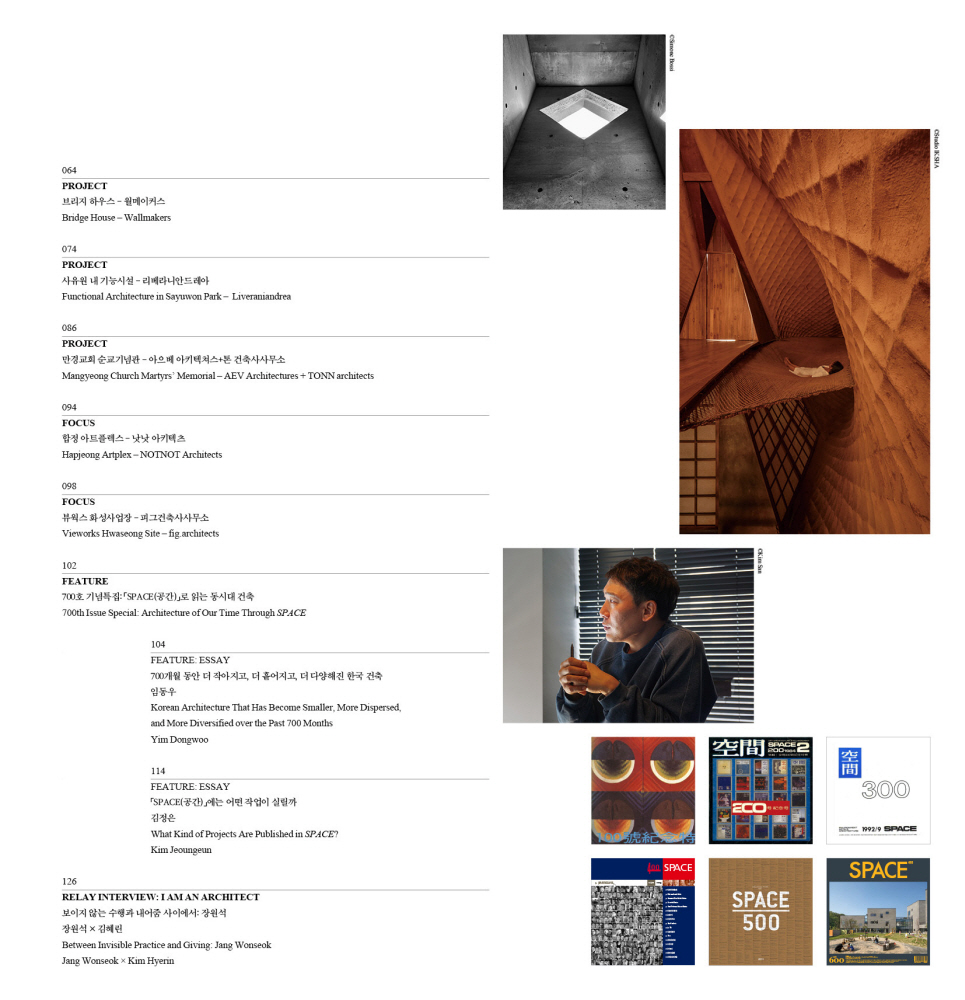
064 PROJECT
Bridge House ‒ Wallmakers
074 PROJECT
Functional Architecture in Sayuwon Park ‒ Liveraniandrea
086 PROJECT
Mangyeong Church Martyrs’ Memorial ‒ AEV Architectures + TONN architects
094 FOCUS
Hapjeong Artplex ‒ NOTNOT Architects
098 FOCUS
Vieworks Hwaseong Site ‒ fig.architects
102 FEATURE
700th Issue Special: Architecture of Our Time Through SPACE
104 FEATURE: ESSAY
Korean Architecture That Has Become Smaller, More Dispersed, and More Diversified over the Past 700 Months_ Yim Dongwoo
114 FEATURE: ESSAY
What Kind of Projects Are Published in SPACE?_ Kim Jeoungeun
126 RELAY INTERVIEW: I AM AN ARCHITECT
Between Invisible Practice and Giving: Jang Wonseok_ Jang Wonseok × Kim Hyerin