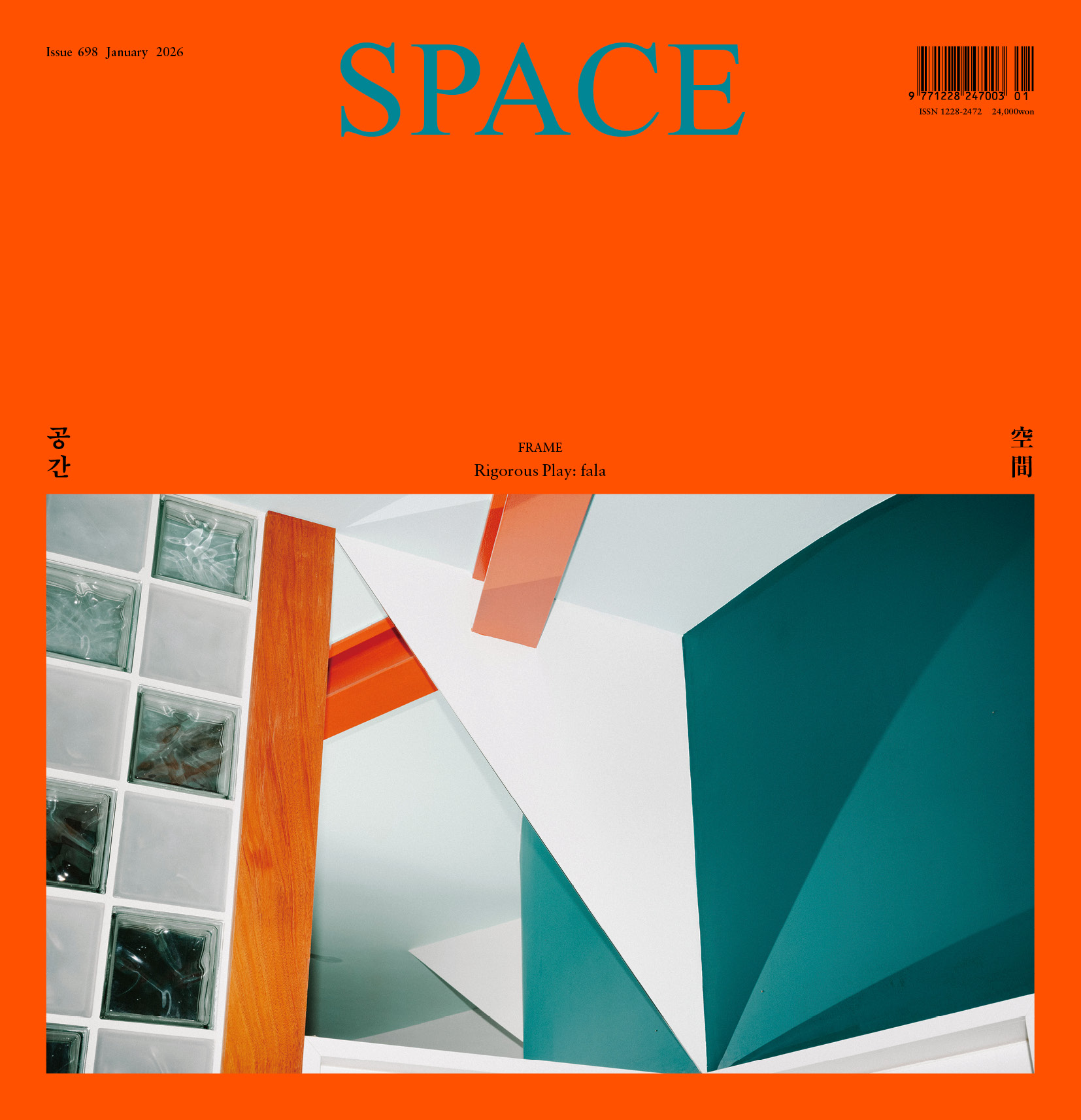

SPACE January 2026 (No. 698)
The First Wave of Deviation
The world that architects face today is no longer the one in which their teachers lived and worked. ‘Before the economic crisis, schools taught us that we were going to design museums, public buildings, and large-scale works of architecture. After graduation, however, Europe moved in the opposite direction’ (fala, refer to p. 64). This is a sentiment to which many architects can relate, wherever they may be practicing. Beyond the simple fact that opportunities have diminished, how can we continue to pursue the essence of architectural design without turning away from an extremely commercialised reality? In what ways can architecture today still change the world? Or is it, perhaps, too harsh to demand such an attitude from architects working under the present conditions?
In this issue, SPACE’s FRAME section introduces recent works by fala (Co-Principals, Filipe Magalhães, Ana Luisa Soares, Ahmed Belkhodja, Lera Samovich), a practice representing a new generation of architects from Portugal ‒ the homeland of Álvaro Siza ‒ and one that challenges the very notion of ‘serious architecture’. Pedro Ferreira, a Portuguese architect who practices and teaches in Korea, observes that in 2010s Porto ‒ transformed into a stage for aggressive real-estate speculation ‒ fala worked alongside pragmatic investors seeking ‘cheap, fast renovations’, deploying what he calls ‘inventive art’ to turn anonymous real-estate stock into a field open to architectural debate.
Founded in 2013, fala initially gained public resonance through small interior and residential renovation projects, leaving a striking impression by combining vivid colours, graphic collage, and a strict geometric language—maintaining their architectural criticality while engaging a broad audience. More than a decade on, their portfolio has expanded at times to include large-scale housing complexes and mixed-use projects. However, the same elements recur obsessively, repeatedly and with variation, as if drawn into a powerful centripetal force, thickening and reinforcing their conceptual framework.
This issue presents four recently completed works—143 (house around a column, 2025), 144 (house of three structures, 2025), 156 (cookie cutter retreat, 2024), and 171 (house of remarks, 2024). Numbered like chapters in an ongoing series, these projects recombine, cut, and playfully exaggerate fundamental architectural elements such as walls, windows, columns, and railings in unfamiliar ways. Project 156, in particular, literally inserts ‒ copy and paste ‒ fragments of plans by master architects such as Álvaro Siza, Ito Toyo, and Frank Gehry into a geometric system, subverting conventional modes of quotation and reference.
Suh Jaewon (Principal, aoa architects), who has been in dialogue with fala over the past several years, discusses through these conversations the relationship between their distinctive drawings, photographs, and architectural concepts, as well as questions of representation and fiction. In addition, echoing Pedro’s description ‒ ‘As architects born of a global movement, they selected their own lineage, making distant heroes feel as familiar as local ones’ ‒ the issue also touches on Japanese architects who influenced fala, including Shinohara Kazuo. (This makes for an intriguing comparison with the interview with Kuma Kengo, presented in two parts starting this issue, in which Kuma describes Shinohara Kazuo’s houses as the culmination of an abstract methodology, while also offering a critical view that calls for a more human-centred design approach—forthcoming in SPACE No. 699, ARCHITECT section).
fala describes itself as a ‘first wave’ seeking to establish its own mode of thinking and architectural practice within Porto’s architectural scene, long dominated by an aesthetic lineage represented by Álvaro Siza over the past half-century. As the first FRAME in SPACE’s 60th anniversary year in 2026, we hope that this dialogue crossing between Portugal and Korea will reach readers as a productive and resonant wave.
We also take this opportunity to announce the renewal in SPACE. To present a wider range of architectural works and ideas in more varied formats, we have introduced the FOCUS and ARCHITECT sections. In addition, the EXHIBITION section ‒ created to cover a broader spectrum of art-world news ‒ will concentrate on exhibition-related articles. We ask for our readers’ continued interest and support as SPACE, newly refined down to its editorial design, moves forward throughout this coming year.
Kim Jeoungeun Editor-in-Chief
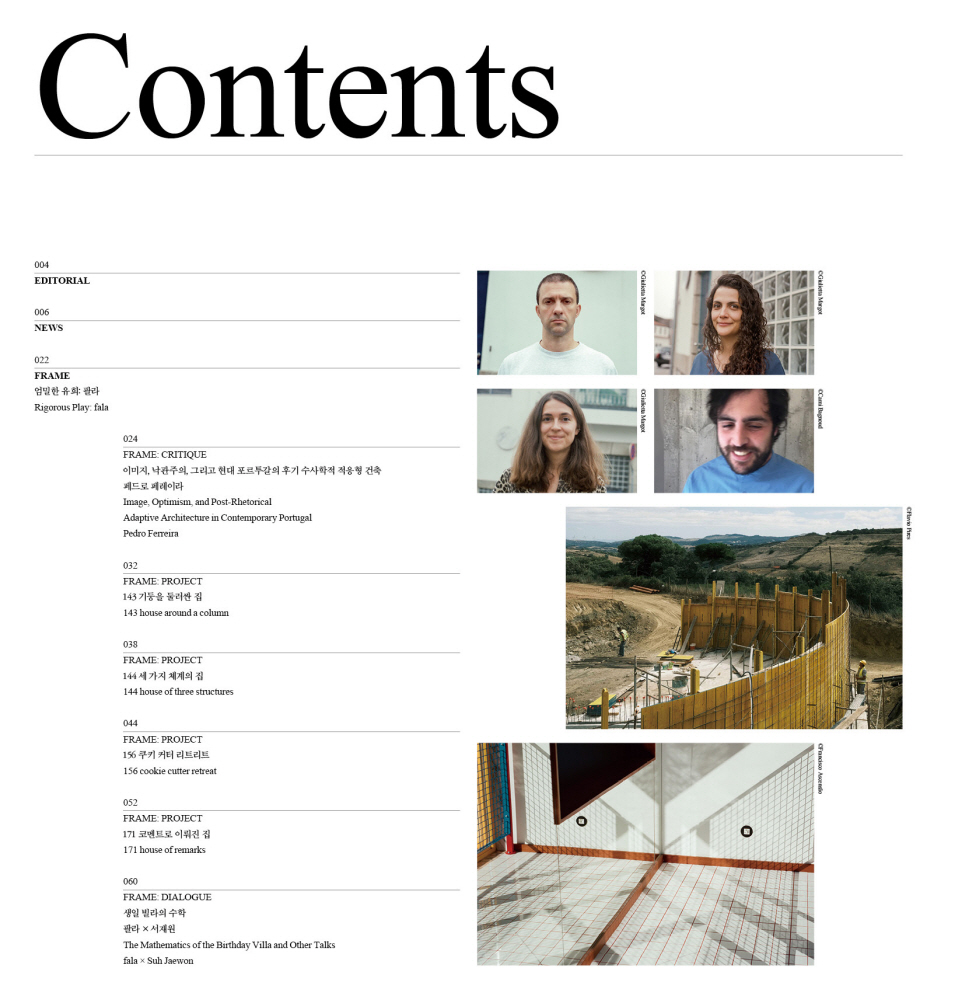
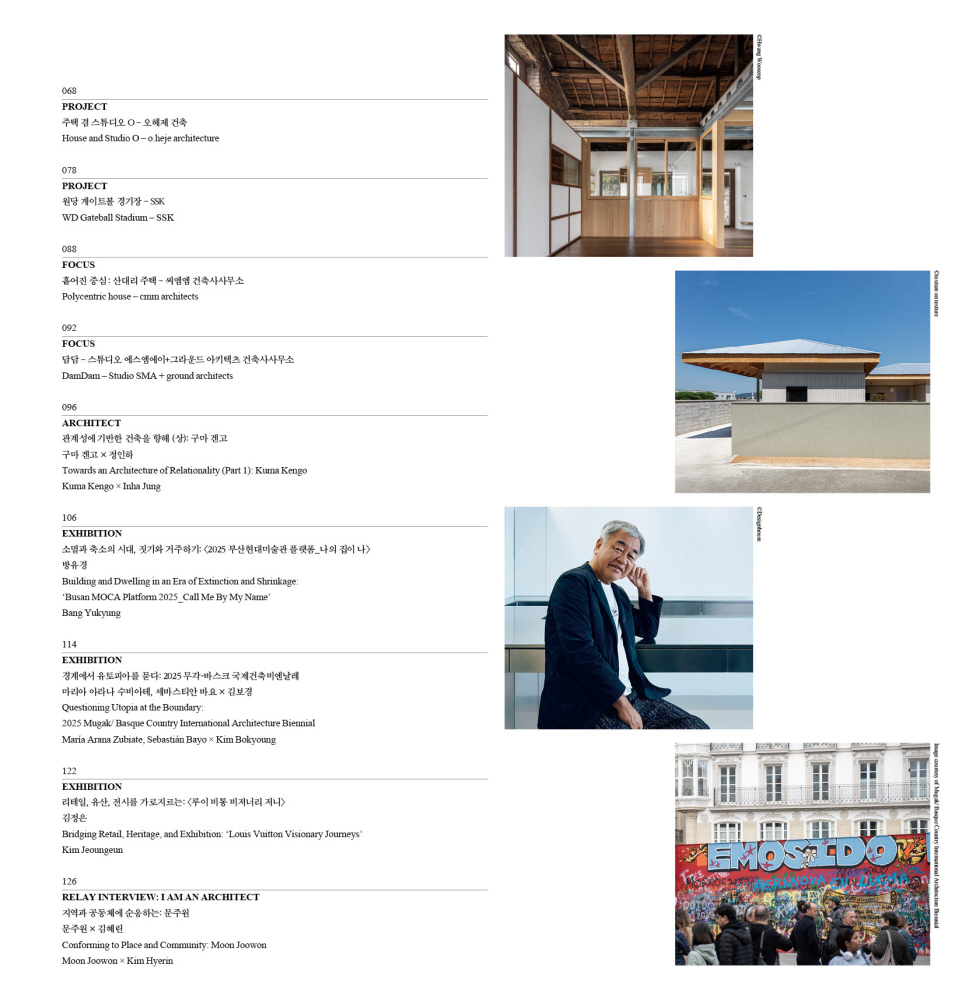
Contents | SPACE January 2026 (No. 698)
004 EDITORIAL
006 NEWS
022 FRAME
Rigorous Play: fala
024 FRAME: CRITIQUE
Image, Optimism, and Post-Rhetorical Adaptive Architecture in Contemporary Portugal_ Pedro Ferreira
032 FRAME: PROJECT
143 house around a column
038 FRAME: PROJECT
144 house of three structures
044 FRAME: PROJECT
156 cookie cutter retreat
052 FRAME: PROJECT
171 house of remarks
060 FRAME: DIALOGUE
The Mathematics of the Birthday Villa and Other Talks_ fala × Suh Jaewon
068 PROJECT
House and Studio O ‒ o.heje architecture
078 PROJECT
WD Gateball Stadium ‒ SSK
088 FOCUS
Polycentric house ‒ cmm architects
092 FOCUS
DamDam ‒ Studio SMA + ground architects
096 ARCHITECT
Towards an Architecture of Relationality (Part 1): Kuma Kengo_ Kuma Kengo × Inha Jung
106 EXHIBITION
Building and Dwelling in an Era of Extinction and Shrinkage: ‘Busan MOCA Platform 2025_Call Me By My Name’_ Bang Yukyung
114 EXHIBITION
Questioning Utopia at the Boundary: 2025 Mugak/ Basque Country International Architecture Biennial_ María Arana Zubiate, Sebastián Bayo × Kim Bokyoung
122 EXHIBITION
Bridging Retail, Heritage, and Exhibition: ‘Louis Vuitton Visionary Journeys’_ Kim Jeoungeun
126 RELAY INTERVIEW: I AM AN ARCHITECT
Conforming to Place and Community: Moon Joowon_ Moon Joowon × Kim Hyerin