
SPACE December 2025 (No. 697)
On the 7th of November, 2025, as part of the 25th anniversary exhibition ‘fiction non fiction’ by guga urban architecture (principal, Cho Junggoo), a book talk programme took place. The event featured Cho Junggoo, Chung Dahyoung (co-director, CAC), and Kim Jonghun (professor, Pai Chai University). Together, they reviewed guga urban architecture’s 25-year practice, the meanings behind their work, and how these ideas were brought together in the exhibition.
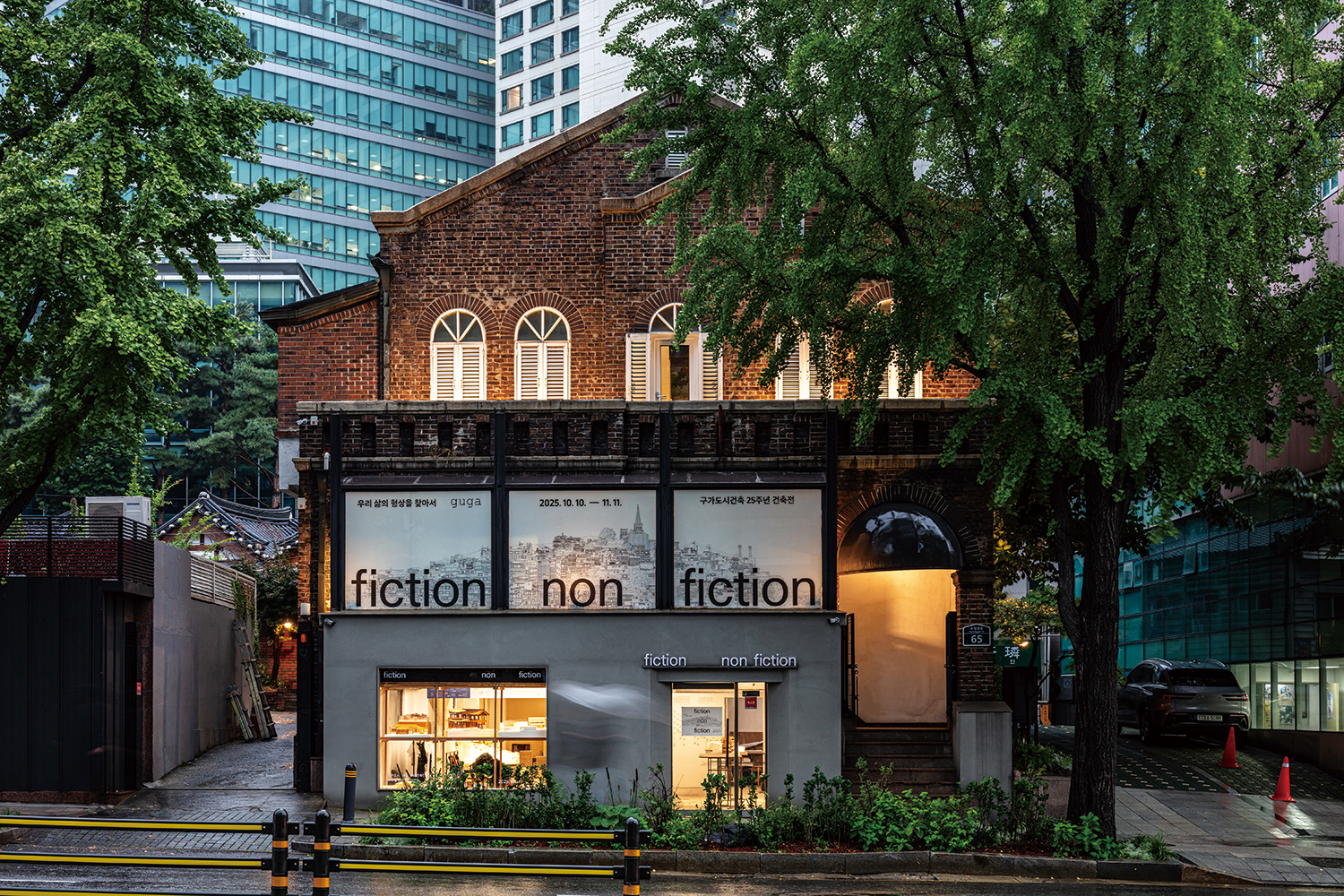
The old Goo Yeong-sook Pediatric Hospital, the venue for ‘fiction non fiction’
The Expansion and Transformation of the Madang in Step with Everyday Life
The event began with a presentation by Kim Jonghun (professor, Pai Chai University), titled ‘Reading the Madang with the Body, Making a House with the Heart: a Frugal Architect Cho Junggoo’s Sensory Design Practice’. As the title suggests, he analysed guga urban architecture (principal, Cho Junggoo, hereinafter guga)’s architectire through the lens of the madang (courtyard), a dominent theme that penetrates both the exhibition and the architectural pratice.
Specificially, by highlighting the ‘wednesday survey’, a weekly urban fieldwork project that has run over 1,100 times, Kim Jonghun interpreted guga’s notion of the madang in its larger context—the urban scale. ‘For Cho Junggoo, alleyways are the madangs of the neighbourhood, and these countless alleys observed through these surveys have become the inspiration for the many Madang-jip that he has designed.’ In this way, Kim Jonghun read guga’s architectural journey as a process of continuous experimentation with the concept of the madang.
A notable example is Gahoe-dong, Yangyudang (2011), a renovation project where Cho Junggoo’s ‘spatial frugality’ is most evident. In this case, though the GFA (gross floor area) was reduced after remodeling, the space became more efficient and tightly organised. It was achieved by the architect’s refined spatial measurement and rational judgment, cultivated through years of weekly surveys.
In later works, the madang further expanded inwards and upwards. For instance, in the Cheonyeon-dong Hanok (2016) project, the architect tried to create a ‘a madang functioning as a living room’ by reinterpreting the traditional composition. In this new type of madang, a daechung (main wooden hall) was integrated to take the function of a kitchen and an atrium was inserted into part of the madang. Kim Jonghun evaluated this as restoring the madang’s original role as a communal space.
Kim Jonghun continued introducing a series of experimental projects including, Samchengdong K (2008), Knock Knock Heon (2016) and 10M4D (2017) in Eunpyeong Hanok Village where madangs were elevated or reinterpreted. In Samchengdong K, visitors must climb a narrow staircase to reach the madang, and upon arriving on the second floor, they are met with a wide and open madang space. This sequence exemplifies his reinterpretation of a traditional spatial experience, passing beneath a pavilion-like structure before arriving at the main hall.
Knock Knock Heon, a two-storey hanok, features a living-room madang on the upper level and a projected dining room above a pilotis structure, offering panoramic views of Bukhansan Mountain. By inverting the typical ‘ㄷ’-shaped madang layout of urban hanoks, the project proposes a new spatial prototype. In contrast, 10M4D employs an interiorised madang that follows the conventional ‘ㄷ’-shaped configuration. In this arrangement, the madang is enclosed by rooms, enabling a free and fluid circulation throughout the house.
From this perspective, Kim Jonghun draws a connection between Cho Junggo and Frank Lloyd Wright. As Frank Lloyd Wright made his transition from the grounded Robie House (1910) to the rising spiral of the Solomon R. Guggenheim Museum (1959), so Jeonju House (2020) is identified as exemplary in guga’s madang experimentation. Rather than placing the madang within or between the houses, this project completely inverts the relationship by placing the house within a surrounding madang. The oval plan amplifies the madang space, and when the traditional hanji doors (paper door) of the first-floor foyer are lifted, the foyer visually merges with the exterior, becoming an extension of the madang itself.
guga’s experiments with madangs are not limited to form or layout but also materials. Beyond earth, tile, and stone, guga has employed water to form madangs. The open-air bath and artificial pond at the front of the Hanok-hotel Ragung (2007) are example of the ‘water madang’. In later proposals, such as the Museum of Jeju Literature (2021) and the Lee Jungseop Art Museum design competition, guga further explored the idea of ‘water madangs’ on a much larger scale. In these projects, the architecture is rendered as a floating mass above an expansive body of water.
Curator Chung Dahyoung (co-director, CAC) pointed out that while the madang is a main theme in guga’s work, it also functions as a rhetorical device frequently used in Korean architectural discourse. She noted that even architects who do not design with the madang often invoke the concept when preparing solo exhibitions or promoting their work internationally. Nonetheless, she argued that this phenomenon – the diverse interpretations and constant reconfigurations of the madang within contemporary Korean architecture – is meaningful in itself, as it keeps the idea alive. At the same time, she posed a critical question: what distinguishes guga’s madangs from such rhetorical uses? To this, Cho Junggoo answered for guga that the madang is not a polished or abstract concept. Rather, it is a liveable, sometimes messy space shaped by the realities of everyday life.
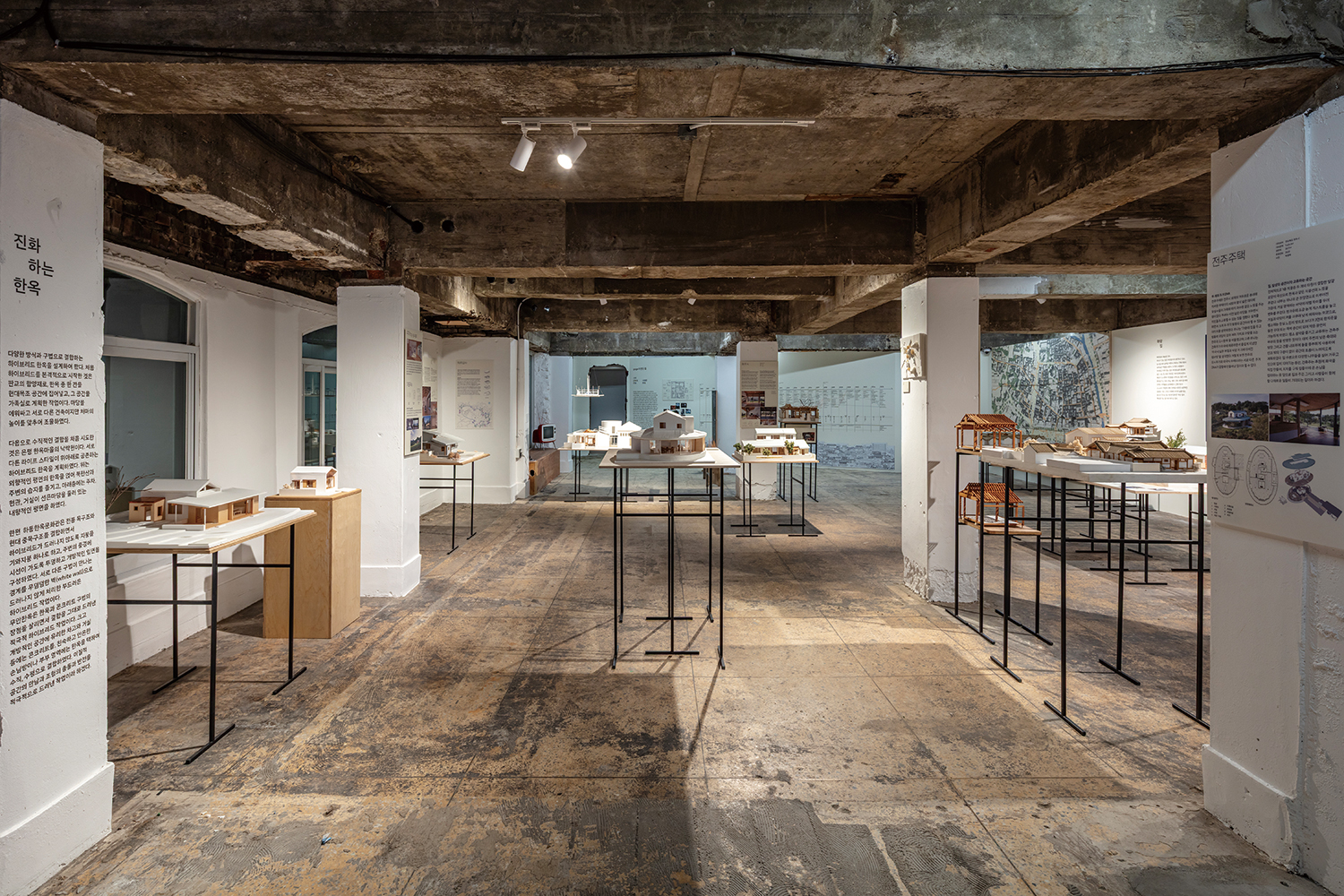
Exhibition view of ‘Houses Built by guga’, located on the second floor
From an Architect’s Perspective, Not a Curator’s
From the perspective of an exhibition curator, Chung Dahyoung discussed where ‘fiction non fiction’ should be positioned within the history of Korean architectural exhibitions. She noted that exhibition is a relatively recent format within the Korean architectural scene. To illustrate this point, she highlighted several historical precedents. The first known solo exhibition by a Korean architect was the ‘Kim Chung-up Architectural Works Exhibition’ (1957), held at the Central Information Center within the Public Relations Office in Sogong-dong. Another significant milestone was ‘Artist of the Year 2002: Seung H-Sang’ (2002), presented at the National Museum of Modern and Contemporary Art (MMCA). Around the same period, architecture first entered the national art stage in 1955 through the National Art Exhibition (Gukjeon), which later evolved into the Korea Architecture Exhibition hosted by the Korean Institute of Architects. However, these examples were not ‘curated exhibitions’ in the curatorial sense that we understand today.
Although international exhibitions such as exhibitions of the Korean Pavilion at the Venice Biennale since 1996 and ‘Megacity Network’ (2007) had been held, the architectural exhibition format did not become a familiar and integral medium in Korean architecture until Chung Dahyoung joined the MMCA as a curator in 2011.
Even after her appointment, most architectural exhibitions remained limited to either archival retrospectives of late or retired architects, such as ‘Figurative Journal: Chung Guyon Archive’ (2013), or pavilion-type installations by emerging architects, as seen in ‘Hyundai Card Culture Project 15: Young Architects Program’ (2014). While solo exhibitions such as Cho Minsuk’s ‘Before/After Mass Studies Does Architecture’ (2014) did take place, only a few exhibitions have meaningfully addressed the work of actively practicing architects.
In this context, she highlighted the importance of ‘fiction non fiction’ as a rare solo exhibition of a mid-career architect who is still actively engaged and working. Furthermore, she emphasised the unique value of the exhibition being entirely initiated and organised by the architect himself, without any institutional interference. Simultaneously she raised a common concern: when architects curate their
own exhibitions, they often serve as artist, designer, and curator, which makes maintaining critical distance difficult. In response, Cho Junggoo confessed that he had initially hoped to work with a professional curator but ended up organising the exhibition himself due to practical constraints. This suggests that, rather than operating from a curatorial ego, he approached the exhibition as a means to communicate his architectural perspective, ideas and lived experiences with visitors.
Indeed, the way Cho Junggoo organised the exhibition reveals a clear separation from the approach of professional curators. He treated the exhibition venue, the old Goo Yeong-sook Pediatric Hospital, as a site condition, much like how he would begin an architectural project. According to Cho Junggoo, the first floor (‘guga’s Foundation’) has a low ceiling and is partially below ground, so he intended it to resemble a storage space where the materials accumulated over 25 years of ‘wednesday surveys’ could be archived. The second floor (‘Houses Built by guga’) was designed as a bright and transparent domestic-like space, while the third floor (‘In Search of a New Form of Life’), with its high ceiling and exposed roof structure, was used to display larger architectural models.
The guzi Pavilion, installed at a 1:1 scale in the building’s parking lot, also reflects this
context-responsive approach. From the early stages of planning, Cho Junggoo envisioned a full-scale installation with multiple possible scenarios. Before the final site was determined, he considered different versions of the pavilion depending on the venue. For instance, when he was exploring the Embassy of Switzerland in Korea as a potential exhibition site, he imagined a small hanok-like hut as a suitable pavilion. However, once the current site was confirmed, he chose to adapt the top unit from his unbuilt proposal for the Lee Jungseop Art Museum. The resulting pavilion blends naturally into its surroundings, as if it had always been there.
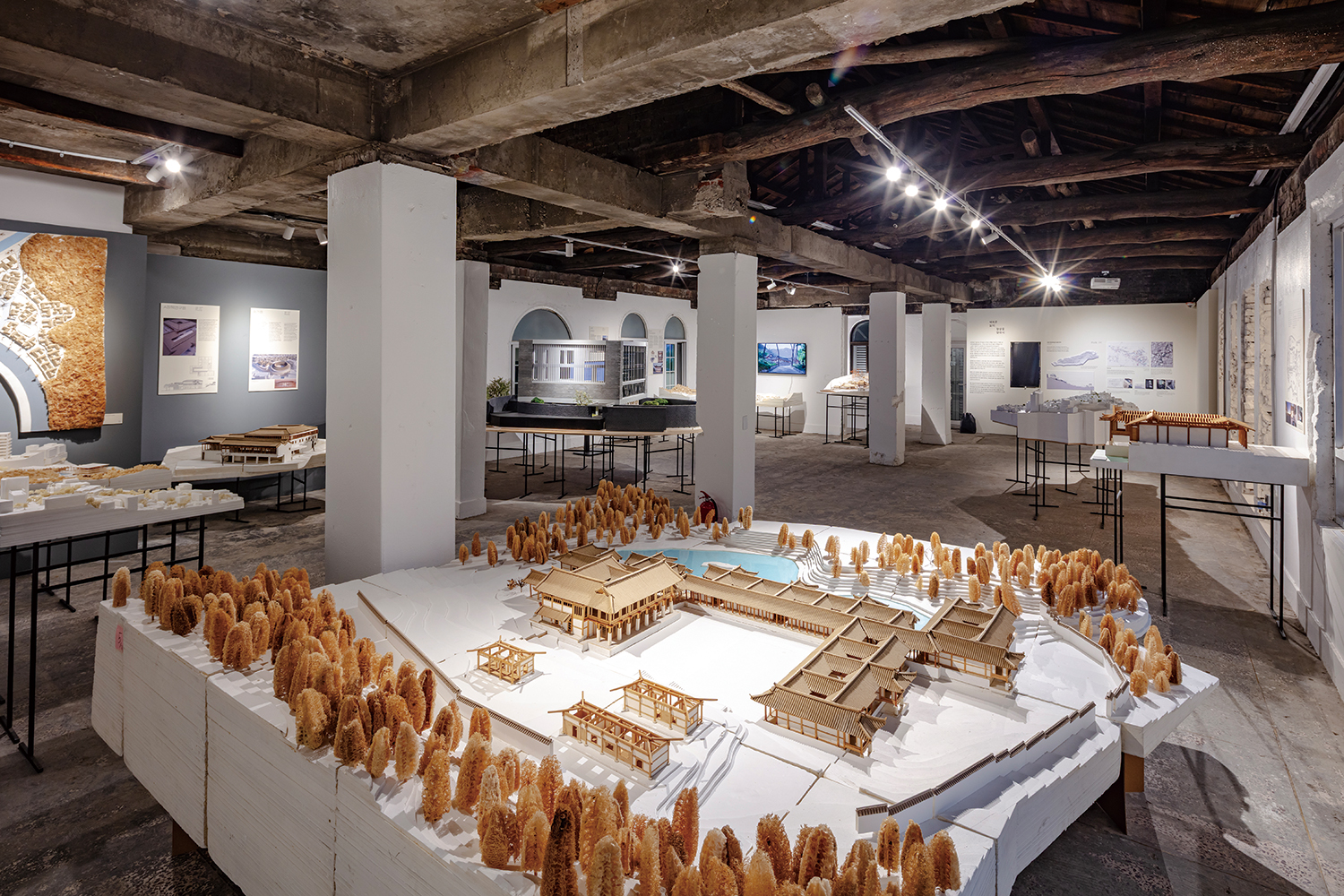
Exhibition view of ‘In Search of a New Form of Life’, located on the third floor. The model seen in the foreground is of the Hanok-hotel Ragung (2007).
Seeking Universality from Experience, Not in Statistics
guga’s architecture always begins with reality. ‘wednesday surveys’, which have now accumulated over a thousand visits, and his Madang-jip series, all begin with observations of everyday lived experience and then reinterpret them through the architectural medium. The exhibition title ‘fiction non fiction’ encapsulates this philosophy: if the survey work represents the realm of non-fiction, then the act of design, filtered through the lens of guga, belongs to the realm of fiction.
Chung Dahyoung suggested the inverse might also hold true. While architectural design is inherently creative, it is nonetheless bound by real-world constraints, regulations, budgets, and physical conditions, which makes it more like non-fiction. Meanwhile, many of the neighbourhoods visited during ‘wednesday surveys’ have already vanished, lending them a ghostly, fictional quality.
These lines of thought raise larger questions. Most of the sites guga explores lie within the historic city walls of Seoul. In the present context, where the majority of the population, the so-called ‘apartment kids’, have grown up in high-rise housing, can these old urban fabrics still be considered representative of everyday life in Seoul? Could such a focus risk romanticising a specific historical moment or aesthetic?
Cho Junggoo responded, ‘Although Korea is often described as a republic of apartments, many people still live in old low-rise buildings, multi-household houses, studio flat units, banjiha (semi-basements), or even jjokbang (dosshouse). However, public discourse seems excessively preoccupied with apartments alone.’ For him, ‘universality’ is not statistical; it is found in places where real life unfolds, spaces that are often overlooked.
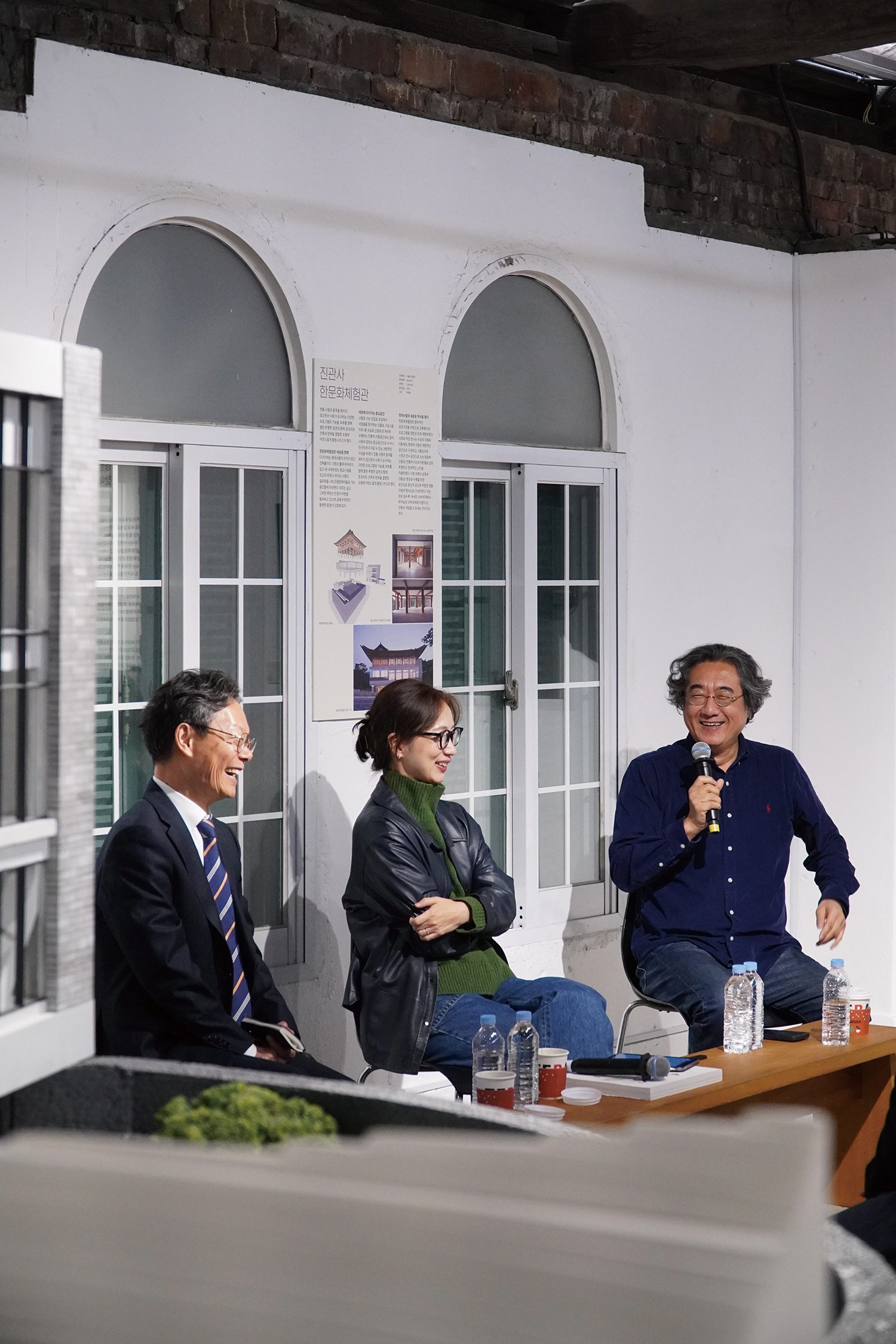
From left; Kim Jonghun, Chung Dahyoung, Cho Junggoo ©guga urban architecture