Exploring the Relationship Between Inside and Outside: Ikimono Architects
photographed by
Ikimono Architects
materials provided by
Ikimono Architects
SPACE November 2025 (No. 696)
Based in Takasaki, about 100 kilometers from Tokyo, Ikimono Architects (principal, Fujino Takashi) have been exploring the relationship between the natural and the artificial, the interior and the exterior, experimenting with the formal possibilities that emerge along their boundaries. A series of houses built within the vegetation, topography, and everyday landscape delicately refine the flow of space, forming open environments where the external world and the inhabitant’s sensibilities intersect.Editor
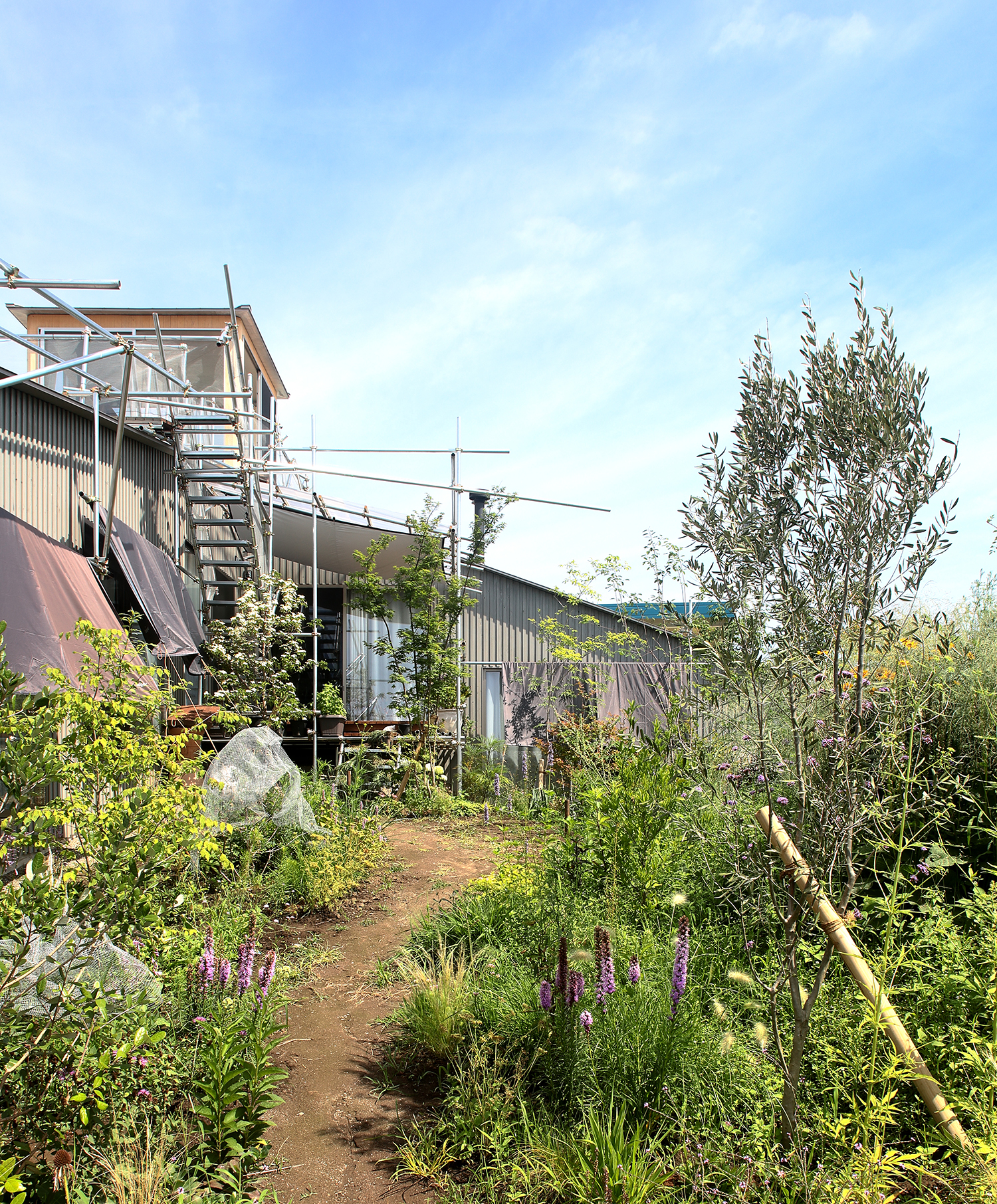
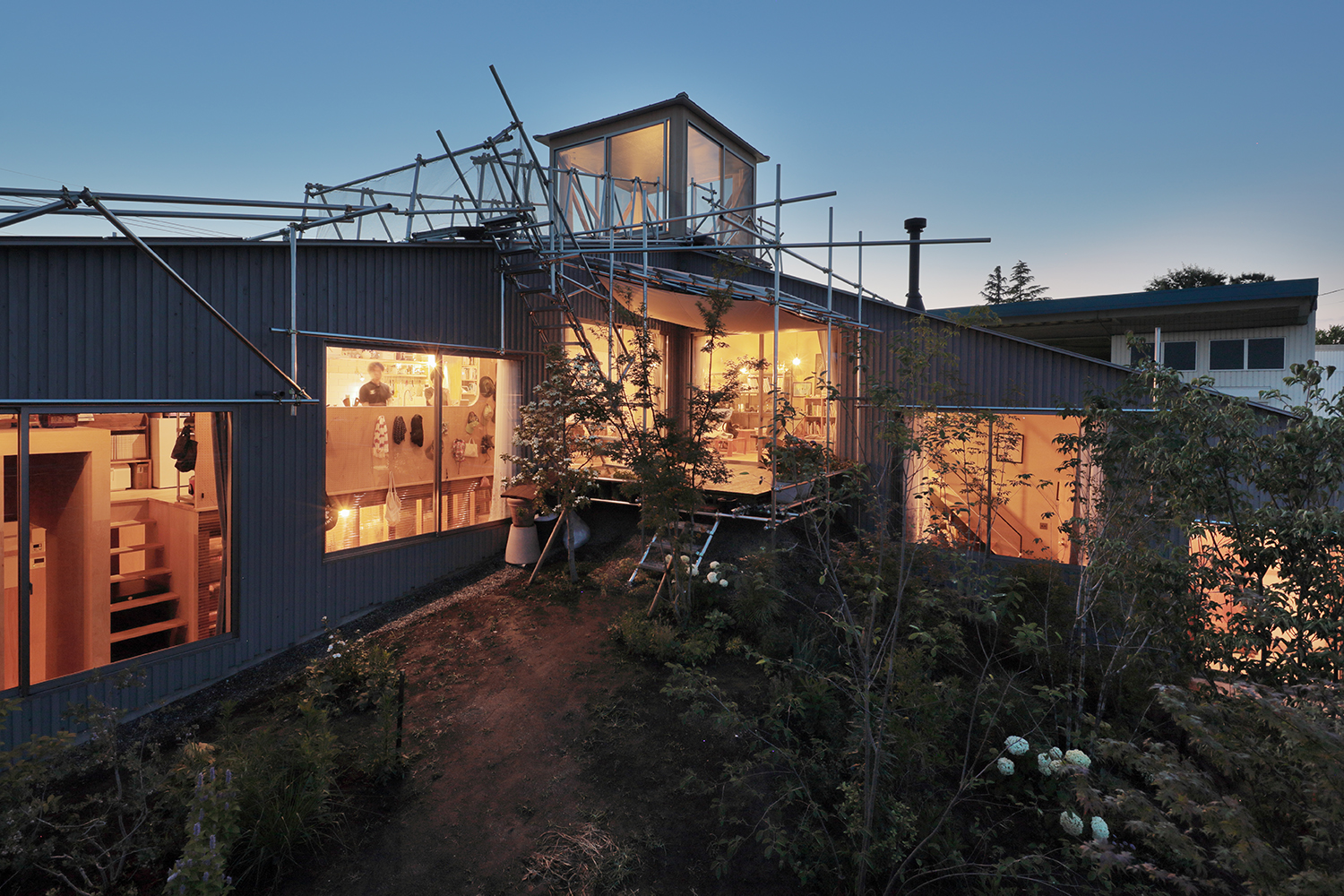
Flower and Roots (2024)
Interview Fujino Takashi principal, Ikimono Architects × Lee Sowoon
Lee Sowoon (Lee): Your office name, Ikimono (生き物), means ‘living being’. What does this name represent?
Fujino Takashi (Fujino): It reflects my intention not to separate nature from the artificial, but to treat both as elements that together compose the human environment. Whether it is a tree still alive or one already cut and processed into lumber, I wish to regard them equally, without distinction, with the same gaze.
Lee: You established your own practice in 2006, choosing Takasaki as your base. How has this environment, distinct from that of a major city, shaped your architectural approach?
Fujino: In Takasaki, there is less pressure to maximise the building coverage or floor area ratio, which allows for more generous spatial planning. Naturally, this presents opportunities to design not only the building itself but also the surrounding outdoor spaces, leading me to perceive the ‘inside and outside’ as part of one continuous flow. One reason I chose to open my current office here is that this place enabled a way of thinking that naturally crosses boundaries, looking outward from the interior garden to the external environment. Of course, this is also where I was born and raised, but more than that, it is a place where I can closely observe how things change over time, which holds a special meaning for me.
Lee: To understand the concept of inside and outside, I would like to examine it through two aspects—the artificial and the natural, and the interior space and the external environment. Flower and Roots (2024) and Carving the Forest (ongoing) are projects in which the relationship between the artificial and the natural is striking. In Flower and Roots, an L-shaped mass with an elevated corner embraces the garden, while in Carving the Forest, ten small houses are placed in the forest, avoiding trees yet loosely entangled with them. What was your attitude towards nature when deciding on the form and layout of these two projects?
Fujino: In Flower and Roots, I erected an artificial L-shaped wall to create a refined space like ‘still water’ within the vast flows of nature. Within the small ecosystem of plants and animals that naturally occur there, I created another space in which humans could stay. There was no intention to design the form that nature itself would take. In contrast, Carving the Forest imagines a people already living in a dense forest. In this case, the residents themselves shape the form that nature takes, maintaining voids of a scale and shape suited to their lives. As a designer, I proposed an image of ‘how life could be made more livable.’ In a larger sense, I do not wish to distinguish between forms created by nature, such as plants, and artificial forms created through architecture. Rather than separating them, I want to create a single physical volume that exists within the world humans inhabit.
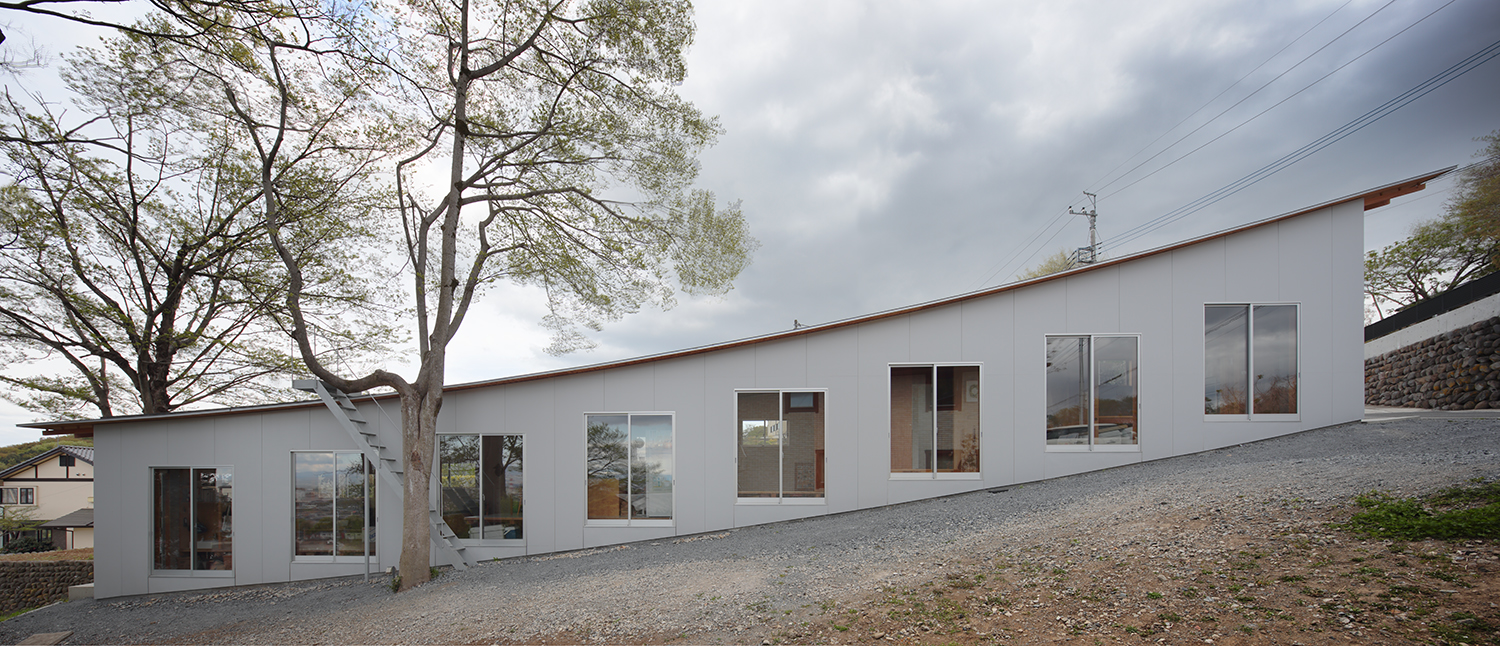
Flower and Roots (2024)
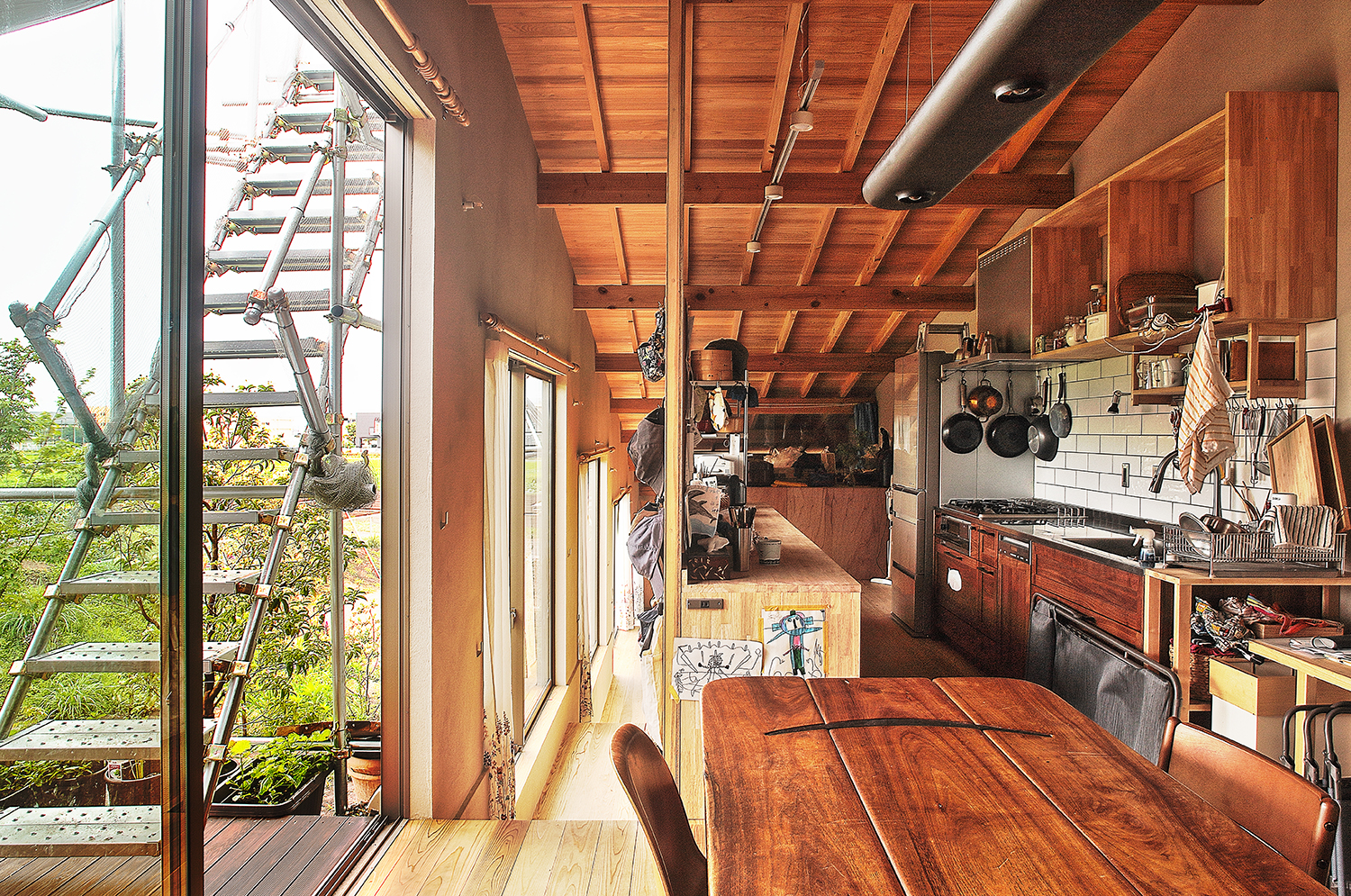
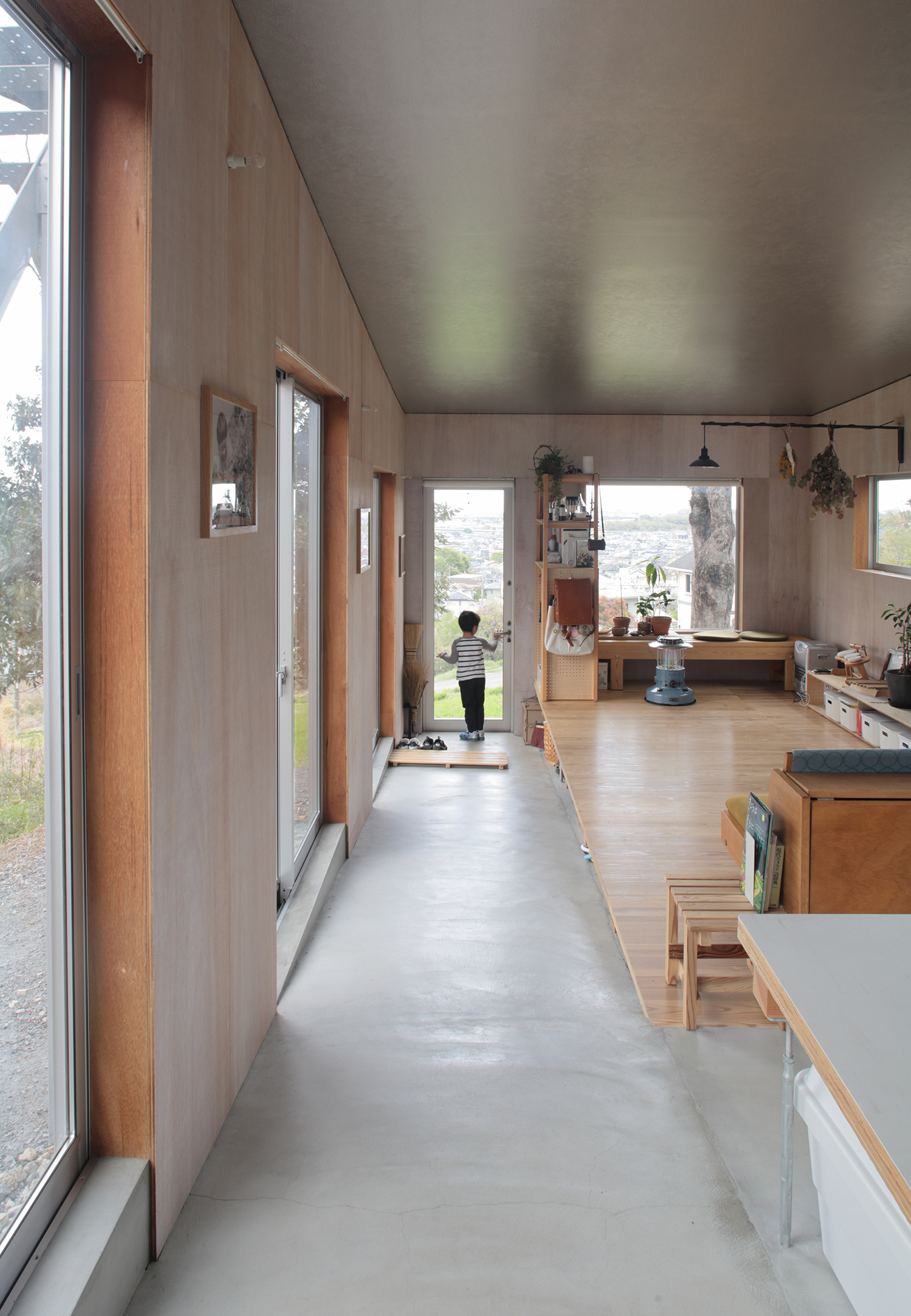
Interior view Flower and Roots
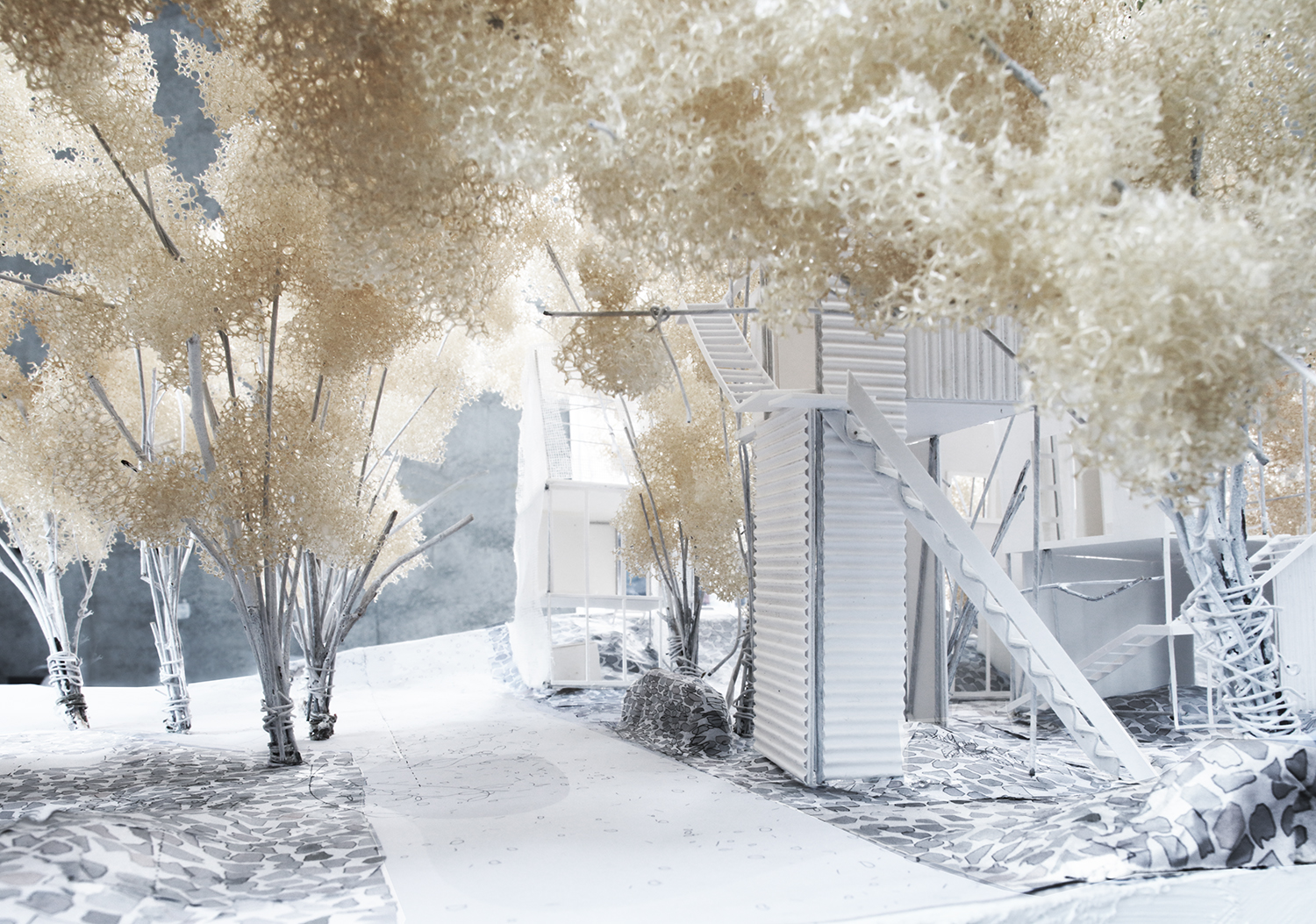
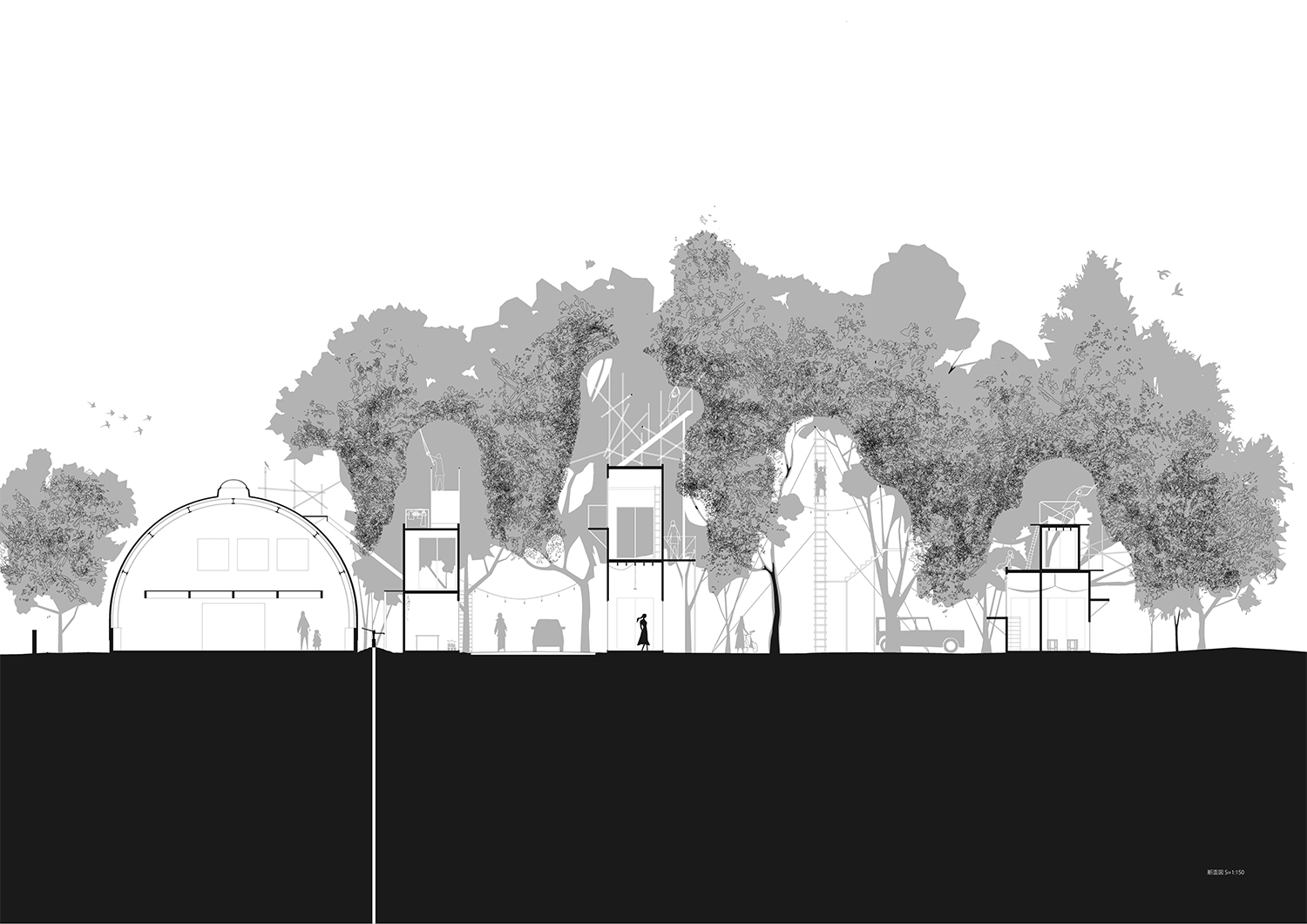
Lee: In Carving the Forest, a unique composition is applied, wherein the roof layer is placed among branches and leaves. How did you perceive the forest environment, and how did you conceive the form of the houses within it?
Fujino: The organic forms seen in the section were not newly designed, they were part of the existing dense forest. What I added below was the image of people shaping the landscape. When I first visited the site, the canopy of branches and leaves overhead felt like the vast roof of the Louvre Abu Dhabi (2017) designed by Jean Nouvel. I wanted to make use of this already pleasant roof-like feature through the minimum possible design interventions. By adding a new architectural roof beneath the ‘natural roof’ created by existing branches and leaves, a unique space was formed that is outdoor yet resembles an interior. To enhance this quality, I designed the space so that people could directly trim and maintain the branches and leaves together.
Lee: Regarding the relationship between interior space and the external environment, both Cablecar (2020) and Flower and Roots were designed on sloped sites, where the interior spaces also follow the gradient. As one moves up and down through the space, it conveys a sense of still being on the ground. What was your intention behind this?
Fujino: Cablecar was designed to allow one to feel the slope of the site as it is, without adding or cutting soil. I wanted to enable the body to sense the inclination of the land—not just visually, but through a subtler, more comprehensive bodily perception that goes beyond the tactile feeling of the soles, allowing one’s eyes, skin, and entire body to perceive the terrain. To achieve this, the building was insulated so well that one could walk barefoot across its surfaces in any season. When shaping the interior, instead of reproducing the external slope directly, I used portions of abstracted geometric curves derived from it. If the topographical characteristics of the exterior were brought too literally into the interior, the continuity between inside and outside – emphasised through the windows – could become excessive, paradoxically limiting one’s perception of space. By employing an incomplete form – an arc cut from a perfect circle – I wanted to evoke the ‘invisible auxiliary lines’ that extend by accounting for the movements of people going up and down the slope. This goes beyond simply living on a slope; it allows one to physically sense the original meaning of living ‘on the mountainside’. In the case of Flower and Roots, which was built on a windy hillside, soil excavated during the construction of the L-shaped wall – designed to block the wind – was reused to create an artificial mound. Because this mound was man-made rather than natural, the interior spaces were connected by horizontally extending stepped floors, ensuring it would not be mistaken for a natural hill.
Lee: In Cablecar, the design allows the exterior environment to be experienced from the corridor rather than directly from the bedroom. Why was this?
Fujino: To add depth to the narrow structure (about 3.6m wide) I introduced a three-layer composition featuring a garden (outside), corridor (intermediate), and room (inside). For example, when the door of the bedroom opens, the corridor that faces it functions like an engawa in a traditional Japanese house, creating a spatial flow that naturally extends from the corridor toward the garden.
Interior view of Cablecar (2020)
Cablecar
Lee: While your previous projects dealt with natural environments and terrain, Grid (2019) explores the relationship with the outside within a densely built residential area. Large, elongated windows optimise natural light, while the building is slightly rotated to adjust the line of sight. How did you conceive of the relationship between inside and outside under these conditions?
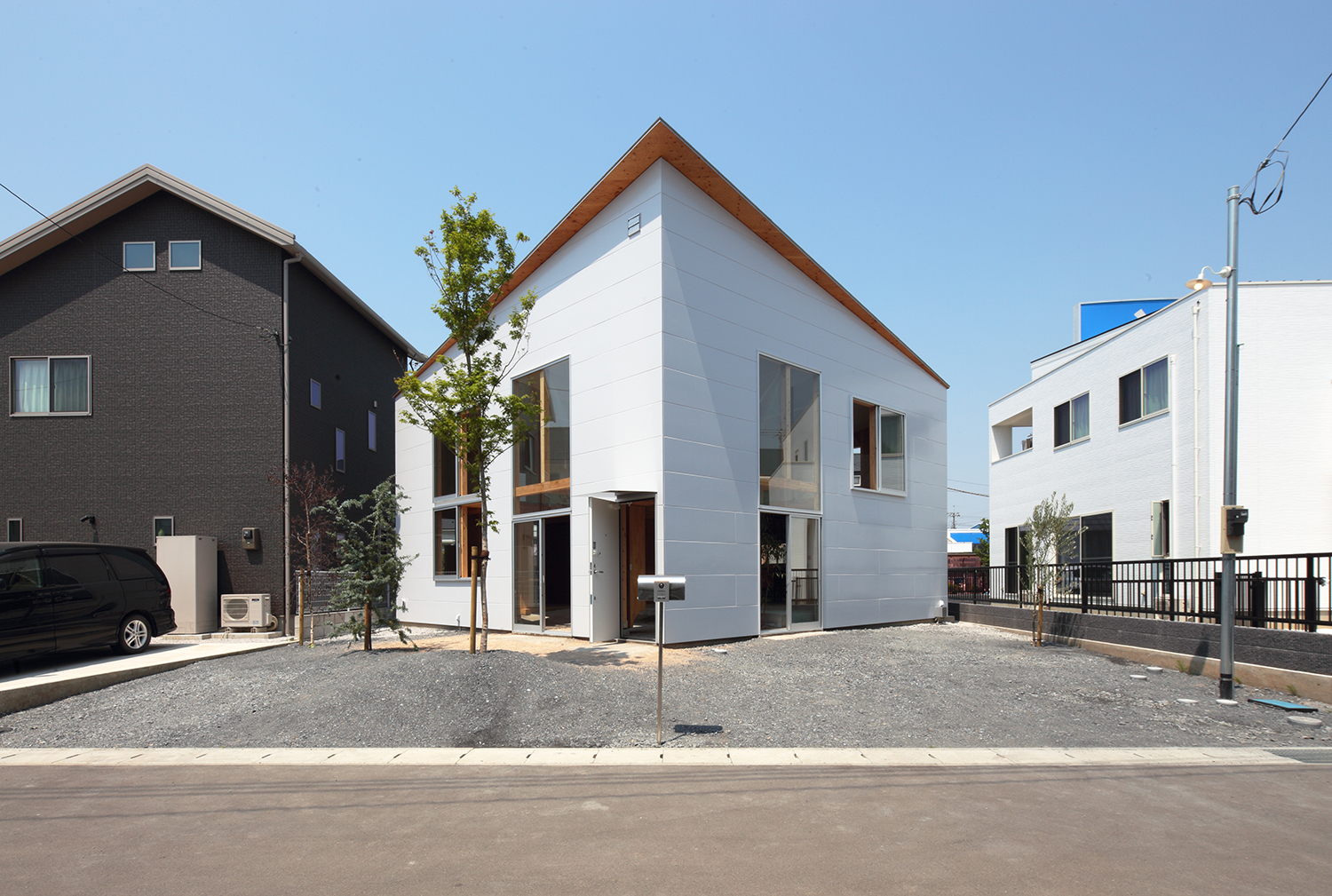
Fujino: The area where Grid stands was once farmland. With the sudden spread of residential development, the land was evenly subdivided, and similar buildings were lined up in a uniform manner. Rectangular houses are placed side by side along the edges of rectangular plots aligned toward the north. By rotating the building 45 degrees within this repetitive grid, its walls no longer directly face the façades of neighbouring houses. When windows are placed on these angled walls, the views through them cut diagonally across the checkerboard-like spaces, extending endlessly through the gaps between houses. Reading this repetitive landscape obliquely made it possible to create a spatial composition in which the line-of-sight gains both greater depth and distance.
Lee: A relatively large area near the entrance was created as an earthenfloored space—an interior that feels like an exterior space. What kinds of activities did you hope would take place in this ‘threshold space’?
Fujino: To reinterpret the boundary where one removes their shoes upon entering, I created a space resembling the earthen floor (doma) of an old farmhouse. This serves as a device to express, in an intuitive way, the project’s main theme – the grid-like arrangement of architectural elements – through which the mental auxiliary lines extend infinitely, from the building’s interior to the exterior, and further toward the surrounding site, as if drawn on graph paper. To develop this concept, I shifted the line where shoes are removed and introduced subtle, organic undulations felt through the soles of the feet.
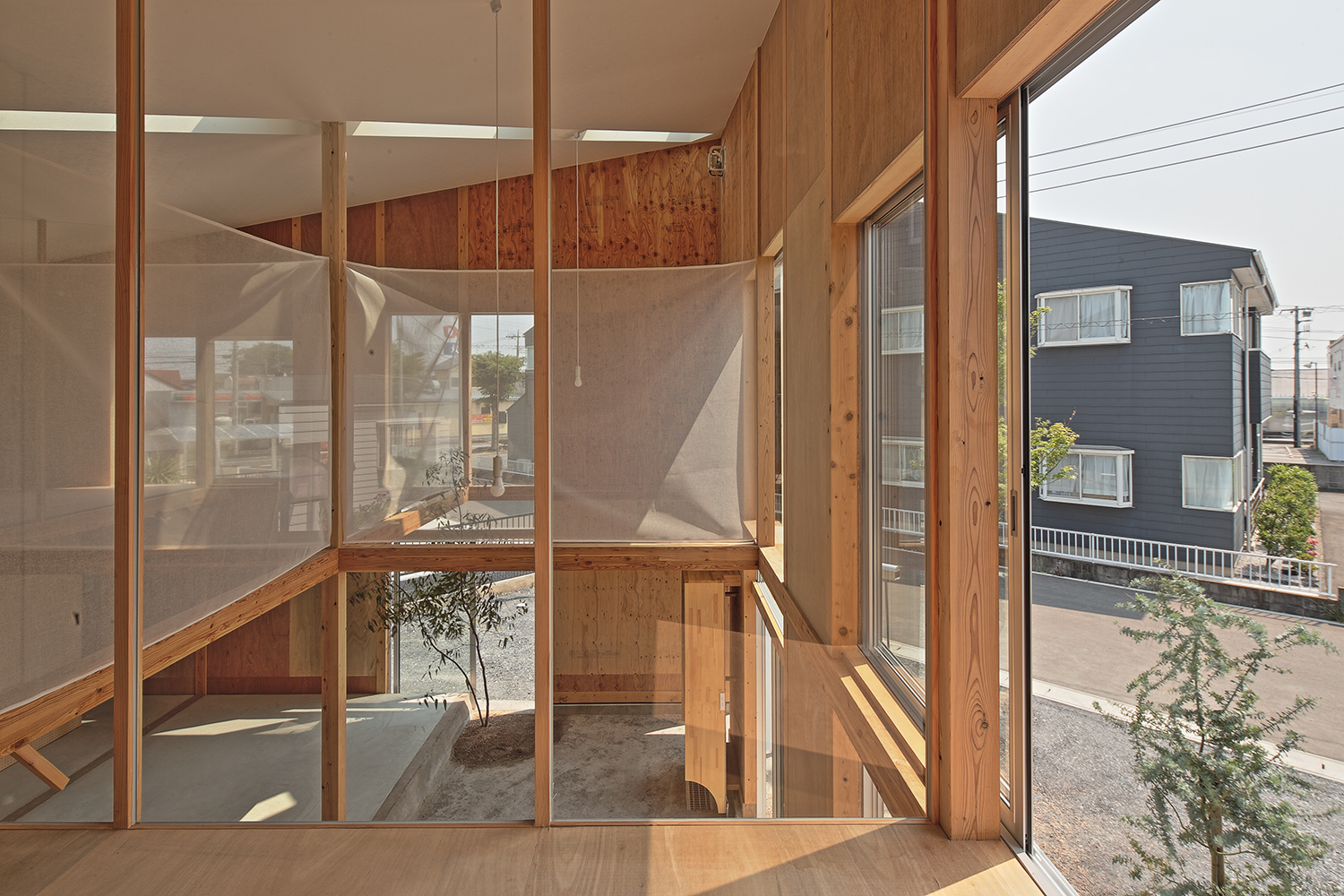
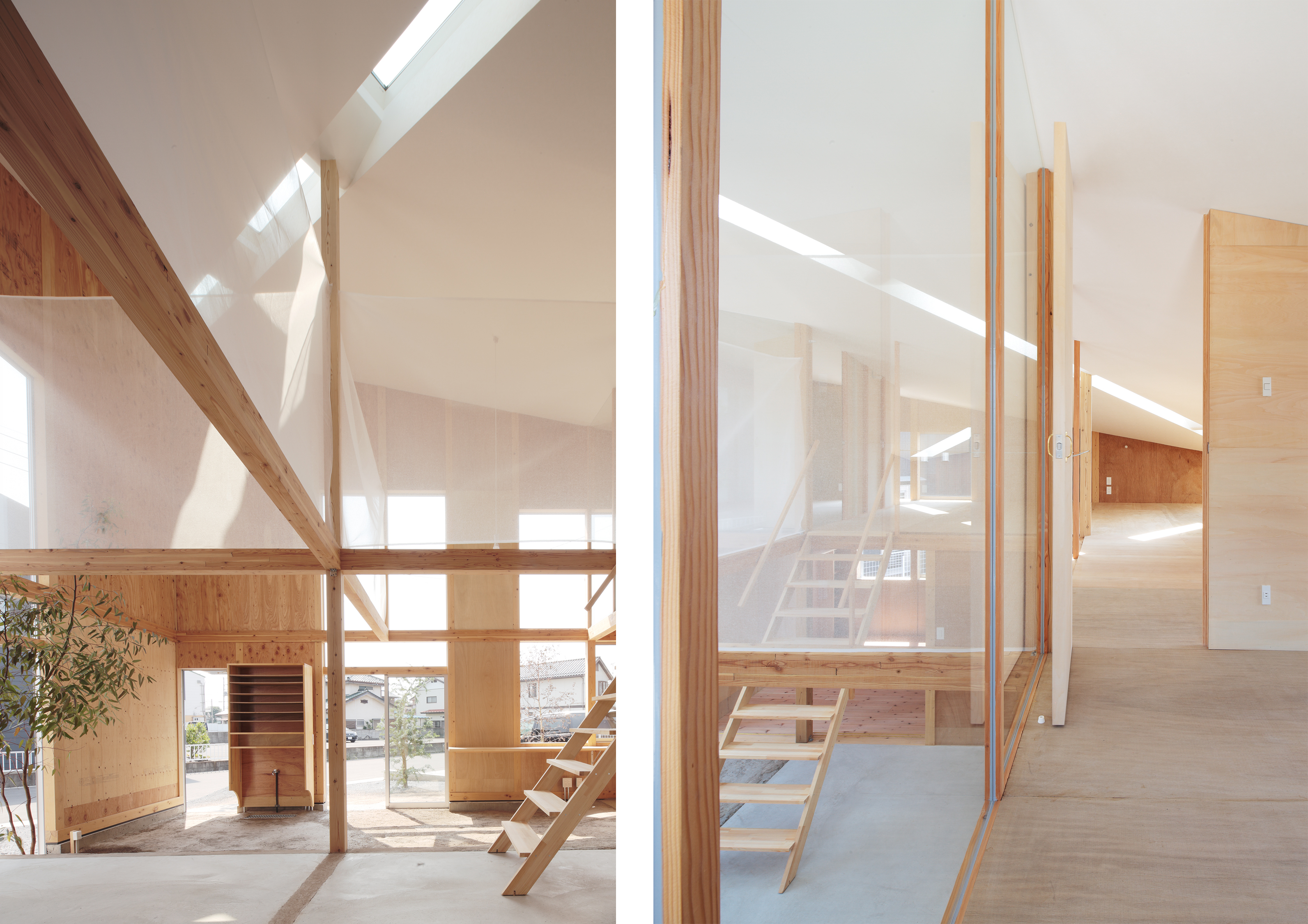
Lee: On the second floor, soft lace fabric blurs the boundary of the interior, serving both as a physical threshold and a sensory medium.
Fujino: The first floor of Grid is composed of a landscape with tangible colours and textures, allowing one to sense the continuity of the grid from interior to exterior. Elements such as soil, stone, cars, and trees visually connect the inside with the outside, naturally revealing their boundary. In contrast, the exterior space on the second-floor level is more open—though trees and utility poles may be visible, the vastness of the sky dominates the view. In other words, the landscape becomes more abstract, while visible phenomena such as wind and light become more pronounced. To express this visually, I used a layer of soft lace fabric. It responds delicately even to the slightest air movement, its surface gently rippling and dappled as the light from the skylight shifts across it. This contrast in the degree of abstraction between the first and second floors is one of the key elements intentionally explored in Grid.
Physical model of Carving the Forest (ongoing)
Section plan of Carving the Forest
Lee: In Flower and Roots, scaffolding is installed along the exterior surface, and tarpaulin replaces curtains or blinds, giving the impression that the building is still under construction. What led you to choose materials rarely used in architecture?
Fujino: This design arms residents with what they need to actively adjust their living environment with their own hands. Therefore, I intentionally avoided any special materials, using instead common items that can be easily found nearby, such as standard clamps and steel pipes. This made it possible to lightly expand or contract the living space. Like plants that grow and wither through Japan’s four seasons – green in summer and brown in winter – nature exists within a cyclical flow of time. I wanted humans, too, to live in tune with that rhythm – opening and closing the scope of their daily life as if breathing – through a dwelling that could be flexible and open to transformation. The tarpaulin used in Flower and Roots is a durable type commonly used in agriculture. They were chosen by the client and are typically installed only during summer. Yet the texture of this material is in harmony with the surrounding fields and farming tools, and to me it feels both familiar and intimate.
Lee: You have continued to use adaptable, common materials that allow residents to participate directly in architecture. As you pursue this approach, what are you currently rethinking in the act of building itself?
Fujino: For residents to participate proactively, the principles must be simple, the cost low, and the materials easily obtainable anywhere. If in ‘architecture without architects’ the materials were locally sourced, then today’s locality can be defined by ‘materials that are easily available’. This is a concept that encompasses not only spatial but also temporal context. However, architecture is not complete through such structures alone. Accessibility for the user is certainly important, but it is not enough. What truly matters is the attitude of paying attention to the outside world. Architects must continuously question whether their architecture genuinely nurtures such awareness, because a comfortable, meticulously designed artificial environment can sometimes become a form of violence—one that too easily shuts off our attention to what lies beyond. This is why I always try to leave an ‘auxiliary line’ within architecture that leads outward.
Lee: Today, people tend to ensure privacy at home and go into public spaces only when necessary. In an era that no longer demands an ‘inside – outside relationship’, what meaning does porosity hold for architecture in Japan and how can one continue exploring that relationship?
Fujino: For a long time, humans lived with the understanding that the house and the city formed a single stage for everyday life. But when the lockdown began during the pandemic, frustration from being confined at home surfaced. What became clear then was that houses and urban spaces had not actually been continuous in daily life. In fact, the house has easily sealed off personal privacy while constantly exploiting the comfort of urban space as something taken for granted. As a result, we came to clearly see what is missing in today’s housing. It is not merely an issue of size or living area, but a fundamental question: What should a house mean to a person? Regarding social issues such as social withdrawal, domestic violence, and solitary death, I believe architects must not remain distant observers but take responsibility as direct participants.
Grid (2019)
Grid (2019)
Grid (2019)
You can see more information on the SPACE No. November (2025).
Fujino Takashi
Fujino Takashi was born in Gunma, Japan in 1975. He studied architecture at the Tohoku University and received a master’s degree. He worked for Shimizu Corporation and Haryu Wood Studio before establishing his own studio Ikimono Architects in 2006. He has been an associate professor at the Tohoku University from 2022. He received a doctoral degree in 2023 from the same university.