[DIALOGUE] Where Computational Design Stands Now: Materials, Tools, Matter | Yong Ju Lee Architecture
photographed by
Yong Ju Lee Architecture (unless otherwise indicated)
materials provided by
Yong Ju Lee Architecture
edited by
Park Jiyoun
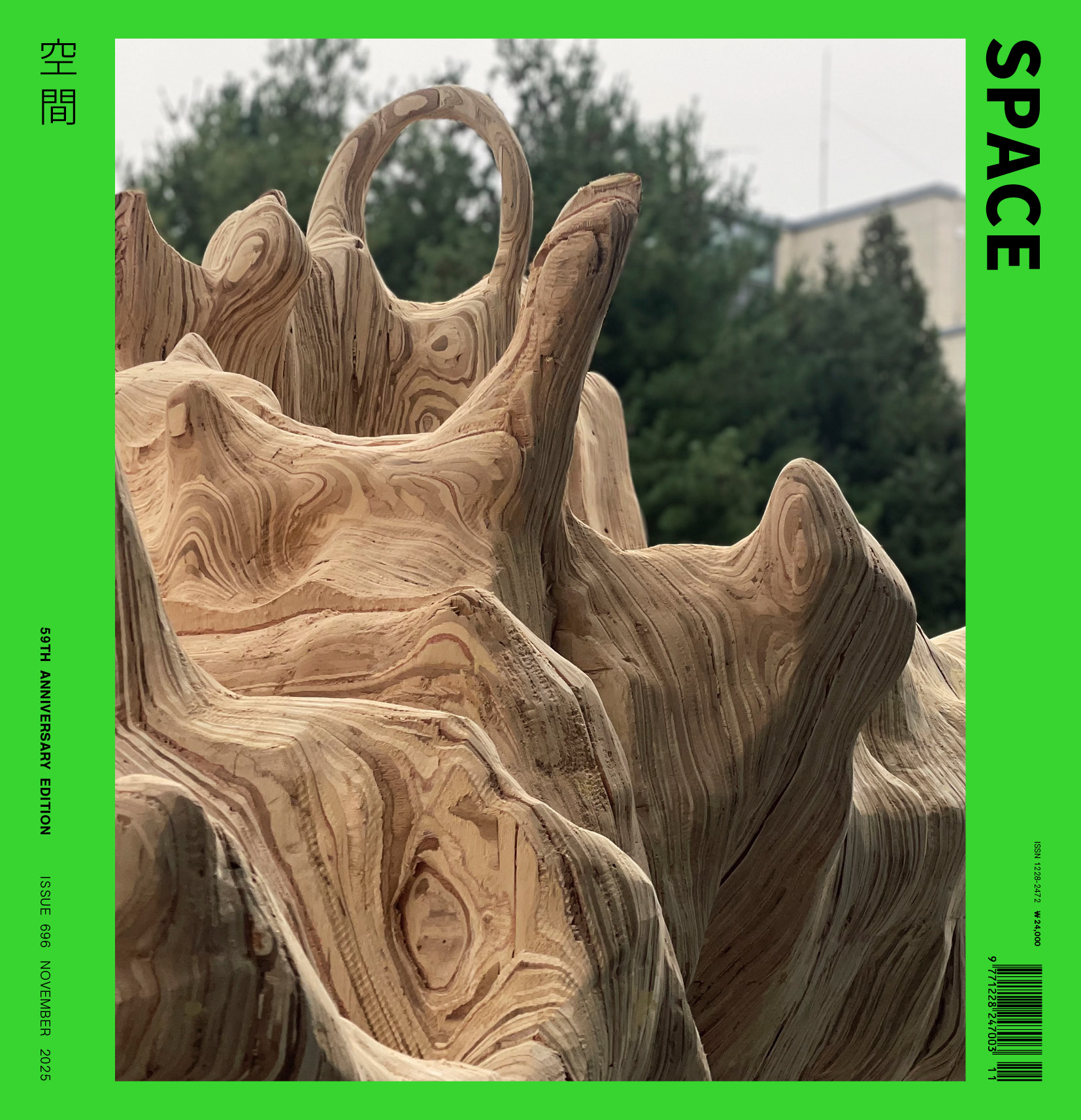
SPACE November 2025 (No. 696)
DIALOGUE Yong Ju Lee principal, Yong Ju Lee Architecture × Yoon Jungwon professor, University of Seoul × Jeong Haewook co-principal, Midday
Context and Choice
Yoon Jungwon (Yoon): I’ve followed your work from a distance since your time in the U.S. Back then, you produced many multimedia installations and computational works, but after returning to Korea you engaged in more conventional building and public projects. Later, upon joining a university, your focus shifted towards more research-oriented, prototypebased design. Why did these shifts in your design priorities occur?
Yong Ju Lee (Lee): I simply followed what I could do according to my circumstances. Around 2010, when I was in the U.S. working on media-based projects, the Lehman Brothers crisis hit, and there were virtually no job opportunities. I had about a year left on my visa, so a friend of mine – who was also doing computer-based work – and I decided to try something, which led us to experiment with what we considered the most cutting-edge medium at the time: media art. When I returned to Korea I didn’t have an established professional foundation, so I began with public architecture projects. After joining a university, I was expected to conduct research, but since most architectural papers in Korea are case studies, I wanted to pursue both design and research together. That naturally brought me back to the field of computation. In retrospect, I think I’m finally doing what I truly want to do now.
Yoon: Were you interested in computation and digital design even as a student?
Lee: That’s right. I never really connected with the emotionally driven approach to spatial design, and around that time I came across architects such as Greg Lynn, Ben van Berkel, and Marcos Novak, who were working in digital architecture. In the early 2000s, this architectural tendency was just beginning to draw attention in Korea. I was fascinated by those strange graphics, so I took a leave of absence from school and learned 3D Max at a private academy. Later, I learned that Columbia University on the east coast was a leading institution in digital architecture, which led me to study there.
Yoon: That’s quite a different path from mine. I actually tried to avoid using those tools but ended up working with them anyway! (laugh) I can also see certain continuities between your projects—each one seems to become the motivation for the next, leading to its reiteration or evolution.
Lee: Since we were working with emerging technologies that hadn’t yet been established in the field of architecture, we often didn’t know where the work would ultimately lead. In such a state, the designer has to bring the project to a close on their own terms. In my case as well, I did as much as I could within the bounds of my way of thinking at the time, the given circumstances, and the grade of technology available—but a sense of incompleteness always remained. I often thought it would be good to revisit and further develop those works when the opportunity arose. Since most of these projects didn’t involve a specific client, there was a certain freedom that allowed me to create some degree of continuity between one work and another.
Jeong Haewook (Jeong): Even when the designer is effectively the client, you still feel regret—what kind of regret do you mean specifically?
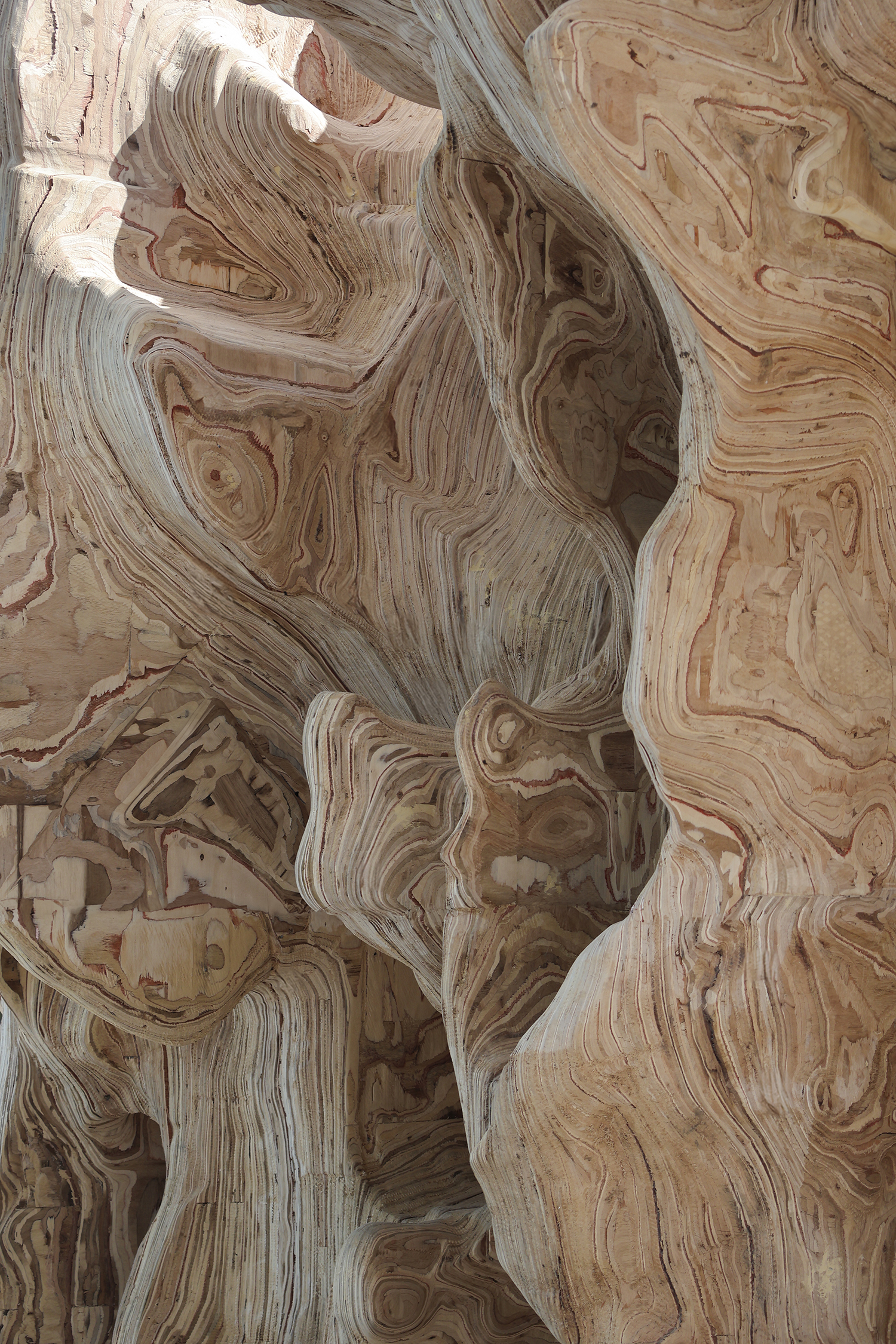
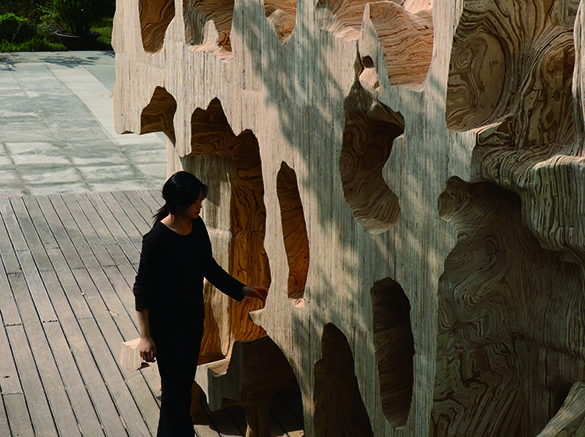
Lee: In the case of Topology: Hanok (2025), only about half of the original plan was realised. Initially, I had imagined people walking between the two separated halves of the structure – much like Damien Hirst’s Mother and Child (Divided) (1993) – so that they could move around and observe it from different angles. But due to limitations of budget and time, that wasn’t possible. If circumstances allow, I’d like to complete the remaining half of Topology: Hanok and experiment with mycelium directly in a 3D
printer, without moulds. I had tried it before, but it failed to build up to sufficient height—probably because of the extruder’s limitations. I think it might be possible if I design and fabricate a different type of extruder, and through that, I’d like to create something large and strange.
Jeong: Then you might not even need to make a dome, which could lead to a completely new form.
Lee: When other materials are mixed with mycelium, mould tends to grow too easily, and it’s hard to control the viscosity. Structurally, mycelium isn’t very strong, so the outcome might be rather ordinary—perhaps cylindrical. As far as I know, no one in the world has successfully 3D-printed mycelium in a single process to a height of more than 50cm.
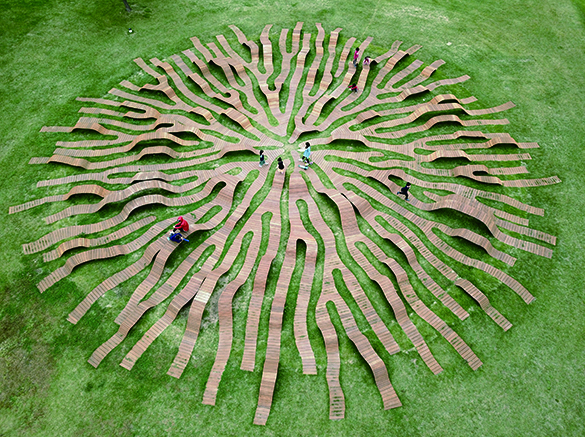
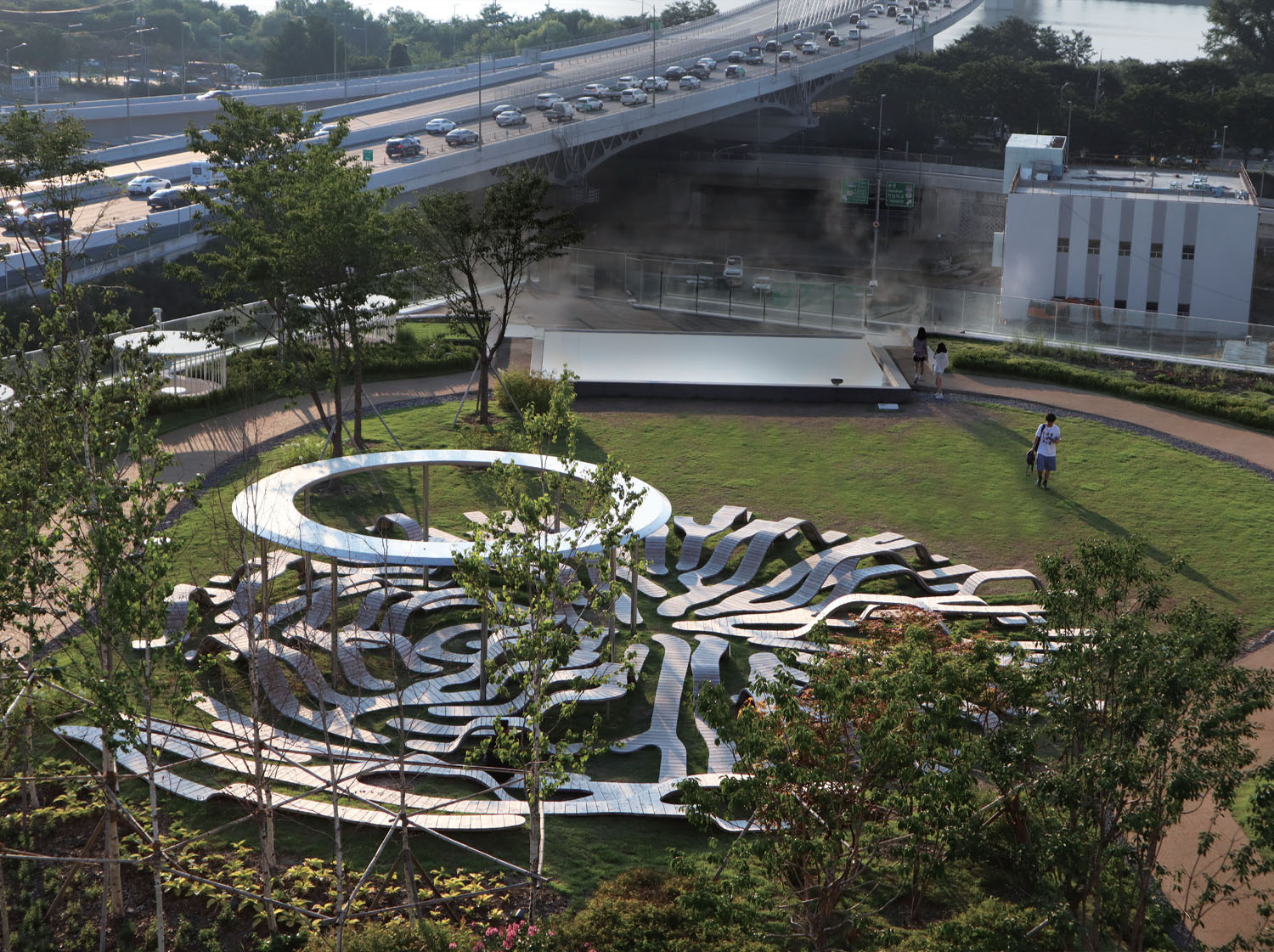
Yoon: Reaction Field (2025) was a project that came to you after the client saw Root Bench (2018) by the Hangang River. It must have been an opportunity to develop something large and strange. What regrets do you harbour about that project?
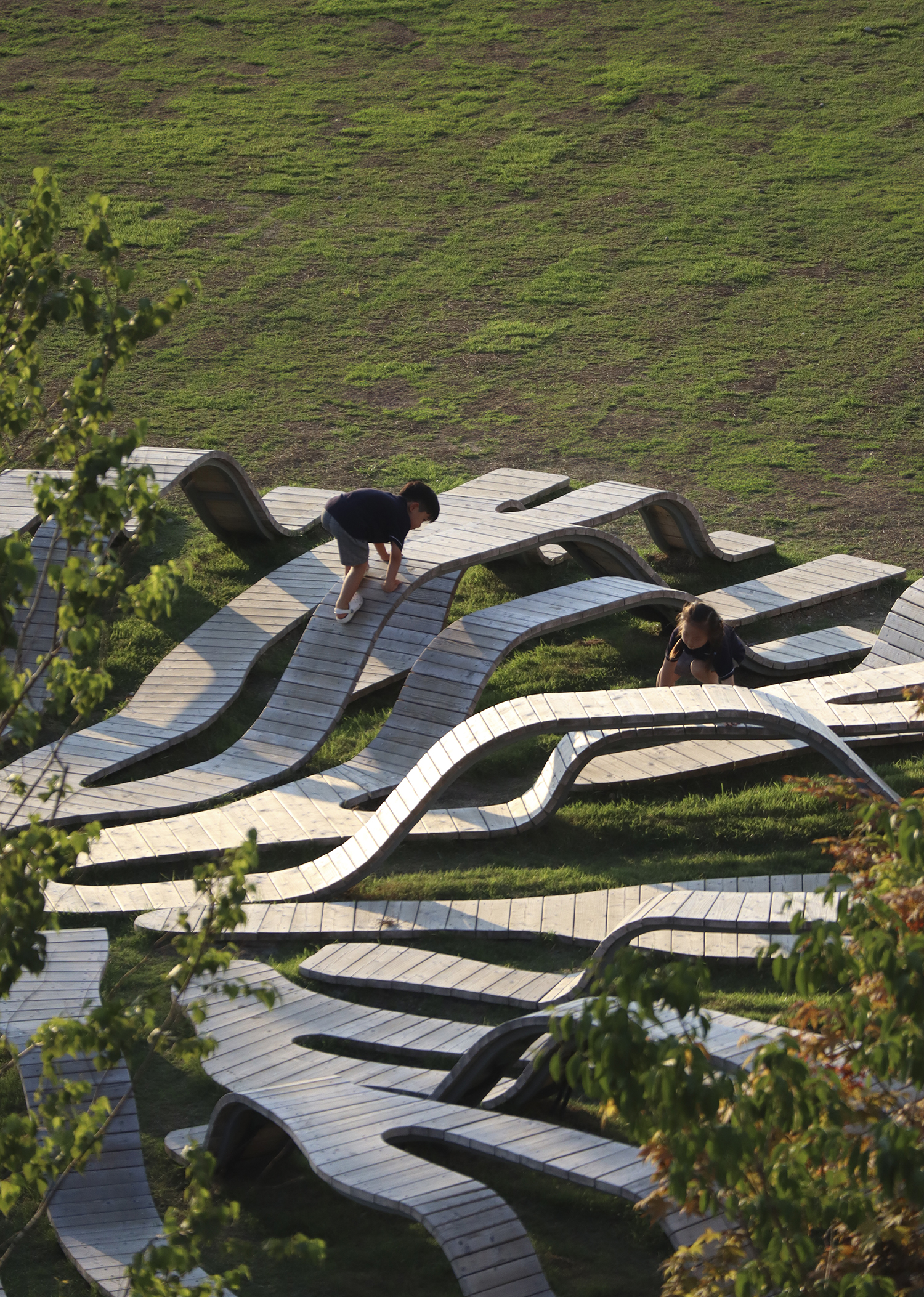
Lee: Reaction Field is perhaps the most similar in nature to my earlier work. I initially proposed a completely new concept because I felt I should keep creating different things, but the client specifically wanted something like Root Bench. In that situation, I tried to introduce variation by using different inputs with the same algorithm. I thought that by doing so, I could produce a different conceptual and procedural narrative.
Jeong: So, is the circular roof related to that input?
Lee: In parametric design, we often have what’s called an attractor that drives the formal transformation. Root Bench was based on a circle centred on a single point, its shape adjusted by external stimuli. In Reaction Field, another attractor was added—the circular roof you mentioned. This roof not only mirrors the upper and lower parts but also modulates the pattern of the bench itself in a different way.
Module, Form, and Material
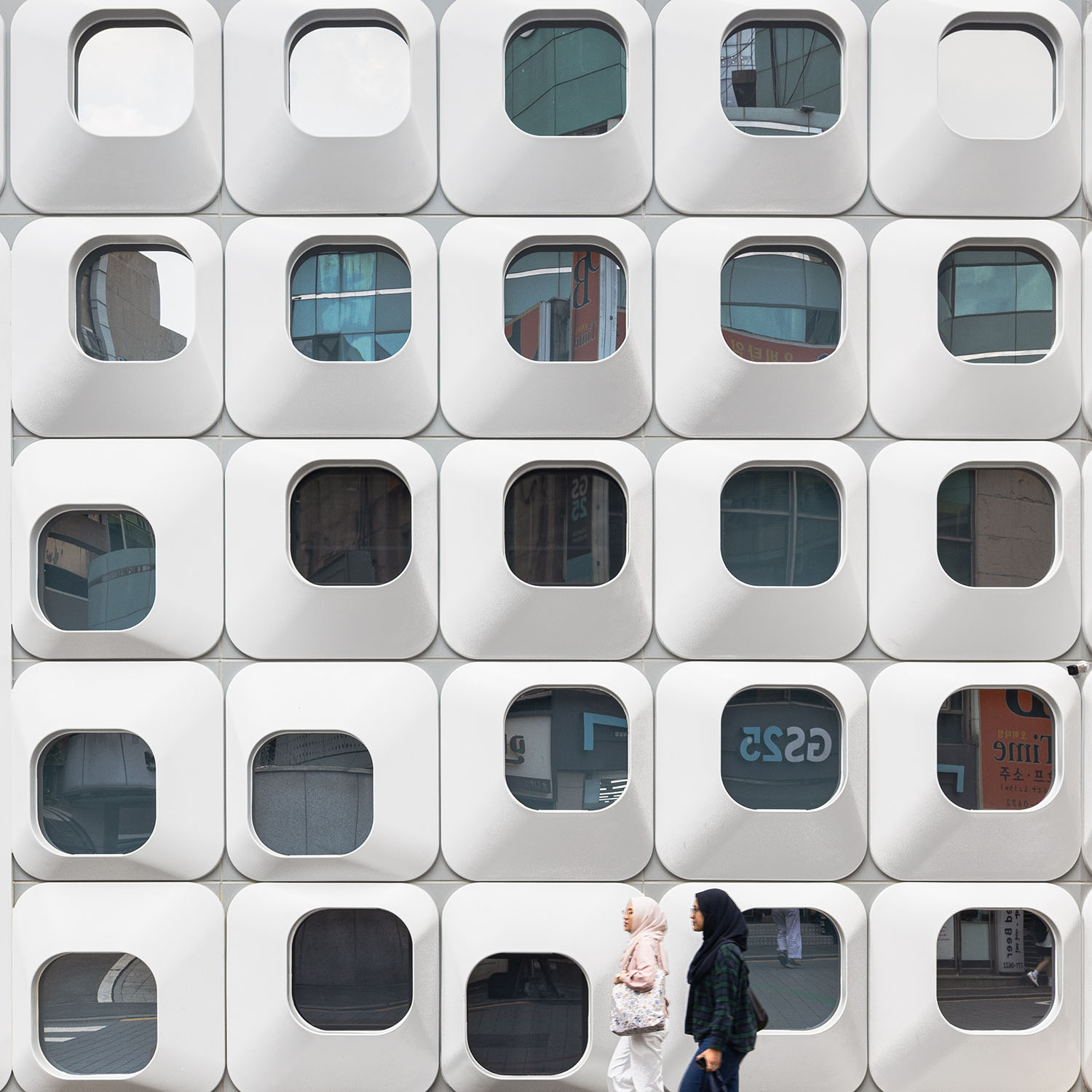
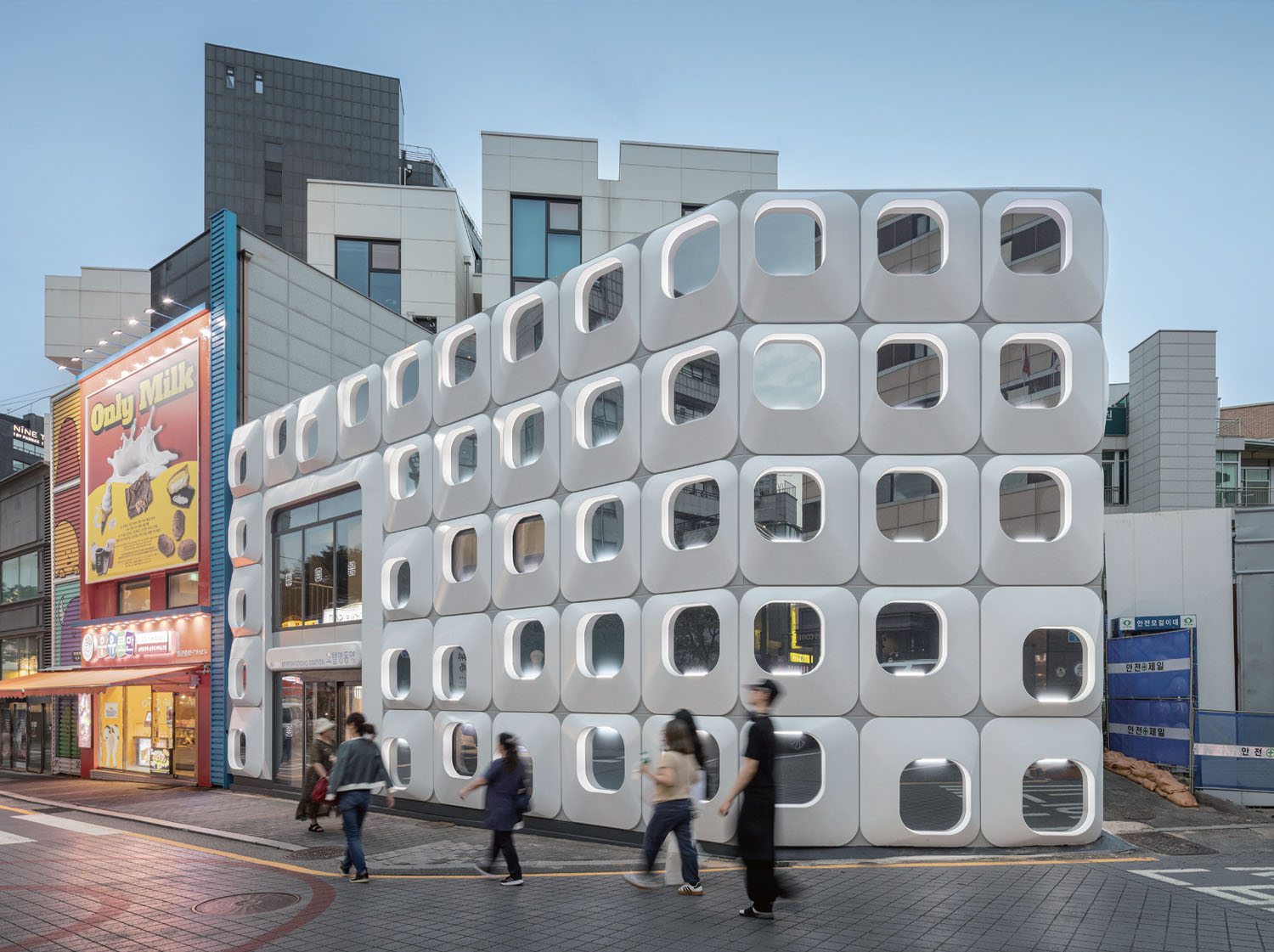
Yoon: When taking the conditions of equipment into account, one inevitably begins to think in terms of modules. Hotel Myeongdong Station (2025) makes its modular system visibly explicit, while Topology: Hanok , though it may appear as a single solid mass without any constructive modules, in fact contains them. Do modules serve as an initial design concept for you, or do you sometimes use a strategy to dismantle the modules?
Lee: I don’t create modules arbitrarily. I’m more interested in the overall form than in modules themselves. As I mentioned earlier, when I plan methods to create large, strange, and extreme forms within the constraints of real-world tools and fabrication processes, they naturally become standardised and modularised.
Yoon: Perhaps because you don’t prioritise modularity, Hotel Myeongdong Station follows a more conventional modular logic, whereas Topology: Hanok does not. It could have been standardised into first, second, and third floors, for instance, yet the sizes and junctions of each unit are irregular.
Lee: That too resulted from the limitations of the tool. My priority was form, but when parts extended beyond the working range of the robotic arm, the cutting points became irregular. If I had access to a robotic arm with a much larger working radius, say 10m, and with precise control, Topology: Hanok wouldn’t have been segmented at all.
Yoon: So, if there were no constraints in fabrication, the entire structure would have been realised as a single entity?
Lee: Exactly. If we could produce a single monolithic form through something like largescale 3D printing – say, with a tower crane-sized printer – and if it could automatically ensure structural stability, many of the architectural discourses we have today would cease to exist. Also, sometimes the visualisation of modules is necessary, and sometimes it isn’t. That’s the main difference between Hotel Myeongdong Station and Topology: Hanok. From the beginning, I wanted Topology: Hanok to appear as one solid mass.
Yoon: But in that case, it moves away from the joinery-based characteristics of the hanok.
Lee: Once I adopted AI as the main tool, I realised that structural logic such as joinery could not be represented within the 2D images generated by the model. So I wondered how hanok could be expressed or identified at the 2D image stage. I concluded that it could be represented formally through the sectional image of hanok. I generated a sequence of 2D images that gradually transformed, then merged them into a single volume. Rather than reproducing joinery systems, I wanted to retain the formal characteristics that remain even when those systems are blurred.
Jeong: Whether or not one treats the unit as a tool is one of the key distinctions among computational design approaches. The computational designers I’m familiar with often emphasise the notion of the cell. For example, at the AA School’s DRL (Design Research Laboratory), they focus on how to turn a designed cell into a shell or a membrane.
Lee: Prioritising the cell as a unit isn’t really my concern. To me, that approach feels like something that has become ‘strange for the sake of being strange’. Perhaps because I’ve seen so many of those outcomes, they don’t even look strange anymore. For instance, when someone wants to make a wobbly, bizarre form but can’t realise it as a single mass, they divide it up. Since the result is meant to look strange, they assume each part must also be strange. But as tools evolve, such logic may no longer hold. From today’s standpoint, it already feels like a story from a transitional era.
Jeong: I agree. Early computational design often embraced the constraints of tools as creative material, channeling them into complexity.
Yoon: The trend of module-centred parametric design is already more than twenty years old, so it may now seem rather stale. To distinguish themselves from this, many designers tend to put great effort into the selection of materials. You also have used various materials from styrofoam and wood to mycelium. What’s your standard approach for selecting materials? Were you trying to practice global design trends within the Korean context, or were you intentionally choosing non-commercial materials?
Lee: Both, actually. I don’t believe that reinforced concrete – which has dominated the market for over a century – will last forever. That realisation led me to imagine architecture made from organic materials, and I thought this direction could distinguish my research from others. When beginning any study, the first thing I do is review previous research. Then I assess whether I can introduce a meaningful difference from those precedents, and based on that, decide whether to proceed. I also consider whether the paper’s conclusion can include a kind of climax. This process helps organise the trajectory of my experiments and works.
Yoon: I think material experimentation is possible because you belong to the academic realm, not professional practice. In practice, regulations and constraints severely limit the use of materials. That’s why early experimental endeavors could only take place in academia. The fact that figures like Bernard Tschumi and Steven Holl could explore paper architecture in the 1980s – 1990s was also because they were based in schools. Now, the scope of architectural experimentation within academia seems to have expanded—from ‘paper’ to ‘making’. At the same time, I think your broad interest in materials comes from the fact that you’re dealing with architecture. Focusing narrowly on a single material would be more of an engineer’s or technologist’s attitude. As architectural designers, we don’t necessarily study the micro-properties of materials in detail. Rather, when we combine a certain material with a specific design methodology, new insights often emerge; if progress stalls, we pivot and discover something else. Perhaps you’re expanding your spectrum through such continuous transformations.
Lee: I partly agree, but the reason I’ve dealt with multiple materials is also because there aren’t many professors in Korea researching computational design. If the research environment were more established, I could have conducted narrower and deeper studies. But now, I even have to present at BIM conferences. BIM is a tool for integrating and managing data across design, construction, and operation, yet in architecture, people often equate computational design with BIM. Some even call me ‘the CAD professor’. (laugh)
Yoon: However, the field of material design in architecture doesn’t have a long history, even internationally, and it seems that the teams exploring it rarely focus on a single material. At the Design Academy Eindhoven, a department dedicated to material design was only recently established. Similarly, Atelier LUMA, which participated in the Gwangju Folly project, is a team researching material design—but even there, individual designers don’t study just one material. Depending on the region and context, a designer might create panels from sunflower seeds, then blocks from salt, later panels from straw, and eventually combine two or more of these materials. In the end, designers tend to develop a broad spectrum of approaches.
Lee: Ronald Rael at University of California (UC), Berkeley, for instance, has focused on working with earth for almost ten years.
Yoon: But even he worked with a wider range of materials early on—he once experimented with 3D printing using salt, before eventually concentrating on earth.
Creation Disguised as Research
Jeong: As you explore new materials and forms, you inevitably reach crossroads that lead to new designs. What, then, is your ultimate destination? Is it simply about making things big and strange, or is your work open-ended? At what point do you think your work gains cultural value?
Yoon: My approach may differ from yours, but I work with the goal of eventual commercialisation—so that one day my research can be applied to an actual building I design.
Lee: For me, rather than commercialisation, I just want people to look at my big and strange works and enjoy them. (laugh)
Jeong: So, it’s creation disguised as research?
Lee: Exactly. If someone who’s not even interested in architecture looks at my work and wonders, ‘What is that?,’ I’d consider that a pretty good reaction.
Jeong: That reminds me of when I visited Reaction Field. It was one of those rare days with good weather, and children were running around, playing on it. Watching that pure form of entertainment made me think—this is one of architecture’s fundamental purposes, yet it’s something we often overlook.
Lee: Honestly, I was hoping people would sit quietly, have a cup of coffee, and enjoy the space. (laugh) But the kids kept climbing onto the benches, so I had to add extra columns for safety.
Jeong: Since you describe your work as closer to creation than research, I’m curious about your personal interests. The pursuit of things ‘big and strange’ must stem from a vast network of references.
Lee: I’ve always liked mutated creatures in science fiction—those hybrids between human and machine, organic and inorganic. I’m drawn to the excessively violent, the grotesque, and the things that go beyond the norm. I often think about how these can be expressed architecturally.
Jeong: Images based on science fiction were closely tied to early computational design. It’s a kind of generational trait—something that only those who lived through a particular time and context share. Tom Wiscombe, for instance, draws nearly all his references from science fiction. He was born in 1970, and if we assume there’s roughly a ten-year cultural gap between Korea and the West, you could say Lee resonates with the generation of Americans born in the 1970s and Koreans born in the late 1970s.
When I was at the Städelschule in Germany, we went through a transitional moment after Peter Cook’s paper architecture and Ben van Berkel’s technology-based experiments. The question then was: what comes next? Many people thought the answer was ‘virtual’. The idea was that you didn’t need to rematerialise the digital—you could experience and perceive it through VR and other means.
By contrast, those born in the mid-to-late 1980s through the early 1990s, who were deeply immersed in the digital, seemed content to leave the strange within the computer. Liam Young, a professor at Southern California Institute of Architecture (SCI-Arc), also teaches architecture but doesn’t produce any physical outcomes. Meanwhile, the generation just before them still seems to have this strong desire to make things tangible.
Lee: When I was at Columbia University, I was part of a group of people who loved computers. We often talked about sci-fi movies and drew all sorts of bizarre sketches. Joseph Kosinski, the director of the recent film F1: The Movie, wasn’t there at the same time, but he belonged to that same circle.
As Jeong mentioned, I’ve always believed that architects must make things that are visible and larger than people. When my classmate and I completed Soft Shelf (2008) in grad school, we were incredibly proud, saying, ‘Finally, we’ve built something bigger than a human.’ That kind of desire has lessened over time, but it’s still something I value deeply.
Jeong: Perhaps the kind of architect who values physical construction will become rare in the future. That makes architects like you even
more precious.
AI and Architects
Yoon: In many of your projects, the robotic arm has consistently functioned as a precise tool for execution, whereas AI seems to have evolved into an active design agent—from Hotel Myeongdong Station to Topology: Hanok. When AI becomes a partner that expands the architect’s creativity, rather than replaces it, how do you think architectural authorship will be redefined?
Lee: The notion of authorship was already a matter of debate when computation first emerged. Today, with so many design resources shared as open source, anyone can easily generate similar forms. Yet even when using the same open source, some designers are able to infuse their work with their own sensibility. Those are the ones who will endure, while the rest will fall into the category of programmers. Ultimately, if one can create work that exceeds the norm, that alone establishes authorship, and I believe people can recognise and judge that for themselves.
Yoon: You’ve drawn a distinction between programmers and creators. Do you see architects as belonging to the latter category?
Lee: Definitely. Architects are not programmers, they’re closer to the final decisionmakers.
Jeong: Discussions on authorship are more advanced in contemporary art than in architecture. Ever since Marcel Duchamp placed a urinal in a museum, formal creation and authorship have become separate issues. Virgil Abloh, for instance, bought Polo Ralph Lauren shirts, printed ‘PYREX 23’ on them, and resold them—effectively separating the act of designing the garment’s physical form from the authorship that generates its value. We keep returning to a generational discussion, but I think people in their 20s and 30s today tend to separate making cool forms from authorship. Their sense of what authorship means is shifting. Lee once said that the architect’s role is ‘to observe and modify the process’, and I completely agree—but I suspect that, before long, the object of that observation won’t be technology itself, but the intangible rules of the game. Because the act of handling technology might soon no longer belong to humans, but to AI.
Lee: If I’m looking toward the near future, I’d say Jeong is looking toward the distant one.
Jeong: I’m also curious about how you feel when working with AI these days. In earlier projects you coded everything manually, but for Hotel Myeongdong Station you were selecting from AI-generated images. What was that like—to go from designing a route step by step to producing images through simple text prompts?
Lee: Honestly, we were short on time back then, so I thought, ‘AI will do its job.’ (laugh) Of course, results vary dramatically depending on how refined your prompts are, but I used fairly ordinary words. Partly because of time constraints, and partly because the client wanted a commercial building. I thought the hotel should look like what the general public imagines when they hear ‘capsule hotel’. So. I used AI almost like a survey tool—to visualise the collective perception of a capsule hotel.
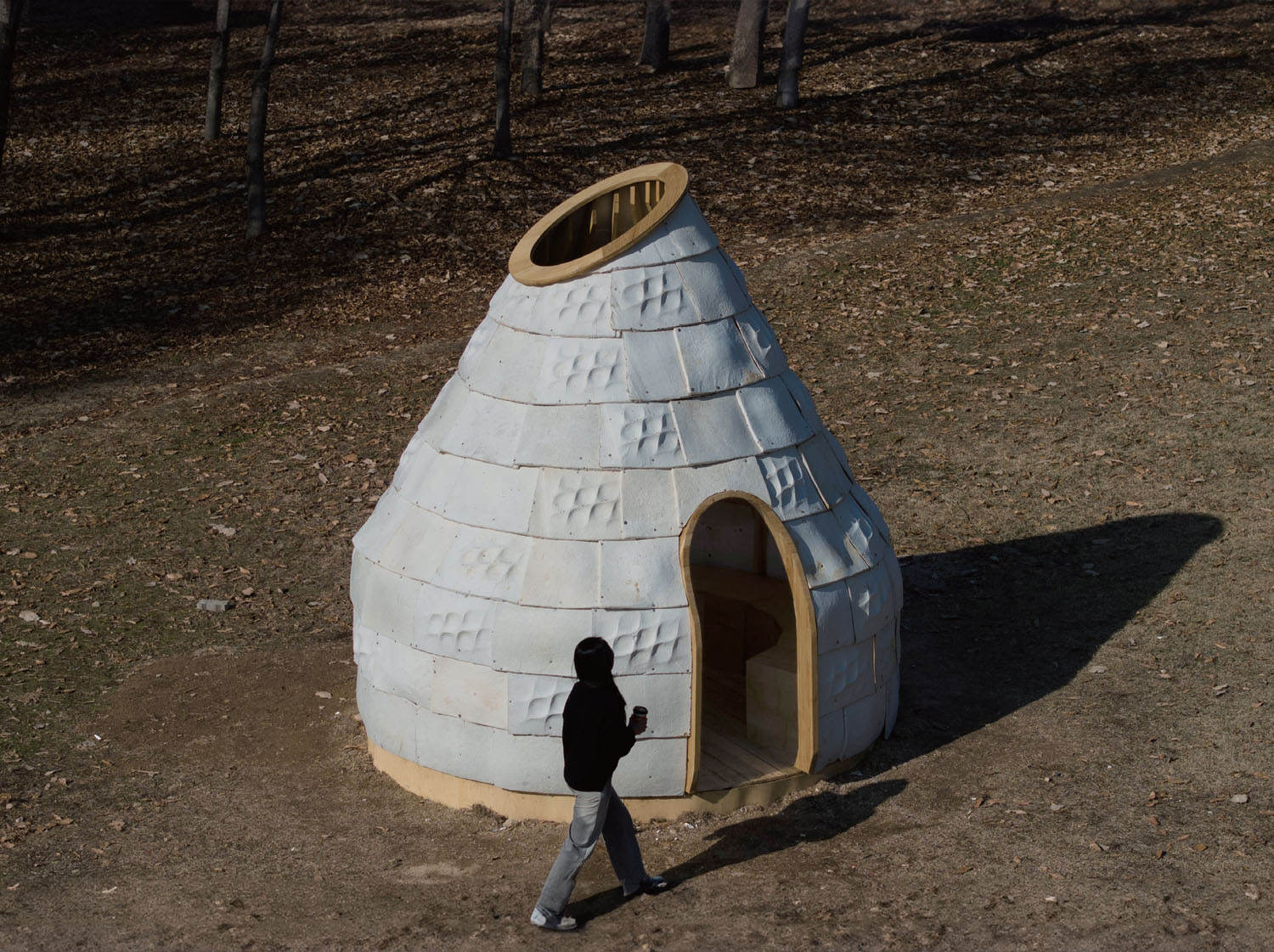
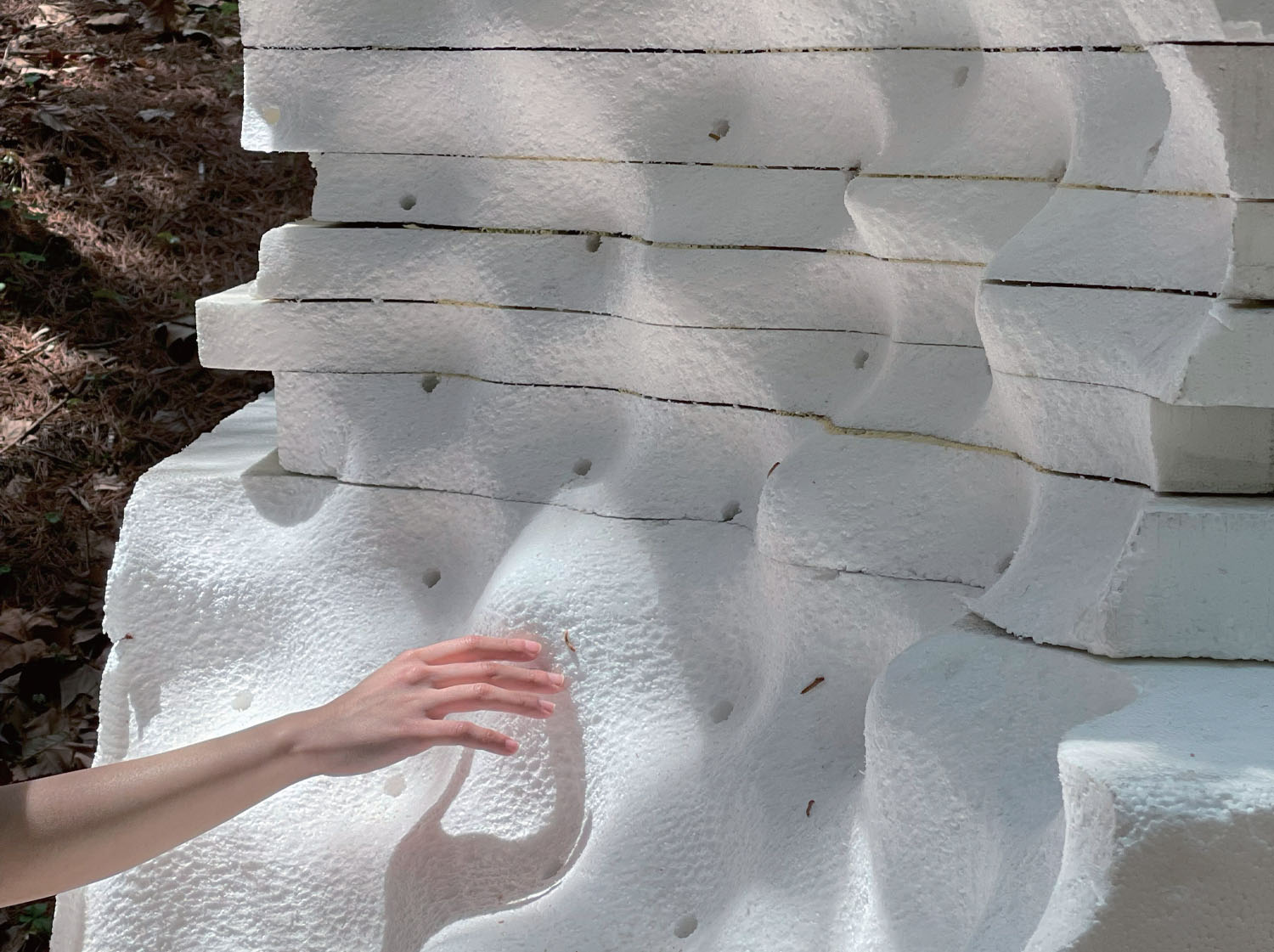
Yoon: I sense a kind of resistance to permanence in your work. Some architects still believe architecture must embody timelessness and eternal truth, but you seem more interested in the fleeting impact of an image—something that strikes people in a moment. In Hotel Myeongdong Station, too, you drew upon the kind of image people immediately associate with a capsule hotel. Even the materials and methods you use carry this sense of temporal brevity: Strata of Decomposition (2025) created by mealworms consuming styrofoam are inherently ephemeral, and the mycelium that forms the basis of Mycelial Hut (2024) has only a short lifespan. How do you think about temporality in terms of architecture’s role, its nature, and its materials?
Lee: I believe that the appearance of a work that exists only for a moment – that is felt only in the moment – can also be meaningful. But in the end, what truly remains is the design of the process itself.
Jeong: You a lways connect new technologies with new formal outcomes. If collage produces a clash between two elements, your approach seems closer to mapping, which seeks points of connection rather than collision. In that sense, is there something specific you pursue in the process itself? Do you feel a kind of thrill when certain parts of the process align perfectly?
Lee: What I want to convey is that there are other kinds of design processes besides the traditional one.
Jeong: There are indeed many nontraditional ways of designing. I’m curious—which particular approach, or when you twist or subvert something, do you find enjoyment?
Lee: The element I most often vary in my design process is the tool. To use a new tool, I have to abandon my previous design habits and find an entirely different way of working. What interests me is how that tool can be used—and how a new kind of process can be designed around it.
Jeong: Even when you’ve chosen the robotic arm as your tool, there are still many possible processes. One must select a particular approach—and that’s what I’m curious about: the criteria and reasoning behind that choice. For example, Peter Testa and Devyn Weiser, professors at SCI-Arc, see robots not as tools but as mediums—they explore the potential of robots not as fabrication devices but as representational instruments. They experimented with architectural representations that could only be captured through the movement of the robotic arm. One memorable student project at SCIArc involved a surface suspended from a robotic arm, which, through the robot’s movement, transformed into a spatial expression. According to the logic of the robot’s own dimension, this surface could be understood as a new kind of drawing. Such a line of thought attempts to overturn traditional notions of architectural representation through new forms of projection or machine vision. It’s different from simply generating new forms. So even with the same tool, the process can change completely depending on the purpose or intent.
Lee: I’m less interested in making a theoretical statement than in finding the point between what’s possible and what’s not—and choosing the method that lies exactly on that boundary. I tend to pick the hardest process I can still control.
Yoon: And what determines that boundary between the possible and the impossible? After all, ‘the most difficult’ isn’t an objective measure. In my case, I define the limits of a project by the time available. For instance, when I work with students, the work must be completed before the end of the semester break—that becomes my criterion. (laugh)
Lee: Deadlines such as project delivery dates are also my standard bar. However, Topology: Hanok didn’t have a fixed deadline, and since it wasn’t a problem even if it remained unfinished, I was able to experiment much more. Once I start designing in Rhino, a final form eventually emerges—that becomes the formal goal I pursue. The final stage of the process is to translate that 3D file into a physically existing object.
Jeong: When it comes to creating form, I feel that the sense of surprise once triggered by physical or visual spectacle has gradually diminished compared to the past—and with the rise of AI, this phenomenon will likely accelerate. In earlier years, architecture students had to work intensively with software and rendering to produce spectacular images, whereas now, such images can be generated in abundance simply through prompts. This shift will inevitably change our aesthetic sensibility, and you seem to be experiencing that transformation at the very front line.
Lee: Whether it’s AI or parametric design, I believe the spectacle they produce merely sets the baseline of what we must now work beyond. We have to adapt to it quickly—and always aim to create something more spectacular than the tool itself. As a designer who works with tools, I believe our role is to produce results that exceed what the tools alone can generate.
Logic and Intuition
Jeong: Before our conversation, I had speculated that Lee’s work might be an extension of the aesthetic tendencies of computational designers who, rather than focusing on science fiction, were interested in forms of life. This appears, in a sense, as a kind of genre grammar. I use the term ‘genre’ here because these formal conventions seem to operate independently of logical rigor. I suspect the roots of this lie in the 18th and 19th centuries, when natural and life sciences were emerging in the West and experiments sought to uncover laws within the forms of life. Ernst Haeckel’s natural history illustrations and Goethe’s morphology are examples of this, which in turn connect to patterns like Alan Turing’s, as Lee has also referenced. Ultimately, this translates in architecture into an impulse to visualise tectonic complexity or a fascination with pure structural forms.
Lee: I wouldn’t say I’m completely unaffected by that worldview. Surely I’ve been influenced, but I want to go beyond that.
Jeong: Part of that answer seems to be resolved by your self-identification as an ‘creator’. I also get the impression that you deliberately borrow symbolic metaphors in your work’s forms. For instance, Mycelial Hut appears to intentionally reference the Primitive Hut, which can be read as an analogy for exposing the current state of a material that has not yet reached industrial production. Likewise, Strata of Decomposition reproduces the form of industrial waste while directly indicating that the object meant to be consumed by insects is, in fact, a ‘trash mound’.
Lee: I think you interpreted the work well. In fact, the dome shape of Mycelial Hut was partly chosen because it’s easier to fabricate panels when the structure has a uniform curvature, and also to reference the form of a hut to reveal a non-designed state. One might ask whether the mycelium panels alone would suffice, but I deliberately made a physical artifact because I felt it was necessary to demonstrate that mycelium could be used architecturally. Strata of Decomposition was scanned exactly as it appeared, because people are familiar with stacked waste styrofoam. It also raises the question of whether the mistakes committed by architecture should be resolved by architecture itself.
Jeong: When using technology, it seems that eventually you reach a point where you must select a single form. Otherwise, it doesn’t seem to be recognized as an architectural outcome. At the same time, Topology: Hanok seeks to capture the topological similarity of hanok through AI, but the approach ultimately relies more on human visual judgment than on computational logic. In particular, after inputting data into AI, the forms are ‘blended’ to generate complexity, and in practice, the layered edges are smoothed through sanding. This process seems less like a computational result of the concept of ‘topology’ than a symbolic gesture that represents the concept through curvilinear form.
Lee: As I mentioned earlier, I was consciously aware that some aspects needed to be intentionally obscured.
Jeong: Not only in Topology: Hanok, but also with Mycelial Hut and Strata of Decomposition, the intuitive choices made to reach the final form always seem to exist independently of the technology, which I found interesting. Finally, could you tell us about your plans for future work?
Lee: I don’t find architectural photography particularly interesting, and I don’t have a concept of architectural field trips. I am influenced more by fields outside architecture—novels, articles, films, music, exhibitions. As in the past, I think I will continue to find things within these realms that can be realised architecturally.
You can see more information on the SPACE No. November (2025).
Yoon Jungwon
Yoon Jungwon is a professor at the school of architecture, University of Seoul. She studied architecture at Seoul National University and Princeton University. Having participated in a wide range of architectural projects in the United States and the Netherlands, she gained experience in comprehensive approaches to architectural composition and in interdisciplinary collaboration with experts from various fields. Currently, she directs the TAD Lab and her own architectural practice, both of which aim to continuously bridge education, research, and design practice through transdisciplinary architectural design. As the curator of architectural production for the 5th Gwangju Folly, she coordinated processes ranging from the sourcing and production to the application of raw materials such as waste resources, natural materials, and traditional materials. Her recent research focuses on digital fabrication using bio-waste materials.
Jeong Haewook
Jeong Haewook is the co-principal of Midday and an adjunct professor at Korea University. Midday engages in publishing, writing, exhibitions, and practice, developing a line of thought on ‘architecture that exists prior to buildings’ and ‘the orders and aesthetics beneath architectural surfaces’. Jeong has co-authored two books – Architecture as Fabulated Reality and Upperhouse-Oriented – and pursues projects that expand architectural reality across diverse media. In 2024, he was featured in the Junglim Foundation’s programme, ‘Emerging Architects’.
Yong Ju Lee
Yong Ju Lee is an architect who pursues experimentation across all layers of space. His works, spanning diverse scales and media, seek to provoke and inspire everyday life. He has exhibited at the National Museum of Modern and Contemporary Art, Korea (MMCA), Museum of Modern Art (MoMA), and the Venice Biennale, and received the Korea Public Architecture Award, iF Design Award, and Architectural Record’s Design Vanguard. He studied architecture at Yonsei University and Columbia University, and is currently an assistant professor at Seoul National University of Science and Technology, leading the Robotic Fabrication Studio. He published Constructing Thought (2024).