




SPACE September 2026 (No. 706)
From July 27 to Aug. 8, the workspace of the printing production company Intime was transformed into ‘Intime Library’, an exhibition composed of books, annotations, and dialogues. Without a printing press of its own, Intime has coordinated the production process by collaborating with a range of specialist companies responsible for output, printing, folding, binding, and post-processing. Founded by Kim Jongmin and Yoo Sungwoon, with Lee Siha and Kim Narae joining later, Intime divided responsibilities across quoting, production, delivery, and settlement, while the geographical range of its site supervision expanded from Chungmuro and Euljiro to Ilsan and Paju. Tracing Intime’s works reveals not only the production structure hidden behind a finished book, but also the network of collaboration through which it comes into being.
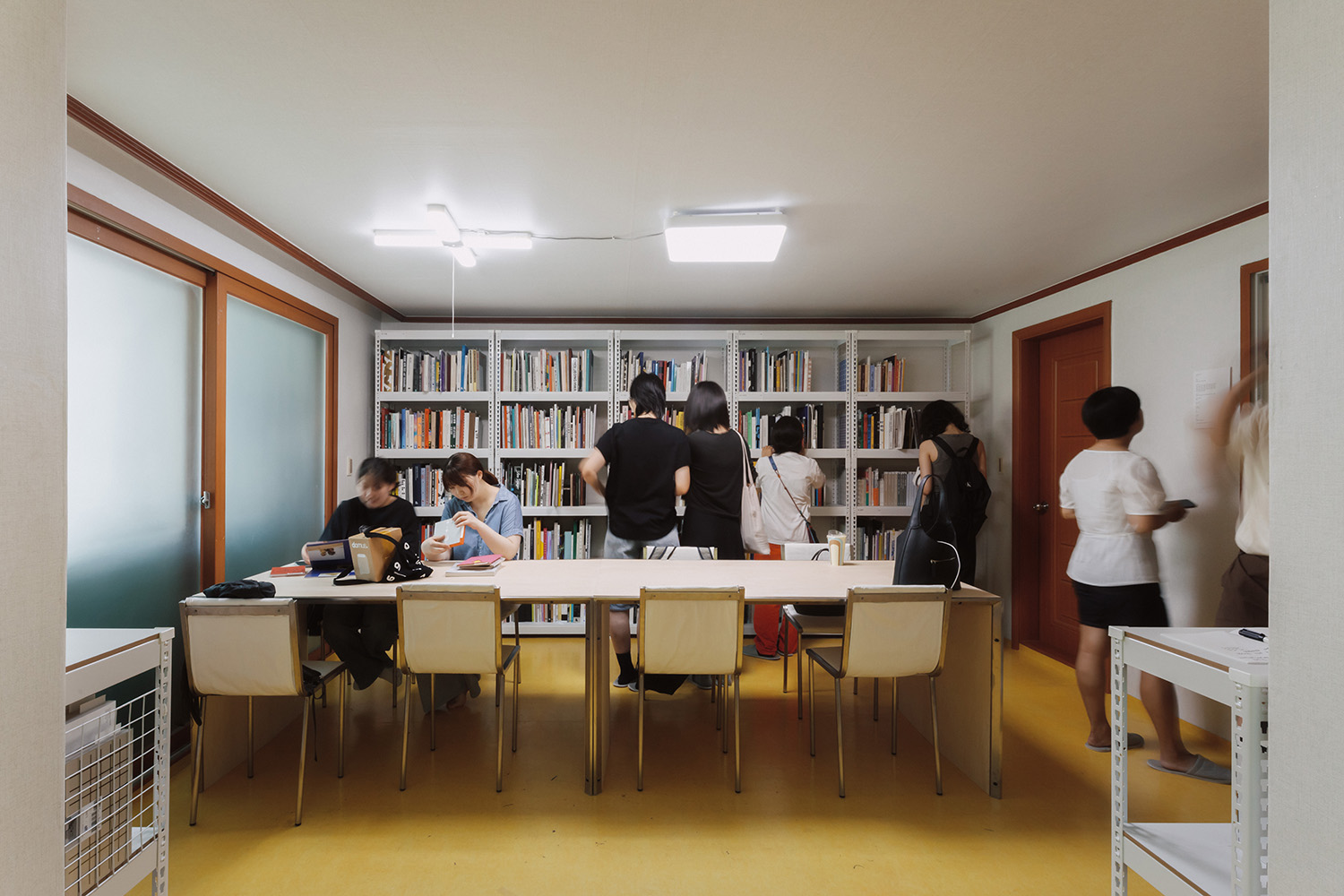
〈인타임 도서관〉 전시 전경 ©texture on texture
Graphic designer and editor Lee Mingyu, who organised the exhibition, has long been interested in the processes that lead to a finished result and in the people whose contributions often remain invisible within those processes. The first edition of Can Lee Younghee Speak? (2023) examined the hidden faces of regional publishing that had remained largely absent from design history through the oral accounts and materials of Lee Younghee, who ran an editorial design studio in Namsan-dong, Daegu. Later, while producing a second edition (2024) for the exhibition ‘All the Names’, Lee Mingyu traced the book’s production process and rewrote its colophon to include the names of 25 workers involved in output, printing, binding, and transportation. In ‘Intime Library’, his focus expands from individual workers to the production companies themselves, examining both Intime’s role in connecting multiple vendors and coordinating production conditions and the books produced through that network.
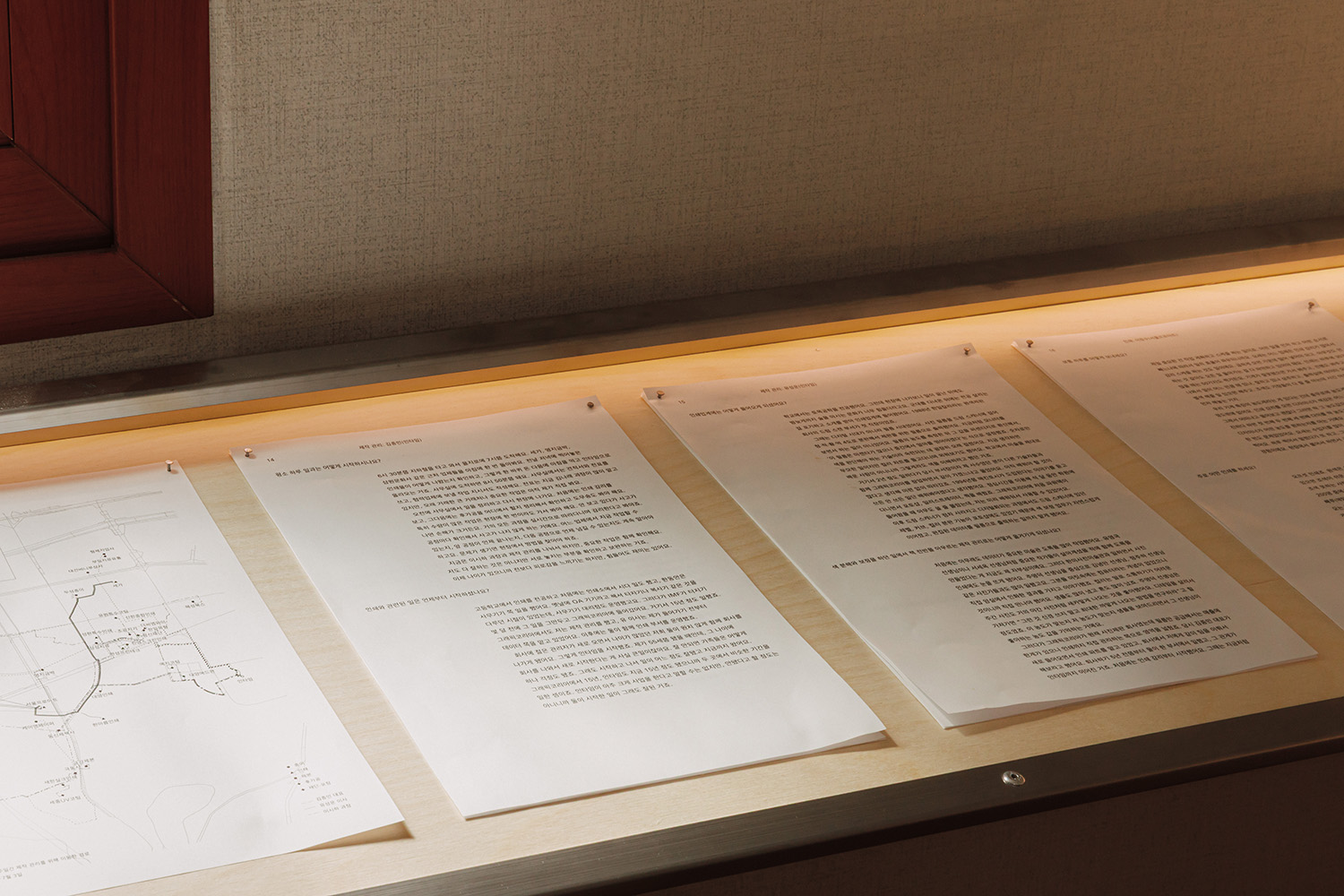
20개의 문서와 웹 아카이브로 구성된 주석 ©texture on texture
Between February 2012 and July 2026, printed works that passed through Intime amounted to approximately 18,000 works. From these, Lee Mingyu selected 2,446 books that involved the participation of editors and designers. Based on this selection, he built the Intime production book database, enabling cross comparison of production specifications and publishing trends that are difficult to discern from just reading individual books alone. The database was developed by cross-referencing colophons and production specification sheets to account for bibliographic information. These analyses and records of the production process form the exhibition’s ‘annotations’. Among them, 1,282 books were borrowed and collected with the cooperation of designers, publishers, authors, and collectors, bringing them back together in the workspace. Catalogues and monographs from national and public museums, photography books, zines, independent publications, and students’ graduation projects ‒ with vastly different publishers, production scales, and distribution methods ‒ are brought together in one place, placed alongside one another according to a single criterion: they were made at Intime.
Five ‘dialogues’ add first-hand experiences from the production scenes that cannot be fully captured through annotations alone. Yoo Sungwoon, Intime’s production director, discussed the physical conditions that affect the final result, including the characteristics of different papers, cutting tolerances, and binding methods. Designer Lee Kyungsoo of Workroom suggested that rather than asking ‘Who is the real producer?’, it may be more appropriate to ask, ‘Who did you make it with?’ Graphic designer Shin Shin (Shin Haeok, Shin Donghyeok) recounted how they first came to know Intime through books by senior designers, as well as the story of how they later introduced Intime to Lee Mingyu when he was still a high school student. The final dialogues addressed the questionable areas inherent within archives itself: the fact that a curator’s perspective inevitably intervenes in deciding what to collect and what to leave out. Once the printing shops’ collective holiday comes to an end, the workspace will return to its original function, and the books will return back to their respective homes. Temporarily brought together in one location, the books reveal the people and processes that had remained hidden behind the finished objects. ‘Intime Library’ invites us to reconsider a book not as the achievement of an individual designer, but as the result of a collective process shaped by numerous producers and collaborators.

0