




SPACE September 2026 (No. 706)
This collaborative exhibition between Korea Foundation and the Georgia Institute of Technology (Georgia Tech), ‘Crossing Grounds: Art, Design & Technology’ presents 16 projects by architects, artists, designers, and researchers at Georgia Tech. These works cross geographical, material, and disciplinary boundaries to demonstrate how research across diverse fields, including robotics and artificial intelligence (AI), digital fabrication, sound technology, biofeedback, materials science, virtual reality (VR), and architecture can be translated into images, sounds, spaces, and material forms. This approach also resonates with Georgia Tech’s new academic line, enhancing the intersection of art and technology across different schools and departments.
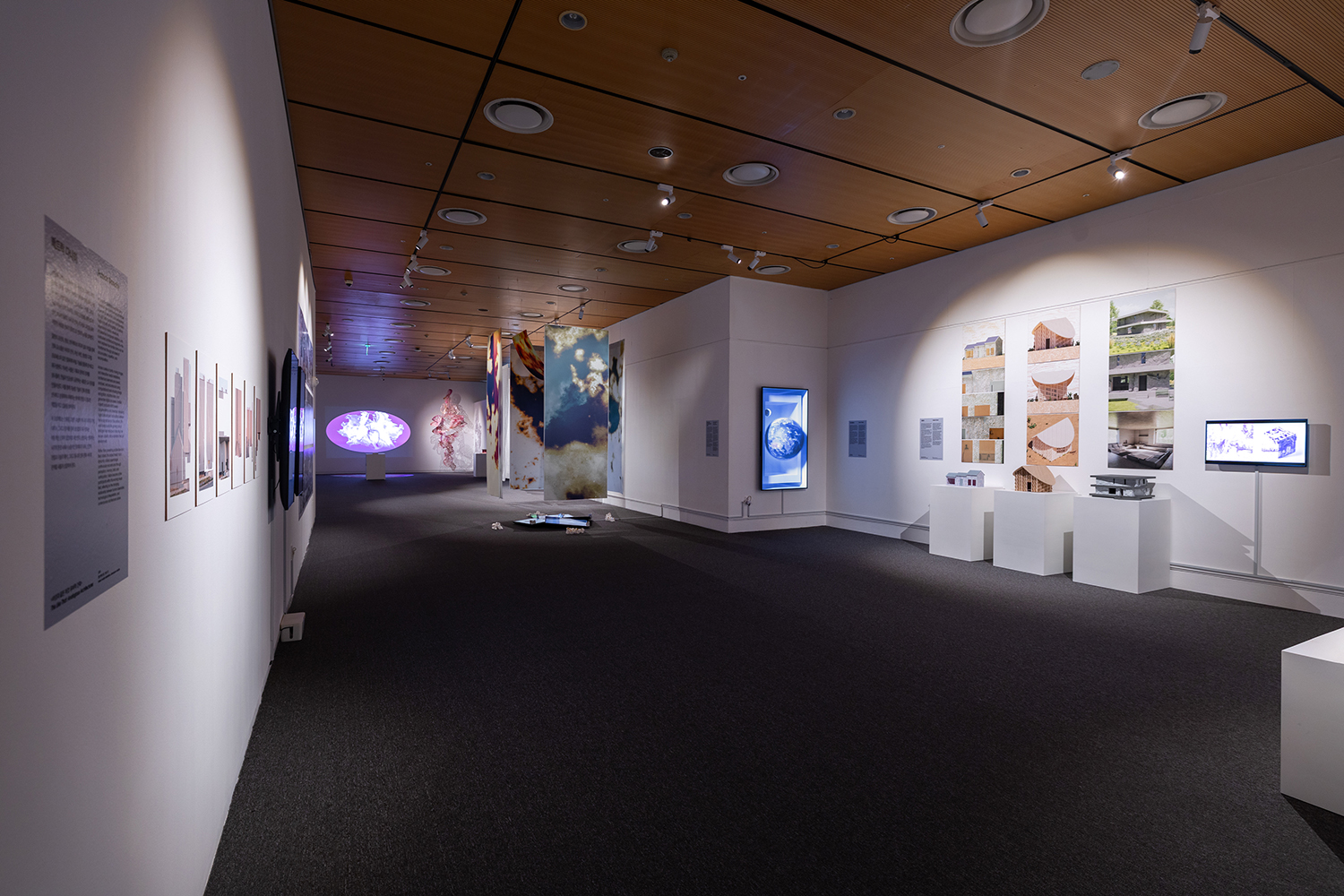
Exhibition view of ‘Crossing Grounds: Art, Design & Technology’ / Image courtesy of Korea Foundation
At the artist talk held on July 28, Kwon Hyojin (Assistant Professor, Georgia Tech), Co-Curator and participating artist, introduced the main theme of the exhibition ‘crossing’ as a process of ‘translation’; the power to interpret and move between different knowledge sets and media to arrive at new meanings. At her institution, Kwon Hyojin investigates how information embedded in digital images can be analysed and transformed into architectural form and material. Architecture After Images comprises three works that convert information embedded in pixels, such as colour, brightness, and resolution, into data for generating architectural form, further using it as a design tool to fabricate the physical form. Applying the same methodology across three different construction systems, masonry, timber construction, and composite cladding, the works treat the image not as a surface that represents a finished building, but as design information that determines both architectural form and methods of construction. Meanwhile, Bojana Ginn transforms information measured from the body into sensible images and sounds. A cross-disciplinary artist who has a medicine and science background, Ginn presents Biometric Sublime and Orchid Dreams, two interactive installations that use sensors to capture visitors’ biometric signals, such as heart rate, and translate them into projected images and sound. At the centre of the screen, colours and organic forms contract and expand in response to the rhythm of the visitor’s pulse. Biometric information typically read as numbers or graphs, now, is translated into new visual form that can be directly perceived through the movement of light and sound.
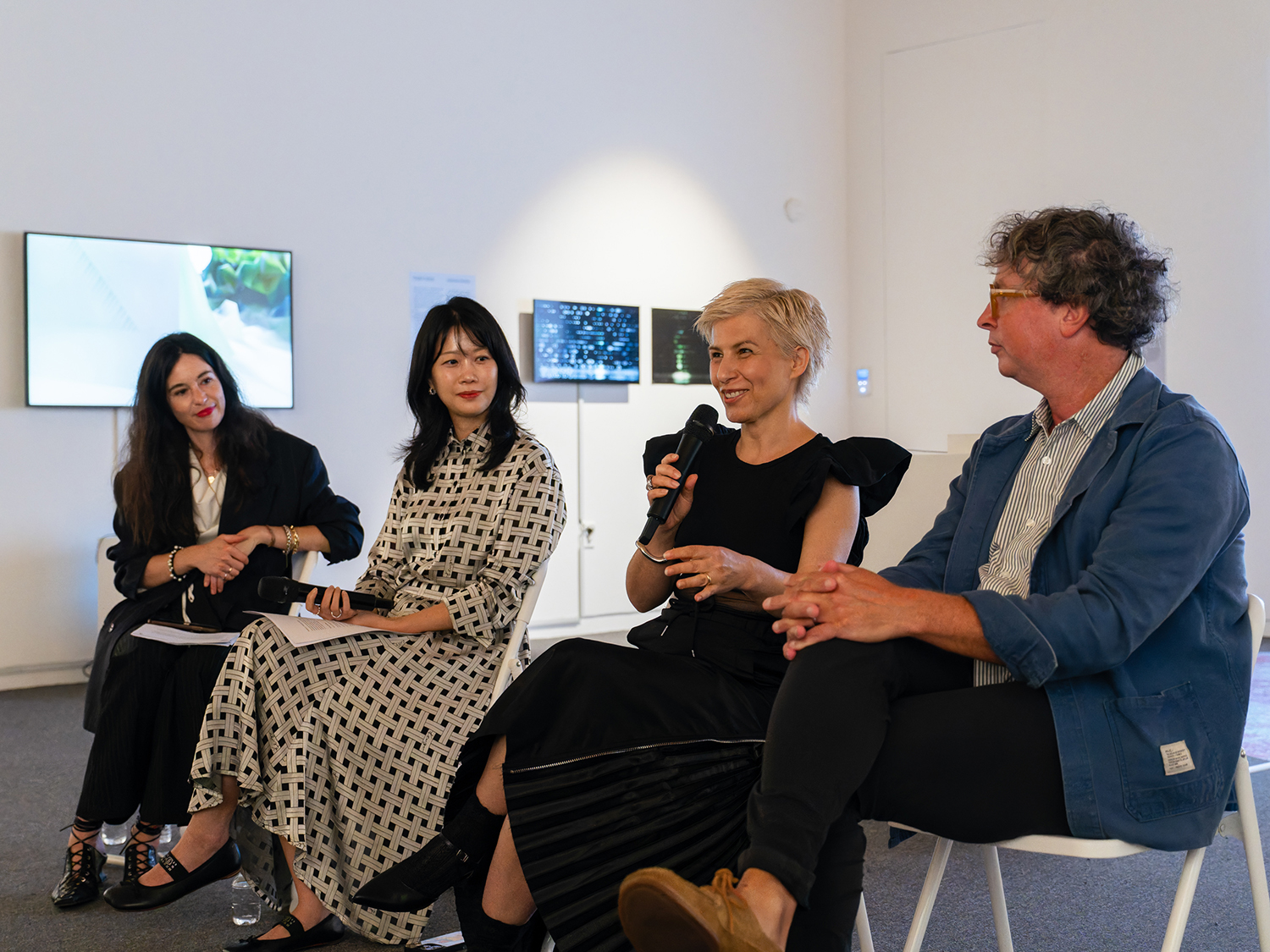
(from left to right) Birney Robert, Kwon Hyojin, Bojana Ginn, Jeremy Bolen during the artist talk / Image courtesy of Korea Foundation
Besides the works discussed during the artist talk, the exhibition also includes six projects by researchers from Georgia Tech, which examine the intersections between architecture and technology. Conversing Computation by Misri Patel (Fellow, Georgia Tech) began with a collaboration with fifth-generation brickmakers in India. Through field research and conversations with the artisans, Patel studied their methods of making earthen bricks and integrated these practices with computational design and manufacturing systems to collaboratively produce prototypes. Rather than replacing traditional craft with digital fabrication, the project explores how distinct modes of making can collectively operate within an actual process of design and production.
Sixteen projects, each with a distinct point of departure, reveal multiple ways in which technologies and knowledge across disciplines are translated into images, sounds, spaces, and material forms. The exhibition, examining the idea of ‘crossing’ beyond interdisciplinary collaboration, will be on show until Sep. 11 at the KF Gallery.
