
SPACE November 2026 (No. 708)
On Sep. 14, Lifethings (Principal, Yang Soo-in) hosted the seminar ‘Talk(-ing) Architect 2’. Last year, Lifethings experimented with a ‘Mouseless Studio’ approach, putting aside the mouse and using AI to translate design intentions into form through language. (covered in SPACE No. 695) Taking the Architectural Design Competition for the Donggang Yeongwol The Well Town Community Center and Sports Center as its testbed, the studio explored whether this approach could produce a proposal viable for actual submission. Whereas last year the team used AI-generated digital jigs (temporary customised software) and MCP (model context protocol) to operate conventional design software such as Revit through natural language, this year it bypassed commercial design software altogether, directly connecting the stages from competition guidelines to final presentation panels through natural language and code. They call this ‘The Pipeline’, referring to the way multiple stages of input and output are linked into a continuous workflow. The aim is to use natural language to revise drawings to the standard required for a design competition in the manner intended by the architect, and to carry those changes through to subsequent outputs. Together with LIFE architects (Co-Principals Hwang Sooyong, Han Jeeyoung), Yang conducted this experiment for about a month and a half from July, using the Design Competition for the Construction of the Later Baekje History and Culture Center as its test case. At the seminar, Yang first explained why the scope of the experiment had expanded from last year’s Mouseless Studio approach to this year’s The Pipeline. Hwang then presented the process of building The Pipeline, while Han shared how it was applied to an actual competition proposal.
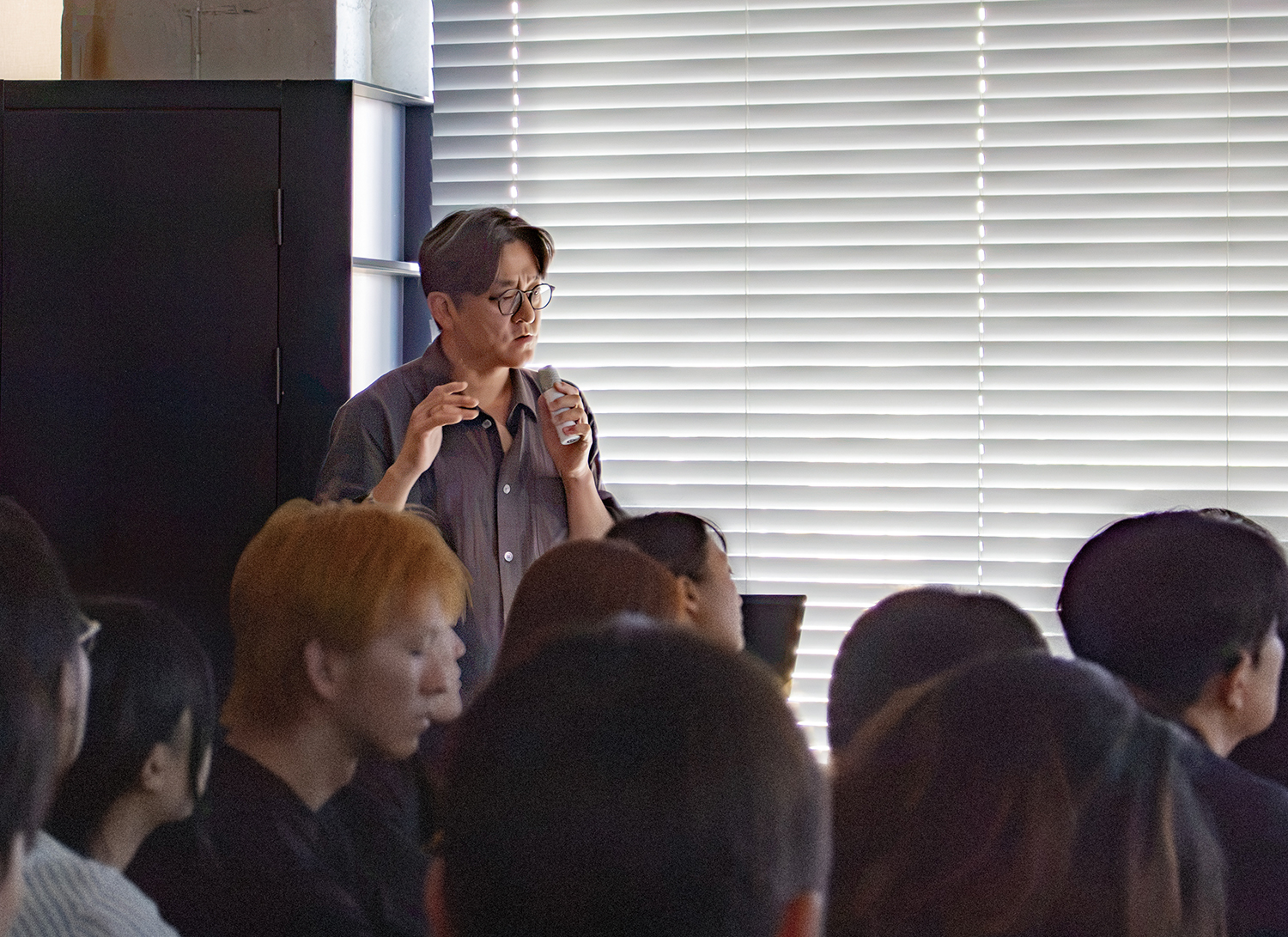
Yang Soo-in explaining the background of the seminar ©Kim Hyoeun
The floor plans initially generated from the competition guidelines alone bore little resemblance to architectural plans that could actually be used. The team therefore had the AI refer to PROJECT SEOUL, the Seoul Metropolitan Government’s design competition archive. Yet while the AI could explain the concepts behind individual projects, it was unable to properly read basic elements in the drawings, such as stairs and cores. In other words, having an LLM (large language model) synthesise and explain text relating to a competition was a different problem from having it understand the spatial relationships represented in drawings. To address this, the team turned to the architect licensing examination. By matching spatial conditions described in language with multiple sample solutions and explanations, they established rules governing room types and their connections. They then returned to the 374 projects and 1,528 drawings accumulated in PROJECT SEOUL to extract layout patterns involving footprints, cores, corridors, and reference grids. Their purpose in choosing a design competition as the subject of the experiment was not primarily to win, but to test how far The Pipeline could function within real-world constraints—including competition guidelines, site conditions, submission formats, and deadlines. Using only natural language and code, they produced drawings, diagrams, perspective views, and presentation panels; even the perspective views were constructed as drawings defined by coordinates and vector values. A single revision was reflected simultaneously across related drawings and area schedules, demonstrating that multiple outputs, from competition guidelines to final submissions, could be connected within a single workflow.
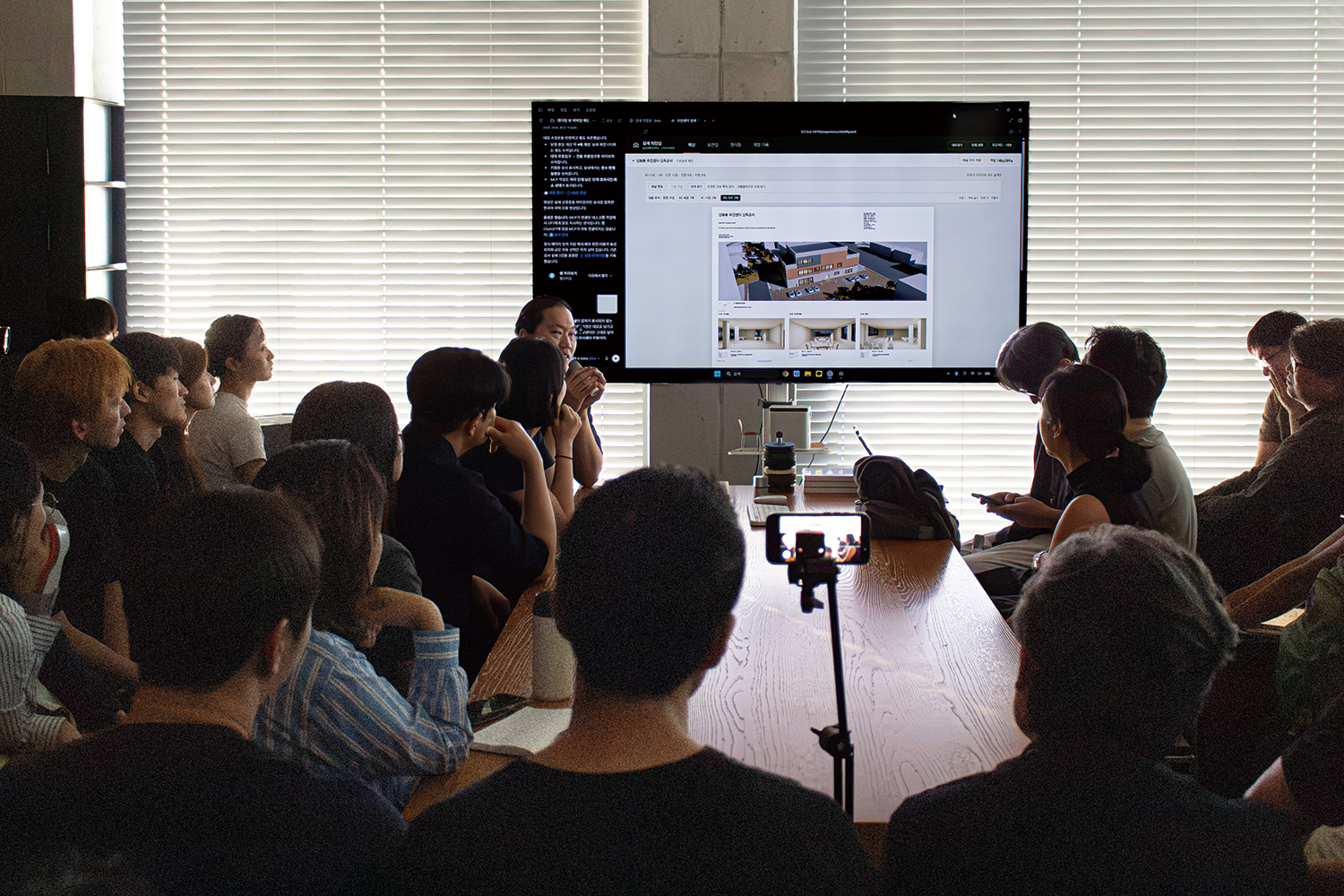
View of the ‘Talk(-ing) Architect 2’ seminar ©Kim Hyoeun
The significance of this experiment lies in moving beyond the use of AI for individual tasks to connect the architect’s judgement and multiple design outputs within a single pipeline. Yang points to the possibility that, rather than adapting their work to the fixed functions of existing software, architects can define the tools and working methods they need and appropriate new technologies accordingly. He explains that while engineers are responsible for developing new technologies into their most efficient forms, architects and designers can bring those technologies into architecture and be the first to test uses and possibilities that were not initially anticipated. Hwang, meanwhile, concluded the seminar by noting that he is continuing to experiment with adjusting the weights of small local AI models in order to incorporate the rules and judgements of individual architects into more personalised models.