
SPACE November 2026 (No. 708)
On Sep. 14, a policy forum entitled ‘The Use of Architectural Drawing Information and Copyright Protection in the Era of AI’ was held in the small auditorium of the National Assembly Library. Hosted by National Assembly members Bok Giwang and Lee Jeongmoon, and organised by the Korea Institute of Registered Architects (KIRA) and the Architecture & Urban Research Institute (auri), the forum explored legislative and institutional reforms needed to establish systems for building and distributing architectural drawing databases and to support the lawful, systematic use of architectural drawing information. Kang Juseok (Deputy Secretary General, KIRA) noted that as the architecture industry shifts from a focus on new construction toward the reuse of existing buildings through remodelling, maintenance, extensions, alterations, and changes of use, the need for past drawings is increasing. Cho Youngjin (Director, auri’s Spatial AI & Big Data Division), explained that as physical AI – including robots, drones, and autonomous vehicles operating in real space – develops and advances beyond generative AI, the data value of architectural drawings capable of accurately documenting built space will continue to grow.
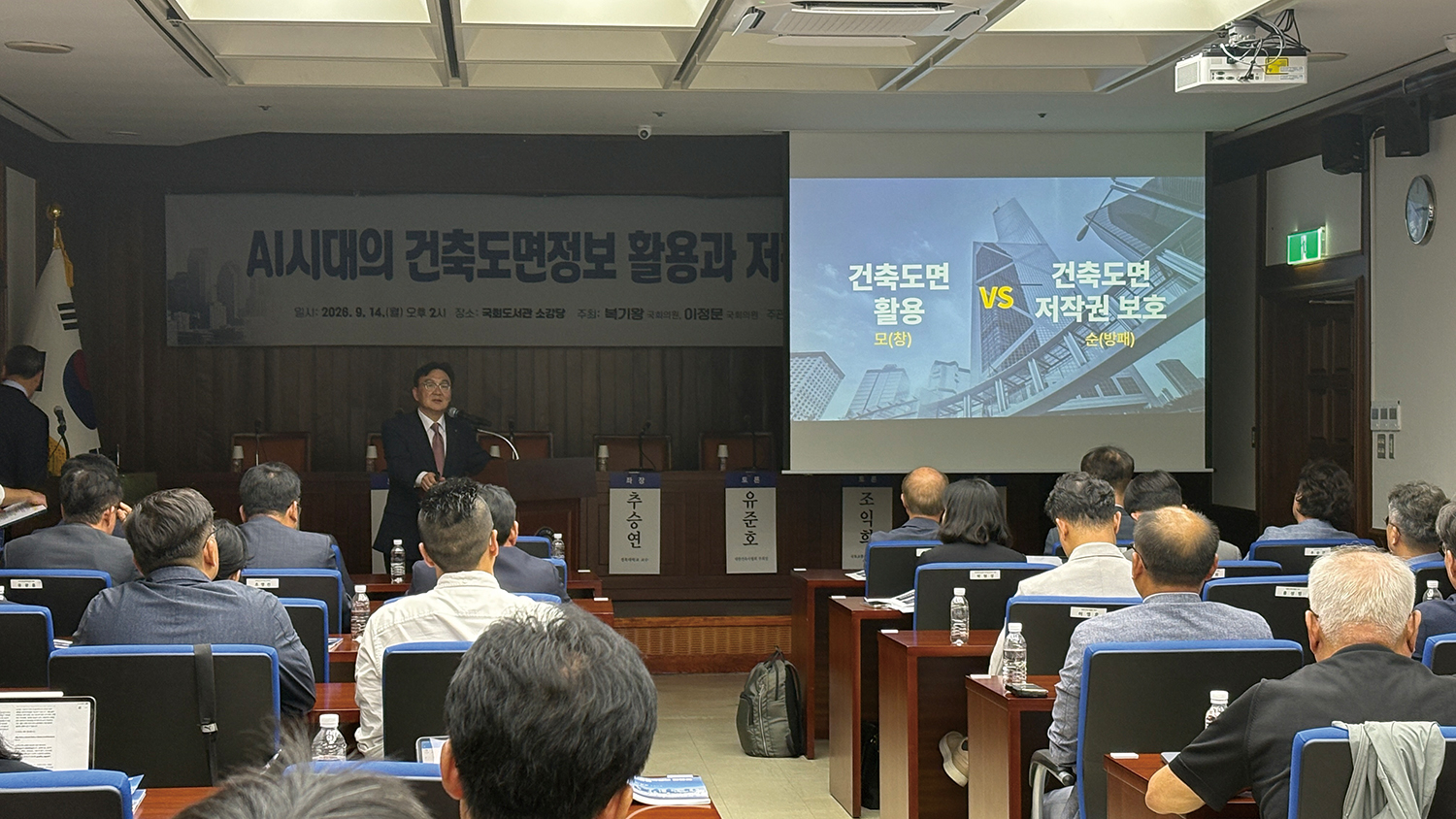
Kang Juseok giving a presentation at the policy forum. Image courtesy of Architecture & Urban Research Institute
Architectural drawings have accumulated in SEUMTER (electronic architectural adminstration system) through permissions and use-approval processes. At present, approximately 747 million drawings and documents are stored there, including about 41.22 million floor plans and 5.46 million site plans. Yet, based on building-register records, 33.7% of drawings are unregistered and 88.7% lack a building ID. File formats are mixed among scanned images, PDFs, and CAD files, while drawing layers and coordinate systems also vary. Cho diagnosed that, despite the sheer volume of drawings, there is no adequate system for identifying and linking information belonging to the same building, and the overall data quality remains poor. To address this, he proposed a ‘Building Data Hub’ that would use a unique building ID to connect permit records and building registers with drawings, addresses and spatial information, and safety and energy data. The next step would be to correct errors and omissions and standardise codes, coordinate systems, and metadata so that the information can be converted into ‘AI-Ready’ data. He also proposed a two-track model in which original administrative records would be maintained as official public records while data for research and industrial use would be provided as separate open datasets. To operate this system on an ongoing basis, he suggested amending the Act on the Management of Building to establish a continuous framework extending from building-status surveys and database construction to use through a big-data platform.
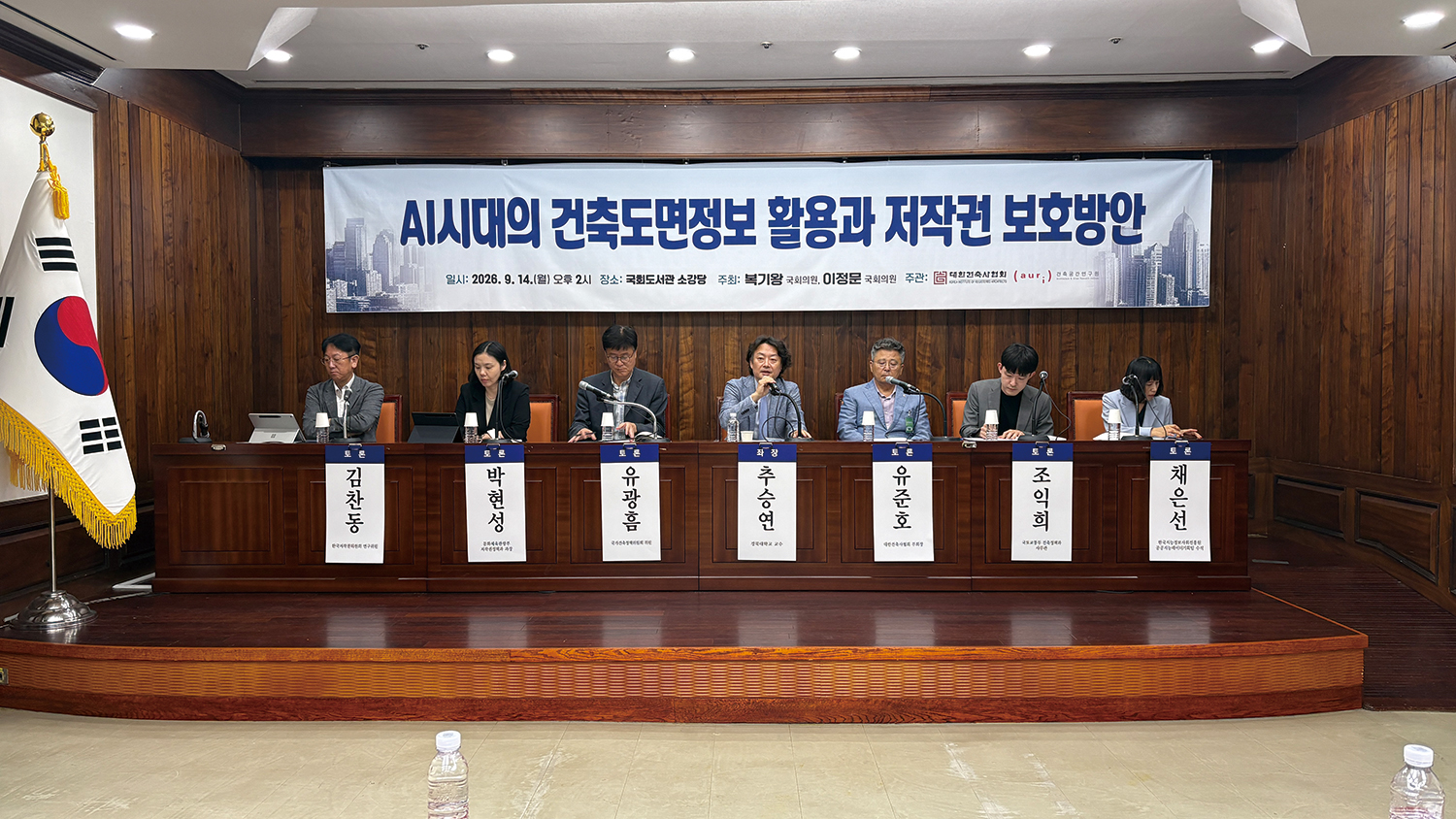
The panel discussion following the presentations. From left to right: Kim Chandong, Park Hyunsung, Yu Kwangheum, Choo Seungyeon, Yu Junho, Cho Ikhee and Chae Eunsun. Image courtesy of Architecture & Urban Research Institute
Improving data quality alone, however, does not mean that drawings can be used freely. According to Kang’s presentation, although the opening of public data to the private sector has expanded since 2015 and textual information such as building registers has been made public, access to architectural drawings has remained restricted because of inadequate procedures for copyright consent and insufficient privacy and security guidelines. He argued that the use of drawings requires a copyright-processing system calibrated to the purpose and scope of use. As a precedent, he gave the example of the music industry, which has established collective management and royalty-settlement systems for large-scale distribution environments where obtaining consent from each rights holder individually is impractical. Applying this model to architectural drawings, he proposed a 3×3 ‘Protection-Use Matrix’ that classifies drawings as core, basic, or detailed, and divides modes of use into a simple viewing, copying and printing, and digital vector download. The broader the scope of use, the more stringent the copyright clearance would become. He also proposed an integrated distribution platform linking drawing requests, rights-holder consent, approval, payment, and settlement, together with copyright trust and collective-management mechanisms.