
SPACE November 2026 (No. 708)
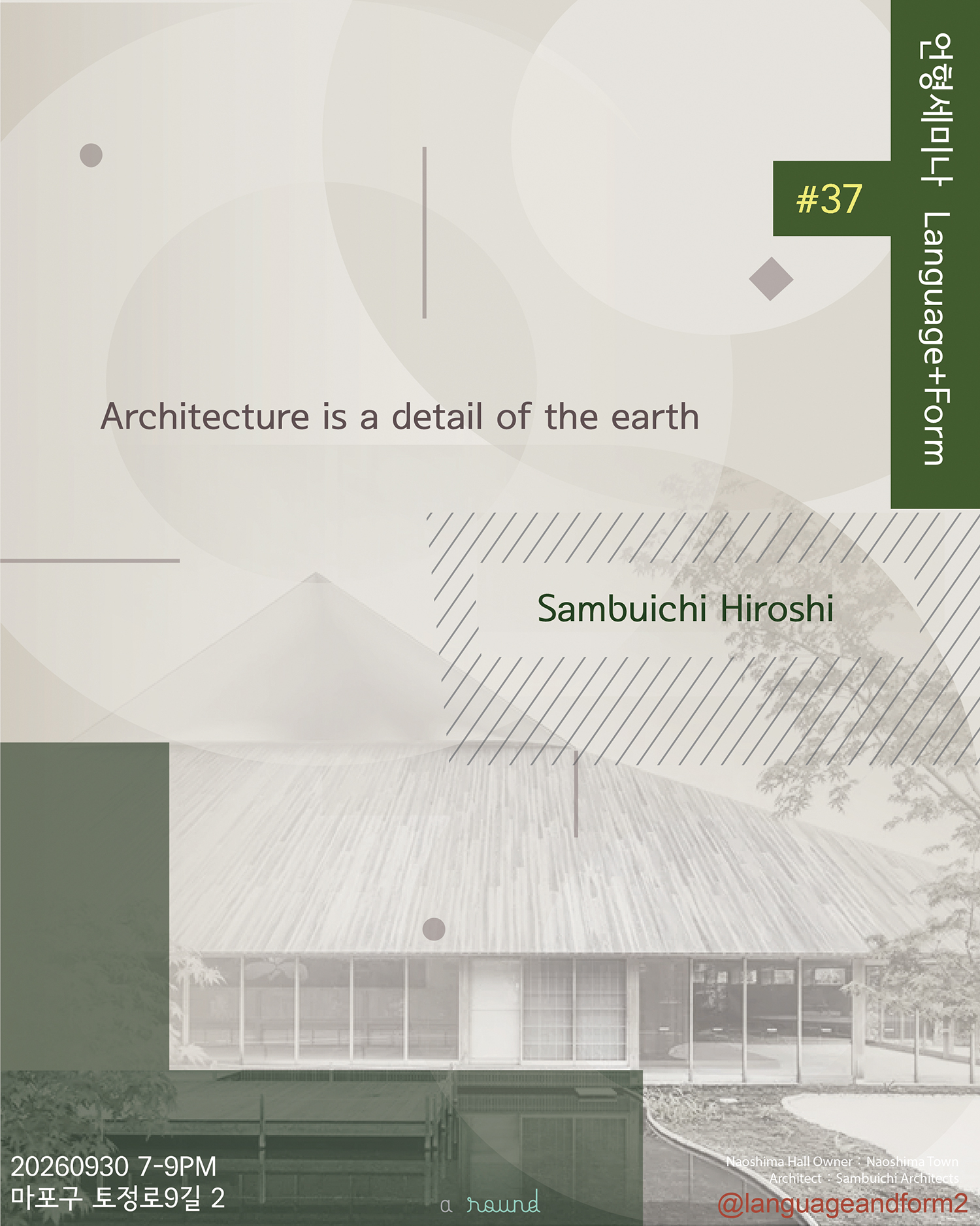
Poster for the 37th Language + Form Seminar ©Language + Form Seminar
The 37th Language + Form seminar took place on Sep. 30, with invited speaker Sambuichi Hiroshi with a lecture titled ‘Architecture is a detail of the earth.’ A Japanese architect whose practice has centred on Hiroshima and the Seto Inland Sea, Sambuichi approaches the relationship between architecture and the environment in a distinctive way. Reflecting on projects ranging from his earliest works to recent commissions, he discussed architecture’s role and place within nature.
Central to Sambuichi’s architecture is the notion of ‘moving materials’. He uses this term to describe elements of nature that are constantly in motion, such as wind, water, and the sun. The stationary materials of architecture, such as concrete and steel, exist to serve these moving materials. The title of the lecture, ‘Architecture is a detail of the earth,’ likewise reflects an attitude that regards architecture not as a self-contained object, but as a small part of the vast flows unfolding across the earth. In his work, nature is not an element added to a building. Rather, it is the context and condition that determines its form, structure, and the way its spaces function.
The starting point of this architectural philosophy was the Running Green Project (2001). This early project for a beachside park facility emerged from a local problem that trees had been cut down to make way for a road in a small coastal village, allowing strong sea winds to penetrate the settlement. Rather than erecting a wall to block the wind, Sambuichi proposed an arched framework that would support plant growth and encourage the regeneration of a windbreak. As vegetation gradually covered the structure, blowing sand subsided, and the site eventually became a gathering place for local residents. He explained that this experience led him to pursue ‘architecture that can be acknowledged by both people and the Earth’. His subsequent work developed toward translating natural phenomena into architecture. A representative example is the Inujima Seirensho Art Museum (2008). Preserving and revitalising the industrial heritage of a copper refinery, the museum follows the concept of ‘using what exists to create what is to come’. It incorporates existing chimneys and karami bricks made from slag produced during the refining process, while harnessing natural energy available on-site, including solar heat, geothermal heat, and air movement, to achieve sustainability. A similar approach can be seen in the Rokko-Shidare Observatory (2010). Taking inspiration from rime ice forming on tree branches, Sambuichi incorporated into the architecture that moments when water changes between its liquid, solid, and gaseous states. In Naoshima Hall (2015), moving materials also intersect with the region’s traditional spatial organisation. He observed that the houses and the village as a whole in medieval Naoshima were arranged to accommodate water and wind flowing along a north-south axis and reinterpreted this principle through contemporary architecture. Wind passing through the hipped-and-gabled roof creates a pressure difference between the interior and exterior, gradually drawing air from below ground toward the skylight. This allows a space accommodating approximately 200 people to remain naturally ventilated without mechanical air-conditioning. At the Miyajima Misen Observatory (2013), the region’s spirituality and culture become important conditions alongside nature. Sambuichi drew on the concept of za (坐), interpreting it not simply as the physical act of sitting, but as a spiritual act. He designed low eaves so that visitors could take in nature while in this seated, contemplative state.
For Sambuichi, architecture is ‘a letter to the future’. He concluded the lecture by saying, ‘Just as I received a message from the village of Naoshima as it was 400 years ago, I hope that Naoshima Hall will, in turn, convey a message to people 400 years from now,’ adding, ‘I hope young architects in Korea will also consider what they wish to pass on to the next generation.’