
SPACE November 2026 (No. 708)
On Sep. 18 the 39th Space Prize for International Students of Architecture Design held its second round of judging and the award ceremony at SPACE GROUP headquarters. Jury chair Choi Wook (Principal, ONE O ONE architects) focused the brief on ‘The “Restoration of Connection” in the Changuimun Gate Section of the Hanyang Doseong’. Although Changuimun Gate is a designated Treasure – and the only gate of the Four Minor Gates (Sasomun) to retain its original form – the adjacent city wall connecting Bugaksan Mountain and Inwangsan Mountain has remained severed since 1968 security interventions following the Blue House raid. Participants were tasked with proposing reconnection strategies for the Changuimun Gate site, pairing topographically faithful heritage restoration with speculative visions for Seoul’s urban future. Departing from past iterations that focused on abstract themes, this cycle prioritised site-specificity and historical interpretation to spark new critical engagement with ‘the ground’ (teo) – demanding an ‘architecture of the ground that embraces land, boundaries, context, and culture’.
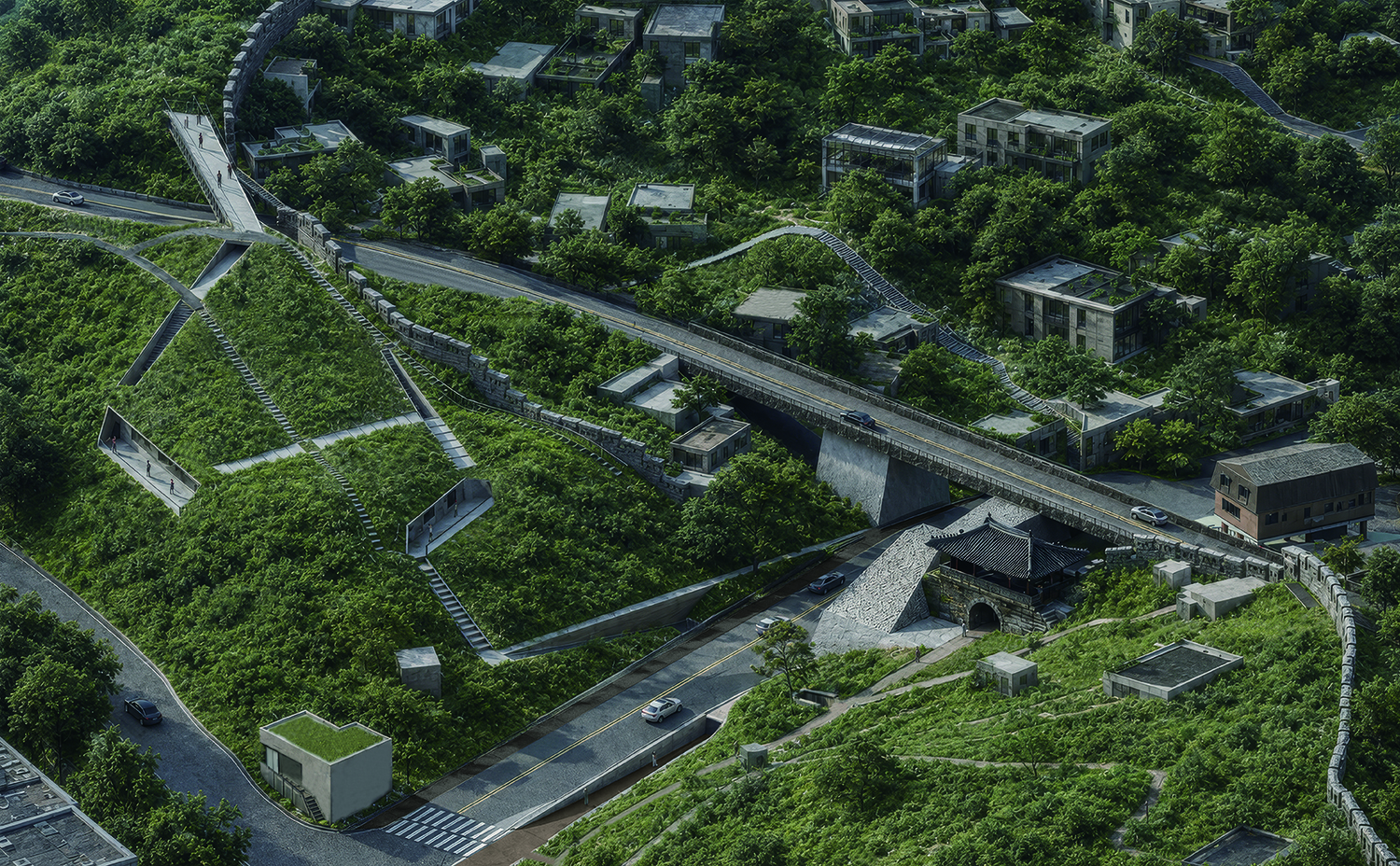
The Grand Prize winning proposal ‘A View Between’ ©Park Minsoo, Kim Minji, Park Sujin
Winning the Grand Prize, ‘A View Between’ by Park Minsoo, Kim Minji, and Park Sujin (Hongik University) eschews verbatim wall reconstruction in favour of absorbing the rupture itself within the site’s historical stratigraphy, establishing a new pedestrian sequence that uncovers its historical trajectory. By identifying three vantage points, the proposal reveals contrasting vistas – the severed wall, the Seoul cityscape, and the Buam-dong landscape – allowing visitors to register incremental shifts in perspective. Architectural interventions along the connecting paths – such as skylights and framed openings – layer transitional spatial experiences. Across the severed zones, the design proposes minimal intervention to respect the existing topography: using natural contours to route circulation underground across Changuimun-ro and introducing a direct pedestrian bridge leading towards Cheongwoon Park. The proposal was praised for ‘addressing the given theme through a refined “sense of emptiness” while bringing to light the “vivid reality of memory” embedded in the land.’ It also received high marks for overcoming the limitations of the current site by minimising topographical alterations through the continuous connection of experiences.
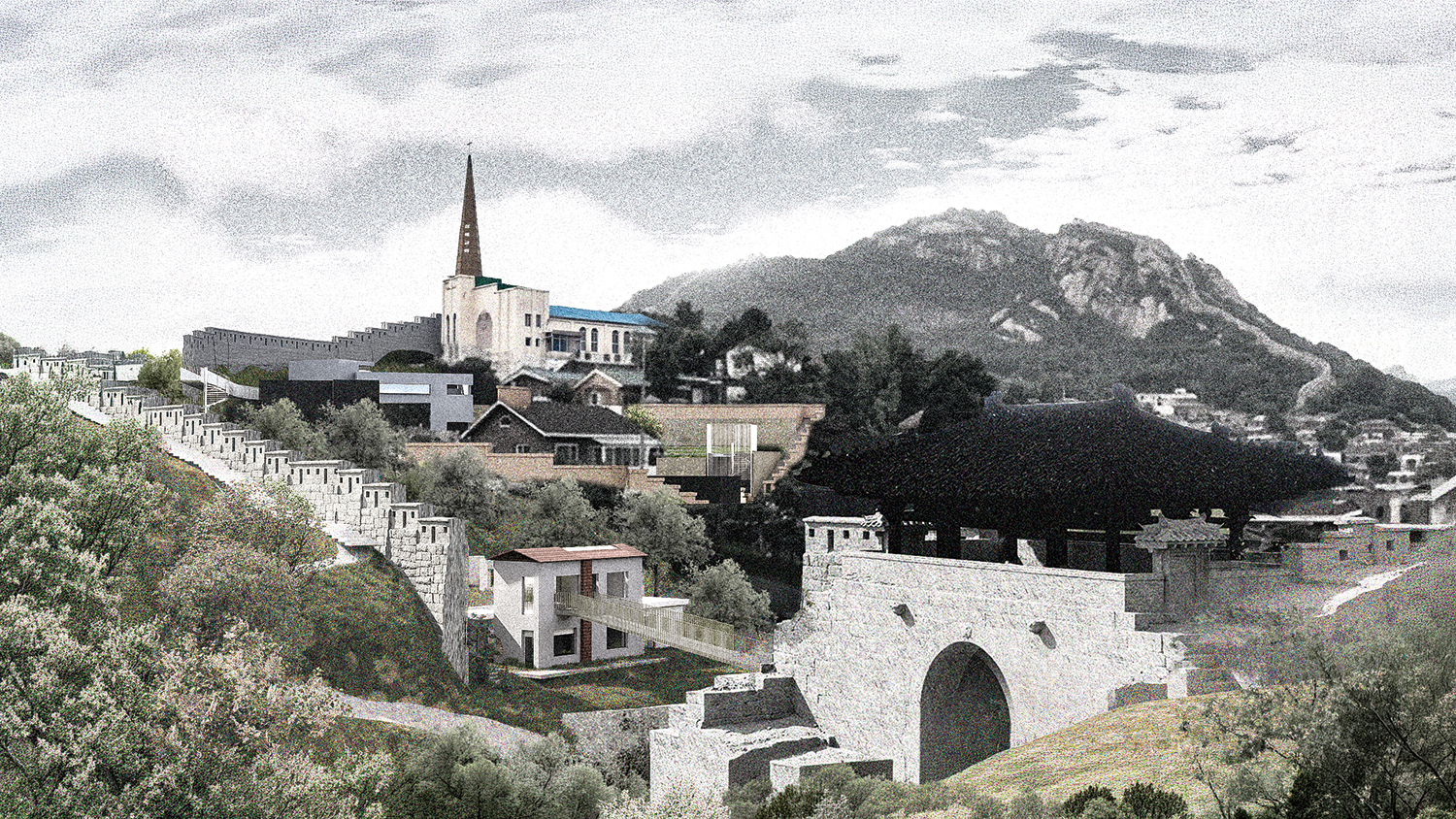
The Prize of Excellence winning proposal ‘VERTICAL BRIDGE’ ©Lee Doyoung, Lim Heejae, Seok Woohyun
The First Prize was awarded to ‘VERTICAL BRIDGE’ by Lee Doyoung, Lim Heejae, and Seok Woohyun (Gachon University). Aiming to reveal the city’s historical strata and urban transformations while forging new relations between the wall’s interior and exterior, the project activated residual land isolated by road infrastructure and juxtaposed pathways as core design elements. By vertically integrating paths that co-exist at varying elevations yet operate independently, the design re-organised the severed urban structure into an organic network by inserting interventions – including an abandoned house pavilion, sunken exhibition hall, teahouse, guidepost, and observatory – at key nodes and residual spaces. The jury praised the proposal for ‘revitalising the existing place through small interventions, demonstrating considerable potential and interesting visual possibilities if realised.’ The proposal was also recognised for its mature perspective on restoration, demonstrated by its reading of fragmented architecture and its revitalisation through change and modification.
In his closing remarks following the awards ceremony, Choi Wook reflected on returning to the stage as a juror—forty-two years after receiving an award at the 2nd Space Prize as an architecture student. Beginning his address by urging students to cultivate a distinctly Korean philosophy, identity, and aesthetic, he closed the event by expressing his appreciation to all participants for their dedicated investigations and thoughtful responses to a challenging prompt grounded in a concrete site with a layered spatial history.