
SPACE November 2026 (No. 708)
The Seogyo-dong house where Yun Hyong-Keun (1928‒2007) lived and worked until his death has opened to the public under the name Yun Hyong-Keun House. Yun was a leading figure in dansaekhwa, one of the major movements in Korean contemporary art. From the 1970s onward, he developed his Cheonjimun series around dark fields of colour and the empty spaces between them, using repeated brushstrokes to convey his reflections on time, nature, and life. He placed great importance on the unity of art and life, and the house, restored to closely resemble its appearance during his lifetime, offers insight into this attitude.
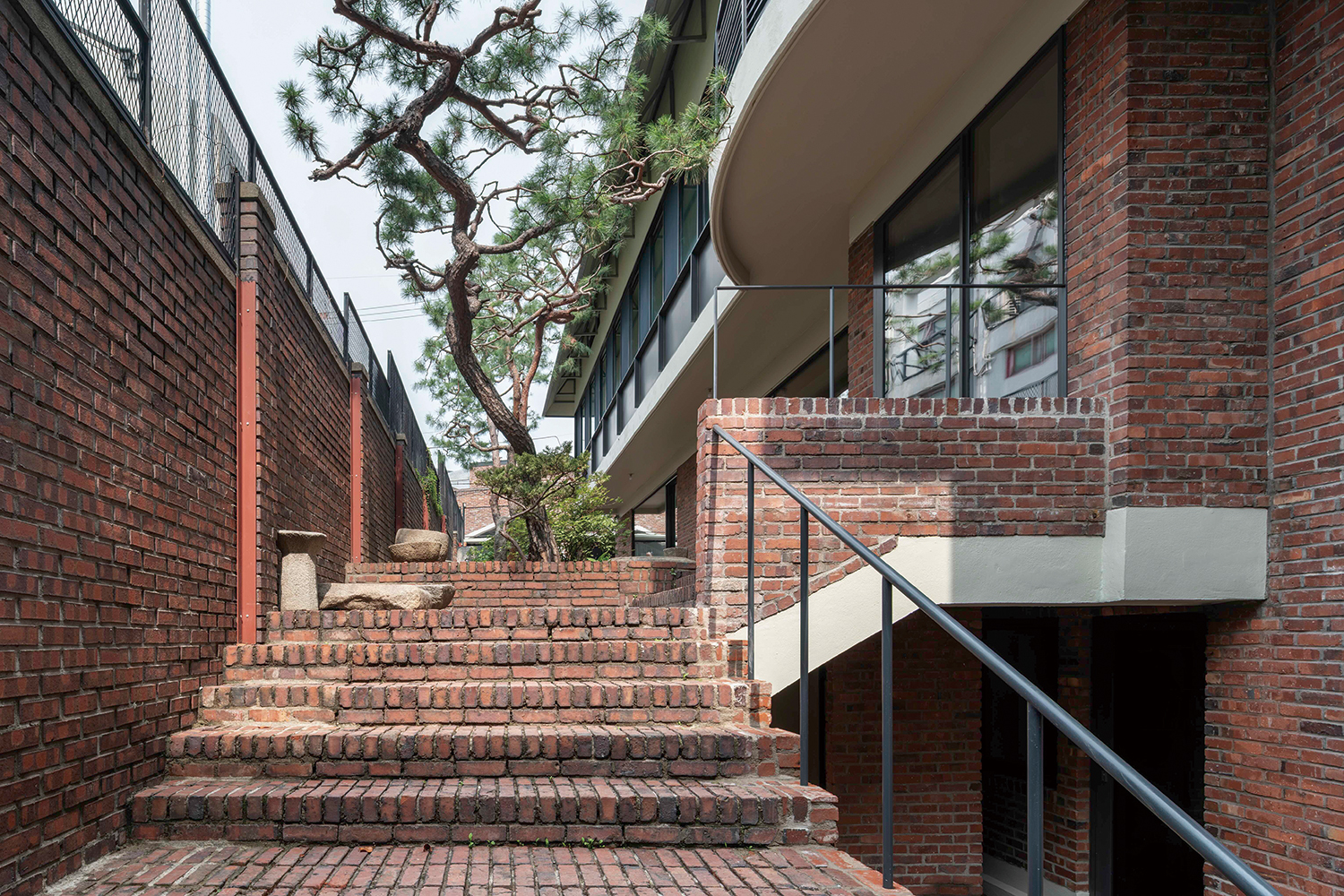
Exterior view of Yun Hyong-Keun House ©Namgoong Sun
The property in Seogyo-dong was originally acquired in 1963 by Yun’s father-in-law, Kim Whanki, through a national housing programme. Yun began living there in 1967. In 1983, the original house was demolished and replaced by the present building, for which Yun commissioned his younger brother, Yun Do-Geun (1935‒2021), for the design. Yun Do-Geun was an architect who taught in the Hongik School of Architecture from 1961 to 2000 and worked on major campus projects, including the extension of Hongik University’s College of Liberal Arts (1980) and Hongik Culture & Sports Center (1986, covered in SPACE No. 246). He is also well known for producing an early design proposal for the UNESCO Building in Seoul. However, the design was not left entirely to Yun Do-Geun. Yun Hyong-Keun was deeply involved in the building process, incorporating his own ideas into the functions, forms, and materials of its spaces. His aesthetic sensibility and way of life also informed details such as the configuration of windows and doors and the interior finishes. The archive room displays various documents and drawings that the artist produced in connection with the house, including sketches exploring the latticework of the second-floor windows.
Given how closely the artist’s life and work are interwoven in this space, the conservation and restoration project focused on preserving the building’s original form and the atmosphere of the time as faithfully as possible. Jiyo Architects (Principal, Kim Sejin), which undertook the project, took on the task of ‘adjusting time by repairing the house’ after carefully considering the extent and purpose of their intervention. Alongside repairing the deteriorated parts of the house, the firm sought to restore the sensibility inherent in the original building. Rather than simply returning the house to its initial state upon completion, this process of ‘adjusting time’ involved focusing on different moments in time across various parts of the house, introducing distinct, multilayered temporal layers.
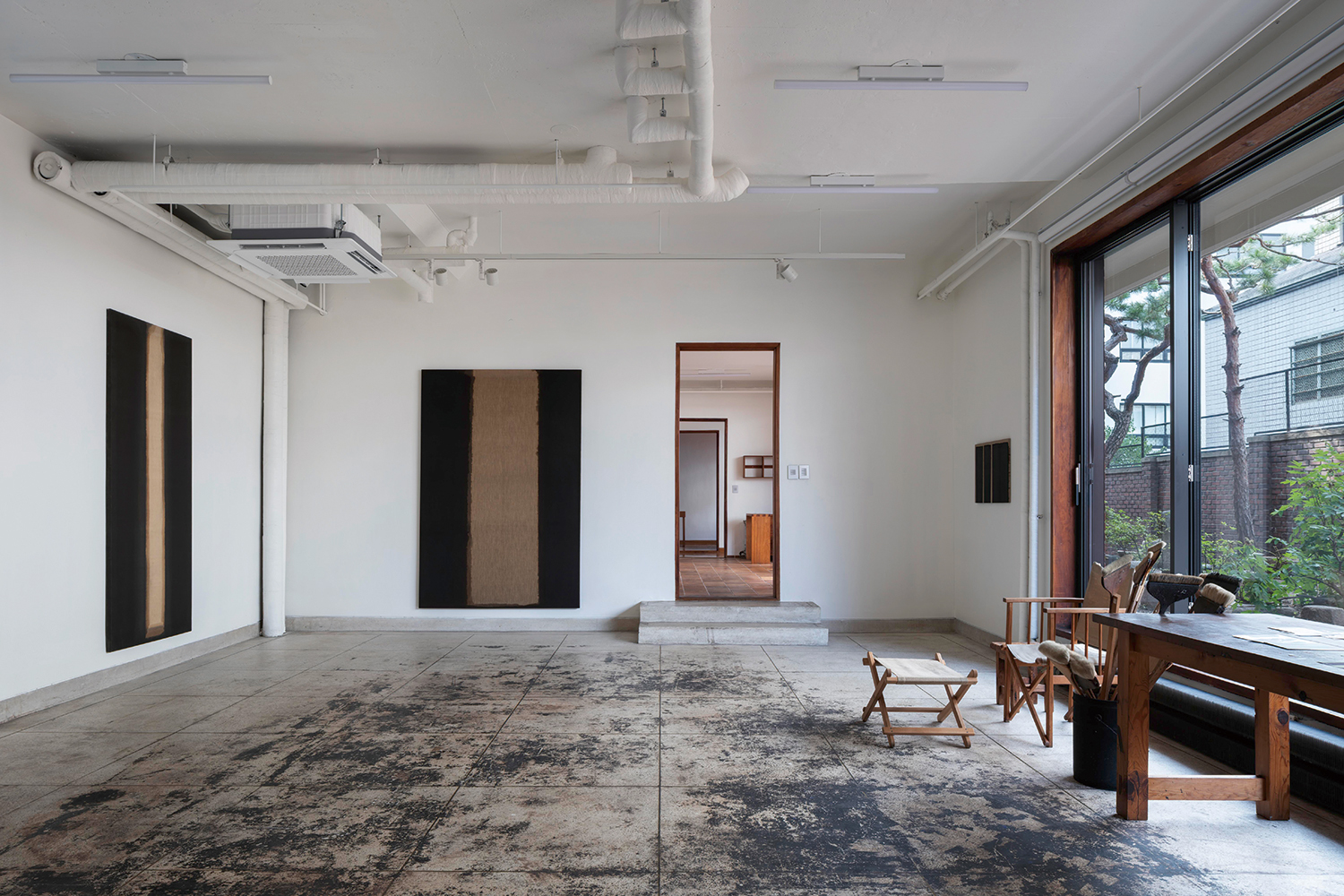
Yun Hyong-Keun’s studio on the first floor ©Namgoong Sun
Entering the elongated rectangular volume, built of bricks in ‘a hue that purifies the colour of earth’, visitors encounter a ground floor with ceilings unusually high for a home built in the 1980s. Tall, vertically elongated windows and doors lend the spaces distinctive proportions. Full-height glazing allowed Yun to paint under natural light in his studio, where layers of paint marks remain on the floor from his practice of working with canvases laid flat. Art tools he used, along with representative paintings from different periods of his career, are displayed here, evoking the atmosphere of his studio at the time. By contrast, the second floor retains the more modest proportions and scale of a typical domestic interior, with the original living room, kitchen, private rooms, and main bedroom preserved intact. Timber finishes and wooden window lattices evoke a distinctly Korean sensibility, while the corridor running along the front of the rooms reveals the vocabulary of Western modernism. These differing architectural elements coexist within a single space, creating a unique atmosphere.
Yun said that art was merely a trace of life, and that a truthful attitude of life mattered more than painting. In keeping with his words, the house serves not merely as a backdrop for explaining his work, but as a means of understanding his artistic world within the context of his life. The Yun Hyong-Keun House opened for a limited period from Sep. 1 to Oct. 17. Following further preparations, it is scheduled to operate seasonally in spring and autumn from 2027.