
SPACE November 2026 (No. 708)
Art Spectrum, launched by the Samsung Foundation of Culture in 2001 to discover and support emerging Korean artists, is being held at the Hoam Museum of Art for the first time in its ninth edition. Since 2024, the programme has expanded the scope of participating artists from those in Korea to Asia more broadly in pursuit of international collaboration. This year’s exhibition, co-curated with the Palais de Tokyo in Paris, has been on show since Sep. 1.
Featuring 23 artists and teams, the exhibition was organised through an approach that departs from conventional curatorial practice: three curators first assembled a list of artists and then considered how their works might impact one another when brought into the same space. Of the 63 works on view, 26 are newly commissioned pieces responding to the spatial conditions of Hoam, making not only the galleries but the entire museum a stage for the exhibition. This curatorial intention is reflected in the unusually long exhibition title, written without spaces between the words, which evokes a situation in which different frequencies overlap and bleed into one another within a single space, producing unexpected points of contact.
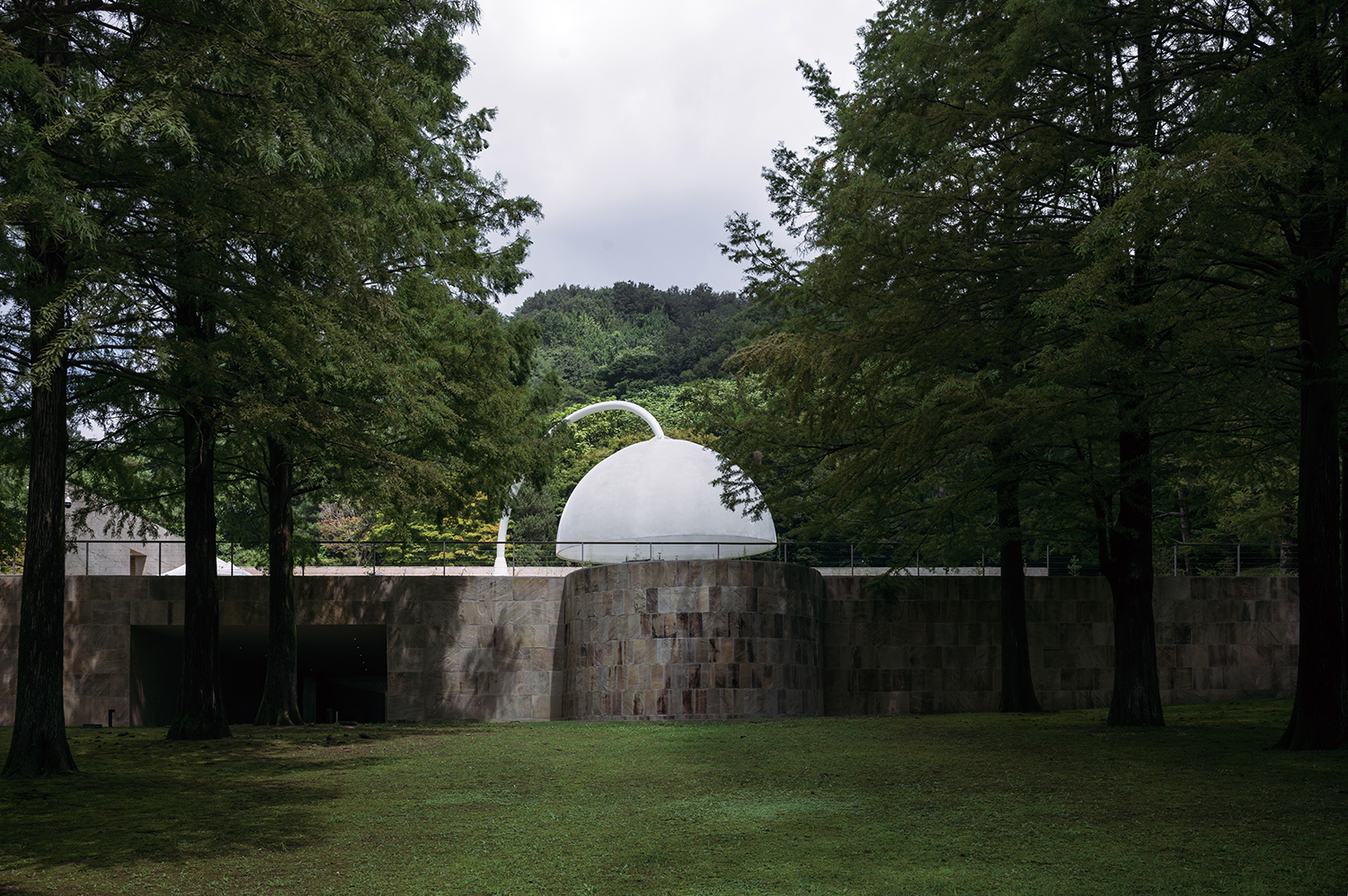
Installation view of Yamada Suzuko’s Hanging Moon (2026) in the upper garden of Hoam Cafe. Image courtesy of Hoam Museum of Art / ©Lee Chunghyung
SIDE CORE’s Time Gate (2021), installed on the roof of the parking structure, marks the beginning of the exhibition. As visitors ascend the stairs to the museum, Hong Aerin’s Music Siren (Duet) (2026) can be heard from the grove of cypress trees in front of Hoam Cafe. Two toy butterflies are moved by motors, which are then detected by infrared sensors and converted into sound signals, producing improvised piano tones. Looking upward, visitors encounter architect Yamada Suzuko’s Hanging Moon (2026), an 8m-diameter hemispherical canopy suspended from the end of a curved shaft in the upper garden of Hoam Cafe. The garden originally displayed sculptures by Bourdelle. When Hoam Cafe was designed, Kim Nam Architects set the building back behind the existing sandstone retaining wall rather than building over the garden, leaving the upper garden open (covered in SPACE No. 700). Suzuko’s work – the first artwork installed in this garden and the first project by an architect to take part in Art Spectrum – asserts its presence by suspending a vast hemispherical structure, bringing two contrasting architectural interventions to overlap on a single site. To give this unfamiliar presence the smooth appearance of a ‘moon’, the work uses a fibre-reinforced plastic (FRP) monocoque structure, in which the skin itself bears the load, instead of a frame-and-membrane system whose structural skeleton would cast shadows when illuminated. FRP also connects the work to another project that begins from a very different set of concerns. After witnessing workers in a Wuhan furniture factory, continually exposed to dust and industrial materials, Ruofan Chen began focusing on material properties and safety, as well as labour in the production process. In her new work for this exhibition, fishing line is used to mimic the glass fibres that make up FRP, turning the material into a reminder of both the hazards of fabrication and the labour involved.
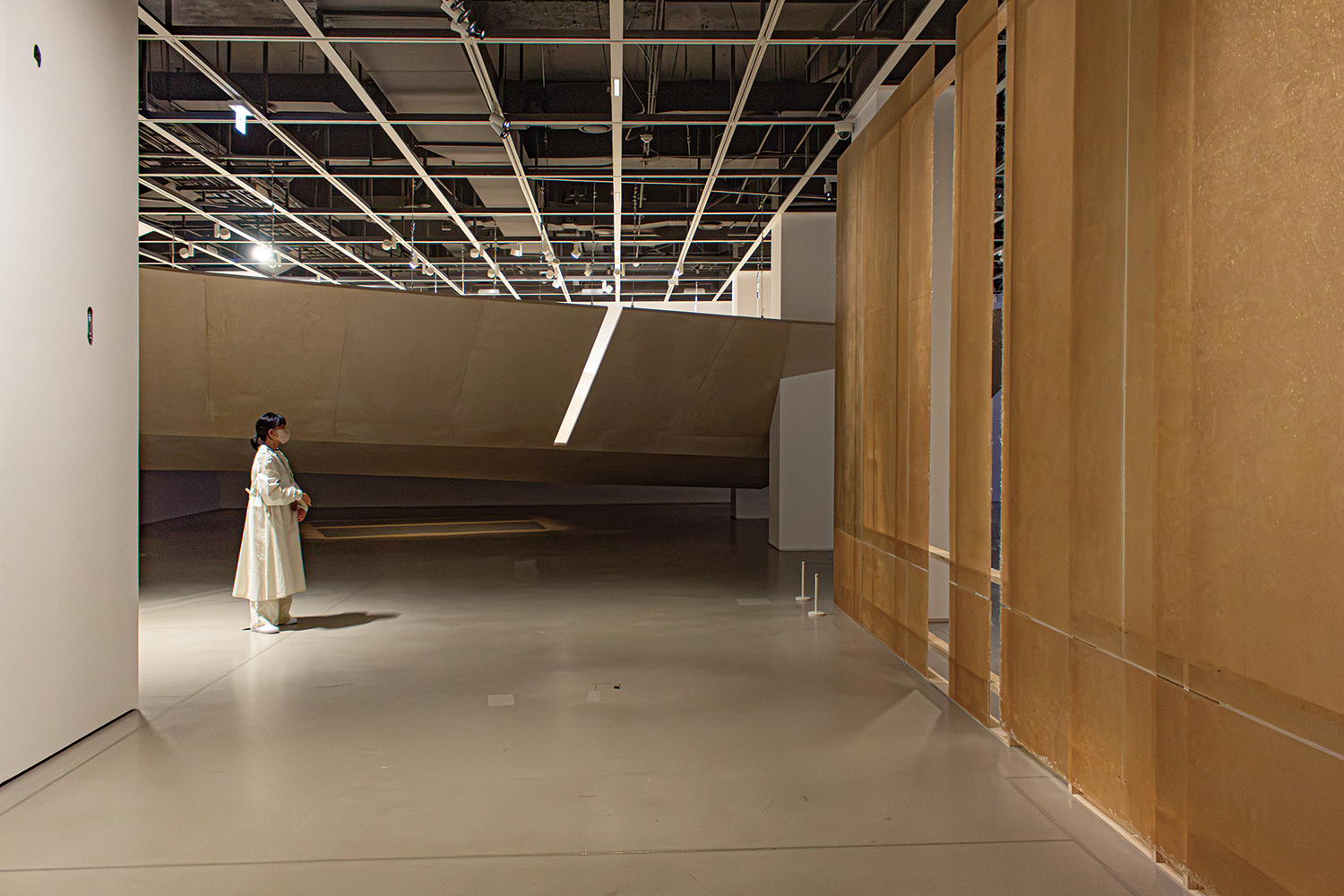
Ruofan Chen’s Suffocating (2026) at the back of the gallery, The Cross-Section Is Dangerous (2026) on the right, and an exhibition guide wearing HALOMINIUM’s In an Age of Chaos, the Keepers of Order Lead the World to Peace (2026). ©Kim Hyoeun
The exhibition extends beyond the spaces in which artworks are displayed to include the gallery guides stationed throughout the museum. HALOMINIUM reinterprets the attendants who protect works and regulate visitor behaviour as ‘keepers’, creating the uniform In an Age of Chaos, the Keepers of Order Lead the World to Peace (2026). The uniform is itself an artwork, while at the same time moving between and interrupting engagement with other works as its wearer restrains visitors in order to protect them. Despite the guide’s role in carrying out museum rules, the garment has no prescribed way of being worn. Its pieces can be connected or separated with buttons and ribbons and combined in multiple ways, allowing institutional control and the wearer’s autonomy to coexist. From the garden, exterior walls, and galleries, to the clothing worn by exhibition guides, the works are tuned to different frequencies, overlapping and seeping into one another throughout the Hoam Museum of Art, revealing unexpected relationships. The exhibition continues until Dec. 27.