

SPACE November 2026 (No. 708)
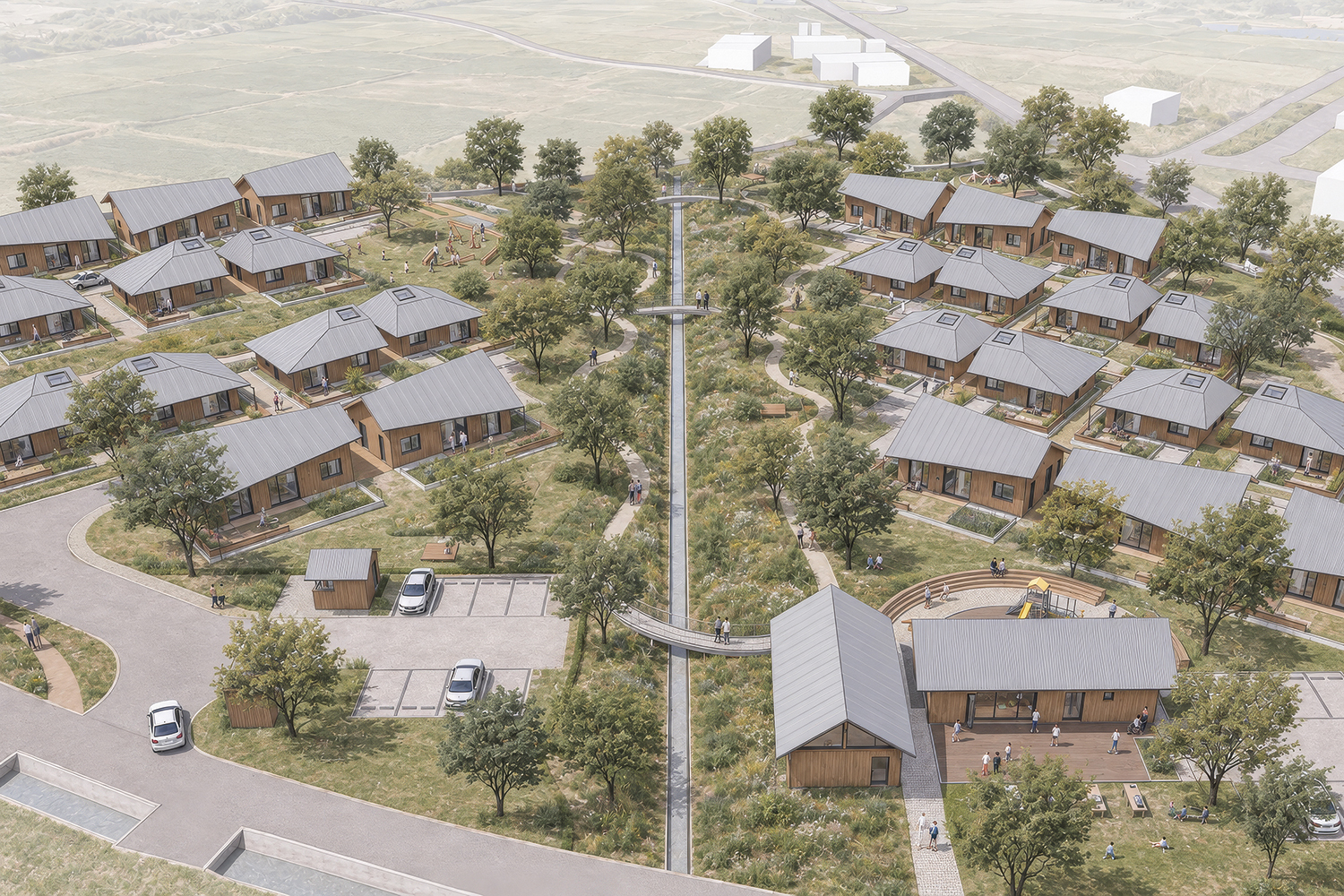
Winning proposal of Design Competition for Yangsan-myeon Rural Youth Housing Development. ©SN Architecture
On Sep. 1, Living Commons: Ecological Rural Housing by SN Architecture (Co-Principals, Kim Eunjin, Kim Sangeun) was selected as the winning proposal in the Design Competition for the Yangsan-myeon Rural Youth Housing Development. The competition was launched to provide housing in a rural area, improve housing stability for young people, newly married couples, and others in need of housing, and to encourage an influx of younger residents. The brief called for a total floor area of 2,062.44m² on a 21,260m² site, comproising 16 homes of the 59m² type, 13 homes of the 74m² type, and one community centre. The total construction budget was set at approximately KRW 7.5 billion.
SN Architecture stated, ‘Our focus was on creating a sustainable living environment in which community and the natural environment coexist harmoniously, while ensuring the comfort and independence of each home.’ Rather than erasing the existing topography and water flows, the proposal sought to incorporate them into the spatial organisation of the new village. The drainage channel dividing the site was reinterpreted as a central ecological landscape axis connecting the two residential clusters, creating a green corridor that spans the development. The scheme also establishes a sequence of spaces that gradually expands from private yards to spaces for neighbourly interaction, shared courtyards, and ecological green spaces. To ensure an efficient construction process, the 29 homes are organised into two types and use a timber panelised construction system, with panels manufactured off-site and assembled on-site.
The winning proposal was praised for transforming the drainage channel from a dividing boundary into a space of connection, and for proposing a pattern of settlement that expands from immediate neighbourly relationships to a village community through a graduated spatial structure. Its use of varied roof forms to counter the monotony of a limited range of housing types was also positively received.