
SPACE July 2026 (No. 704)
On June 4, Centre Pompidou Hanwha opened its doors at the 63 Building in Yeouido, Seoul. Following Málaga and Shanghai, it is the third international partnership venue. The museum occupies the annex of the 63 Building, which had housed an aquarium since 1985. Led by Jean-Michel Wilmotte (Principal, Wilmotte & Associés), the building underwent a complete renovation and has been reborn as a four-storey museum with two main exhibition galleries. The inaugural exhibition ‘The Cubists: Inventing Modern Vision’, opens this new chapter by focusing on Cubism, one of the pivotal turning points in twentieth-century art. As suggested by the plural form in the exhibition title – ‘Cubists’ – the exhibition does not confine Cubism to the style associated with the early experiments of Georges Braque and Pablo Picasso. Instead, it examines Cubism as a plurality of interconnected trajectories shaped by diverse regions, groups, and media.
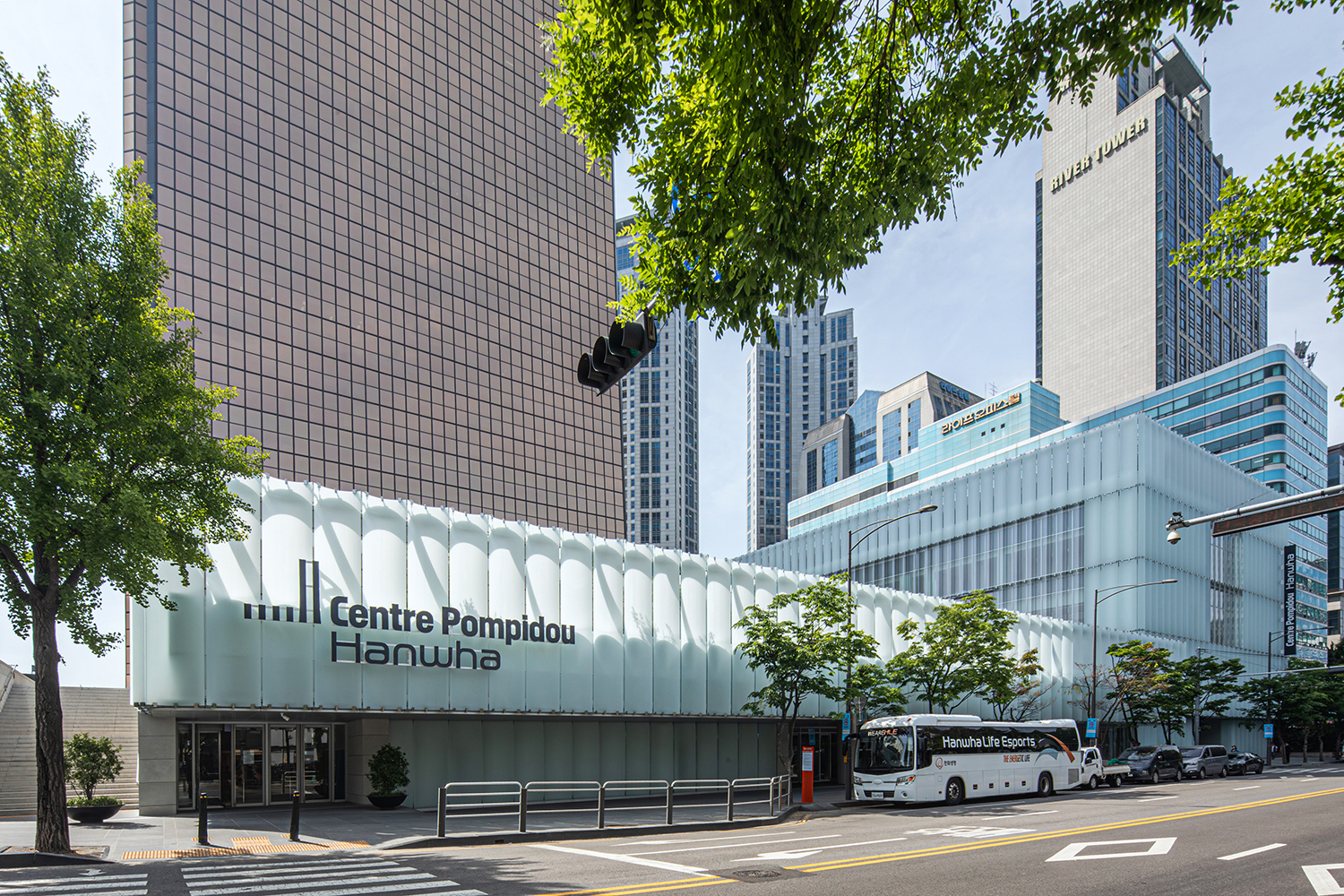
Exterior view of Centre Pompidou Hanwha ©Image courtesy of Centre Pompidou Hanwha
Greeting visitors in the first-floor lobby is ‘The Large Horse’ (1914 – 1976) by Raymond Duchamp-Villon, a sculpture that fuses horse and rider into a single dynamic form. By revealing the point at which wartime Cubism intersected with the sensibilities of machine-age modernity, the sculpture signals the exhibition’s broader reading of Cubism—from the experimental paintings of 1907 to its stylistic transformations in the 1920s. Following this, the main Centre Pompidou collection section unfolds chronologically through eight thematic sections featuring ninety-one works.
The exhibition begins with Picasso’s Bust of a Woman (1907) and Braque’s The Viaduct at L’Estaque (1908). Under the influence of Paul Cézanne as well as African and Oceanic art, the human figure and landscape ceased to be stable subjects of representation and instead became unfamiliar formal constructions. The subsequent section on ‘Analytical Cubism’ presents the movement’s most rigorous and radical phase. Through the fragmentation and reconstruction of objects and space from multiple viewpoints, Braque and Picasso completely broke away from with the illusionistic conventions of faithful representation.
The middle portion of the exhibition traces Cubism’s expansion into a public and collective movement. ‘Salon Cubism’ emerged through major Parisian salon exhibitions and established itself as a controversial artistic force. A key example is The Wedding (1911 – 1912) by Fernand Léger, exhibited at the Salon des Indépendants. Subsequent sections explore the ‘Orphic Cubism’, which emphasised colour, rhythm, and movement while moving toward abstraction, and ‘Synthetic Cubism’, which introduced real-world materials such as newspapers and ropes into the picture plane, transforming paintings to a site where image and materiality converge.
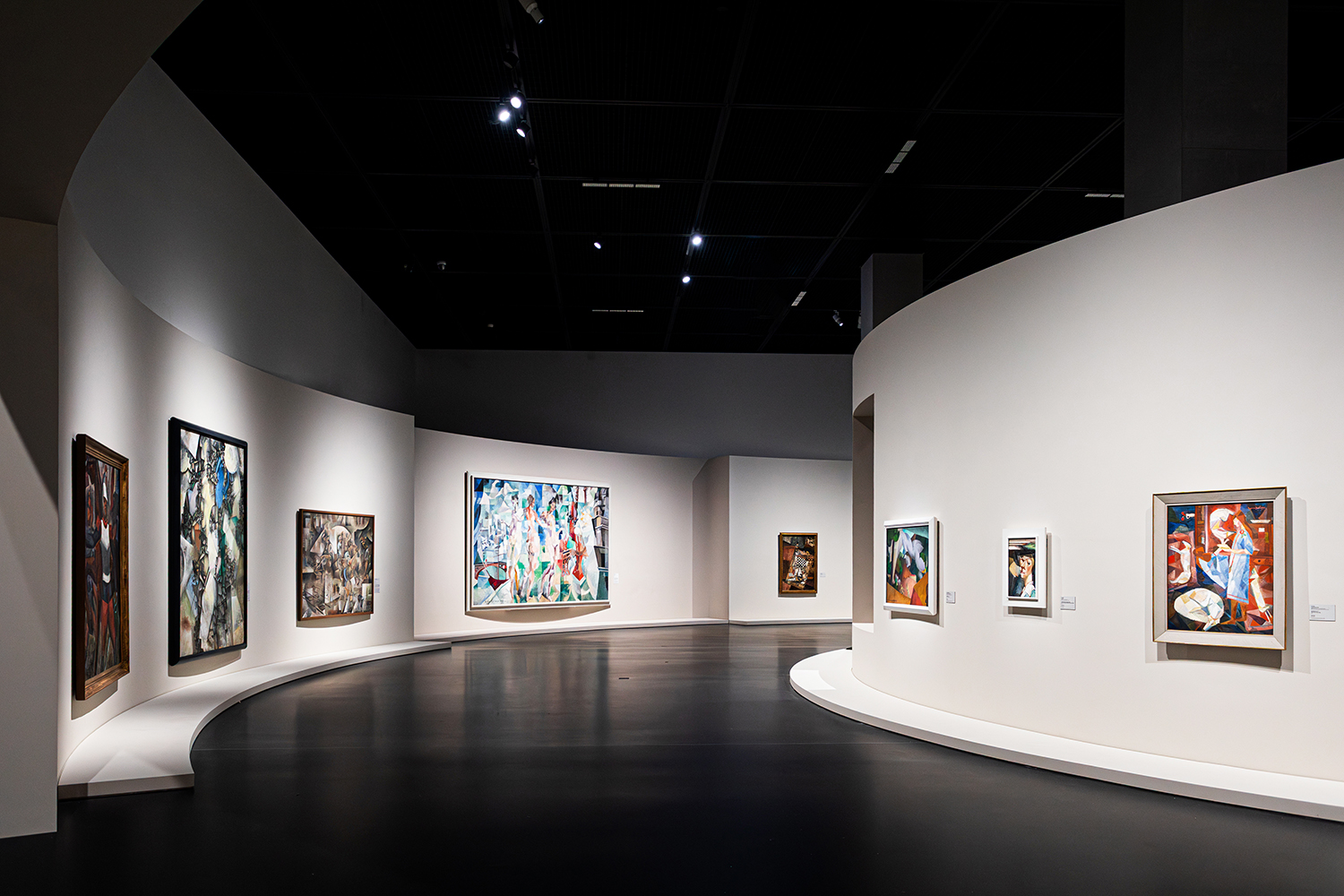
Exhibition view of Section 3, ‘Encountering the Public: Salon Cubism 1910 – 1913’ ©Image courtesy of Centre Pompidou Hanwha
The later part of the exhibition focuses on Cubism’s international dissemination and transformation. Beyond France, Cubism spread across Europe, Russia, and the U.S., intersecting with local artistic languages. Among the featured works, Lady with a Hat (1913) by Natalia Goncharova presents a self-portrait constructed from multiple viewpoints and vibrant colors, illustrating Cubism’s reinterpretation within Russian Cubo-Futurism. By the 1920s, Cubism had become a shared formal language, uniting different artists within Purism, Art Deco, and Neoclassicism. The following special mezzanine exhibition in Gallery 2, ‘KOREA FOCUS: A Dream Map Toward the Modern Avant-Garde’, presents twenty-one works by eleven Korean modern and contemporary artists. The section examines how Cubism and other Western avant-garde movements, introduced to Korea during the 1920s and 1930s, were subsequently reinterpreted through the experiences of war, urban daily life, and traditional pictorial composition. Works such as The Korean War (1954) by Lee Soo-auck and Musician (late 1950s) by Ham Dae-jung reconstruct wartime experiences and human figures through geometric analysis, multiple viewpoints, and divided colour planes. Meanwhile, the Open Stalls (1956) by Park Re-Hyun combines traditional materials with Cubist compositional strategies, reimagining the everyday life of urban commoners through a modern visual language. Through these works, Cubism is presented not merely as an European artistic movement, but as a crucial influence and intermediary in the transformation of Korean art from representation toward abstraction. The exhibition runs until Oct. 4.