




SPACE September 2026 (No. 706)
DESIGN SUMMIT 2026 took place over two days from Aug. 6 at the COEX Auditorium. The programme, ‘Twelve Ways of Weaving Saekdong; How Originality Is Made’, in association with the SPACE DESIGN FAIR 2026, featured a showcase of twelve speakers presenting their work and their singular methodologies.
Everyday Practice (Co-Principals, Kwon Joonho, Kim Kyungchul) titled their lecture, ‘How to be a graphic designer, without losing your soul’. For them, protecting the ‘soul’ is less about adhering to a personal style than about refining one’s judgment within a given reality. For example, in their exhibition, ‘Yoo Youngkuk: A Mountain Within Me’, they interpreted the mountains from the paintings as a logotype based on non-square Hangul forms.
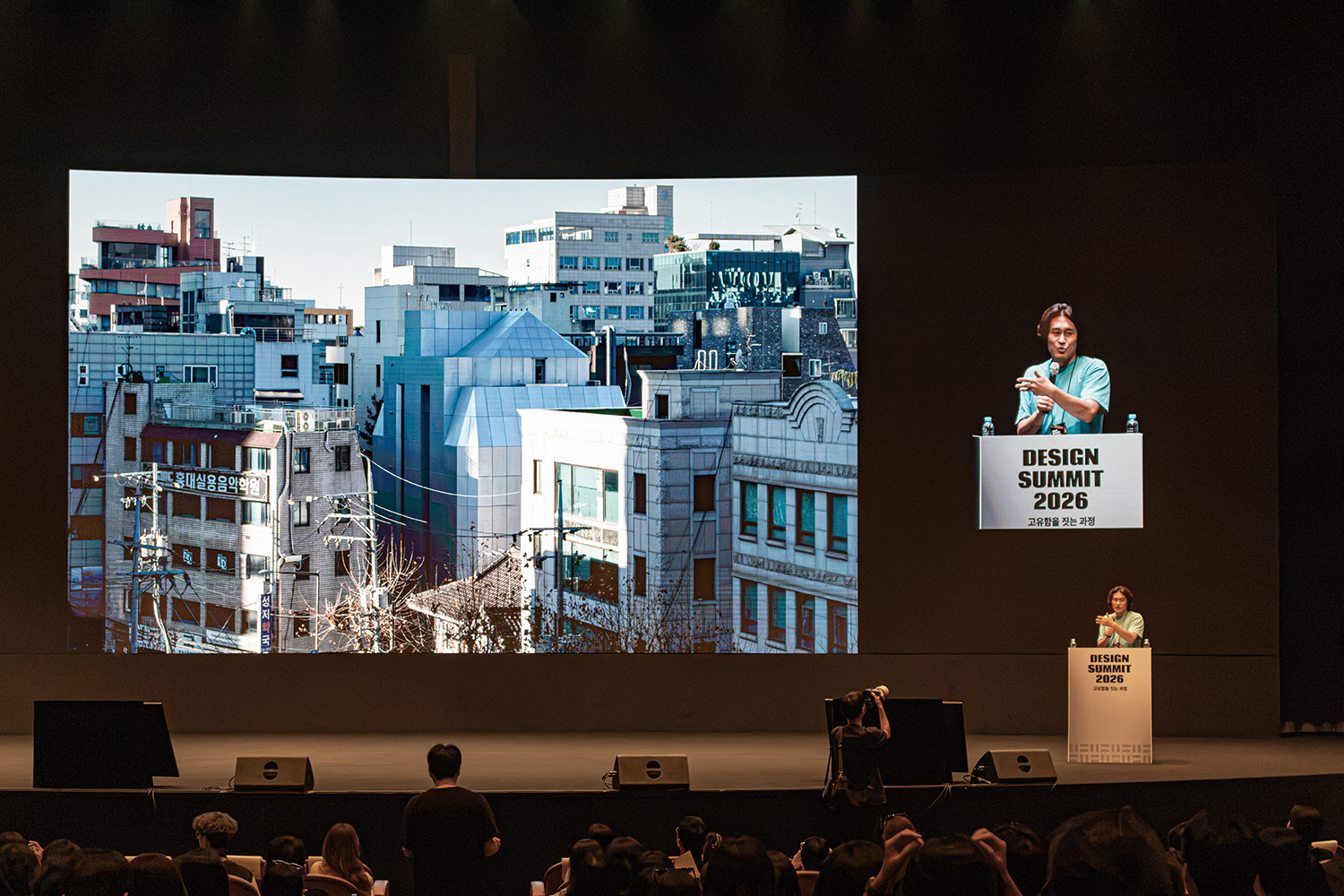
Han Seungjae explaining 3D Building (2025) ©Kim Hyoeun
For those skeptical of their legibility, they quote Yoo: ‘A painting that requires explanation is no longer a painting; it is superfluous’. In different media, they have shown distinctive approaches. For the exhibition catalogue, they kept only essential information and colour so that readers could focus on the artworks. For the Buldak Brand Website, instead of conducting a visual experiment, they honestly presented practical information on the product and purchase pages. Rather than blindly obsessing over an initial design logic, their approach to ‘preserving the soul’ lay in recalibrating the balance between experimentation and usability in each project.
Han Seungjae (Co-Principal, FHHH Friends) chose three different dog characters to narrate their lives in practice, especially the seven rules. While ‘we do not design together’ and ‘if anyone objects, we do not proceed’ are rules intended to respect each other’s individuality, ‘leave no way back’ is a design principle that also prevents them from postponing decisions. What makes this principle possible is accumulating sufficient reasons to commit to a single choice. Over twenty years of moving between Yeonnam-dong and Yeonhui-dong, he was frustrated by the visual density of street signage. This experience led to a desire to create a ‘spaceship-like void’, which ultimately took form as a 3D Building (2025) project. In this building, windows were minimised but the soundproofing requirements of a practical music academy were met.
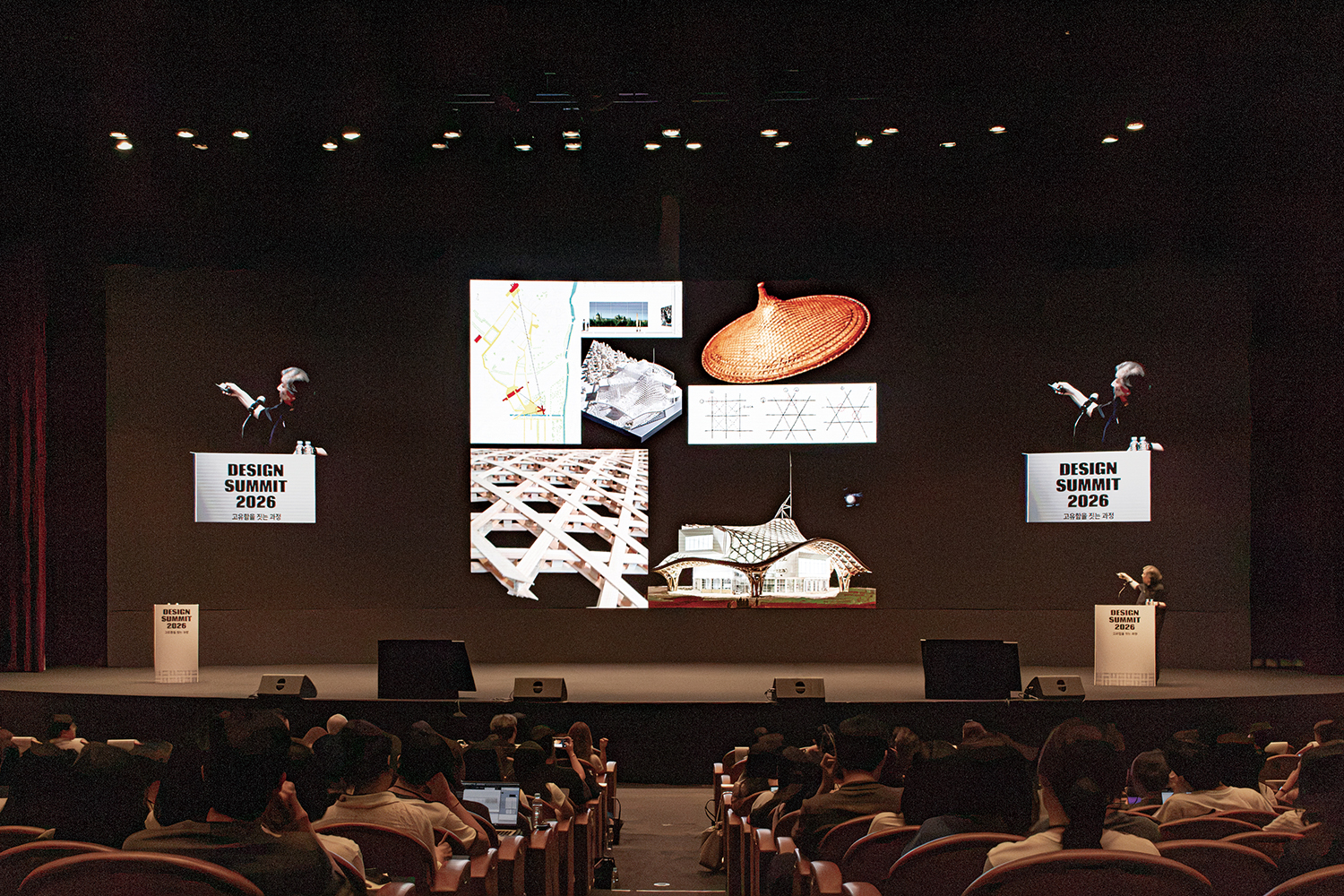
Ban Shigeru explaining the roof structure of Centre Pompidou-Metz (2010) ©Kim Hyoeun
Ban Shigeru (Shigeru Ban Architects) seamlessly presented nearly 40 projects to explain his approach to architecture, which he describes as ‘problem-solving’. He asserted that it is not disasters such as earthquakes themselves that injure people, but collapsing buildings, and architects should take responsibility for the vulnerable living conditions which developed before cities were rebuilt. One of his representative works, Paper Log House-Kobe was his reaction to the 1995 Great Hanshin‒Awaji Earthquake. The emergency shelter used beer crates filled with sandbags as foundations and paper tubes for walls. Its low-cost construction allowed the structure to be easily dismantled and its materials recycled. In the same year, he completed Paper Church-Kobe on the site of the Takatori Church which had been destroyed by the earthquake. The project was a collective effort made by various donations and volunteers. A few years later, this temporary church, which was meant to be demolished, was relocated to Taiwan and reconstructed as Paper Dome Taiwan (2008), a permanent structure. Through these experiences, he realised that even a robust concrete building becomes temporary once it is demolished, while flimsy architecture made of paper can become permanent as long as it continues to be needed and used. His observation reveals an understanding of architectural permanence grounded not in the lifespan of materials, but in the people and circumstances that sustain the need for architecture.
Instead of highlighting their successful outcomes, twelve distinguished speakers from different disciplines and generations emphasised what they had observed, what choices they had made, and the criteria they had developed along the way. Their stories suggest that ‘originality’ lies not in the difference between final results, but in the process of developing one’s own ways of judging and working.
