




SPACE September 2026 (No. 706)
Lee Deokyoung’s solo exhibition ‘Grotto’ was on show at Chapter II in Yeonnam-dong from July 18 to Aug. 14. Lee has explored anxiety and calm arising from societal relationships and personal experiences, as well as the psychological balance that continually shifts between these two poles. In this exhibition, the artist observes irregularities in man-made objects and the order inherent in natural forms, unfolding an inner landscape in which protection and oppression coexist.
For the artist, the word ‘grotto’ in the exhibition’s title represents both a place of safety and a place of escape from which it is not easy to leave. The roughly 16m2 space where Lee spent a year in a residency after moving to Seoul contained both a sense of comfort and a sense of confinement. Whenever the space began to feel suffocating, the artist would go outside and photograph the surrounding landscape, and the urban scenes he discovered were then connected back to his own living space, becoming key subjects informing the exhibition.
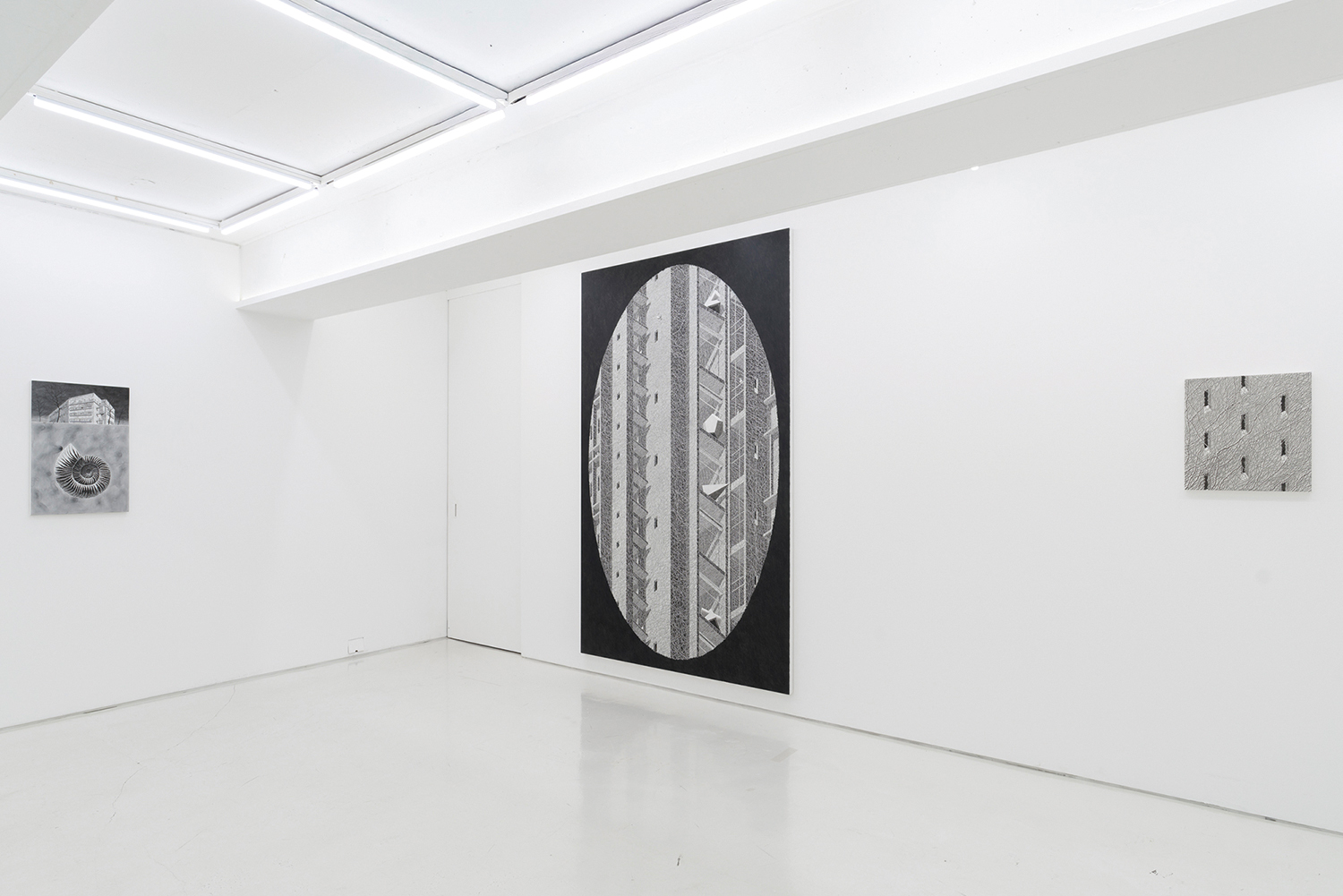
(from left to right) Fossils of the Street (2025), Complete Neglect (2025), Perfect Balance (2025) by Lee Deokyoung. Image courtesy of Chapter II
In Fossils of the Street (2025), the façade of Chungjeong Apartments is positioned vertically alongside the image of a fossil. After hearing that the building was ‘the oldest apartment complex in Korea’, Lee visited it and was struck by its neglected exterior, which reminded him of a fossil. The disorderly state of the electrical wires, garbage, and dust left inside seemed to offer a glimpse into the imperfect human psyche, while the complex circulation of its corridor-style layout felt like a maze. The building, transformed into something resembling a ruin, conveyed an uncanny sensation—as though we are observing a person retreating into a cave and shutting others out. And yet, Lee notes that this old apartment complex, having escaped human control, appeared beautiful to him.
The artist’s gaze expands toward scenes in which nature begins to blend into ruins. He regarded vines growing over abandoned concrete structures as one of the most natural and unadulterated kinds of structure. In Complete Neglect (2025) and Perfect Balance (2025), concrete walls and dense vines coexist while having entirely different formulations. This exploration continues in other works. In Room 103 (2025), a pastoral landscape is superimposed onto the entrance of the residency where the artist lived, while in Grotto (2026), tall silver grass extends into an architectural interior, creating a stark contrast. In these two different works, a sense of comfort and tension can be perceived simultaneously within opposing elements.
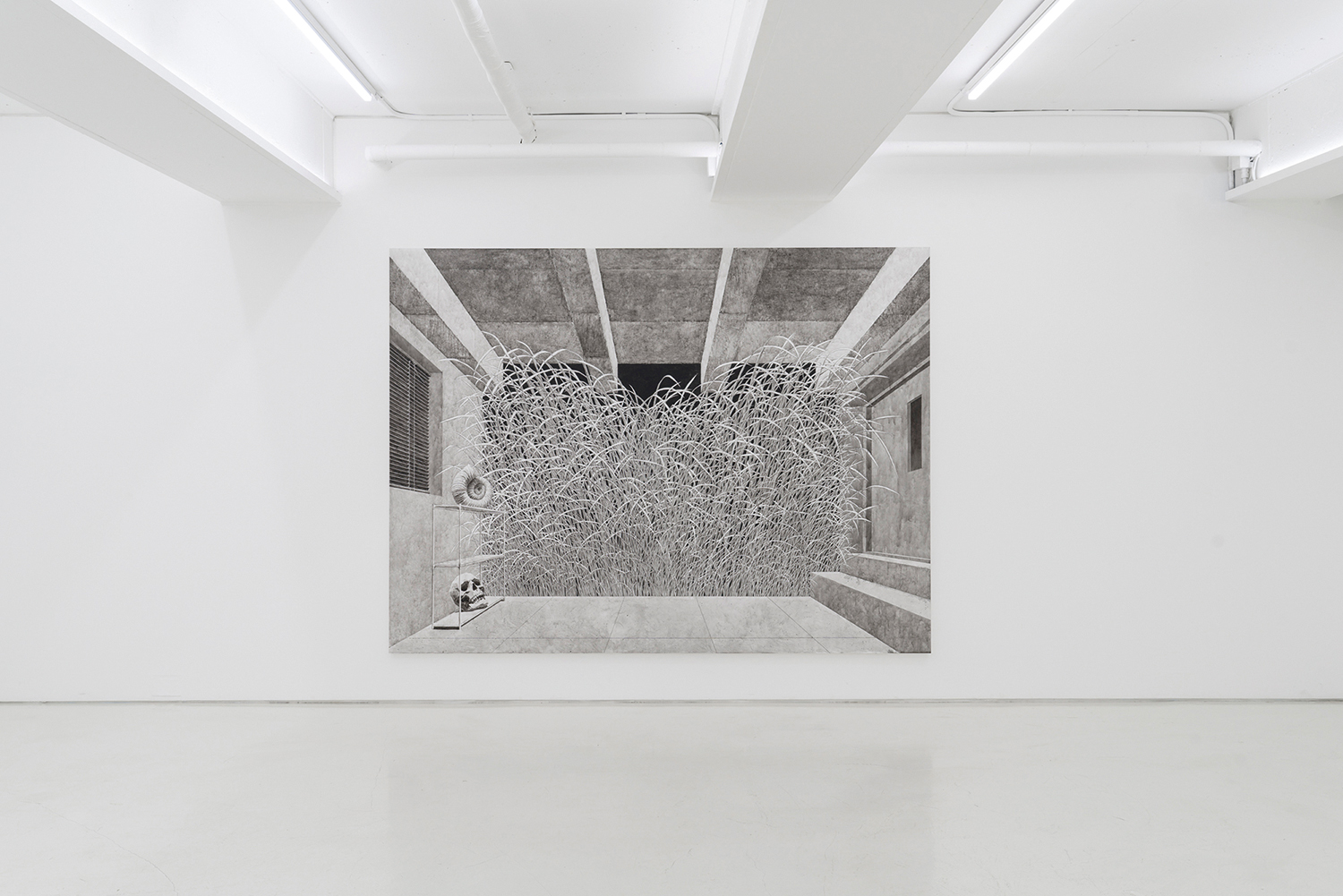
Grotto (2026) by Lee Deokyoung. Image courtesy of Chapter II
Works by Lee Deokyoung have also been installed at SPRING FLARE, a bookstore opposite the exhibition space: Mountains and Life (2026), Imbalance (2026), Dark Mountain (2026), and Balance (2026) are all meticulously drawn in pen and depicting mountains, trees, and residential developments. At first, the clearly rendered urban structures appear to contrast with the intricately depicted natural forms, however, as one gazes longer, that distinction gradually begins to waver. The man-made objects appear increasingly disorderly, while nature is perceived through simpler forms.
Behind the works are three books, including Han Byungchul’s Palliativgesellschaft, recommended by the artist. While Palliativgesellschaft analyses contemporary society’s retreat into a state of chronic anesthesia as it attempts to suppress and avoid pain, ‘Grotto’ proposes another possibility: to recover the senses that have been numbed by revealing and embracing the worn, weathered, protruding, and overgrown elements of the city.
