




SPACE September 2026 (No. 706)
Marking the centenary of Antoni Gaudí’s death, the Tower of Jesus Christ at the Sagrada Família in Barcelona has reached its final height of 172.5m, bringing the exterior construction of the basilica’s central tower to its conclusion. Completed 144 years after construction of the basilica began in 1882, the tower was blessed on June 10, the centenary of Gaudí’s death. In commemoration, ‘Gaudí: Back to the Origins’, jointly organised by the Gaudí Foundation and Gaudí Seoul, opened at Sinsa House on Aug. 1.
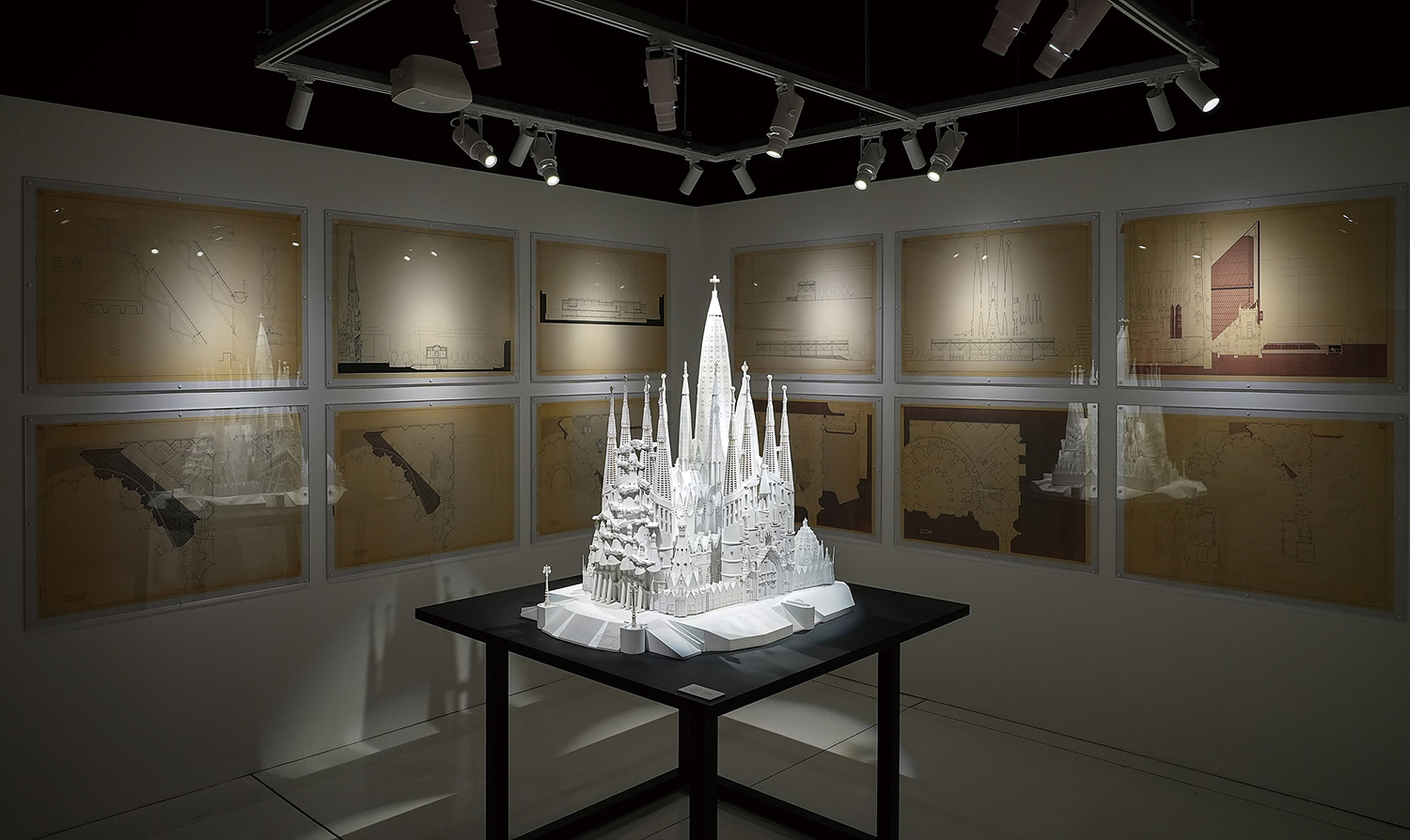
Drawings and a model of the Sagrada Família. Image courtesy of Gaudí Seoul
The exhibition is the Seoul edition of the Gaudí Foundation’s world tour, which will travel to major cities across the globe until 2030. The Junglim Planning Advisory (jpa.) of Junglim Architecture developed the spatial layout and visitor circulation of this iteration, adapting the existing exhibition content to the particular conditions of Sinsa House.
The first three of the exhibition’s seven sections introduce Gaudí’s life and the architectural context that shaped his work. Born in Reus, Catalonia, Gaudí spent part of his childhood in nearby Riudoms, where his family had a farmhouse. There, he developed an early interest in the order and structures found in nature. He later studied architecture in Barcelona, where he encountered French, Islamic, and Catalan architectural traditions, as well as the city’s rapidly industrialising urban environment. His early work absorbed a range of stylistic influences, while he gradually deepened his exploration of the principles shaping structure and space.
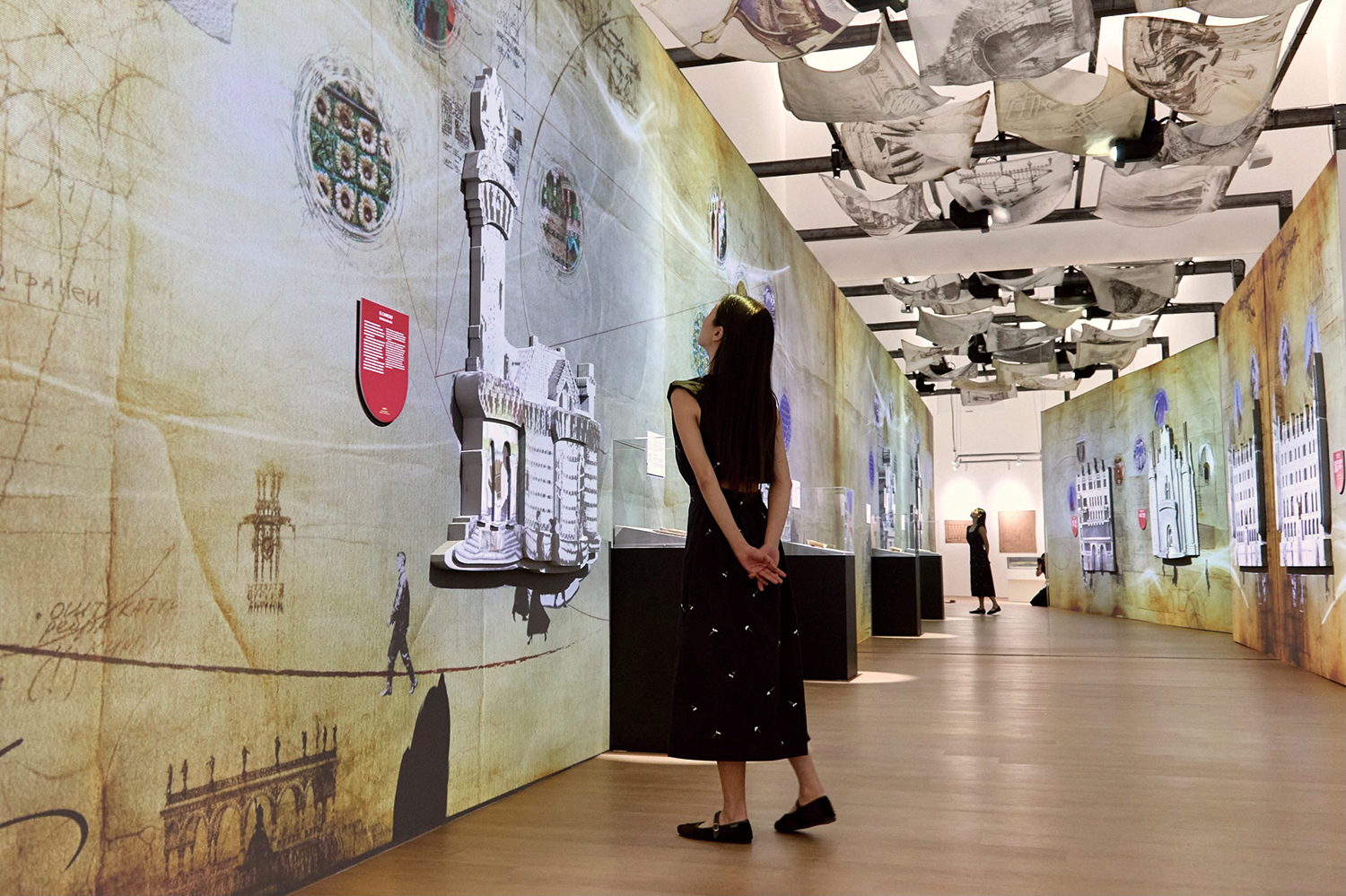
Exhibition view of ‘Gaudí: Back to the Origins’. Image courtesy of Gaudí Seoul
The fourth section, ‘The Atelier of Gaudí’, shows how the structural inquiry introduced earlier developed into concrete design methods through structural models and panels. Gaudí used chains and weights to observe tension and equilibrium under gravity and to explore structural form. He also used a range of three-dimensional models to study form and the effects of light. A representative example is the polyfunicular model, in which chains and weights form equilibrium curves in tension; by inverting those curves, Gaudí could derive forms that remain stable under compression. This method was used in the design process for Colònia Güell. In the exhibition, visitors can explore the principle through physical reconstruction and digital simulations.
This exploration of form also extended to geometric surfaces such as the hyperboloid, hyperbolic paraboloid, and conoid. Although these three surfaces have different properties, they share the ability to be generated through the movement or arrangement of straight-line elements. Hyperboloids are used in the vaults and daylighting system of the Sagrada Família, while hyperbolic paraboloids appear in the curved structures of Colònia Güell. A conoid is used for the undulating roof of the Sagrada Família Schools.
The following section, ‘Sagrada Família: The Eternal Basilica’, brings together architectural drawings of the basilica with Gaudí’s notebooks and working materials. Across the galleries, approximately 30 original artifacts and 42 authorised replicas are on display, including reproductions of Gaudí’s stereoscopic glasses, architectural door handles, chairs, and other objects. Together, these materials shift the focus from images of completed works to the observation, experimentation, and geometric principles behind Gaudí’s architecture. ‘Gaudí: Back to the Origins’ will be on display until Oct. 31.
