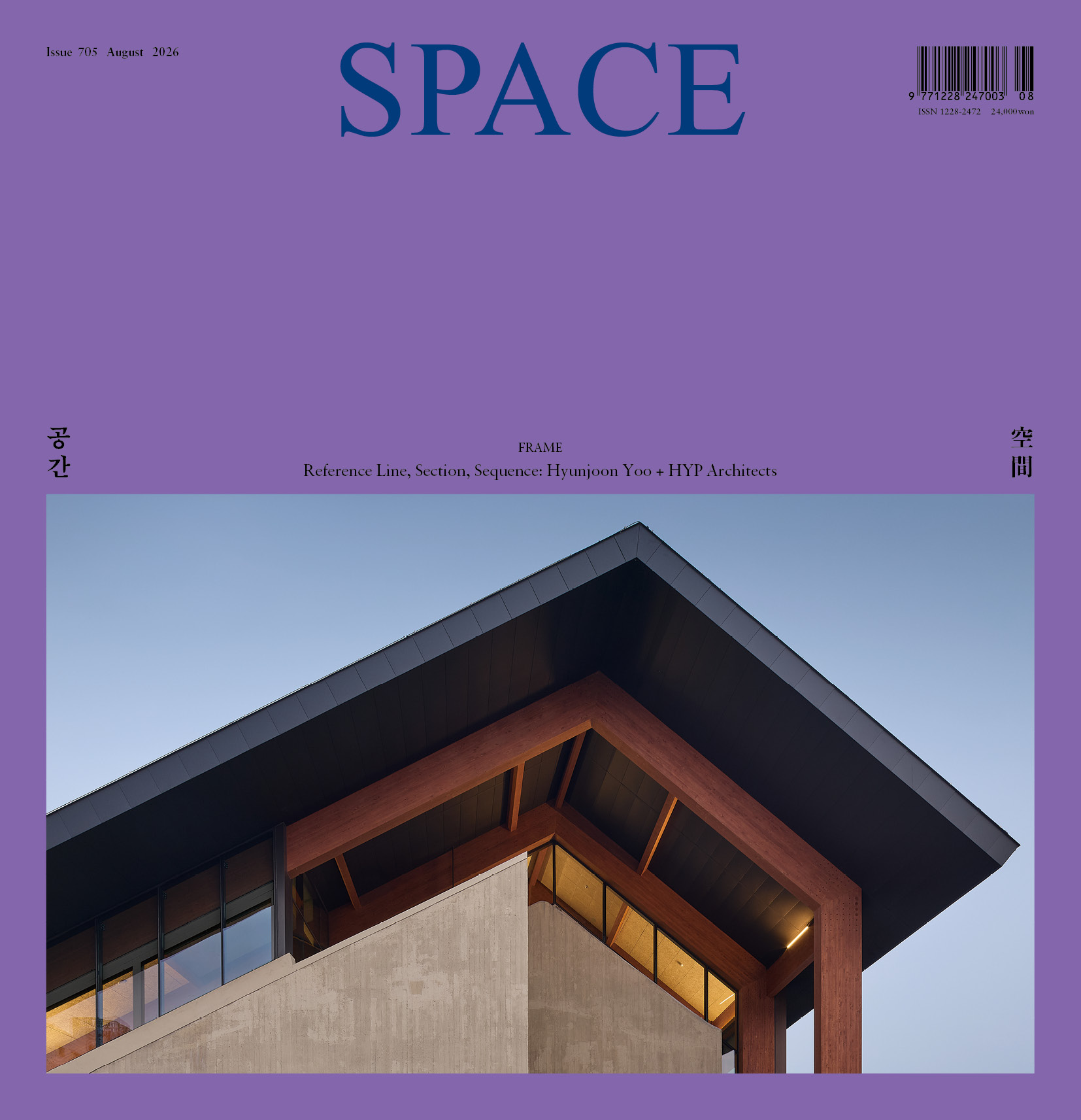

SPACE August 2026 (No. 705)
National Museum of Modern and Contemporary Art (MMCA) Gwacheon marks its 40th anniversary with ‘MMCA Gwacheon 40th Anniversary: Imaginations in Light’, on view since July 10. Drawing on the site-specific qualities of the MMCA Gwacheon, the anniversary programme expands both the role of the museum and means of experiencing its spaces. As part of a design façade initiative, a new graphic identity and visual system have been introduced, alongside newly installed furniture that creates alternative rest areas throughout the museum. Three exhibitions – ‘Lightscape’, ‘Afterimage’, and ‘Lingering Grounds’ – conceived by nine artists and three curators, reexamine the museum by activating spaces that had not previously functioned as galleries.
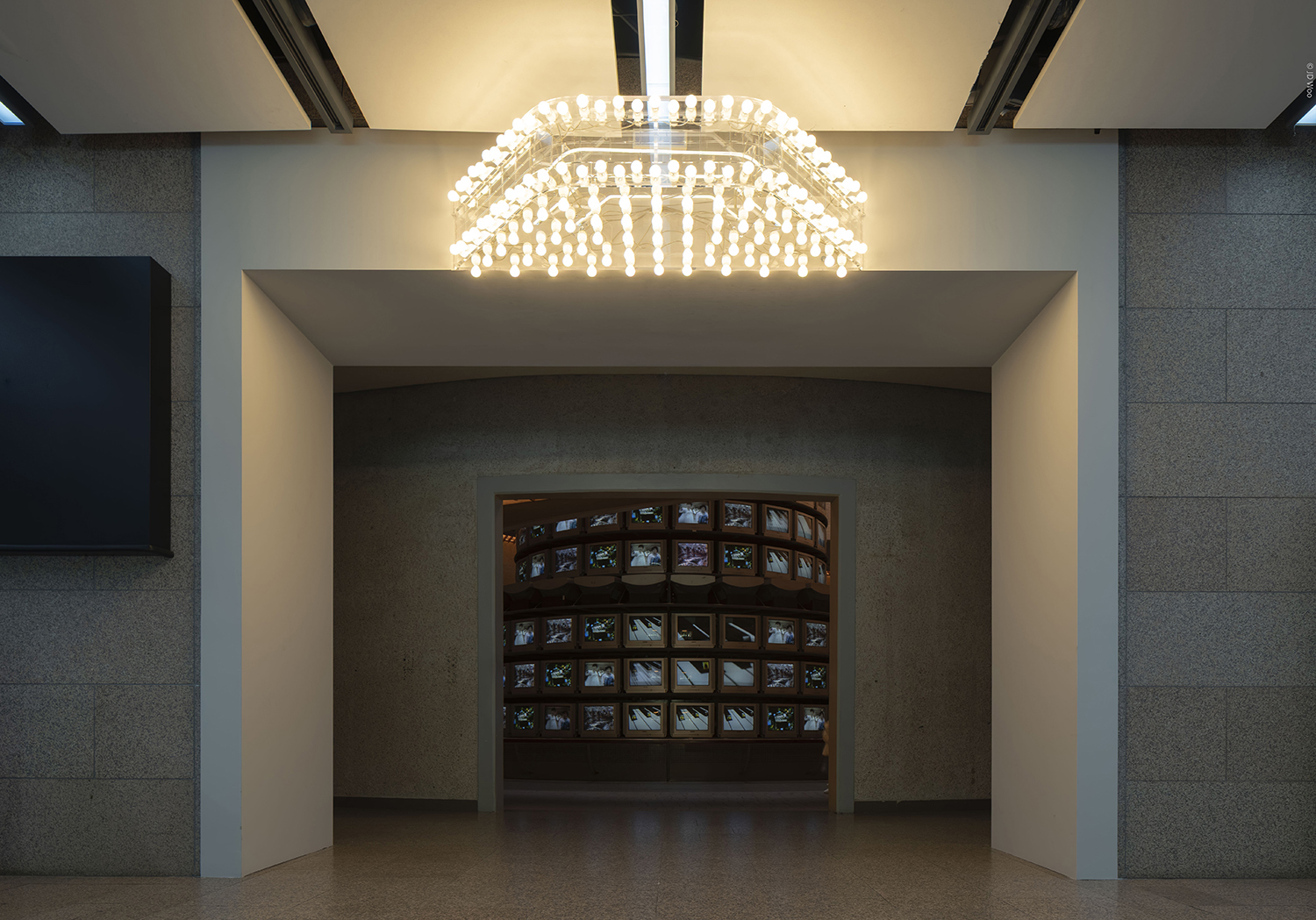
〈MMCA 과천 40주년: 빛의 상상들〉 전시 전경. ‘다다익선’을 마주하기 전 로비에 설치된 필립 파레노의 ‘마퀴’ Image courtesy of National Museum of Modern and Contemporary Art (MMCA), Korea
‘Lightscape’ transforms transitional zones such as the lobby and bridge corridors, which are typically passed through en route to exhibition halls, into display environments. At the threshold between the lobby, More and More (1988) by Nam June Paik has been installed, and in the galleries beyond Philippe Parreno’s Marquee (2019) announces entry to an artistic event. Resembling the illuminated signage of a cinema or theatre, the work hovers overhead, its neon, LED, and incandescent lights pulsing and oscillating in brightness. Kim Ayoung’s Delivery Dancer’s Arc: Inverse (2024) traces the routes of a delivery worker navigating a fictional city, where realities and temporalities intersect. Reconfigured from a three-channel installation into a single-channel work, it is presented as a site-specific intervention along the third floor bridge corridor connecting exhibition halls. Suspended LED panels extend above the balustrade, allowing the work to be viewed from multiple levels and spatialising its narrative structure, in which a single path diverges into multiple spatiotemporal trajectories.
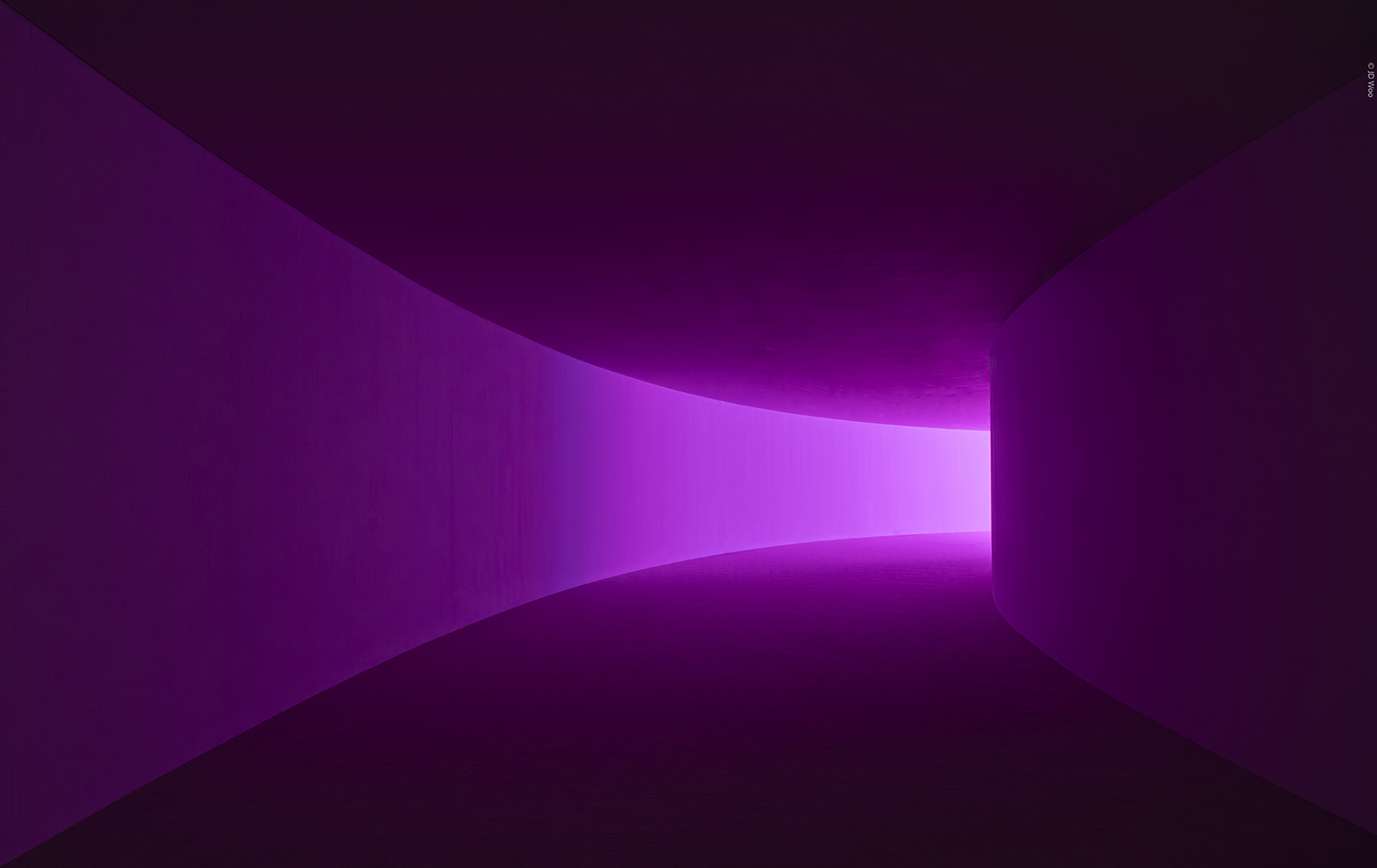
〈MMCA 과천 40주년: 빛의 상상들〉 전시 전경. 제임스 터렐의 작품으로 향하는 원형 전시실 복도 Image courtesy of National Museum of Modern and Contemporary Art (MMCA), Korea
Gallery 2 (Circular Gallery) which was used as a rest area and venue for programmes rather than exhibitions for the past decade, is reactivated through ‘Afterimage’. To the left of the entrance is James Turrell, and, to the right, Iván Navarro, returning to the space after ten years. Turrell’s Imaginings, Wide Rectangular Curved Glass (2021) creates the only environment in the exhibition composed entirely of artificial light. As visitors move along the curved wall, the intensity of light gradually deepens, revealing the work at the culmination of their movement. While Turrell saturates the entire gallery with light, challenging our bodily and spatial perception, Navarro constructs an illusion of infinite recession through neon and mirrored repetition. Natural light entering through the curved wall’s openings intersects with the artificial light of Navarro’s floor-based installation, extending the viewer’s gaze simultaneously outward toward the landscape and inward into the work’s perceived depth.
Set against the outdoor Sculpture Park, ‘Lingering Grounds’ introduces five new works among the museum’s existing 84 sculptures. While the permanent collection largely features durable materials such as stone and steel, the newly installed works employ more mutable materials including styrofoam and plastic, creating a contrast in both materiality and form. These works extend beyond objects to be viewed, inviting visitors to sit, rest, and engage physically. As a result, the outdoor Sculpture Park is reimagined as a space for slower movement and prolonged dwelling.
‘Lightscape’ and ‘Lingering Grounds’ run through Nov. 29, while ‘Afterimage’ continues until late October 2027. Around the museum’s anniversary on Aug. 25, a series of special events linked to the exhibition will also be held.