
SPACE August 2026 (No. 705)
Since 2015, the AA Visiting School (AAVS) Seoul has operated global architecture workshops in collaboration with Yonsei University. Since 2023, the programme has focused on the theme ‘What Emerges from Seoul’, and, beginning last year, it has hosted public keynote lectures by Asian architects. Following Aoki Jun in 2025, Tezuka Takaharu, Tezuka Yui (Co-Principals, Tezuka Architects) delivered this year’s lecture on July 12 at Engineering Hall 3, Yonsei University. Tezuka Architects opened the lecture with a vivid presence, dressed in bold colours, embodying their belief that architecture is not a fixed object but a living organism, one that breathes, weathers, transforms, and grows. Introducing the colours associated with their family members, they stated, ‘We design architecture for the happiness of the people, so we need to know what happiness is to design architecture.’ For them, the family, as the smallest unit of community, serves as a key to understanding happiness.
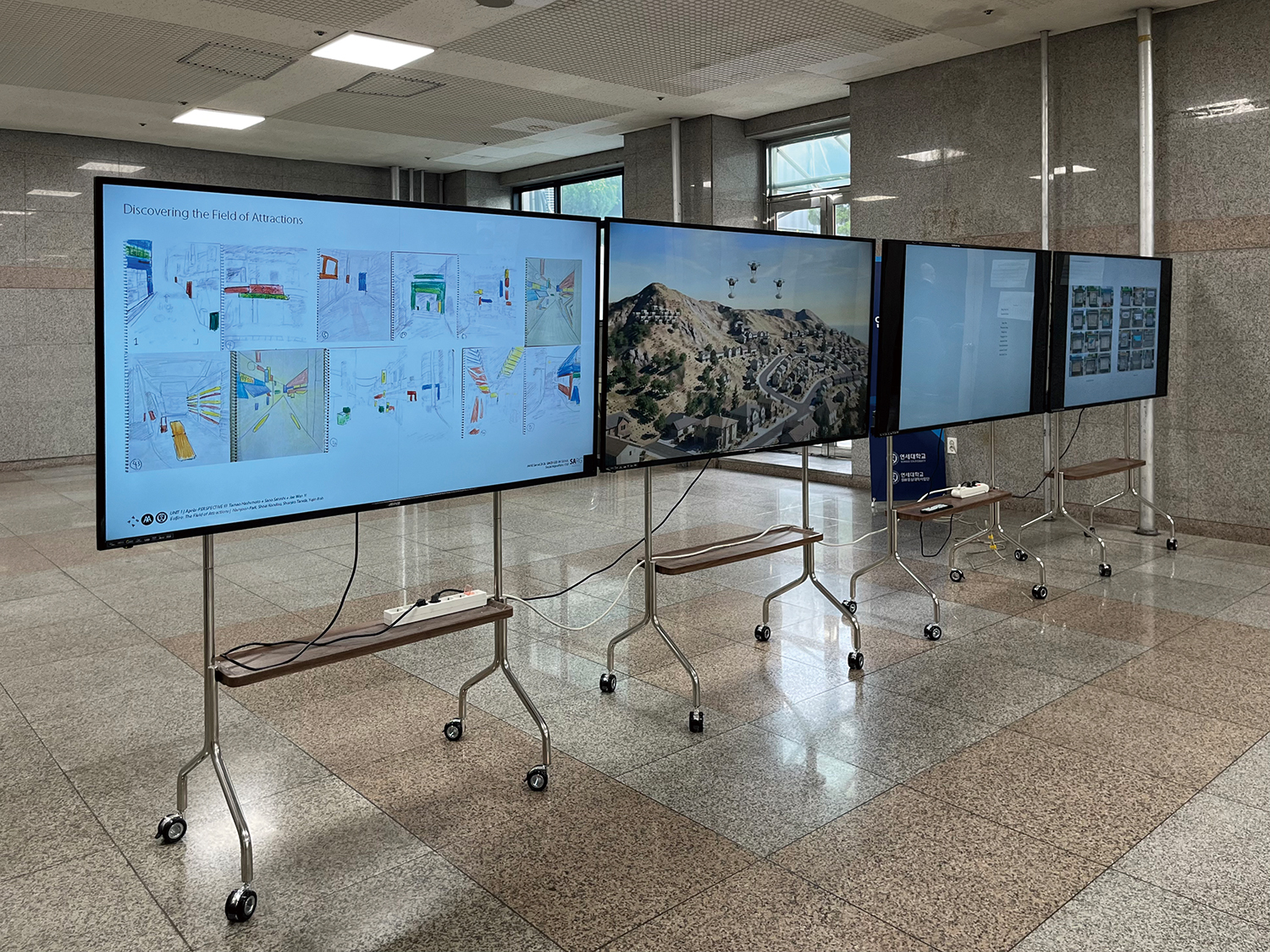
Works produced by individual units of AAVS Seoul 2026 and videos introducing the AA School and DRL courses ©Kim Hyoeun
The lecture traced an expansion of architecture’s scope, from the life of a single family to broader communities and society. Roof House (2001), inspired by a client’s habit of eating lunch on the roof, extended this behaviour to the scale of a house. This idea evolved into Fuji Kindergarten (2007), where children continuously run along an oval rooftop. In Ring Around a Tree (2011), floors at varying heights that are scaled to children, function as both furniture and playground equipment, while Woods of Net (2009) encourages children to discover their own modes of play within a hybrid structure of timber and netting.
Tezuka Takaharu emphasised, ‘Inside is still outside. That intermediate space between outside and inside is very, very important’, extending the discussion from human behaviour to the natural environment. At Matsunoyama Natural Science Museum (2003), rather than controlling the heavy snowfall, the building embraces it, becoming buried and creating an ice-cave-like environment. At Muku Nursery (2018), located on the opposite side of Mount Fuji, a non-orthogonal spatial configuration and integrated water features demonstrate how nature and educational environments can be seamlessly connected.
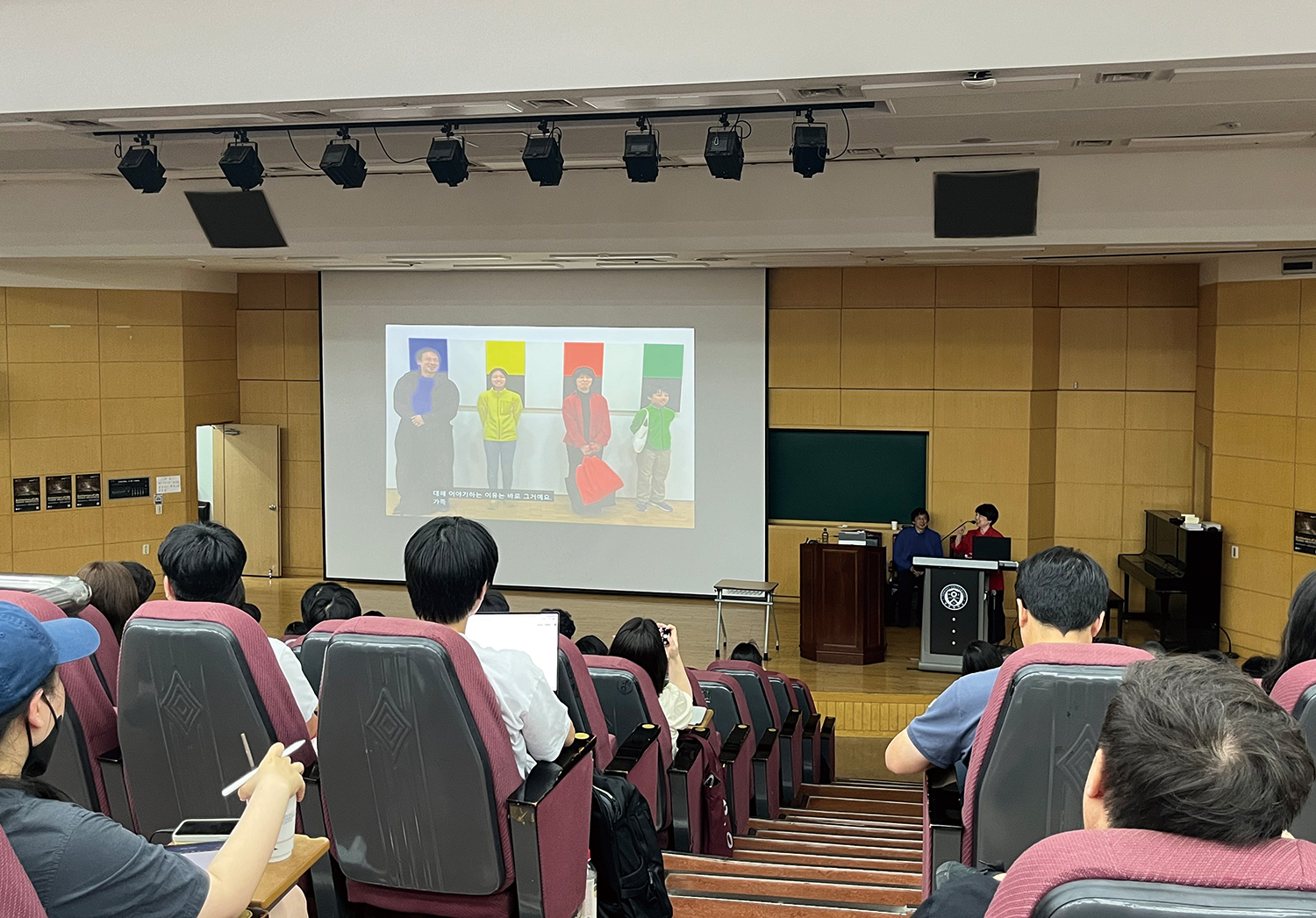
Tezuka Yui introducing the colours representing each member of her family ©Kim Hyoeun
In the latter part of the lecture, Tezuka Takaharu highlighted the expanding social role of the architect through recent projects. At PLAY! PARK (2020), a children’s museum, Tezuka Takaharu took on the role of the director, curating exhibitions and performances while actively engaging in spatial operation. Fushi (2023), planned near the villa of former Japanese Prime Minister Nakasone Yasuhiro – who played a key role in ending the Cold War – creates a setting where national leaders can meet as individuals through shared activities such as dining and bathing, fostering dialogue on peace. In Najmara (2025), located in Dubai, the design focuses on seating arrangements and learning methods, proposing clusters of classrooms that form a larger collective around a central shared space. Meanwhile, the ongoing project Jhamtse Gatsal, an orphanage school for children in extreme poverty in the Himalayas, extends beyond architecture to encompass educational systems, community formation, and fundraising efforts. The project insists upon a model of learning based on care and knowledge sharing rather than competition, enabling children to learn from and relate to one another.
Towards the end of the lecture, Tezuka Takaharu remarked, ‘We don’t design just architecture. We design the programme’ adding ‘Architecture is like air. If you make good air, you get a happy life’, comparing architecture to air. Grounded in the family as a starting point for understanding happiness, Tezuka Architects aim to design not only spaces but also human behaviors, relationships, and systems of education and care, believing that architecture can contribute to a better life. This philosophy is also central to their book Architecture of Life. At the entrance to the lecture hall, works produced by individual units of AAVS Seoul 2026 were exhibited alongside videos introducing the AA School and DRL courses.