




SPACE August 2026 (No. 705)
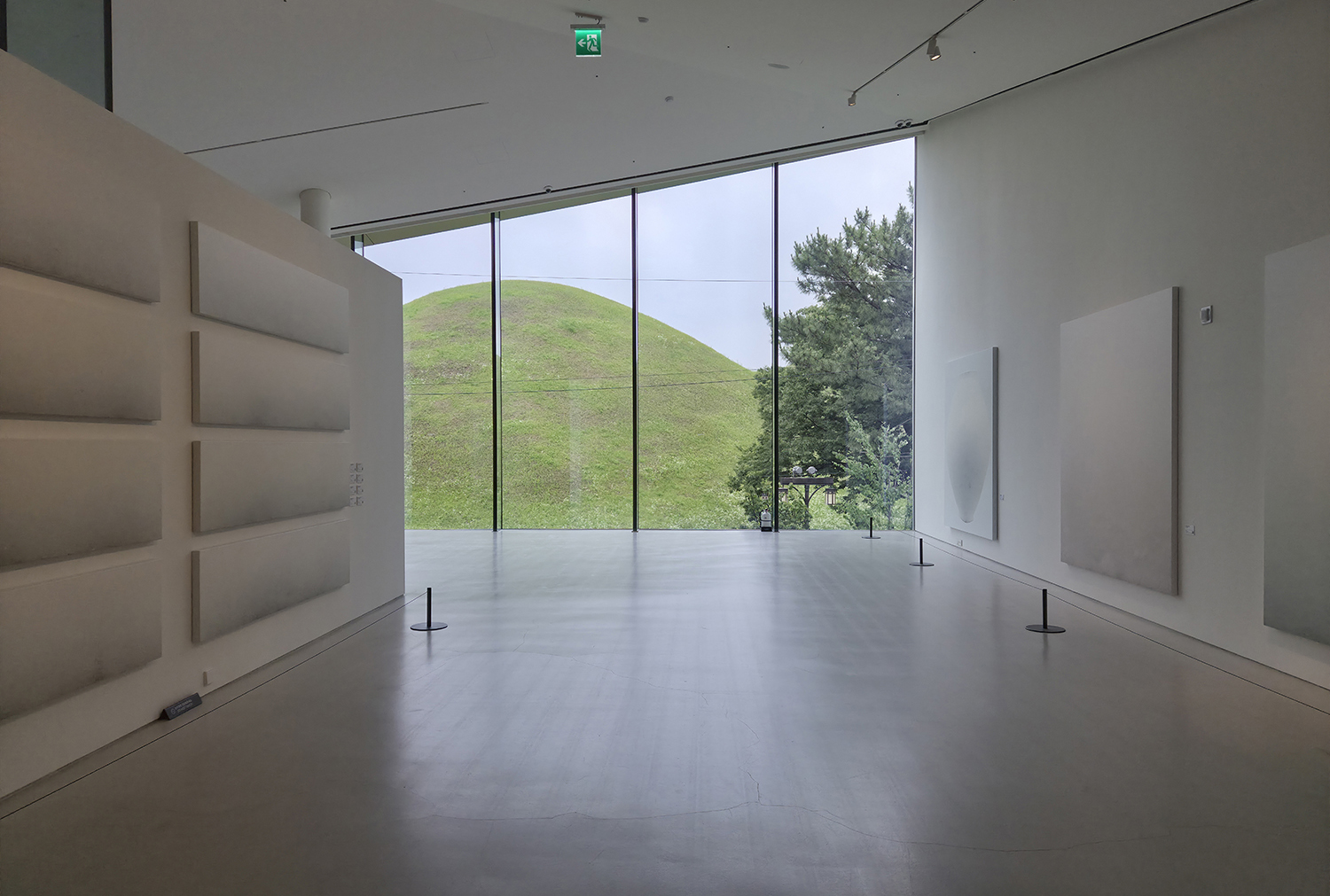
Exhibition view of ‘CAESURA : RELEASE, ABIDE TO BECOME’. The above-ground gallery ©Bang Yukyung
A solo exhibition ‘CAESURA : RELEASE, ABIDE TO BECOME’ by Choi Youngwook, best known for his paintings of moon jars, is currently on view at OAR Contemporary Art Museum in Gyeongju. Featuring 76 works spanning over the artist’s early pieces to recent work, the exhibition traces three decades of his practice.
Having grown up around Insadong in Seoul, young Choi Youngwook regarded the moon jar as a familiar everyday object. However, his perception shifted after encountering an exhibition of Korean white porcelain at the National Palace Museum of Korea. The transformative experience provided the impetus to explore the silhouette of the moon jar and eventually leading to his Karma series. While karma traditionally refers to the principle of causality in which intentional actions become causes that inevitably produce corresponding results, for the artist, it extends beyond its religious meaning. Karma is embodied in the very act of making. The artist repeatedly applies and sands dozens of thin layers of gesso mixed with stone powder onto the canvas, gradually constructing a physical surface. The resulting network of fine crack lines recalls the bingnyeol (crackle patterns) produced by the differing rates of shrinkage between ceramic clay and glaze. In the meeting, separating, and reconnecting of these lines, he reads the cycles of life.
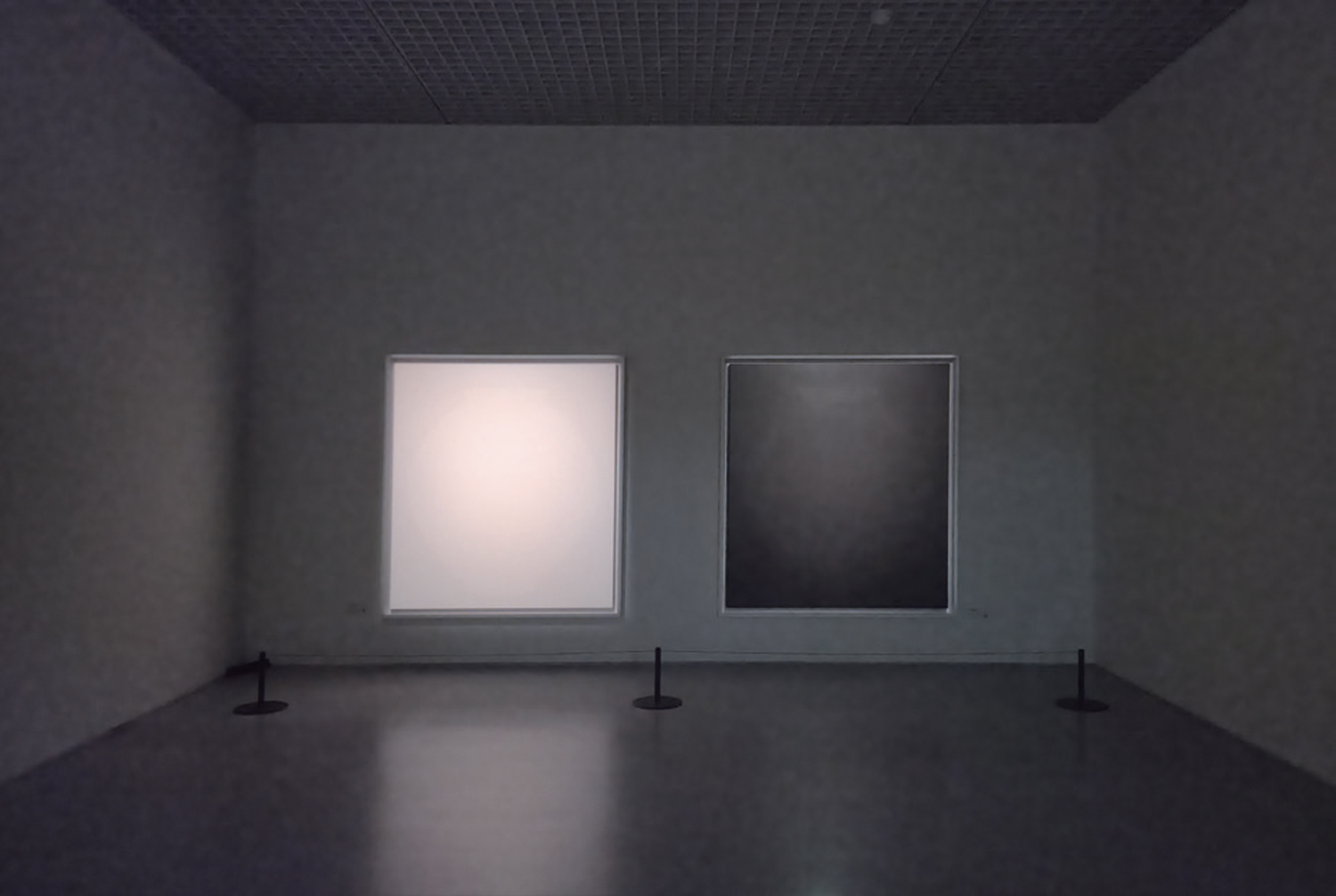
Exhibition view of ‘CAESURA : RELEASE, ABIDE TO BECOME’. The basement gallery ©Bang Yukyung
The exhibition reconstructs his practice through four successive phases: ‘Exploration-Discovery-Internalization-Expansion’. During the initial stage, ‘Exploration’, when he first began his moon jar series, the artist concentrated on the realistic depiction of the cracked surface. Working primarily in oil, he carefully rendered the glossy quality of ceramic glaze and the crackle patterns, emphasising the tactile materiality and three-dimensional texture. A subsequent shift to water-based media marked the beginning of the ‘Discovery’ phase. From this time, he moved away from hyperrealistic representation. The crackle patterns gradually became structural elements that organised the composition, while the pictorial surface flattened, redirecting attention toward atmosphere and perceptual intensity. In the following stage, ‘Internalization’, the moon jar became gradually internalised, and its physical form was progressively distilled. Compositional elements were reduced while the scale of the canvas expanded. In the artist’s more recent monochromatic works, the moon jar survives only as a structural outline. By the ‘Expansion’ phase, which began in 2020, even this residual form disappears, giving way to fully abstract compositions.
Over the past three decades, his engagement with the moon jar has developed from an exploration of its formal qualities and representation into an investigation of the pictorial surface itself. The exhibition reflects this trajectory through a sequence of distinct exhibition environments. In the dark basement gallery, where natural daylight is deliberately controlled, viewers are encouraged to focus on the intricate lines of the painted surface and the layered materiality of the works. By contrast, above-ground galleries establish multiple viewing relationship by overlapping the exhibited moon jar with the ancient royal tombs visible through its windows. As visitors move horizontally through the space, they continually recalibrate their relationship from the interior gallery to exterior landscape. This visual journey continues vertically via the staircase leading to second-floor gallery and the rooftop. There, visitors are ultimately met with panoramic views of Gyeongju’s natural landscape and the Daereungwon Ancient Royal Tombs, bringing the exhibition experience to its conclusion. The exhibition runs until Aug. 17.
7