
SPACE August 2026 (No. 705)
On June 30, Hyundai Motor Group officially opened the Suwon High-Tech Center in Yongin, Gyeonggi-do. The new facility expands the operations of the former Suwon Center and occupies a site of 16,729.3m² with a total floor area of 51,496.73m². The five-storey building with two basement levels was designed by Suh Architects (Principal, Suh Eul-ho), which previously collaborated with Hyundai Motor Group on several architectural projects, including Hyundai Motorstudio Seoul (2014) and the Hyundai Motor Songpa Showroom (2020). Construction was carried out by Hyundai Engineering & Construction.
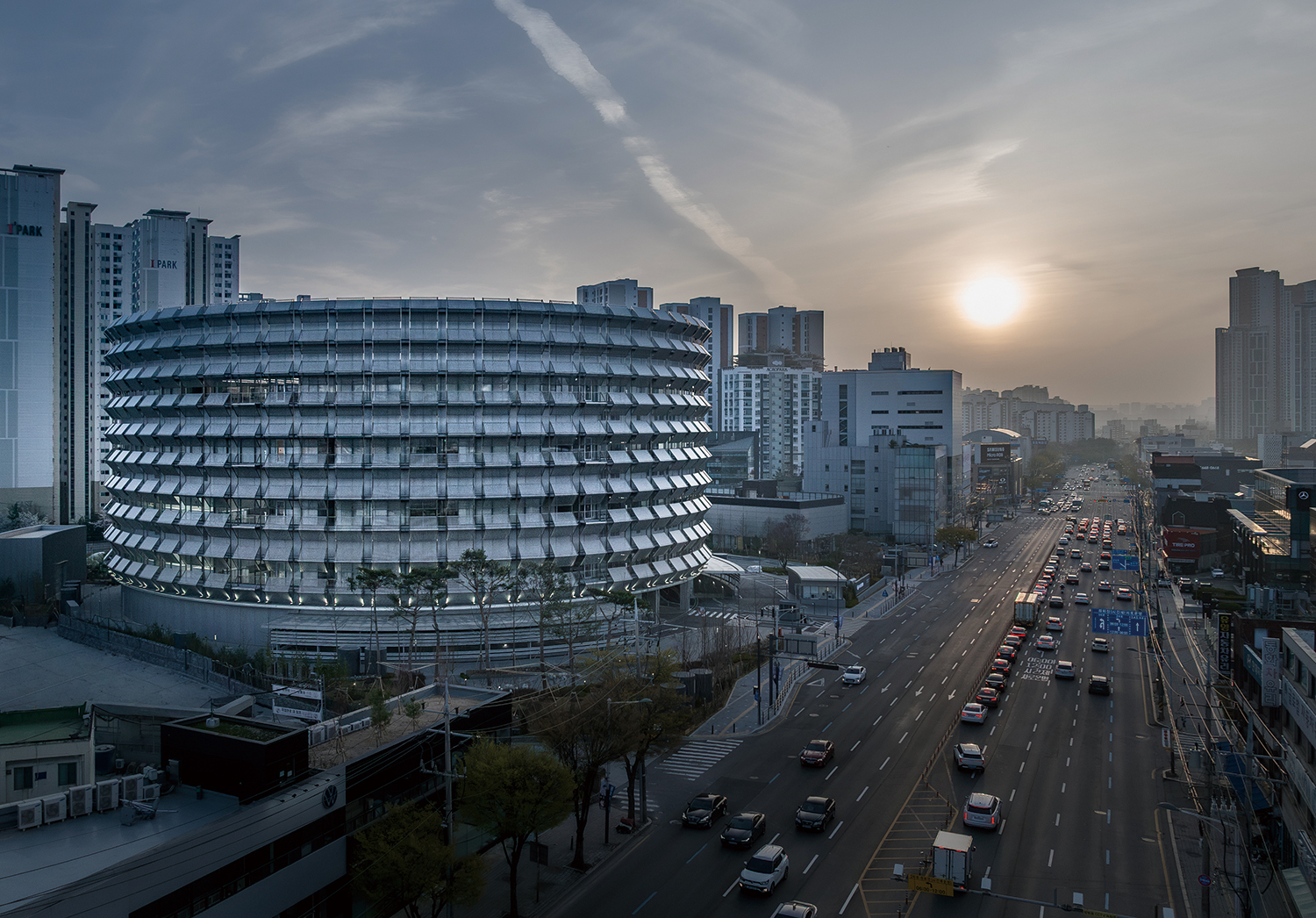
Exterior view of the Hyundai Motor Group Suwon High-Tech Center ©Kyungmo Choi / Image courtesy of imagebakery
How does architecture achieve the image of being ‘high-tech’? In the architectural discipline, the term, ‘high-tech’ refers not merely to the advanced technologies incorporated into a building, but to a condition in which an invisible system, such as structure and building services, became visible through their clear organisation and order. Historically, since its emergence in the U.K. in the 1960s, architects such as Norman Foster and Richard Rogers have shaped the image of high-tech architecture by actively adopting steel and glass construction, lightweight construction, exposed structural and mechanical systems, and flexible interior spaces. Of these works, a canonical example is the Centre Pompidou in Paris, where ducts, plumbing, and circulation systems are distinguished by blue, green, and red respectively, allowing the building’s envelope to be read almost as a diagram of its own inner workings.
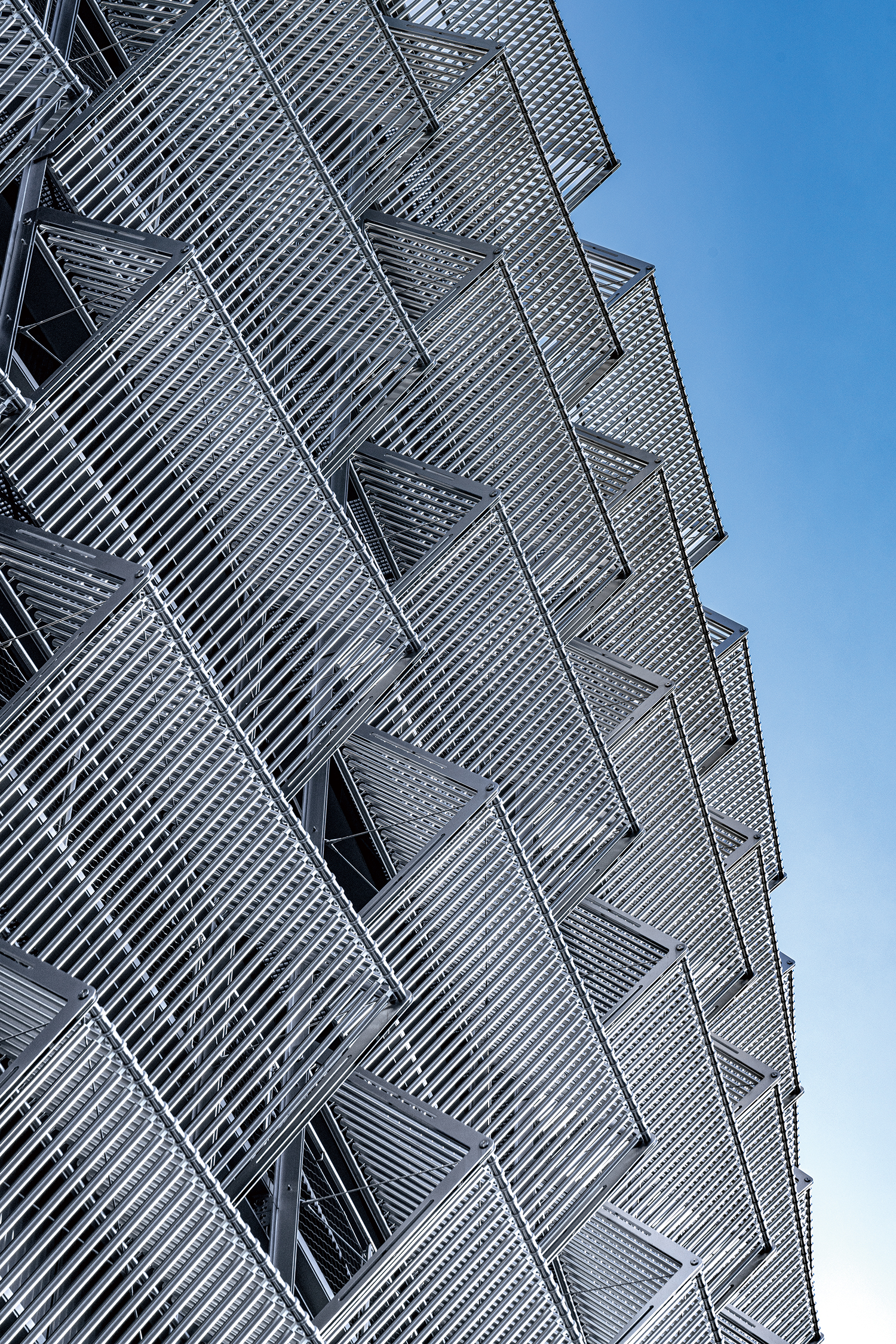
detailed view of the façade louvres ©Kyungmo Choi / Image courtesy of imagebakery
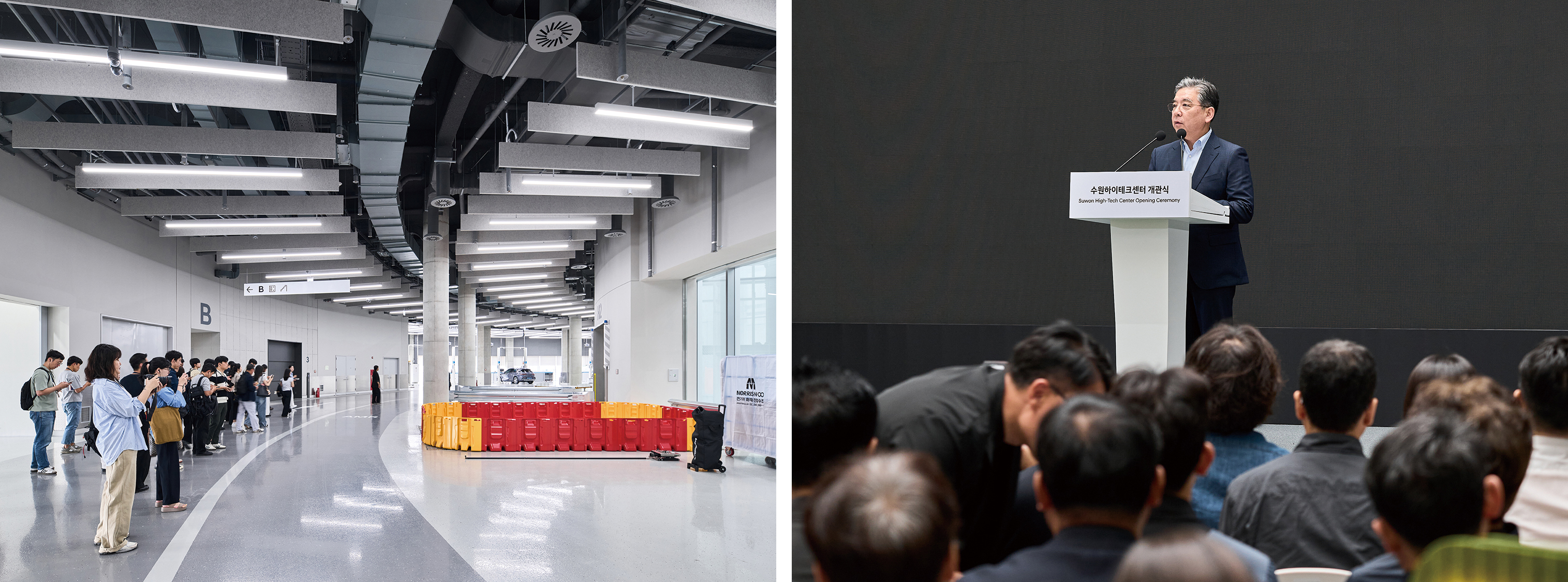 opening ceremony (left) and guided tour (right) ©Choi Jinbo
From this perspective, the Suwon High-Tech Center demonstrates how an otherwise invisible service ‒ vehicle maintenance ‒ can be brought into view. Here, legibility, understood as the visibility of the building’s operational logic, becomes the condition for establishing the transparency of the maintenance service. The building’s circular form, sophisticated envelope, and exposed machinery and data are all shaped by this condition.
First, the building was designed as a circular tower, with maintenance facilities arranged around a central atrium. A car lift vertically connects the ground-floor vehicle reception area to the maintenance facilities on the upper floors. Through the transparent glass envelope, the entire maintenance area, including the interior spaces and the vehicles transported to the upper levels by the car lift, can be observed from the atrium. Here, the car lift is more than a means of vertical circulation; it not only showcases the maintenance process itself but also reveals the operational system.
Behind this view from the central courtyard, an automated logistics system undergirds the entire building, coordinating the movement of vehicles, parts, and technicians. On the second through fourth floors, vehicles are arranged according to their type and service category, while the auto parts and accessories stored in the basement are delivered to each workshop through an automated logistics network. For example, when an engineer requests a component through the integrated management system, robots, such as AMR and ACR retrieve and deliver the required parts directly to the workstations. By minimising unnecessary movement and waiting times, the system improves the continuity and efficiency of the maintenance process. As a result, this integrated workflow supports Hyundai’s distinctive one-to-one service model, in which a single engineer oversees the entire process, from vehicle intake and customer consultation to maintenance and final delivery.
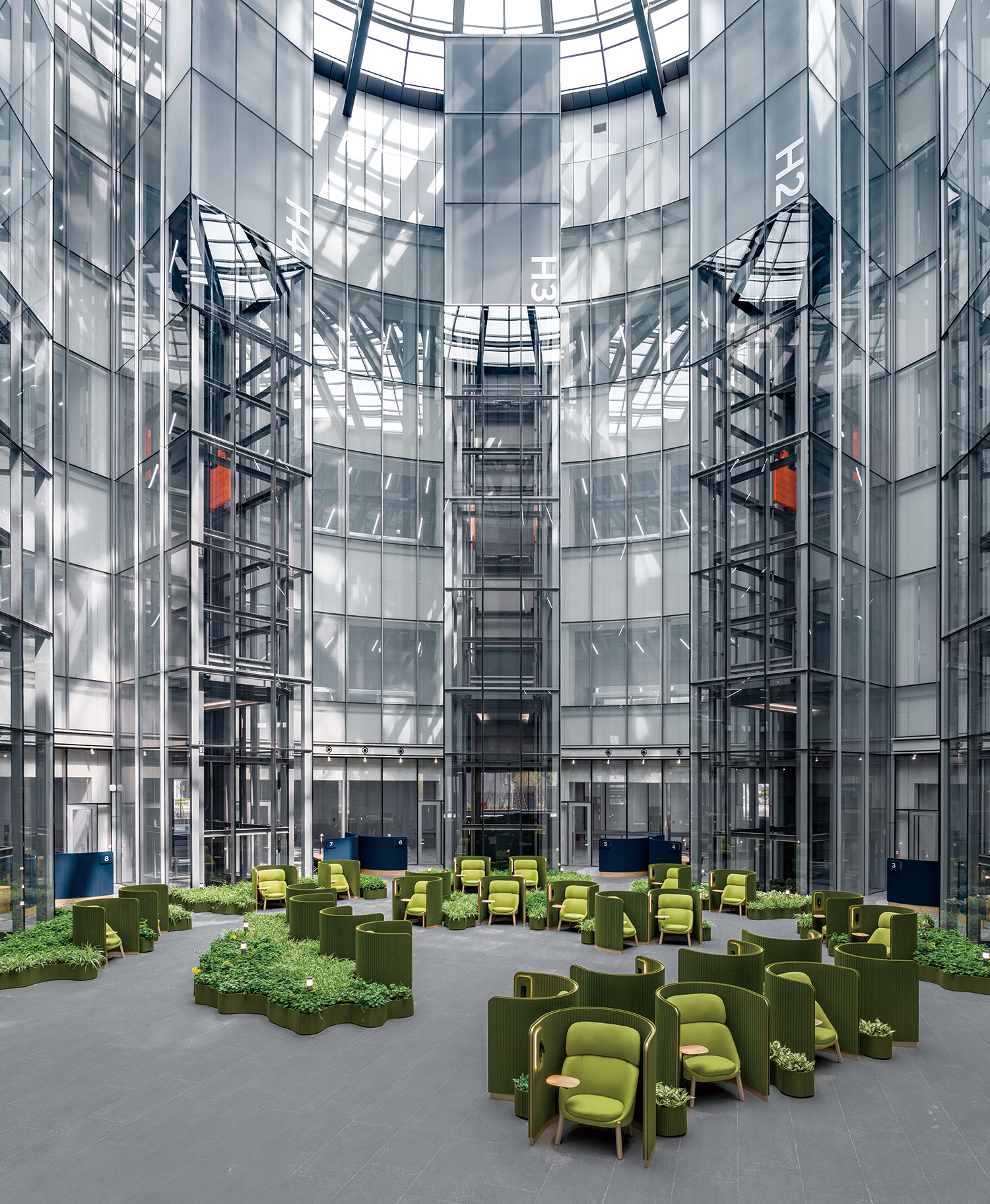
1F atrium ©Kyungmo Choi / Image courtesy of imagebakery
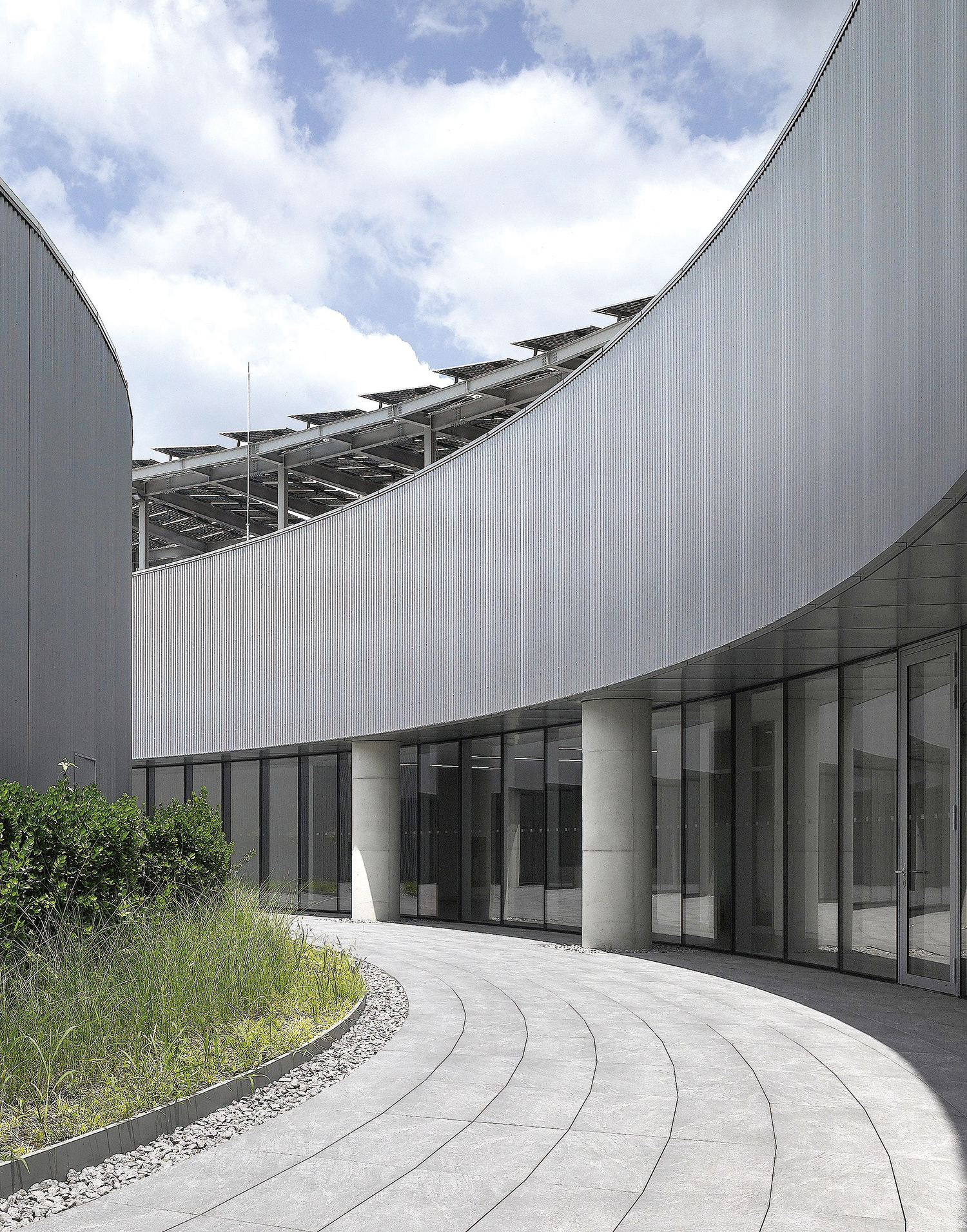
5F outdoor space ©Kyungmo Choi / Image courtesy of imagebakery
Transparency lies not in exposing every aspect of the work, but in the trust that comes from being able to trace the progress of the service and the basis for technical decisions. If the atrium and car lift make the maintenance process visible through the physical movement of vehicles, the Center’s mobile service communicates its progress through information. Data becomes particularly important during the inspection process. Before a customer arrives, the vehicle’s service history and condition are analysed to develop a maintenance plan. Once the vehicle is received, engineers and analysts in the Data & NVH Analysis Laboratory identify the causes of defects using various methods, including noise and vibration analysis, video recordings, and data collected from electronic control units (ECUs). Based on this accumulated data, the dedicated engineer translates a complex technical process into information that customers can easily understand, thereby reinforcing their trust in the service.
From the exterior, the image of high-tech architecture has been articulated through the pipe-louver façade. A total of 660 stainless-steel extruded pipe louvers (Ø50 × 0.7T) wrap the cylindrical volume, providing approximately 40 percent transparency to regulate daylight while polishing the large facility into a refined and unified surface. The façade also resonates with Hyundai Motor’s identity as a manufacturer. Qualities associated with the automobile industry including repetition, precision, assembly, and maintenance, are translated into the continuous linear order of the building envelope.
Suwon High-Tech Center is expected to serve as the primary hub for advanced vehicle maintenance across six cities in the southern Gyeonggi-do. Designed to process approximately 60 vehicles per day, or 14,400 annually, the Center will also provide technical support, maintenance training, and advanced inspection services for more than 80 Bluehands service centers within Suwon region. Ultimately, it aims to expand its role as a high-tech service hub capable of addressing the growing demands of electric vehicles and other complex maintenance tasks involving noise and vibration, as well as electronic control systems.
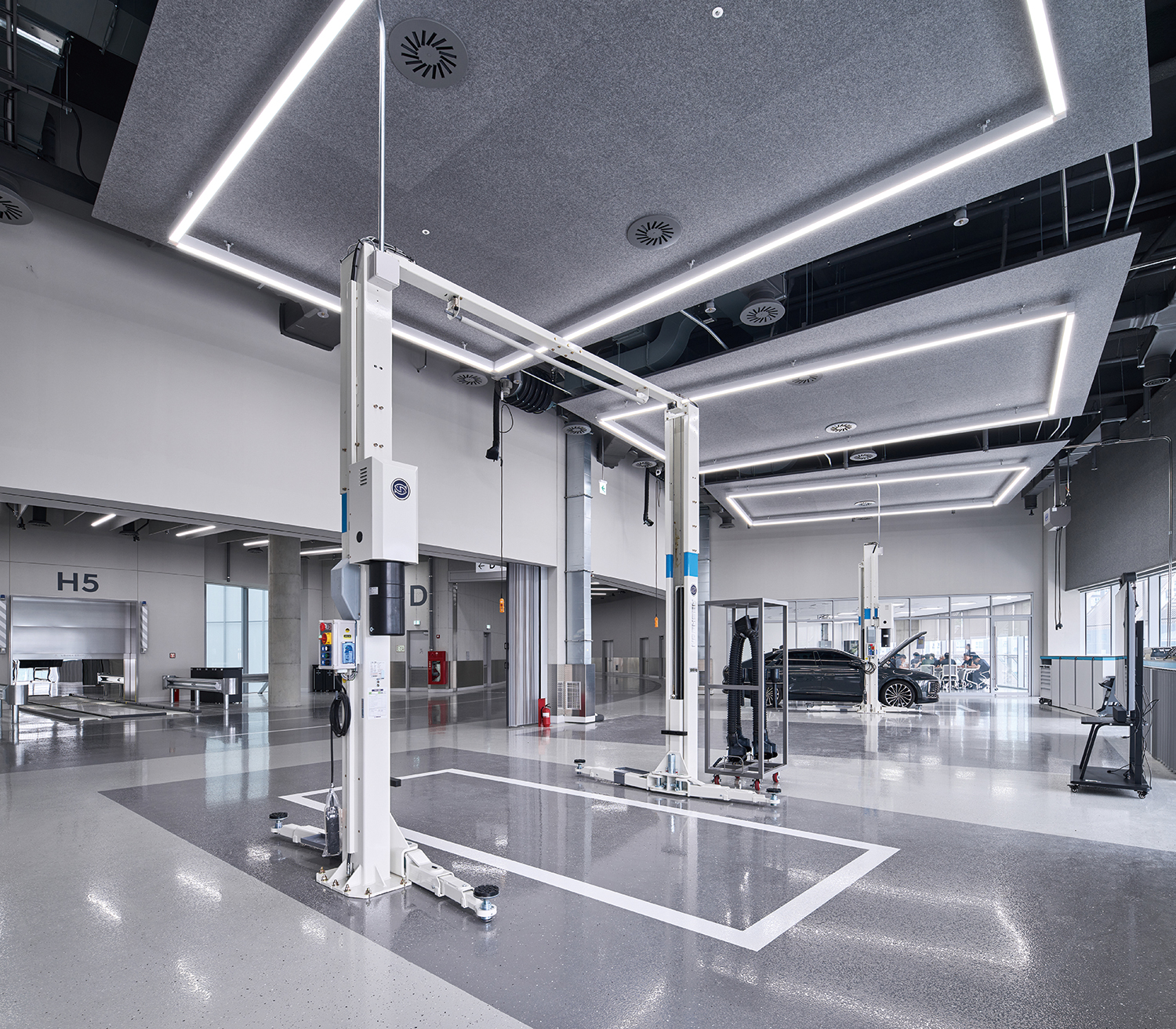
service bay ©Choi Jinbo
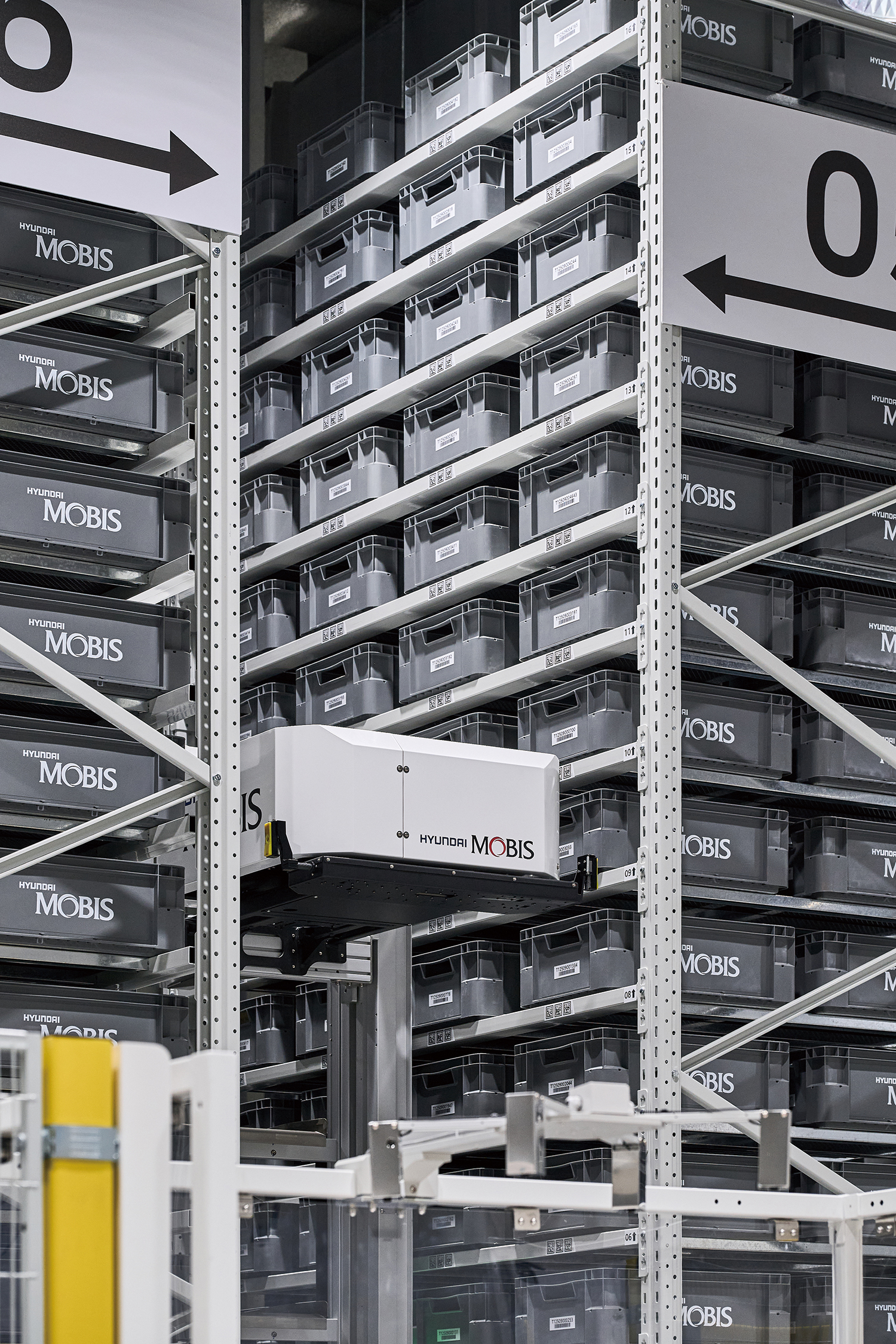
an ACR robot in the Hyundai Mobis warehouse on B1 ©Choi Jinbo