




SPACE July 2026 (No. 704)
On June 4, ‘Questionology in Architecture’, a special lecture and exhibition marking the retirement of Choi Moongyu (Professor, Yonsei University), was held at Jake Lah Hall, Baekyangnuri, Yonsei University. The first part consisted of two lectures; ‘Questionology in Architecture’ by Choi Moongyu and ‘Power of Doubt: Why we love Choi Moongyu’ by Pai Hyungmin (Professor Emeritus, University of Seoul). In the second session, Lee Yeonkyung (Professor, Yonsei University) served as moderator, guiding a conversation between the two speakers.
Rather than presenting his works in chronological order, Choi Moongyu centred his lecture on the questions underpinning them. Everyday conditions, such as the programme that dictates a building’s ground floor, the National Housing size standard, apartment layouts, and the sloping of the land, became departure points for him to reconsider housing systems, family models, and the connection between buildings and their sites. This was less in the pursuit of a grand abstraction than an attitude towards unsettling given conditions that had come to be taken for granted.
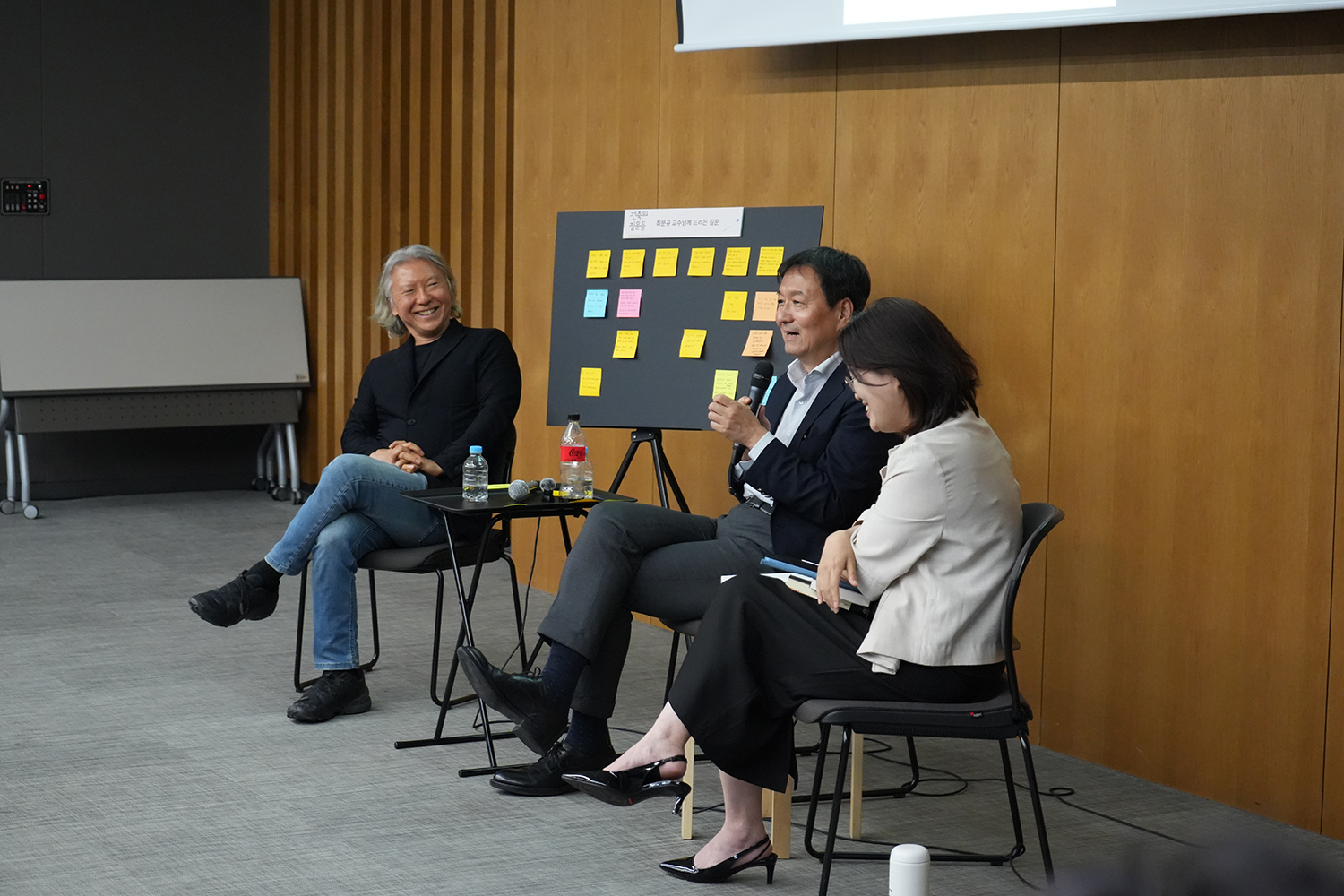
(from left to right) Pai Hyungmin, Choi Moongyu, Lee Yeonkyung ©Yonsei University Department of Architecture and Architectural Engineering
Housing emerged as one of the central themes of the lecture. The 85m2 floor-area standard established for the National Housing programme in 1973 was founded upon now-outdated norms of everyday life, including the concept of the ‘normal family’ and hierarchical room arrangements. He questioned why such standards continue to be reproduced today, even as single-person households have rapidly increased. He also criticised the convention of treating floor area as a unit of exchange, arguing that it had flattened space. As an alternative, he proposed a shift from square metres to cubic metres to consider bodily movement and ways of living.
Another central theme of the lecture was the question of site. For Choi, the site is not merely a given condition, but a question a building must work through in order to find its place. In Ssamziegil (2004), for example, the width and slope of Insadong’s alleyways were translated into the building’s internal circulation system. This inquries was also found in projects such as SSU Student Union (2011), Hyundai Card Music Library (2015), SNU Medical Library (2025), and Park Seobo Museum (scheduled for completion in 2026). Across these projects, whether a building could retain the same meaning outside its site emerged as an important criterion throughout his practice.
In the following lecture, Pai Hyungmin, speaking as both a critic and a longtime friend, described Choi’s architecture in terms of lucid thinking and sensory disjunction. Referring to the title of his 2007 essay for a German publication, ‘Clear and Uncanny’, Pai argued that Choi’s architecture embraces external conditions and follows a reasonable design logic, yet produces spatial experiences that cannot be entirely explained through rational order. For Pai, this quality emerges from the gap between the order perceived from outside and the experience that unfolds within. Pai further connected this observation to Choi’s practice of sketching. Choi’s sketches do not anticipate the experience of the completed architecture; rather, they function as instruments of thought, holding onto the direction of an idea and tracing its logical development. In this sense, they differ from diagrams that clearly illustrate design logic, because they retain questions that precede the finalisation of form.
Later in the conversation, Lee Yeonkyung pointed out that the two lectures illuminated Choi Moongyu’s work from different directions. Pai’s perspective began with curiosity about the internal logic behind the design, whereas Choi’s own approach began with doubt about the conditions preceding design. In response, Choi explained that his way of thinking begins with refusing to overlook the deceptions encountered in everyday life, and that this attitude also helps restrain his desire for architectural expression. For instance, he noted that he has often adopted square windows in his projects, as determining the proportions of a rectangular opening can easily introduce excessive personal preference. In addition, rather than emphasising distinctive colours or textures, he tends to select materials that are universal and long-established. This is not an attempt to eliminate aesthetic considerations, but to avoid obscuring the way his ideas are communicated.
Towards the end, the discussion shifted to architectural education. Choi argued that architecture schools should teach students that ‘design is not everything in architecture.’ While design should be pursued rigorously, he stressed that students should not leave architecture carrying a sense of failure simply because they struggle with it. For Choi, architectural education is not merely a form of professional training, but a time to learn to doubt and question the world. In his closing remarks, he expressed his belief that architecture would never disappear and left the architects and students in attendance with the lingering question of how they would respond to and endure within our changing world.
5