
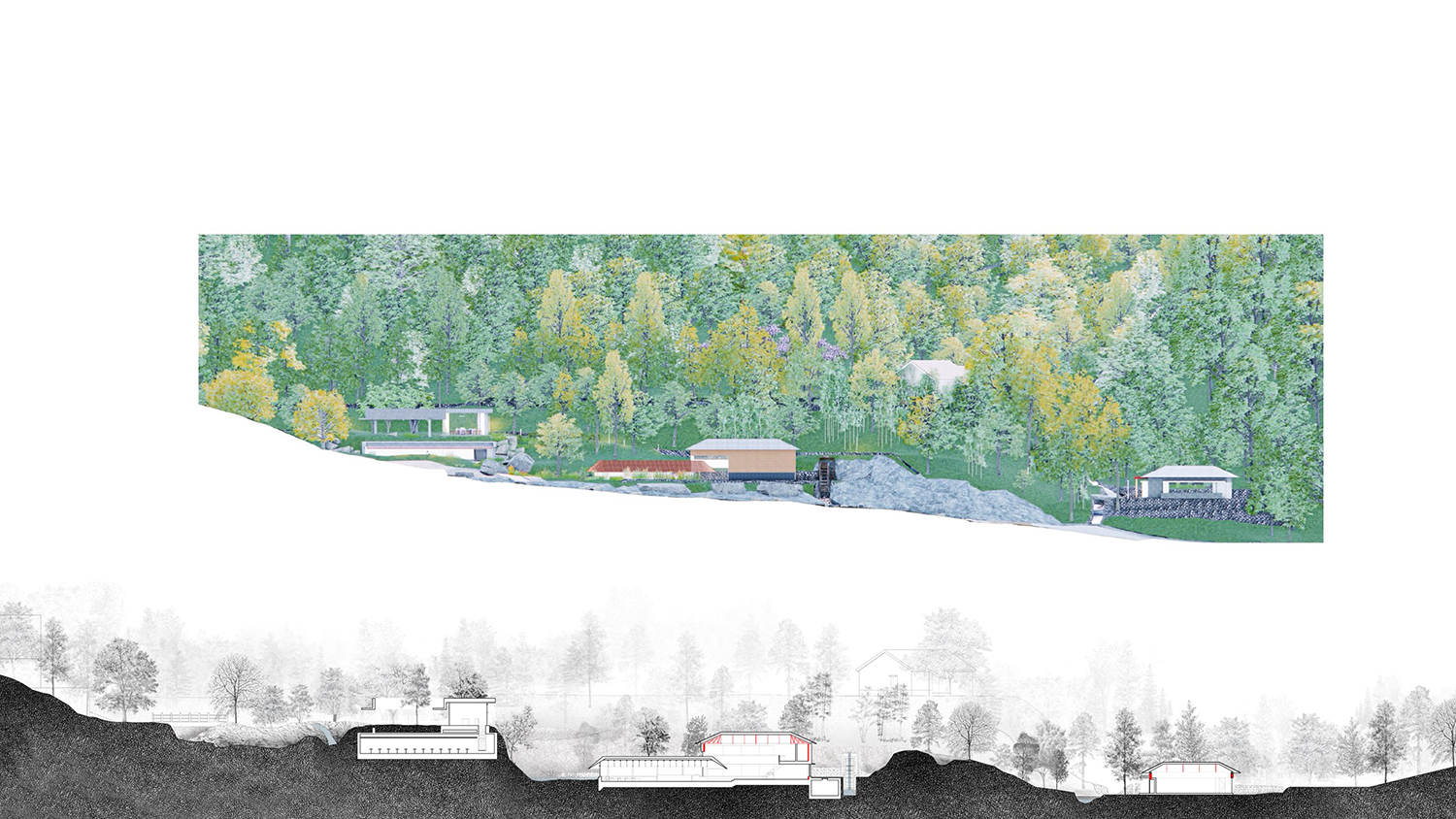
Winning proposal of Invited Design Competition for the Uijae Cultural Heritage Restoration ©ONE O ONE architects
Invited Design Competition for the Uijae Cultural Heritage Restoration and Improvement Project On Nov. 11, 2025, the winning entry for the invited design competition for the Uijae Cultural Heritage Restoration and Improvement Project, part of the Art-Integrated Night Tourism Spatial Development Initiative, organised by Metropolitan City Dong-gu Office, was awarded to ONE O ONE architects (Principal, Choi Wook) + Landscape Design WALK (Principal, Shin Ieecheol) This invited competition aims to restore the Uijae Heritage Site, comprising two components: the extension and renovation of existing buildings, and the landscape design of the 6,812 m² site. Based on an in-depth analysis of the site’s dynamic topographical conditions, the winning entry proposes a new access network connecting three existing buildings. Through this intervention, it integrates the site’s varied topography and vegetation to create a cohesive and harmonised landscape. According to ONE O ONE archtects, the competition was approached as a process of restoration through a careful reading of the site’s original landscape. As the Uijae Heritage Site historically brought together agriculture, education, and art, tracing its past uses, including rice fields, tea fields, gorges, waterways, and stone walls, became the starting point of the design. The main design strategy can be summarised as ‘weaving topography, vegetation, and water streams with architecture into a single landscape’. To achieve this, the level differences generated by the former agricultural school, rice fields, and water flows were restored in the form of multiple wetlands and ponds. Architecture is then positioned at the thresholds between these conditions. Each building establishes a distinct relationship with water, forest, and rock formations, contributing to the formation of a new landscape. At the same time, they are connected by a circulation path that unfolds as a continuous spatial experience. The winning team noted that their proposal was positively received for its integration of landscape and architecture, and the ability to generate a sequential experience through the relationship between paths and built forms, in dialogue with the Uijae Museum of Korean Art.