




「SPACE(공간)」 2026년 6월호 (통권 703호)
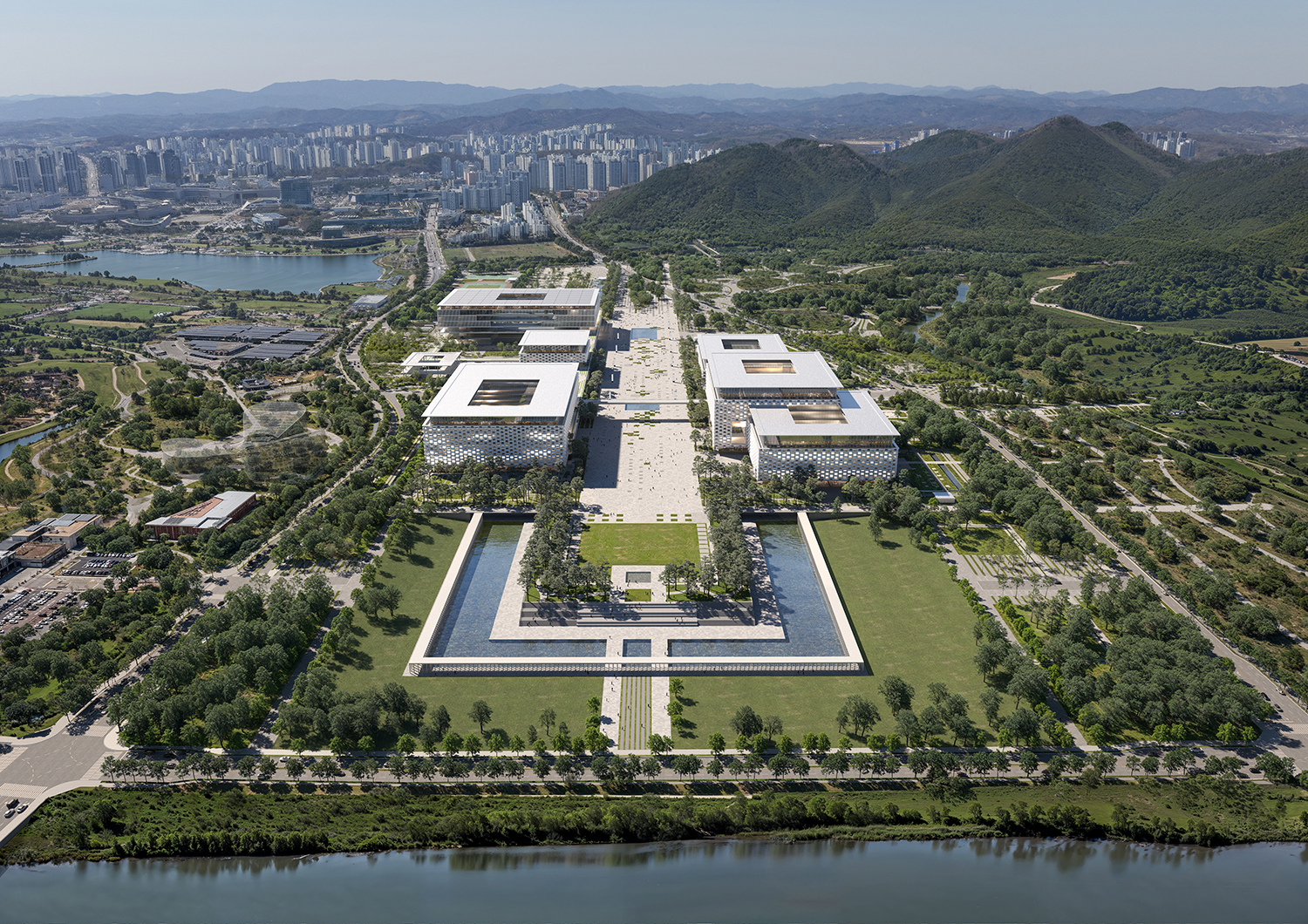
Winning proposal of International Master Plan Competition for the National Assembly Sejong Complex ©KUNWON Architects Planners Engineers + UNSANGDONG Architects + DAUL ARCHITECTS & PLANNERS
On May 7, National Assembly Secretariat announced the winning proposal for the International Master Plan Competition for the National Assembly Sejong Complex. The selected team consists of KUNWON Architects Planners Engineers (Principal, Kang Dongwoo) + UNSANGDONG Architects (Co-Principals, Jang Yoongyoo, Shin Changhoon) + DAUL ARCHITECTS & PLANNERS (President, Sheen Dongjae). The competition guidelines can be summarised as the creation of a future-oriented space that embodies national sovereignty as well as the dignity and identity of Korea, situated on a site of approximately 631,000 m2 within the Sejong Multifunctional Administrative City. According to the winning team, the proposal focuses on ‘escaping the authoritative image of past government buildings and spatially realising a true democracy in which the people and their representative institutions stand on equal footing’. To achieve this objective, the proposal foregrounds three core values: a sense of Koreanness that shapes space through emptiness rather than Western monumentality; symbolism, with the Geumgang River understood as a historical flow extending across thousands of years; and urban centrality, established through a connection to the vast natural landscape of Sejong. Rather than occupying the centre of the site with a massive building, the proposal preserves the public forum, where the two axes intersect, as an open void. This ‘organic transitional space’ is intended to embody a process of coexistence in which the site is naturally filled with the people’s will. The plan also draws the surrounding natural axes into the complex to create four large courtyards, while horizontally clustering the major buildings and connecting them through a three-dimensional corridor system. Through this strategy, the team envisioned a ‘network of mutual coexistence between presence and absence’. The team also shared several positive comments from the jury. First, the main building, positioned toward the Geumgang River, was praised for blending naturally into the surrounding mountain and river landscape. Second, the jury highlighted the organic connections between the four courtyards, the corridors, and the main programs of the National Assembly. Third, the proposal introduced two principal axes: an ‘axis of symbolism’ linking the main building with the Geumgang River, and an ‘axis of the people’s will’ centred on the library. By avoiding a single dominant axis, the plan mitigates the authoritative force often associated with monumental planning and instead creates a more complex sense of place.
5