
SPACE May 2026 (No. 702)
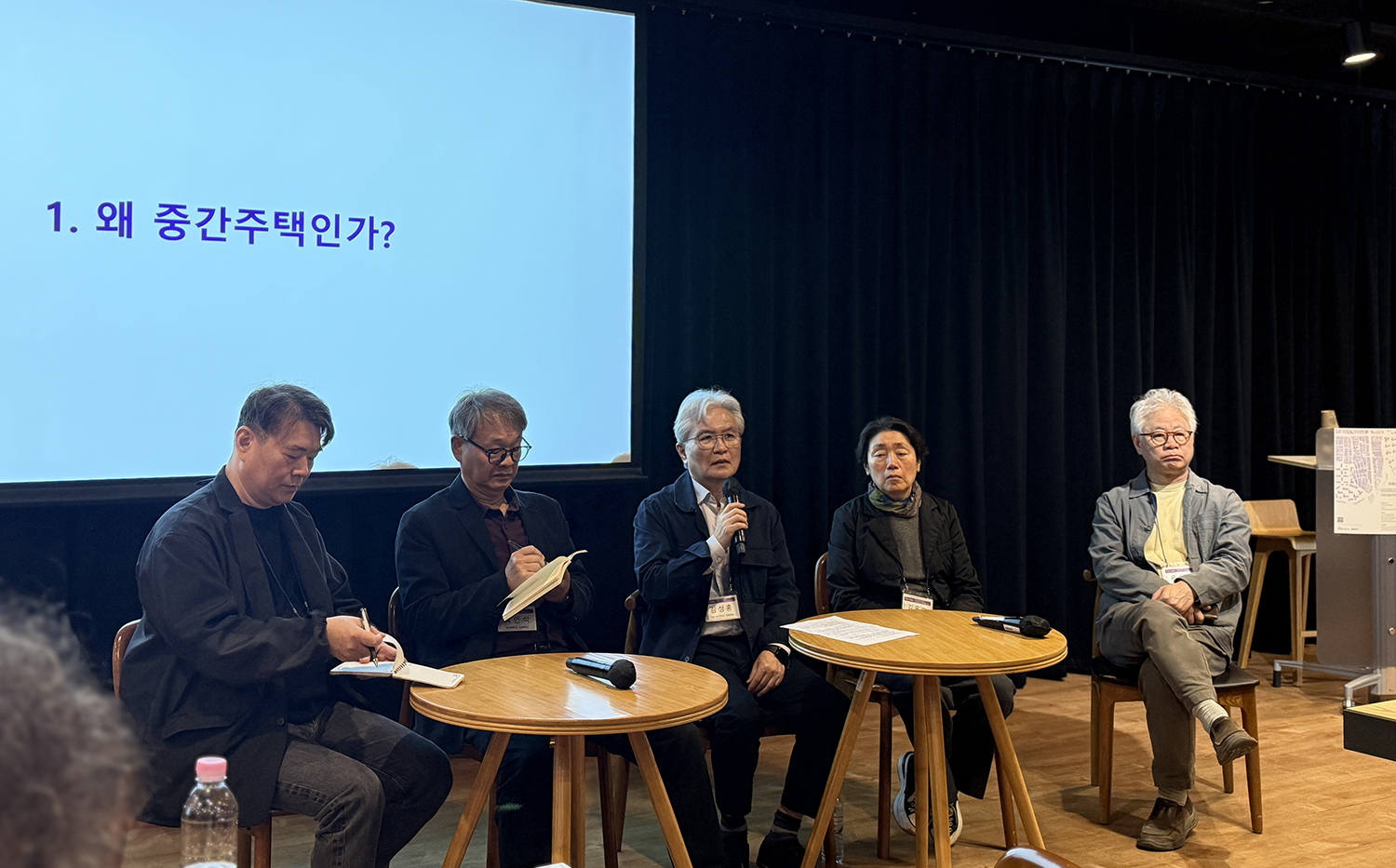
Symposium in progress, from left: Kim Daesung, Park Insuk, Sung Hong Kim, Kim Yongmi, Yoon Seunghyun. Image courtesy of Korea Architects Institute (KAI)
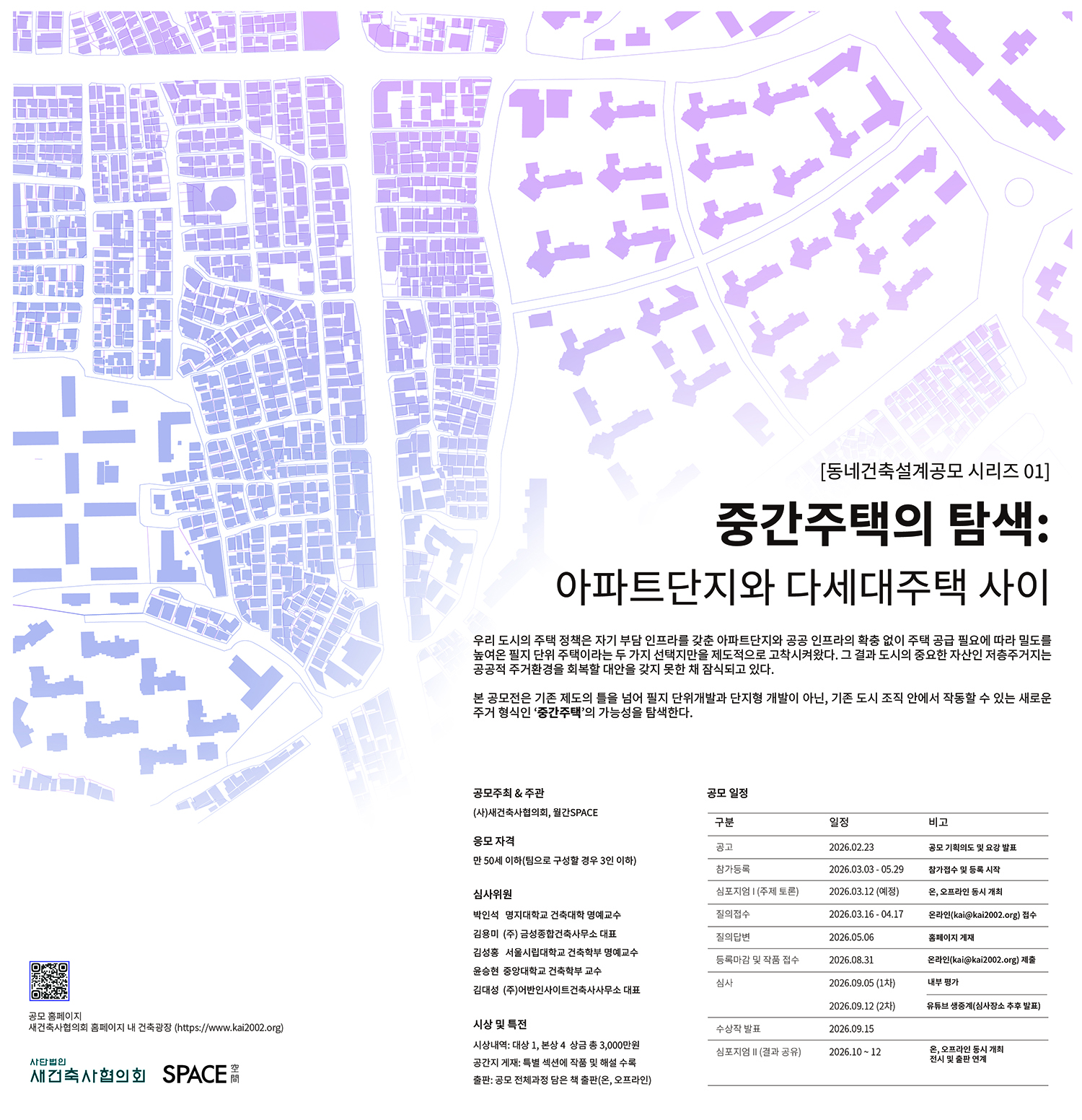
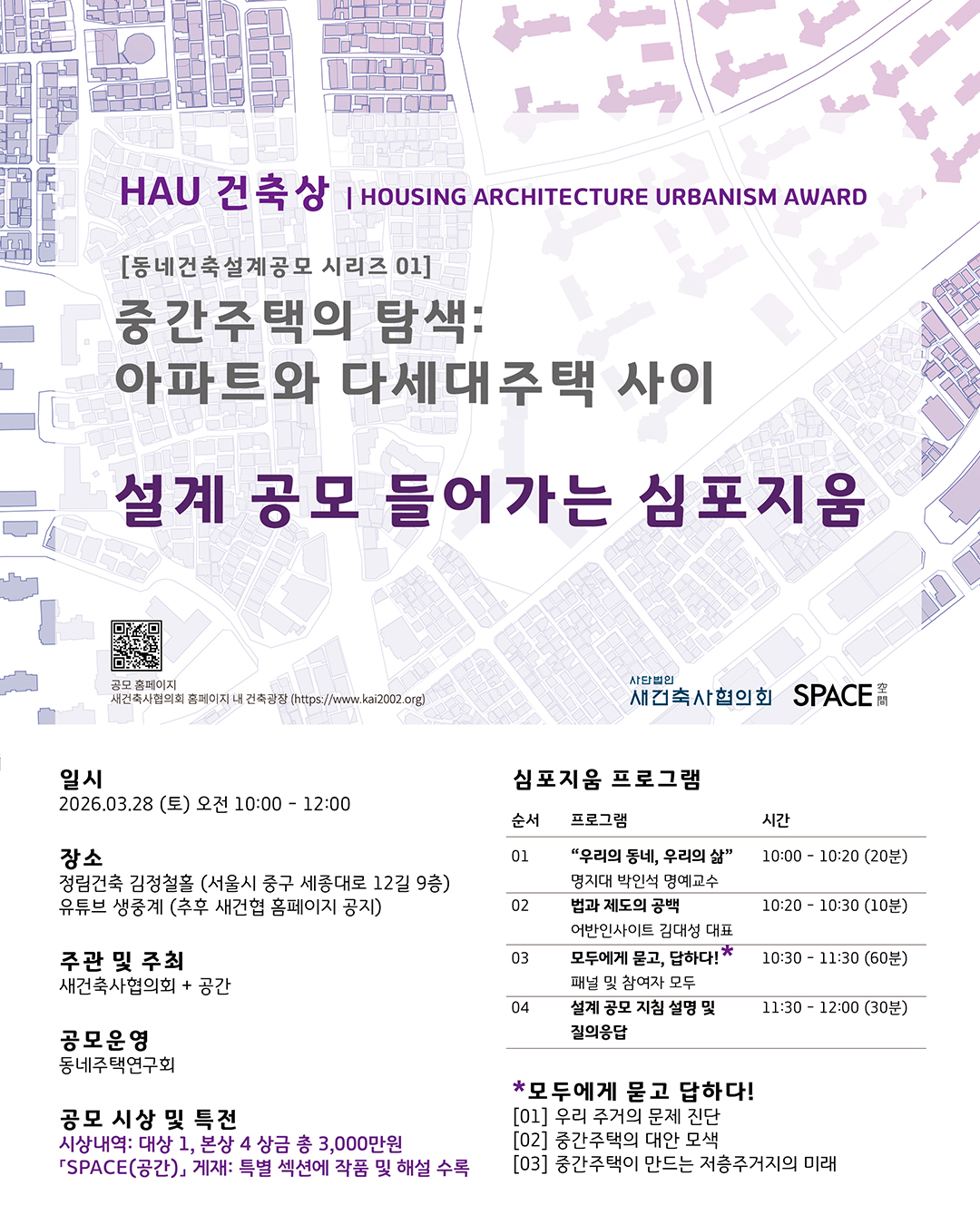
On Mar. 28, an Inaugural Symposium for HAU Award 2026 Design Competition #1, titled ‘Exploring the Missing Middle: Between Large Apartment Complexes and Small-Lot Multi-Family Housing’ was held. The event was co-hosted by the Korea Architects Institute (KAI) and SPACE. As part of the competition, the symposium aimed to explore alternative housing typologies situated between large-scale apartment complexes and parcel-based housing, while also fostering a broader understanding of the need for ‘in-between’ housing. The symposium was moderated by Yoon Seunghyun (Professor, Chung-Ang University), followed by an opening address from Lim Hyoungnam (Chairman, KAI). Presentations were then delivered by Park Insuk (Professor Emeritus, Myongji University) and Kim Daesung (Principal, URBAN INSITE Architects). In his lecture, Park Insuk analysed Korea’s polarised housing environment and examined structural issues within the current housing market through statistical data. While apartments account for a large proportion of the housing supply, only about 32% of households actually own apartments. Of these, approximately 12% are multi-homeowners, who collectively acquire more than half of the total housing supply. As a result, apartments fail to function as a viable housing option for the lower 70% of income groups. Thus, Park Insuk stressed the need to diversify the housing market through small-scale urban developments and expand our residential choices. He also highlighted that this in-between housing should directly engage with public space, stressing the importance of enhancing the quality of shared environments through a symbiotic relationship with urban contexts. Meanwhile, Kim Daeseong approached the issue from an institutional perspective, scrutinising why current housing typologies have taken their present form. He explained that the configuration of low-rise residential neighbourhoods is largely determined by parcel forms, building regulations governing total floor area, and parking laws. Multi-family and multi-household housing types are typically limited to a total floor area of 660m² per building; beyond this threshold, stricter regulations applicable to apartment complexes and row housing developments are enforced, making larger-scale projects difficult unless extensive land is secured. Notably, under Korea’s parking laws, small-scale parking facilities accommodating fewer than eight vehicles (as required for buildings under 660 m²) allow flexible use of driveways and tandem parking. This has led to streetscapes dominated by parking. Kim concluded that in order to create new housing typologies, it is necessary to move beyond the constraints of current legal and institutional frameworks. Proposing a new regulatory system that enables the proliferation of alternative housing forms, he noted, is one of the central aims of this competition. The discussion continued with a panel featuring Park Insuk, Kim Daeseong, Sung Hong Kim (Professor Emeritus, University of Seoul), Kim Yongmi (Co-Principal, G.S Architects & Associates), and Yoon Seunghyun, who also served the jurors for the competition. Moderating the session, Sung Hong Kim opened with the question, ‘Why does housing remain on the margins of architectural discourse?’ He pointed out that although housing is a critical issue intertwined with broader societal challenges such as declining birth rates, it has often been reduced to matters of the real estate market or institutional frameworks, thereby excluded from broader architectural debate. He further questioned whether this neglect stems from a tendency within the architectural field to not regard housing as an architectural problem, or from a lack of sufficient research and exploration of alternatives. In response, Park Insuk noted that housing was a central concern for modern architects in the 1920s, and that active discussions on new apartment models and housing typologies continued through the 1960s and 1970s. However, with the rise of private-sector-led apartment development and the forming of the real estate market in the late 1970s, elite architects began to distance themselves from apartments, viewing them as products of real estate rather than architecture. Although participation resumed with the establishment of the SH Corporation in 1989 and the expansion of public design competitions, he suggested that the long gap had already weakened the architectural foundations for public housing. The discussion proceeded by addressing contemporary challenges. Yoon Seunghyun highlighted the high barriers to entry in the current collective housing sector, while Kim Yongmi explained the background of this competition. She noted that the initiative was intended to create a platform where younger generations of architects could propose new directions for collective housing and collectively shape a discourse around the prototypes of housing that ‘we should be building.’
7