
SPACE March 2026 (No. 700)
‘Unfinished Flora: Soyo Lee’, an exhibition introducing the research-based art of Soyo Lee, an artist who moves fluidly between art and scholarship, has been on view at the Buk-Seoul Museum of Art since Dec. 4, 2025. In this exhibition, organised as part of the museum’s curatorial programme, ‘Artist Research’ series, Lee presents one of her research-based art projects, Notes to Illustrations of Joseon Plants: A Selection of Toxic Plants (2021 ‒ ongoing). The project is rooted in the various academic frameworks including art history, natural history, and biology, and showcases her long-term commitment to researching the cultural history of biological specimens.
©Lee Sowoon
Notes to Illustrations of Joseon Plants: A Selection of Toxic Plants (2021 – ongoing) is composed of eight installation works (top), each forming a set of ‘Episode Drawing, Preserved Plant Object, and Reference Material’ for a single plant species, along with the Comparison of Illustrations series (2025, bottom). ©Lee Sowoon
The term ‘research’ is often used as either a starting point or a device by which to legitimise a work in the contemporary art scene. In most cases, research is limited and called upon at the point of inspiration, as an intellectual or conceptual groundwork. Yet when we speak of ‘research-based art’, to what extent can research genuinely determine the formal language of a work and its internal logic of production?
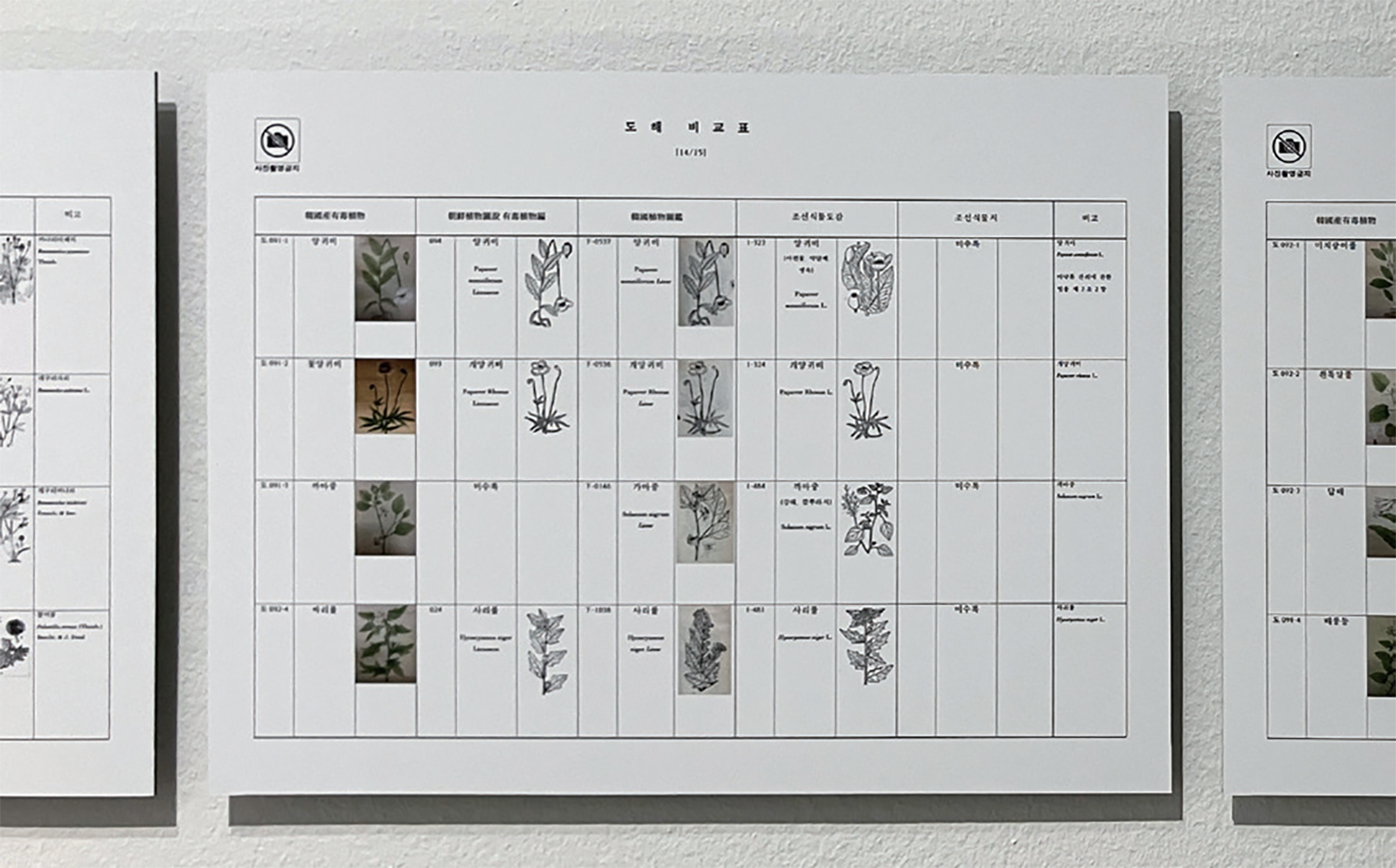
Lee defines research as an approach by which on positions oneself, informed by the accumulation of past studies, within a genealogy of knowledge production. At the centre of research is collective intelligence and it has transcended time and space through systems of reference and citation. In this exhibition, Illustrations of Joseon Plants: A Selection of Toxic Plants (1948), falls into this category, as a precedent study with a footnote. This research was initially compiled by Toh Pongshyup and Shim Hakchin, as a record of observations and collections of plant species across the Korean Peninsula, yet the volume was never completed. Since then, it has been cited, interpreted, and supplemented by successive generations of researchers. As an artist, Lee positioned herself within this lineage, and she has participated in this ongoing body of research. Her engagement is not only limited to a meta-study comparing botanical publications from both South and North Korea since the 1940s, but also years of fieldwork, including locating habitats, collecting specimens, and observing plant life, to survey the vegetation in the contemporary setting. Comparison of Illustrations series (2025), displayed on the gallery wall, is the documentation of the ways in which the botanical illustrations and descriptions from the original publication have been cited and transformed as part of subsequent research. The work itself may be understood as a research outcome of the scientific and empirical methodology.
The issue lies in how a process that is established as research is transformed into art. Given that the form of research (language) and the form of art (shape) cannot be derived through a logical chain of causality, she acknowledges the inevitable presence of a flight of idea within her work. Her ideas are not based on a given concept or narrative, but as part of morphological analysis. Her installation works, composed of plants collected during the research process preserved specimens and drawings, serve as a showcase for her morphological analysis.
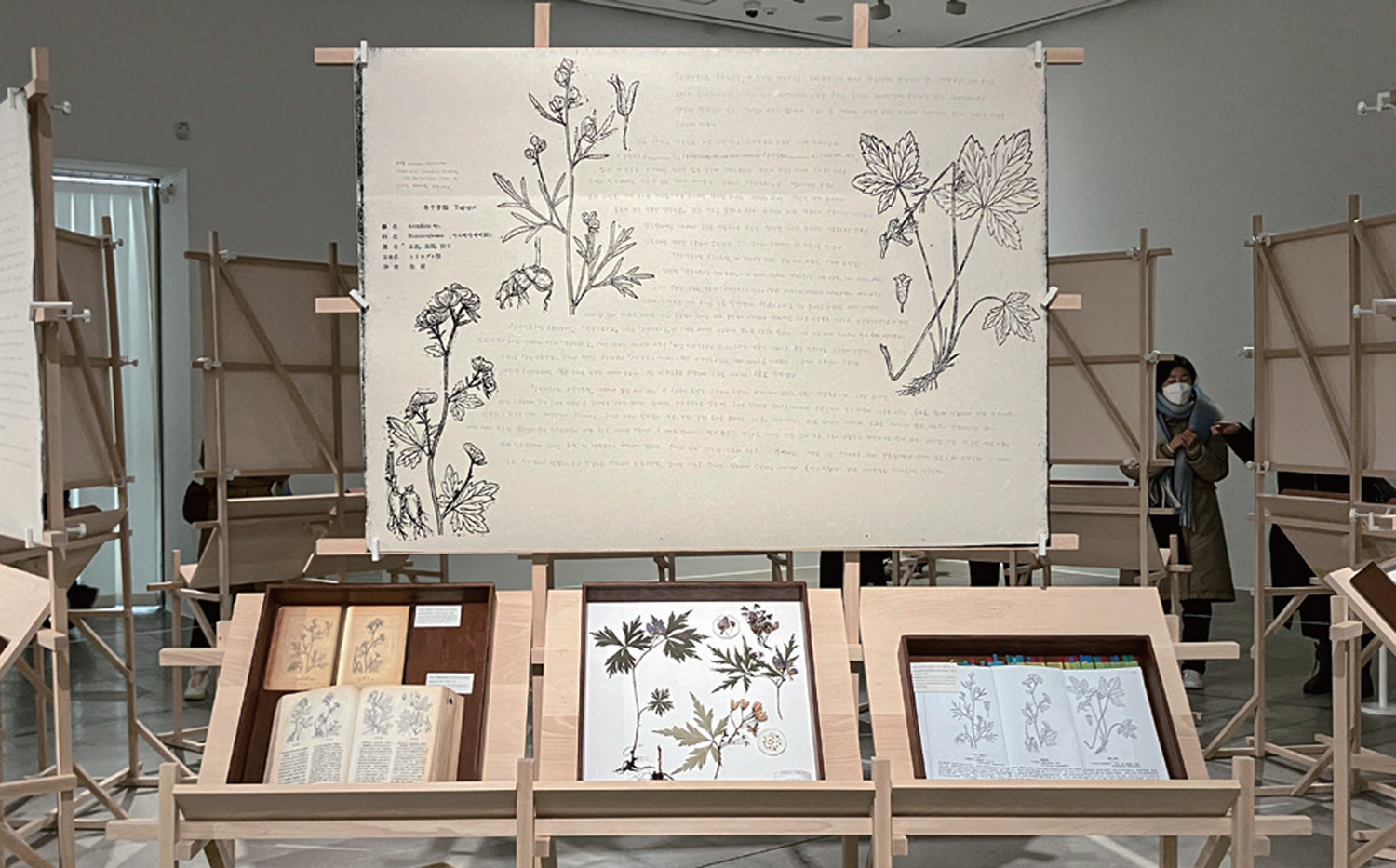
‘Preserved Plant Object’ collages individually preserved components, leaves, flowers, seeds, onto specimen boards. Rather than presenting plants in their natural state, the work reconstructs a specific scene from the research process to achieve visual harmony. Likewise, ‘Episode Drawing’ translates the artist’s reflections that emerged during the processes of collecting, examining, and preserving plants into text and drawing. This approach relates to the inherent iconography of the specimen. Although specimens are often regarded as a objective record of fact, they are in fact products shaped by processes of selection, elimination, and arrangement which are biased by the maker’s sensibility and subjectivity. Specimens therefore function not only as tools for producing and verifying knowledge but also as entities that demand visual and formal composition. From this perspective, the installation can be understood as a materialised rendering of research, structured through morphological judgments derived from the artist’s inquiry.
Through this distinctive methodology, the specimen, the exhibition reveals where the creative flight between research and art becomes possible without conflating meaning. The exhibition runs until Mar. 22.