




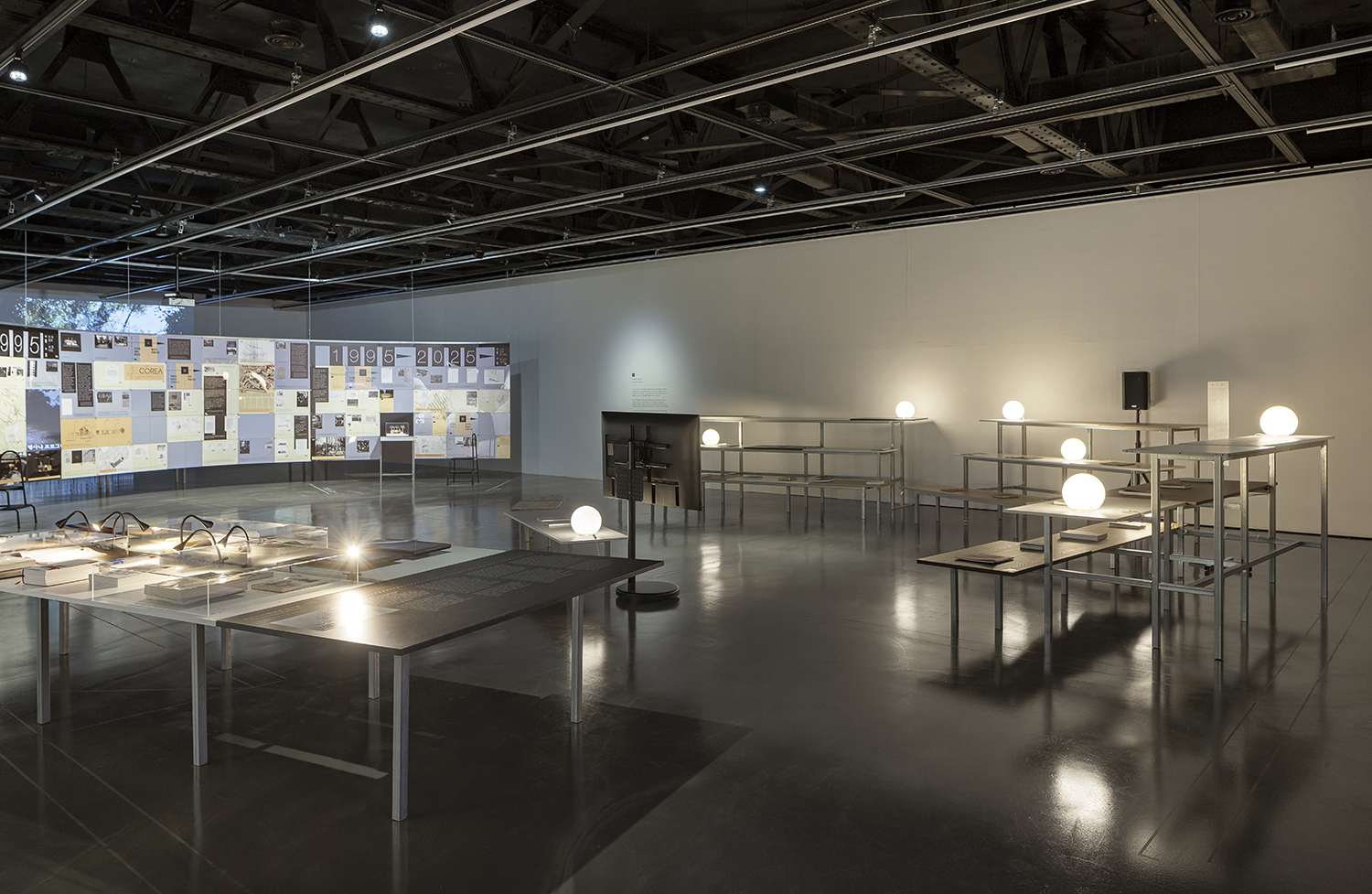
View of ‘Living Archives’; visible at the rear left is ‘Layering Archives’ ©Choi Yongjoon / Image courtesy of ARKO Art Center
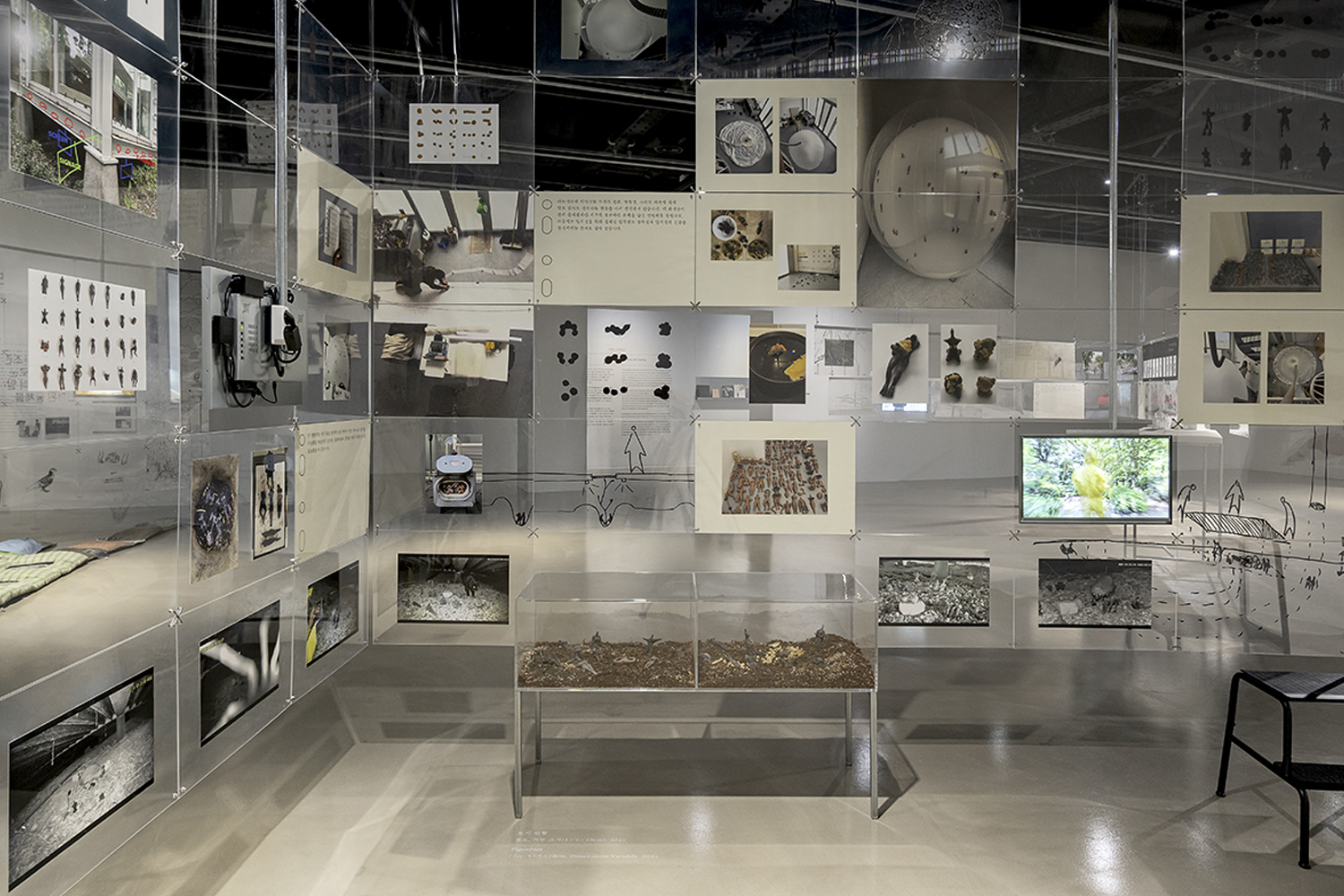
Panel explaining Young Yena’s 30 Million Years Under the Pavilion and Nanogyna placed on the soil at the centre ©Choi Yongjoon / Image courtesy of ARKO Art Center
On Feb. 6, the Homecoming Exhibition of the Korean Pavilion of 2025 Venice Biennale, ‘Little Toad Little Toad: Unbuilding Pavilion’ opened to the public. Unlike the setting offered by the Korean Pavilion in Giardini, which embraces transparency and openness, the exhibition venue, ARKO Art Center Gallery 1, 2, delivers different spatial conditions. The curators, CAC (Co-Directors, Chung Dahyoung, Kim Heejung, Jung Sungkyu) decided to recontextualise the displays within these new physical constrains, rather than simply reproduce a carbon copy of the seven-month-long exhibition presented in Venice.
In Gallery 1, the exhibition makes the best use of ARKO Art Center’s spacious floor area, which is approximately four times larger than that of the Korean Pavilion in Giardini, allowing the show to unfold and introduce the curatorial and archival documentation that had been placed in every corner of the Pavilion. For example, ‘Unfolding Archives’, a video work combined with footage filmed in Venice and archival materials from various institutions including ASAC, is shown on a significantly larger screen. ‘Layering Archives’, a curatorial research project that weaves the past, present and future of the Korean Pavilion based on archival sources, also features here. Content that had previously been presented as a visual curatorial essay in the exhibition catalogue has now been rearticulated through gently curving panels installed in the spacious gallery and accompanying booklets. Together, the two distinct archival resources enable visitors to witness and imagine the complex conditions surrounding the construction of the Korean Pavilion in Giardini. The specific political context, the post-Cold War era, along with Korea’s symbolic position as the only divided nation, formed the foundation for its realisation. At the same time, the regional context of the Giardini, a reclaimed public green space in Venice where neither cultivation, seeding, nor harvesting could take place, helps explain how the Pavilion came to assume its present form.
In the exhibition in Venice, participating architects presented site specific works based on this archival research. Overwriting, Overriding by Lee Dammy proposes a new identity for the Korean Pavilion beyond the framework of nationalism. In her work, she calls upon the enduring honey locust tress next to the Pavilion, the cat Mucca that periodically lingers in parts of the Giardini, including the Korean Pavilion, and Nam June Paik’s, Tangun as a Scythian King (1993), which was exhibited on the current site of the Korean Pavilion when he was commissioned as a contributing artist for the German Pavilion. The Korean Pavilion itself was lifted above the ground to minimise any impact on existing site conditions, including tree roots or any geological features. Young Yena’s 30 Million Years Under the Pavilion sheds light on the terrain the pavilion was obliged to preserve and develops a fictional excavation narrative centred on an imaginary creature called Nanogyna. Time for Trees by Park Heechan, a series which consists of three works, Giardini Travelers, Elevated Gaze 1995, and A Shadow Caster, focuses on trees as a connective medium that penetrates Venice, the Giardini, and the Korean Pavilion. Of the three, A Shadow Caster introduces the shadows of the surrounding trees into the interior space. Kim Hyunjong’s New Voyage is a fresh attempt to reactivate and transform the pavilion’s rooftop, which was originally designed as an exhibition space. He used the existing ‘mast’ structure on the roof, which involves symbolic image of a ship, to question the outdated nationalist format of the national pavilion and to search for a new design direction.
The homecoming exhibition presents these works in Gallery 2 through suspended transparent acrylic structures and video interviews with the artists. Together with interviews filmed on site in Venice, the acrylic panels echo the spatial configuration of the Korean Pavilion where the works were originally installed, faintly evoking the sensory atmosphere of the original space of the exhibition. In addition, ‘Living Archives’ in Gallery 1 provides ongoing access to documentation of past exhibitions at the Korean Pavilion, and a series of forums has been scheduled. In Gallery 2, a ‘Curatorial Fable’, told from the perspective of the toad, wends its way throughout the exhibition to form a cohesive narrative, followed by an ‘Epilogue’ that extends beyond a reflection on the Korean Pavilion to address the sustainability of the Giardini and the Venice Biennale itself. The exhibition runs Apr. 5.
1